322 books match the query 'Social Policy' and 11 start with n
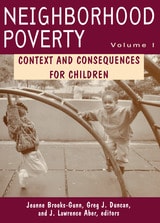
cover of Neighborhood Poverty: Context and Consequences for Children

Neighborhood Poverty

Context and Consequences for Children

Jeanne Brooks-Gunn

Russell Sage Foundation, 1997
Perhaps the most alarming phenomenon in American cities has been the transformation of many neighborhoods into isolated ghettos where poverty is the norm and violent crime, drug use, out-of-wedlock births, and soaring school dropout rates are rampant. Public concern over these destitute areas has focused on their most vulnerable inhabitants—children and adolescents. How profoundly does neighborhood poverty endanger their well-being and development? Is the influence of neighborhood more powerful than that of the family? Neighborhood Poverty: Context and Consequences for Children approaches these questions with an insightful and wide-ranging investigation into the effect of community poverty on children's physical health, cognitive and verbal abilities, educational attainment, and social adjustment. This two-volume set offers the most current research and analysis from experts in the fields of child development, social psychology, sociology and economics. Drawing from national and city-based sources, Volume I reports the empirical evidence concerning the relationship between children and community. As the essays demonstrate, poverty entails a host of problems that affects the quality of educational, recreational, and child care services. Poor neighborhoods usually share other negative features—particularly racial segregation and a preponderance of single mother families—that may adversely affect children. Yet children are not equally susceptible to the pitfalls of deprived communities. Neighborhood has different effects depending on a child's age, race, and gender, while parenting techniques and a family's degree of community involvement also serve as mitigating factors. Volume II incorporates empirical data on neighborhood poverty into discussions of policy and program development. The contributors point to promising community initiatives and suggest methods to strengthen neighborhood-based service programs for children. Several essays analyze the conceptual and methodological issues surrounding the measurement of neighborhood characteristics. These essays focus on the need to expand scientific insight into urban poverty by drawing on broader pools of ethnographic, epidemiological, and quantitative data. Volume II explores the possibilities for a richer and more well-rounded understanding of neighborhood and poverty issues. To grasp the human cost of poverty, we must clearly understand how living in distressed neighborhoods impairs children's ability to function at every level. Neighborhood Poverty explores the multiple and complex paths between community, family, and childhood development. These two volumes provide and indispensible guide for social policy and demonstrate the power of interdisciplinary social science to probe complex social issues.
[more]
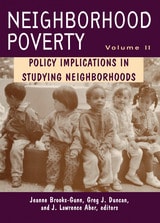
cover of Neighborhood Poverty: Policy Implications in Studying Neighborhoods

Neighborhood Poverty

Policy Implications in Studying Neighborhoods

Jeanne Brooks-Gunn

Russell Sage Foundation, 1997

Perhaps the most alarming phenomenon in American cities has been the transformation of many neighborhoods into isolated ghettos where poverty is the norm and violent crime, drug use, out-of-wedlock births, and soaring school dropout rates are rampant. Public concern over these destitute areas has focused on their most vulnerable inhabitants—children and adolescents. How profoundly does neighborhood poverty endanger their well-being and development? Is the influence of neighborhood more powerful than that of the family? Neighborhood Poverty approaches these questions with an insightful and wide-ranging investigation into the effect of community poverty on children's physical health, cognitive and verbal abilities, educational attainment, and social adjustment. This two-volume set offers the most current research and analysis from experts in the fields of child development, social psychology, sociology and economics. Drawing from national and city-based sources, Volume I reports the empirical evidence concerning the relationship between children and community. As the essays demonstrate, poverty entails a host of problems that affects the quality of educational, recreational, and child care services.Poor neighborhoods usually share other negative features—particularly racial segregation and a preponderance of single mother families—that may adversely affect children. Yet children are not equally susceptible to the pitfalls of deprived communities. Neighborhood has different effects depending on a child's age, race, and gender, while parenting techniques and a family's degree of community involvement also serve as mitigating factors. Volume II incorporates empirical data on neighborhood poverty into discussions of policy and program development. The contributors point to promising community initiatives and suggest methods to strengthen neighborhood-based service programs for children. Several essays analyze the conceptual and methodological issues surrounding the measurement of neighborhood characteristics. These essays focus on the need to expand scientific insight into urban poverty by drawing on broader pools of ethnographic, epidemiological, and quantitative data. Volume II explores the possibilities for a richer and more well-rounded understanding of neighborhood and poverty issues. To grasp the human cost of poverty, we must clearly understand how living in distressed neighborhoods impairs children's ability to function at every level. Neighborhood Poverty explores the multiple and complex paths between community, family, and childhood development. These two volumes provide and indispensable guide for social policy and demonstrate the power of interdisciplinary social science to probe complex social issues.
[more]
cover of Network Culture: Politics for the Information Age

Network Culture

Politics for the Information Age

Tiziana Terranova

Pluto Press, 2004

[more]
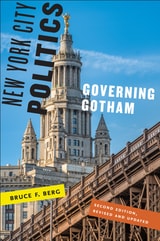
cover of New York City Politics: Governing Gotham

New York City Politics

Governing Gotham

Berg, Bruce F

Rutgers University Press, 2018

Most experts consider economic development to be the dominant factor influencing urban politics. They point to the importance of the finance and real estate industries, the need to improve the tax base, and the push to create jobs. Bruce F. Berg maintains that there are three forces which are equally important in explaining New York City politics: economic development; the city’s relationships with the state and federal governments, which influence taxation, revenue and public policy responsibilities; and New York City’s racial and ethnic diversity, resulting in demands for more equitable representation and greater equity in the delivery of public goods and services.

New York City Politics focuses on the impact of these three forces on the governance of New York City’s political system including the need to promote democratic accountability, service delivery equity, as well as the maintenance of civil harmony. This second edition updates the discussion with examples from the Bloomberg and de Blasio administrations as well as current public policy issues including infrastructure, housing and homelessness, land use regulations, and education.  
[more]
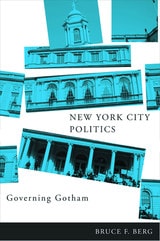
cover of New York City Politics: Governing Gotham

New York City Politics

Governing Gotham

Berg, Bruce F

Rutgers University Press, 2007

Most experts consider economic development to be the dominant factor influencing urban politics. They point to the importance of the finance and real estate industries, the need to improve the tax base, and the push to create jobs. Bruce F. Berg maintains that there are three forces which are equally important in explaining New York City politics: economic development; the city’s relationships with the state and federal governments, which influence taxation, revenue and public policy responsibilities; and New York City’s racial and ethnic diversity, resulting in demands for more equitable representation and greater equity in the delivery of public goods and services.
 
New York City Politics focuses on the impact of these three forces on the governance of New York City’s political system including the need to promote democratic accountability, service delivery equity, as well as the maintenance of civil harmony. This second edition updates the discussion with examples from the Bloomberg and de Blasio administrations as well as current public policy issues including infrastructure, housing and homelessness, land use regulations, and education. 
[more]
cover of No Child Left Behind and the Public Schools

No Child Left Behind and the Public Schools

Scott Franklin Abernathy

University of Michigan Press, 2007

“A powerful, detailed, and exceptionally balanced critique of NCLB. It offers some hope for how we might overcome its faults. No legislator or educational expert should be allowed to get away with not reading it—whether to agree or disagree. It’s a must learning experience.”

—Deborah Meier, Senior Scholar and Adjunct Professor, Steinhardt School of Education, New York University, and author of In Schools We Trust

“A concise, highly readable, and balanced account of NCLB, with insightful and realistic suggestions for reform. Teachers, professors, policymakers, and parents—this is the one book about NCLB you ought to read.”

—James E. Ryan, William L. Matheson and Robert M. Morgenthau Distinguished Professor, University of Virginia School of Law

This far-reaching new study looks at the successes and failures of one of the most ambitious and controversial educational initiatives since desegregation—the No Child Left Behind Act of 2001.

NCLB’s opponents criticize it as underfunded and unworkable, while supporters see it as a radical but necessary educational reform that evens the score between advantaged and disadvantaged students. Yet the most basic and important question remains unasked: “Can we ever really know if a child’s education is good?”

Ultimately, Scott Franklin Abernathy argues, policymakers must begin from this question, rather than assuming that any test can accurately measure the elusive thing we call “good” education.
[more]
cover of No Real Choice: How Culture and Politics Matter for Reproductive Autonomy

No Real Choice

How Culture and Politics Matter for Reproductive Autonomy

Katrina Kimport

Rutgers University Press, 2022

In the United States, the “right to choose” an abortion is the law of the land. But what if a woman continues her pregnancy because she didn’t really have a choice? What if state laws, federal policies, stigma, and a host of other obstacles push that choice out of her reach?  
 
Based on candid, in-depth interviews with women who considered but did not obtain an abortion, No Real Choice punctures the myth that American women have full autonomy over their reproductive choices. Focusing on the experiences of a predominantly Black and low-income group of women, sociologist Katrina Kimport finds that structural, cultural, and experiential factors can make choosing abortion impossible–especially for those who experience racism and class discrimination. From these conversations, we see the obstacles to “choice” these women face, such as bans on public insurance coverage of abortion and rampant antiabortion claims that abortion is harmful. Kimport's interviews reveal that even as activists fight to preserve Roe v. Wade, class and racial disparities have already curtailed many women’s freedom of choice. 
 
No Real Choice analyzes both the structural obstacles to abortion and the cultural ideologies that try to persuade women not to choose abortion. Told with care and sensitivity, No Real Choice gives voice to women whose experiences are often overlooked in debates on abortion, illustrating how real reproductive choice is denied, for whom, and at what cost. 

[more]
cover of None of Your Damn Business: Privacy in the United States from the Gilded Age to the Digital Age

None of Your Damn Business

Privacy in the United States from the Gilded Age to the Digital Age

Lawrence Cappello

University of Chicago Press, 2019

Capello investigates why we’ve been so blithe about giving up our privacy and all the opportunities we’ve had along the way to rein it in.

Every day, Americans surrender their private information to entities claiming to have their best interests in mind. This trade-off has long been taken for granted, but the extent of its nefariousness has recently become much clearer. As None of Your Damn Business reveals, the problem is not so much that data will be used in ways we don’t want, but rather how willing we have been to have our information used, abused, and sold right back to us. In this startling book, Lawrence Cappello targets moments from the past 130 years of US history when privacy was central to battles over journalistic freedom, national security, surveillance, big data, and reproductive rights. As he makes dismayingly clear, Americans have had numerous opportunities to protect the public good while simultaneously safeguarding our information, and we’ve squandered them every time. None of Your Damn Business is a rich and provocative survey of an alarming topic that grows only more relevant with each fresh outrage of trust betrayed.
[more]
cover of Not Only the Market

Not Only the Market

Martin Potucek

Central European University Press, 1999
Successful transition for any post-communist country is reliant upon market, government and the civil sector. Potucek's pioneering study of the Czech Republic highlights the early transitional mistakes made during the Klaus era with respect to the role of these sectors. Not Only the Market examines the balance between where the sectors are or should be and makes useful comparisons with other post-communist countries. Focusing on developmental issues, the book looks at a number of public concerns including social and health care reform, privatization and the emerging patterns of corporatism and examines problems such as insufficient legislation, excessive lenience and the incompetence of public administration which has created an unreasonably large space for socio-pathological forces - corruption, Mafia activity and the siphoning of public funds into private hands. The causes and consequences of these forces are considered and Potucek provides a blueprint of reform which emphasizes the necessity of a conscious public policy to optimize both freedom and inequality.
[more]
cover of Not by Reason Alone: Religion, History, and Identity in Early Modern Political Thought

Not by Reason Alone

Religion, History, and Identity in Early Modern Political Thought

Joshua Mitchell

University of Chicago Press, 1993

Masterfully interweaving political, religious, and historical themes, Not by Reason Alone creates a new interpretation of early modern political thought. Where most accounts assume that modern thought followed a decisive break with Christianity, Joshua Mitchell reveals that the line between the age of faith and that of reason is not quite so clear. Instead, he shows that the ideas of Luther, Hobbes, Locke, and Rousseau draw on history, rather than reason alone, for a sense of political authority.

This erudite and ambitious work crosses disciplinary boundaries to expose unsuspected connections between political theory, religion, and history. In doing so, it offers a view of modern political thought undistorted by conventional distinctions between the ancient and the modern, and between the religious and the political.

"Original. . . . A delight to read a political philosopher who takes the theologies of Hobbes and Locke seriously." —J. M. Porter, Canadian Journal of History

"Mitchell's argument both illuminates and fascinates. . . . An arresting, even stunning, contribution to our study of modern political thought."—William R. Stevenson, Jr., Christian Scholar's Review
[more]
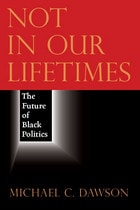
cover of Not in Our Lifetimes: The Future of Black Politics

Not in Our Lifetimes

The Future of Black Politics

Michael C. Dawson

University of Chicago Press, 2011

For all the talk about a new postracial America, the fundamental realities of American racism—and the problems facing black political movements—have not changed. Michael C. Dawson lays out a nuanced analysis of the persistence of racial inequality and structural disadvantages, and the ways that whites and blacks continue to see the same problems—the disastrous response to Katrina being a prime example—through completely different, race-inflected lenses. In fact, argues Dawson, the new era heralded by Barack Obama’s election is more racially complicated, as the widening class gap among African Americans and the hot-button issue of immigration have the potential to create new fissures for conservative and race-based exploitation. Through a thoughtful analysis of the rise of the Tea Party and the largely successful “blackening” of President Obama, Dawson ultimately argues that black politics remains weak—and that achieving the dream of racial and economic equality will require the sort of coalition-building and reaching across racial divides that have always marked successful political movements.

Polemical but astute, passionate but pragmatic, Not in Our Lifetimes forces us to rethink easy assumptions about racial progress—and begin the hard work of creating real, lasting change.


[more]