Results by title
139 books match the query 'Social archaeology' and 4 start with n
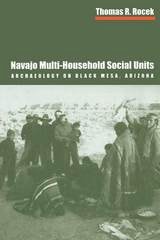
Navajo Multi-Household Social Units
Archaeology on Black Mesa, ArizonaThomas R. Rocek
University of Arizona Press, 1995
In a rigorous and innovative study, Thomas R. Rocek examines the 150-year-old ethnohistorical and archaeological record of Navajo settlement on Black Mesa in northern Arizona. Rocek's study, the first of its kind, not only reveals a rich array of interacting factors that have helped to shape Navajo life during this period but also constructs a valuable case study in archaeological method and theory, certain to be useful to other researchers of nonurban societies.
Rocek explores a neglected but major source of social flexibility in these societies. While many studies have focused on household and community-level organization, few have examined the flexible, intermediate-sized, "middle-level" cooperative units that bind small groups of households together. Middle-level units, says the author, must be recognized as important sources of social flexibility in many such cultural contexts. Futhermore, attention to middle-level units is critical for understanding household or community-level organization, because the flexibility they offer can fundamentally alter the behavior of social units of a larger or smaller scale.
In examining the archaeological record of Navajo settlement, Rocek develops archaeological methods for examing multiple-household social units (variously called "outfits or "cooperating groups") through spatial analysis, investigates evidence of change in middle-level units over time, relates these changes to economic and demographic flux, and compares the Navajo case study to the broader ethnographic literature of middle-level units. Rocek finds similarities with social organization in non-unilineally organized societies, in groups that have been traditionally described as characterized by network organization, and particularly in pastoral societies. The results of Rocek's study offer a new perspective on variability in Navajo social organization while suggesting general patterns of the response of social groups to change.
Rocek's work will be of significant interest not only to those with a professional interest in Navajo history and culture, but also, for its methodological insights, to a far broader range of archaeologists, social anthropologists, ethnohistorians, ethnoarchaeologists, historians, cultural geographers, and political scientists.
[more]
Negotiating the Past in the Past
Identity, Memory, and Landscape in Archaeological ResearchNorman Yoffee
University of Arizona Press, 2008
Ralph Waldo Emerson once said that “all history becomes subjective,” that, in fact, “properly there is no history, only biography.” Today, Emerson’s observation is hardly revolutionary for archaeologists; it has become conventional wisdom that the present is a battleground where interpretations of the events and meanings of the past are constantly being disputed. What were the major events? Whose lives did these events impact, and how? Who were the key players? What was their legacy? We know all too well that the answers to these questions can vary considerably depending on what political, social, or personal agenda is driving the response.
Despite our keen eye for discerning historical spin doctors operating today, it has been only in recent years that archaeologists have begun exploring in detail how the past was used in the past itself. This volume of ten original works brings critical insight to this frequently overlooked dimension of earlier societies. Drawing on the concepts of identity, memory, and landscape, the contributors show how these points of entry can lead to substantially new accounts of how people understood their lives and why things changed as they did.
Chapters include the archaeologies of the eastern Mediterranean, including Mesopotamia, Iran, Greece, and Rome; prehistoric Greece; Achaemenid and Hellenistic Armenia; Athens in the Roman period; Nubia and Egypt; medieval South India; and northern Maya Quintana Roo. The contributors show how and why, in each society, certain versions of the past were promoted while others were aggressively forgotten for the purpose of promoting innovation, gaining political advantage, or creating a new group identity.
Commentaries by leading scholars Lynn Meskell and Jack Davis blend with newer voices to create a unique set of essays that is diverse but interrelated, exceptionally researched, and novel in its perspectives.
CONTENTS
1. Peering into the Palimpsest: An Introduction to the Volume
Norman Yoffee
2. Collecting, Defacing, Reinscribing (and Otherwise Performing) Memory in the Ancient World
Catherine Lyon Crawford
3. Unforgettable Landscapes: Attachments to the Past in Hellenistic Armenia
Lori Khatchadourian
4. Mortuary Studies, Memory, and the Mycenaean Polity
Seth Button
5. Identity under Construction in Roman Athens
Sanjaya Thakur
6. Inscribing the Napatan Landscape: Architecture and Royal Identity
Lindsay Ambridge
7. Negotiated Pasts and the Memorialized Present in Ancient India: Chalukyas of Vatapi
Hemanth Kadambi
8. Creating, Transforming, Rejecting, and Reinterpreting Ancient Maya Urban Landscapes: Insights from Lagartera and Margarita
Laura P. Villamil
9. Back to the Future: From the Past in the Present to the Past in the Past
Lynn Meskell
10. Memory Groups and the State: Erasing the Past and Inscribing the Present in the Landscapes of the Mediterranean and Near East
Jack L. Davis
About the Editor
About the Contributors
Index
[more]
Networks of Power
Political Relations in the Late Postclassic Naco ValleyEdward Schortman
University Press of Colorado, 2011
Little is known about how Late Postclassic populations in southeast Mesoamerica organized their political relations. Networks of Power fills gaps in the knowledge of this little-studied area, reconstructing the course of political history in the Naco Valley from the fourteenth through early sixteenth centuries.
Describing the material and behavioral patterns pertaining to the Late Postclassic period using components of three settlements in the Naco Valley of northwestern Honduras, the book focuses on how contests for power shaped political structures. Power-seeking individuals, including but not restricted to ruling elites, depended on networks of allies to support their political objectives. Ongoing and partially successful competitions waged within networks led to the incorporation of exotic ideas and imported items into the daily practices of all Naco Valley occupants. The result was a fragile hierarchical structure forever vulnerable to the initiatives of agents operating on local and distant stages.
Networks of Power describes who was involved in these competitions and in which networks they participated; what resources were mustered within these webs; which projects were fueled by these assets; and how, and to what extent, they contributed to the achievement of political aims.
[more]
North American Indigenous Warfare and Ritual Violence
Edited by Richard J. Chacon and Rubén G. Mendoza
University of Arizona Press, 2007
Despite evidence of warfare and violent conflict in pre-Columbian North America, scholars argue that the scale and scope of Native American violence is exaggerated. They contend that scholarly misrepresentation has denigrated indigenous peoples when in fact they lived together in peace and harmony. In rebutting that contention, this groundbreaking book presents clear evidence—from multiple academic disciplines—that indigenous populations engaged in warfare and ritual violence long before European contact. In ten well-documented and thoroughly researched chapters, fourteen leading scholars dispassionately describe sources and consequences of Amerindian warfare and violence, including ritual violence. Originally presented at an American Anthropological Association symposium, their findings construct a convincing case that bloodshed and killing have been woven into the fabric of indigenous life in North America for many centuries.
The editors argue that a failure to acknowledge the roles of warfare and violence in the lives of indigenous North Americans is itself a vestige of colonial repression—depriving native warriors of their history of armed resistance. These essays document specific acts of Native American violence across the North American continent. Including contributions from anthropologists, archaeologists, historians, and ethnographers, they argue not only that violence existed but also that it was an important and frequently celebrated component of Amerindian life.
CONTENTS
Acknowledgments
Introduction
Richard J. Chacon and Rubén G. Mendoza
1. Traditional Native Warfare in Western Alaska
Ernest S. Burch Jr.
2. Barbarism and Ardour of War from the Tenderest Years”: Cree-Inuit Warfare in the Hudson Bay Region
Charles A. Bishop and Victor P. Lytwyn
3. Aboriginal Warfare on the Northwest Coast: Did the Potlatch Replace Warfare?
Joan A. Lovisek
4. Ethnohistoric Descriptions of Chumash Warfare
John R. Johnson
5. Documenting Conflict in the Prehistoric Pueblo Southwest
Polly Schaafsma
6. Cahokia and the Evidence for Late Pre-Columbian War in the North American Midcontinent
Thomas E. Emerson
7. Iroquois-Huron Warfare
Dean R. Snow
8. Desecrating the Sacred Ancestor Temples: Chiefly Conflict and Violence in the American Southeast
David H. Dye and Adam King
9. Warfare, Population, and Food Production in Prehistoric Eastern North America
George R. Milner
10. The Osteological Evidence for Indigenous Warfare in North America
Patricia M. Lambert
11. Ethical Considerations and Conclusions Regarding Indigenous Warfare and Violence in North America
Richard J. Chacon and Rubén G. Mendoza
References
About the Contributors
Index
[more]