Results by title
121 books match the query 'Social classes' and 3 start with n
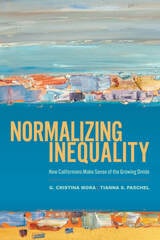
Normalizing Inequality
How Californians Make Sense of the Growing DivideG. Cristina Mora
Russell Sage Foundation, 2026
California has long been mythologized as the quintessential land of opportunity and reinvention—a place where anyone, regardless of origin, can forge a new life and realize their aspirations. Yet beneath this gilded narrative lies a starker reality: California ranks among the most unequal states in one of the world's most unequal countries, where the middle class finds itself increasingly squeezed. Economic inequality is not an anomaly but part of a broader global phenomenon, as disparities deepen across the world. While we know a lot about its contours, its evolution over time and its intersections with race and immigration, we understand far less about how ordinary people interpret and internalize it. In Normalizing Inequality, sociologists G. Cristina Mora and Tianna S. Paschel illuminate how middle-class Californians perceive and come to accept the inequalities that surround them.
Drawing on extensive interviews and surveys, Mora and Paschel uncover a profound paradox at the heart of middle-class consciousness. They find that Californians are keenly aware of the systemic causes of inequality—they recognize policies engineered to benefit the wealthy, they acknowledge how structural racism makes it hard for some groups to get ahead—yet they consistently minimize these forces. Instead, they gravitate toward explanations rooted in individualism, moral character, and the idea that things are worse in other places. Racism and racial inequality in California become palatable when framed as "not as bad as the South." Immigrant exploitation, however severe, transforms into evidence of the American Dream fulfilled simply upon arrival. Economic pressures that displace others become surmountable through personal industriousness and forbearance.
These beliefs about inequality grow more troubling still. Middle-class Californians sometimes blame disempowered people for their circumstances—acknowledging structural barriers facing homeless and undocumented populations while simultaneously faulting them for insufficient drive or criminal behavior that compounds their difficulties. When contemplating California's future, interviewees envision economic prosperity propelled by technological innovation, yet remain curiously unconcerned with how present inequalities might shape that tomorrow. Their imagined future is one where White and Asian American populations thrive, while Black, Latino, and economically marginalized Californians either vanish through displacement or fade into irrelevance. As respondents use these interpretive frameworks to make sense of inequality, they lean heavily on California's foundational narratives of opportunity, sanctuary and multiracial promise.
Normalizing Inequality offers an incisive examination of how ordinary citizens make sense of inequality and, through that very process of sense-making, how they tolerate and passively reproduce the conditions they often claim to deplore.

Not Quite White
White Trash and the Boundaries of WhitenessMatt Wray
Duke University Press, 2006
Of crucial importance are the ideas about poor whites that circulated through early-twentieth-century public health campaigns, such as hookworm eradication and eugenic reforms. In these crusades, impoverished whites, particularly but not exclusively in the American South, were targeted for interventions by sanitarians who viewed them as “filthy, lazy crackers” in need of racial uplift and by eugenicists who viewed them as a “feebleminded menace” to the white race, threats that needed to be confined and involuntarily sterilized.
Part historical inquiry and part sociological investigation, Not Quite White demonstrates the power of social categories and boundaries to shape social relationships and institutions, to invent groups where none exist, and to influence policies and legislation that end up harming the very people they aim to help. It illuminates not only the cultural significance and consequences of poor white stereotypes but also how dominant whites exploited and expanded these stereotypes to bolster and defend their own fragile claims to whiteness.
Not-So-Nuclear Families
Class, Gender, and Networks of CareHansen, Karen V
Rutgers University Press, 2004
In recent years U.S. public policy has focused on strengthening the nuclear family as a primary strategy for improving the lives of America's youth. It is often assumed that this normative type of family is an independent, self-sufficient unit adequate for raising children. But half of all households in the United States with young children have two employed parents. How do working parents provide care and mobilize the help that they need?
In Not-So-Nuclear Families: Class, Gender, and Networks of Care, Karen V. Hansen investigates the lives of working parents and the informal networks they construct to help care for their children. She chronicles the conflicts, hardships, and triumphs of four families of various social classes. Each must navigate the ideology that mandates that parents, mothers in particular, rear their own children, in the face of an economic reality that requires that parents rely on the help of others. In vivid family stories, parents detail how they and their networks of friends, paid caregivers, and extended kin collectively close the "care gap" for their school-aged children.
Hansen not only debunks the myth that families in the United States are independent, isolated, and self-reliant units, she breaks new theoretical ground by asserting that informal networks of care can potentially provide unique and valuable bonds that nuclear families cannot.