Results by title
479 books match the query 'Sources' and 12 start with n

Narrative Threads
Accounting and Recounting in Andean KhipuEdited by Jeffrey Quilter and Gary Urton
University of Texas Press, 2002
The Inka Empire stretched over much of the length and breadth of the South American Andes, encompassed elaborately planned cities linked by a complex network of roads and messengers, and created astonishing works of architecture and artistry and a compelling mythology—all without the aid of a graphic writing system. Instead, the Inkas' records consisted of devices made of knotted and dyed strings—called khipu—on which they recorded information pertaining to the organization and history of their empire. Despite more than a century of research on these remarkable devices, the khipu remain largely undeciphered.
In this benchmark book, twelve international scholars tackle the most vexed question in khipu studies: how did the Inkas record and transmit narrative records by means of knotted strings? The authors approach the problem from a variety of angles. Several essays mine Spanish colonial sources for details about the kinds of narrative encoded in the khipu. Others look at the uses to which khipu were put before and after the Conquest, as well as their current use in some contemporary Andean communities. Still others analyze the formal characteristics of khipu and seek to explain how they encode various kinds of numerical and narrative data.
Narratives of Exile and Identity
Soviet Deportation Memoirs from the Baltic StatesTomas Balkelis
Central European University Press, 2018
Natalia Shelikhova
Russian Oligarch of Alaska CommerceEdited by Dawn Lea Black and Alexander Petrov
University of Alaska Press, 2010
This volume makes available for the first time in English a variety of primary source materials relating to the life and work of Natalia Shelikov, a pioneering nineteenth-century Russian-American businesswoman. As a principal of the Russian-American Company, Shelikov worked in Alaska, and her business acumen and wide-ranging connections—including the empress of Russia and a swathe of northern leaders—were crucial to the growth of Alaska’s economy, as well as to the welfare of the Native people, in whose life and culture she took a strong interest. The letters, petitions, and personal documents presented here will be indispensable for students of Alaska and nineteenth-century women’s history.
National Romanticism
The Formation of National MovementsMiroslav Hroch
Central European University Press, 2007
Navajo Multi-Household Social Units
Archaeology on Black Mesa, ArizonaThomas R. Rocek
University of Arizona Press, 1995
Rocek explores a neglected but major source of social flexibility in these societies. While many studies have focused on household and community-level organization, few have examined the flexible, intermediate-sized, "middle-level" cooperative units that bind small groups of households together. Middle-level units, says the author, must be recognized as important sources of social flexibility in many such cultural contexts. Futhermore, attention to middle-level units is critical for understanding household or community-level organization, because the flexibility they offer can fundamentally alter the behavior of social units of a larger or smaller scale.
In examining the archaeological record of Navajo settlement, Rocek develops archaeological methods for examing multiple-household social units (variously called "outfits or "cooperating groups") through spatial analysis, investigates evidence of change in middle-level units over time, relates these changes to economic and demographic flux, and compares the Navajo case study to the broader ethnographic literature of middle-level units. Rocek finds similarities with social organization in non-unilineally organized societies, in groups that have been traditionally described as characterized by network organization, and particularly in pastoral societies. The results of Rocek's study offer a new perspective on variability in Navajo social organization while suggesting general patterns of the response of social groups to change.
Rocek's work will be of significant interest not only to those with a professional interest in Navajo history and culture, but also, for its methodological insights, to a far broader range of archaeologists, social anthropologists, ethnohistorians, ethnoarchaeologists, historians, cultural geographers, and political scientists.

Nazi Ideology before 1933
A DocumentationIntroduced and translated by Barbara Miller Lane and Leila J. Rupp
University of Texas Press, 1978
This volume brings together a hitherto scattered and inaccessible body of material crucial to the understanding of the evolution of Nazi political thought. Before the publication of this volume, scholars had virtually ignored the extensive writings and programs published by leading Nazi ideologues before 1933. Barbara Miller Lane and Leila J. Rupp have collected the political writings of Nazi theorists—Dietrich Eckart, Alfred Rosenberg, Gottfried Feder, Joseph Goebbels, Gregor and Otto Strasser, Heinrich Himmler, and Richard Walther Darré—during the period before the National Socialists came to power. The Strassers are given considerable space because of their great intellectual importance within the party before 1933. In commentary by the editors, the significance of each Nazi theorist is weighed and evaluated at each stage of the history of the party.
Lane and Rupp conclude that Nazi ideology, before 1933 at least, was not a consistent whole but a doctrine in the process of rapid development to which new ideas were continually introduced. By the time the Nazis came to power, however, a group of interrelated assertions and official promises had been made to party followers and to the public. Hitler and the Third Reich had to accommodate this ideology, even when not implementing it. Hitler’s role in the development of Nazi ideology, interpreted here as a very permissive one, is thoroughly assessed. His own writings, however, have been omitted since they are readily available elsewhere.
The twenty-eight documents included in this book illustrate themes and phases in Nazi ideology which are discussed in the introduction and the detailed prefatory notes. Long selections, as often as possible full-length, are provided to allow the reader to follow the arguments. Each selection is accompanied by an introductory note and annotations which clarify its relationship to other works of the author and other writings of the period. Also included are original translations of the “Twenty-Five Points” and a number of little-known official party statements.
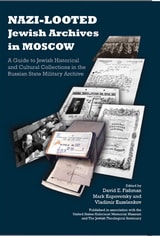
Nazi-Looted Jewish Archives in Moscow
A Guide to Jewish Historical and Cultural Collections in the Russian State Military ArchiveEdited by David E. Fishman, Mark Kupovetsky, and Vladimir Kuzelenkov
University of Scranton Press, 2010

Neo-Babylonian Trial Records
Shalom E. Holtz
SBL Press, 2014
New translations of fifty transliterated texts for research and classroom use
This collection of sixth-century B.C.E. Mesopotamian texts provides a close-up, often dramatic, view of ancient courtroom encounters shedding light on Neo-Babylonian legal culture and daily life. In addition to the legal texts, Holtz provides an introduction to Neo-Babylonian social history, archival records, and legal materials. This is an essential resource for scholars interested in the history of law.
Features
- Fifty new English translations
- Transliterations for use in advanced Akkadian courses
- Background essays perfect for courses dealing with ancient Near Eastern history and law
- Explanatory essays preceding each text and its translation
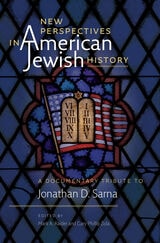
New Perspectives in American Jewish History
A Documentary Tribute to Jonathan D. SarnaEdited by Mark A. Raider and Gary Phillip Zola
Brandeis University Press, 2021
Widely regarded as today’s foremost American Jewish historian, Jonathan D. Sarna had a huge impact on the academy. Sarna’s influence is perhaps nowhere more apparent than among his former doctoral students—a veritable “Sarna diaspora” of over three dozen active scholars around the world. Both a tribute to Sarna and an important collection in its own right, New Perspectives in American Jewish History was compiled by Sarna’s former students and presents previously unpublished, neglected, or rarely seen historical documents and images that illuminate the breadth, diversity, and dynamism of the American Jewish experience. Beginning with the earliest known Jewish divorce in circum-Atlantic history (1774) and concluding with a Black Lives Matter Haggadah supplement (2019), the collection travels across time and space to shed light on intriguing and generative moments that span the varieties of Jewish experience in the American setting from the colonial era to the present. The materials underscore the interrelationship of myriad themes including ritual observance, Jewish-Christian relations, civil rights, Zionism and Israel, and immigration. While not intended as a comprehensive treatment of American Jewish history, the collection offers a chronological road map of American Jewry’s evolving self-understanding and encounter with America over the course of four centuries. A brief prefatory note sets up the analytic context of each document and helps to unpack and explore its significance. The capacious and multifaceted quality of the American Jewish experience is further amplified here by a sampling of artistic texts such as photographs, advertisements, cartoons, and more.
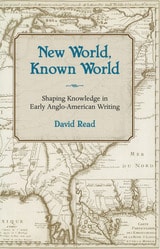
New World, Known World
Shaping Knowledge in Early Anglo-American WritingDavid Read
University of Missouri Press, 2005

Nineteenth-Century Scottish Rhetoric
The American ConnectionWinifred Bryan Horner
Southern Illinois University Press, 1992
Winifred Bryan Horner argues that an understanding of the changes that occurred in the content of nineteenth-century courses in logic, rhetoric, and belles lettres taught in Scottish universities provides important critical insight into the development of the twentieth-century American composition course, as well as courses in English literature and critical theory.
Because of the inaccessibility of primary materials documenting the changes in courses taught at Scottish universities, the impression remains that the nineteenth century represents a break with the traditional school curriculum rather than a logical transition to a new focus of study. Horner has discovered that the notes of students who attended these classes—meticulously transcribed records of the lectures that professors dictated in lieu of printed texts—provide reliable documentation of the content of courses taught during the period. Using these records, Horner traces the evolution of current traditional composition, developed in the United States in the first part of the twentieth century, from courses taught in nineteenth-century, northern Scottish universities. She locates the beginning of courses in English literature and belletristic composition in the southern schools, particularly Edinburgh.
Horner’s study opens new vistas for the study of the evolution of university curricula, especially the never before acknowledged influence of belletristric rhetoric on the development of the North American composition course.
Northern New Spain
A Research GuideThomas C. Barnes, Thomas H. Naylor, and Charles W. Polzer
University of Arizona Press, 1981