Results by title
323 books match the query 'Southeast Asia' and 9 start with n

Nagara and Commandery
Origins of the Southeast Asian Urban TraditionsPaul Wheatley
University of Chicago Press, 1983
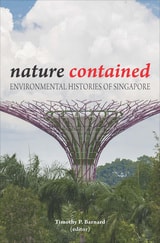
Nature Contained
Environmental Histories of SingaporeTimothy P. Barnard
National University of Singapore Press, 2014
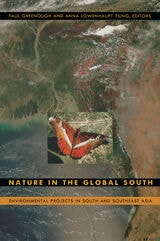
Nature in the Global South
Environmental Projects in South and Southeast AsiaPaul Greenough and Anna Lowenhaupt Tsing, eds.
Duke University Press, 2003
With contributors based in anthropology, ecology, sociology, history, and environmental and policy studies, Nature in the Global South features some of the most innovative and influential work being done in the social studies of nature. While some of the essays look at how social and natural landscapes are created, maintained, and transformed by scientists, officials, monks, and farmers, others analyze specific campaigns to eradicate smallpox and save forests, waterways, and animal habitats. In case studies centered in the Philippines, India, Pakistan, Thailand, Indonesia, and South and Southeast Asia as a whole, contributors examine how the tropics, the jungle, tribes, and peasants are understood and transformed; how shifts in colonial ideas about the landscape led to extremely deleterious changes in rural well-being; and how uneasy environmental compromises are forged in the present among rural, urban, and global allies.
Contributors:
Warwick Anderson
Amita Baviskar
Peter Brosius
Susan Darlington
Michael R. Dove
Ann Grodzins Gold
Paul Greenough
Roger Jeffery
Nancy Peluso
K. Sivaramakrishnan
Nandini Sundar
Anna Lowenhaupt Tsing
Charles Zerner
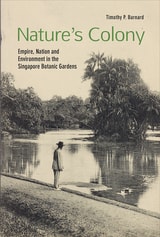
Nature's Colony
Empire, Nation and Environment in the Singapore Botanic GardensTimothy P. Barnard
National University of Singapore Press, 2017
Initially conceived to exploit nature for the benefit of empire, the Gardens were part of a symbolic struggle by administrators, scientists, and gardeners to assert dominance within Southeast Asia’s tropical landscape, reflecting shifting understandings of power, science, and nature among local administrators and distant mentors in Britain. Consequently, as an outpost of imperial science, the Gardens were instrumental in the development of plantation crops, such as rubber and oil palm, which went on to shape landscapes across the globe. Since the independence of Singapore, the Gardens have played a role in the “greening” of the country and have been named as Singapore’s first World Heritage Site. Setting the Gardens alongside the Royal Botanic Gardens, Kew, and botanic gardens in India, Ceylon, Mauritius, and the West Indies, Nature’s Colony provide the first in-depth look at the history of this influential institution.
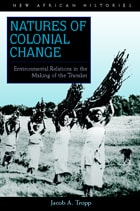
Natures of Colonial Change
Environmental Relations in the Making of the TranskeiJacob A. Tropp
Ohio University Press, 2006
In this groundbreaking study, Jacob A. Tropp explores the interconnections between negotiations over the environment and an emerging colonial relationship in a particular South African context—the Transkei—subsequently the largest of the notorious “homelands” under apartheid.
In the late nineteenth century, South Africa’s Cape Colony completed its incorporation of the area beyond the Kei River, known as the Transkei, and began transforming the region into a labor reserve. It simultaneously restructured popular access to local forests, reserving those resources for the benefit of the white settler economy. This placed new constraints on local Africans in accessing resources for agriculture, livestock management, hunting, building materials, fuel, medicine, and ritual practices.
Drawing from a diverse array of oral and written sources, Tropp reveals how bargaining over resources—between and among colonial officials, chiefs and headmen, and local African men and women—was interwoven with major changes in local political authority, gendered economic relations, and cultural practices as well as with intense struggles over the very meaning and scope of colonial rule itself.
Natures of Colonial Change sheds new light on the colonial era in the Transkei by looking at significant yet neglected dimensions of this history: how both “colonizing” and “colonized” groups negotiated environmental access and how such negotiations helped shape the broader making and meaning of life in the new colonial order.
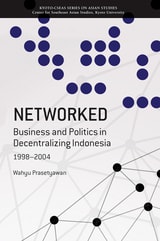
Networked
Business and Politics in Decentralizing Indonesia, 1998-2004Wahyu Prasetyawan
National University of Singapore Press, 2018
Networked Business and Politics in Decentralizing Indonesia evaluates three cases of deep-seated political conflict and intrigue including central government, local governments, and multinational companies. It looks at how the structure of the national political economy has changed as the result of local politicians becoming involved in disputes with the national government over control of natural resources. It also analyzes how these changes will affect the distribution of wealth in the country as well as Indonesia’s evolving democratic politics and modes of governance.
New Terrains in Southeast Asian History
Abu Talib Ahmad
Ohio University Press, 2003
At a watershed moment in the scholarly approach to the history of this important region, New Terrains in Southeast Asian History captures the richness and diversity of historical discourse among Southeast Asian scholars. Through the perspectives of scholars who live and work within the region, the book offers readers a rare opportunity to enter into the world of Southeast Asian historiography. Individual chapters subject the dominance of national narratives to critical reflection and deconstruction, while others highlight the need to go beyond essentially political narratives to seek out deeper cultural, economic, and social structures by utilizing new sources, methodologies, and concepts. Taken as a whole, the book contends that new terrains in Southeast Asian history may be found “at the interstices and on the margins” where nations, societies, or cultures engage the unending processes of historical change.
The contributors are Abdul Rahman Haji Ismail, Abu Talib Ahmad, Andrew Hardy, Badriyah Haji Salleh, Brenda S. A. Yeoh, C. J. W.-L. Wee, Ni Ni Myint, Dhiravat na Pombejra, Hong Lysa, Huang Jianli, Kobkua Suwannathat-Pian, M. R. Fernando, P. Lim Pui Huen, Paul H. Kratoska, Tan Liok Ee, Thongchai Winichakul, and Yong Mun Cheong.

New World Orderings
China and the Global SouthLisa Rofel and Carlos Rojas, editors
Duke University Press, 2022
Contributors. Andrea Bachner, Luciano Damián Bolinaga, Nellie Chu, Rachel Cypher, Mingwei Huang, T. Tu Huynh, Yu-lin Lee, Ng Kim Chew, Lisa Rofel, Carlos Rojas, Shuang Shen, Derek Sheridan, Nicolai Volland
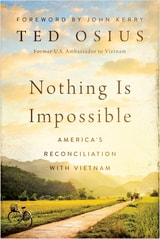
Nothing Is Impossible
America's Reconciliation with VietnamTed Osius
Rutgers University Press, 2022
Ted Osius, former ambassador during the Obama administration, offers a vivid account, starting in the 1990s, of the various forms of diplomacy that made this reconciliation possible. He considers the leaders who put aside past traumas to work on creating a brighter future, including senators John McCain and John Kerry, two Vietnam veterans and ideological opponents who set aside their differences for a greater cause, and Pete Peterson—the former POW who became the first U.S. ambassador to a new Vietnam. Osius also draws upon his own experiences working first-hand with various Vietnamese leaders and traveling the country on bicycle to spotlight the ordinary Vietnamese people who have helped bring about their nation’s extraordinary renaissance.
With a foreword by former Secretary of State John Kerry, Nothing Is Impossible tells an inspiring story of how international diplomacy can create a better world.