Results by title
4155 books match the query 'State & Local' and 117 start with n
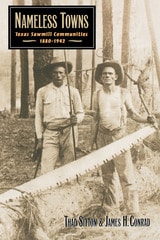
Nameless Towns
Texas Sawmill Communities, 1880-1942By Thad Sitton and James H. Conrad
University of Texas Press, 1998
Winner, T. H. Fehrenbach Award, Texas Historical Commission
Sawmill communities were once the thriving centers of East Texas life. Many sprang up almost overnight in a pine forest clearing, and many disappeared just as quickly after the company "cut out" its last trees. But during their heyday, these company towns made Texas the nation's third-largest lumber producer and created a colorful way of life that lingers in the memories of the remaining former residents and their children and grandchildren.
Drawing on oral history, company records, and other archival sources, Sitton and Conrad recreate the lifeways of the sawmill communities. They describe the companies that ran the mills and the different kinds of jobs involved in logging and milling. They depict the usually rough-hewn towns, with their central mill, unpainted houses, company store, and schools, churches, and community centers. And they characterize the lives of the people, from the hard, awesomely dangerous mill work to the dances, picnics, and other recreations that offered welcome diversions.
Narrating Jane
Telling the Story of an Early African American Mormon WomanQuincy D. Newell
Utah State University Press, 2016
In volume 21 of the Arrington Lecture Series, Quincy Newell studies the life of Jane Elizabeth Manning James, an African American, born in 1822, who converted to Mormonism in 1843. The narrative of Jane's life has to date been told in versions that favored official LDS positions on race and gender at the time of their telling. Newell's study here brings contemporary historical scholarship and critical distance to bear on the facts and the meanings of Jane M. James's experience.
The Arrington Lecture series, established by one of the twentieth-century West's most distinguished historians, Leonard Arrington, has become a leading forum for prominent historians to address topics related to Mormon history. Utah State University hosts the Leonard J. Arrington Mormon History Lecture Series through the Merrill-Cazier Library Special Collections and Archives department.
Narratives of the American West
Literature and HistoryRichard W. Etulain
University of Nevada Press, 2027
Narratives of the American West: Literature and History brings together Richard W. Etulain’s most resonant work—along with newly written essays—to reveal how history and storytelling have continually shaped each other in the making of the West. Part historiographical memoir, part wide‑ranging critical survey, the collection moves from Etulain’s Basque upbringing in eastern Washington to his lifetime of teaching, editing, and writing, showing how personal experience and intellectual inquiry converge on the page.
In the tradition of Elliott West’s The Essential West, Etulain maps the field’s major interpretive turns, from Frederick Jackson Turner to Earl Pomeroy to West’s“Greater Reconstruction,” and demonstrates how literary craft and historical method inform each other. Along the way, he demythologizes the stories of iconic figures, such as Billy the Kid, Calamity Jane, Chief Joseph, and Sacagawea, tracing how cultural memory evolves across novels, films, and archives.
Featuring new essays on Wallace Stegner and Elliott West, alongside revised classics on western myths, genres, regions, and peoples, this accessible yet rigorous volume invites readers to embrace narratives that are complex and morally engaged. Essential for scholars, students, and curious general readers alike, Narratives of the American West is a compelling guide to how the West has been written and remembered—and why those stories still matter.
Nashville Metro
The Politics of City-County ConsolidationBrett W. Hawkins
Vanderbilt University Press, 2024
This is a valuable artifact in itself, but the new foreword by Judge David Briley—former Nashville mayor and grandson of the first metro Nashville mayor, Beverly Briley—offers a firsthand account of the realities of metropolitan government sixty years on.
Nashville in the 1890s
William Waller
Vanderbilt University Press, 1970
It is, however, not a complete insight into Nashville in the 1890s. Readers should take note that the book focuses almost exclusively on the experiences and worldviews of white Nashvillians. These stories have incredible value for local historians and anyone interested in Nashville history, but the book’s failure to deal with race—as evidenced by Waller’s belief that “the social order was thought to be providential,” which was clearly not true for Nashville’s Black residents who struggled against the unjust systems designed to oppress them—is a grave shortcoming.
Nashville's New Americans
Tracing the Journeys of Our Immigrant NeighborsSheri Lea Sellmeyer
Vanderbilt University Press, 2026
Whether it’s building skyscrapers, running successful restaurants, researching diseases, performing music, cleaning hotel rooms, or holding public office, immigrants are changing Nashville from a mid‑sized city known for its country music industry to an increasingly diverse, multicultural destination. In Metro Nashville schools today, students speak more than 120 languages. The city is bigger, more congested, and more expensive than it’s ever been, drawing criticism from both longtime residents and newcomers. But growth has also brought top‑notch scientists and educators, a world‑class symphony, major league sports teams, investment from major corporations—and a wide range of immigrants whose talent and hard work have helped make all of that happen.
Through its profiles of thirty-nine immigrants from thirty-eight countries in Asia, the Middle East, Africa, Europe, Latin America, and Australia, Nashville’s New Americans provides a case study from one of the fastest-growing cities in the country on the contributions immigrants are making to its culture and economy.

Nashville, 1900 to 1910
William Waller
Vanderbilt University Press, 1972
Nathan Boone and the American Frontier
R. Douglas Hurt
University of Missouri Press, 2000
Celebrated as one of America's frontier heroes, Daniel Boone left a legacy that made the Boone name almost synonymous with frontier settlement. Nathan Boone, the youngest of Daniel's sons, played a vital role in American pioneering, following in much the same steps as his famous father. In Nathan Boone and the American Frontier, R. Douglas Hurt presents for the first time the life of this important frontiersman.
Based on primary collections, newspaper articles, government documents, and secondary sources, this well-crafted biography begins with Nathan's childhood in present-day Kentucky and Virginia and then follows his family's move to Missouri. Hurt traces Boone's early activities as a hunter, trapper, and surveyor, as well as his leadership of a company of rangers during the War of 1812. After the war, Boone returned to survey work. In 1831, he organized another company of rangers for the Black Hawk War and returned to military life, making it his career. The remainder of the book recounts Boone's activities with the army in Iowa and the Indian Territory, where he was the first Boone to gain notice outside Missouri or Kentucky. Even today his work is recognized in the form of state parks, buildings, and place-names.
Although Nathan Boone was an important figure, he lived much of his life in the shadow of his father. R. Douglas Hurt, however, makes a strong case for Nathan's contribution to the larger context of life in the American backcountry, especially the execution of military and Indian policy and the settlement of the frontier.
By recognizing the significant role that Nathan Boone played, Nathan Boone and the American Frontier also provides the recognition due the many unheralded frontiersmen who helped settle the West. Anyone with an interest in the history of Missouri, the frontier, or the Boone name will find this book informative and compelling.

Nathan Hale
The Life and Death of America's First SpyM. William Phelps
University Press of New England, 2015
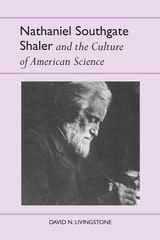
Nathaniel Southgate Shaler and the Culture of American Science
David N. Livingstone
University of Alabama Press, 1987
An influential American scientist and educator.
Nathaniel Southgate Shaler and the Culture of American Science is the first book-length study of the man who served a Harvard’s Professor of Geology and Paleontology during the Darwinian era. Shaler was a student of Louis Agassiz and went on to a successful, multifaceted career as a geologist, geographer, educator, humanist, and poet. Livingstone employs a thematic approach to chart Shaler’s career against the broader intellectual currents of America’s Gilded Age. After tracing Shaler’s life story from his boyhood in Kentucky through his student years at Harvard, his service with the Geological Survey, and eventually his years as Dean of Harvard’s Lawrence Scientific School, the author examines Shaler’s evolutionary vision and portrays his strategic efforts to reconcile the nineteenth century’s scientific and religious world views.
Livingstone assesses Shaler’s prolific writings, including those on race, which demonstrate a typical concern to provide a “scientific” perspective on the political questions of immigration restriction and eugenic control. IN addition, the book explores his efforts to interweave geography and history, particularly in relation to the American frontier; and his contributions to geology and geomorphology. The portrait of Shaler is completed with a review of his educational thinking and his role in establishing the American Summer School and in furthering scientific and technological education.
Nathaniel Southgate Shaler emerges from Livingstone’s work as a distinctive figure in the development of the new scientific culture, a figure who provides a focal point for assessing the impact of evolutionary naturalism on late-nineteenth-century American thought.
Nation Within
The History of the American Occupation of Hawai'iTom Coffman
Duke University Press, 2009
Native American Communities in Wisconsin, 1600–1960
A Study of Tradition and ChangeRobert E. Bieder
University of Wisconsin Press, 1995
The first comprehensive history of Native American tribes in Wisconsin, this thorough and thoroughly readable account follows Wisconsin’s Indian communities—Ojibwa, Potawatomie, Menominee, Winnebago, Oneida, Stockbridge-Munsee, and Ottawa—from the 1600s through 1960. Written for students and general readers, it covers in detail the ways that native communities have striven to shape and maintain their traditions in the face of enormous external pressures.
The author, Robert E. Bieder, begins by describing the Wisconsin region in the 1600s—both the natural environment, with its profound significance for Native American peoples, and the territories of the many tribal cultures throughout the region—and then surveys experiences with French, British, and, finally, American contact. Using native legends and historical and ethnological sources, Bieder describes how the Wisconsin communities adapted first to the influx of Indian groups fleeing the expanding Iroquois Confederacy in eastern America and then to the arrival of fur traders, lumber men, and farmers. Economic shifts and general social forces, he shows, brought about massive adjustments in diet, settlement patterns, politics, and religion, leading to a redefinition of native tradition.
Historical photographs and maps illustrate the text, and an extensive bibliography has many suggestions for further reading.
Native American Place Names of Indiana
Michael McCafferty
University of Illinois Press, 2007
A linguistic history of Native American place-names in Indiana
In tracing the roots of Indiana place names, Michael McCafferty focuses on those created and used by local Native Americans. Drawing from exciting new sources that include three Illinois dictionaries from the eighteenth century, the author documents the language used to describe landmarks essential to fur traders in Les Pays d’en Haut and settlers of the Old Northwest territory. Impeccably researched, this study details who created each name, as well as when, where, how and why they were used. The result is a detailed linguistic history of lakes, streams, cities, counties, and other Indiana names. Each entry includes native language forms, translations, and pronunciation guides, offering fresh historical insight into the state of Indiana.
Native Americans and Pennsylvania
Daniel K. Richter
Temple University Press, 2026
Engagingly written, deeply researched, and thoroughly revised to reflect the most recent interdisciplinary scholarship, this new edition of Native Americans and Pennsylvania focuses on Indigenous actors, voices, and landscapes, while tracing interconnections among local, continental, and global trends.
The story begins thousands of years before there was such a thing as “Pennsylvania.” William Penn did not paint his colony on a blank canvas. Colonists adapted ancient patterns of trade and cultural interaction created by the ancestors of Lenape, Conestoga, and Haudenosaunee peoples and convinced themselves they had made them their own. In the process, Pennsylvanians developed moral justifications for the expropriation of Indigenous land, pernicious doctrines about racial superiority, and brutal mechanisms of vigilante violence that profoundly influenced later United States government policies.
Those policies kept Pennsylvania in the foreground of national Native American issues long after the Commonwealth expelled the majority of its Indigenous population to far-flung diasporic homes: forced cultural assimilation at off-reservation boarding schools in the nineteenth century, cultural revitalization and political activism in the twentieth, and struggles with cultural institutions over the repatriation of human remains and controversies over who has the right to claim Indigenous identity in the twenty-first.
In the series Pennsylvania History
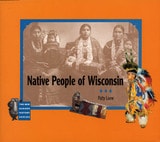
Native People of Wisconsin
Patty Loew
Wisconsin Historical Society Press, 2003
The revised edition ofPatty Loew'sNative People of Wisconsin is now available, ISBN 9780870207488.Native People of Wisconsin, the fifth text in the New Badger History series for upper elementary and middle school students, focuses on the Indian Nations in the state: the Menominee, Ho-Chunk, Ojibwe, Oneida, Mohican Nation, Stockbridge-Munsee Band, and the Brothertown Indians. Patty Loew has followed the same structure she used in Indian Nations of Wisconsin, her book for general audiences, in which she provided chapters on Early History and European Arrivals, then devoted the remaining chapters to each of the Indian Nations in Wisconsin today.
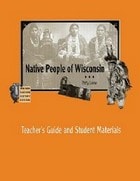
Native People of Wisconsin, TG
Bobbie Malone and Kori Oberle
Wisconsin Historical Society Press, 2003
The revised and updated Teacher's Guide for Native People of Wisconsin is available Winter 2015, ISBN 9780870207495.This teacher's guide helps students grasp fully the rich content of Native People of Wisconsin. The guide offers more structured activities that reengage students in the text itself in a manner that diverges from teacher's guides to our earlier publications. Activities for each chapter focus on interdisciplinary standards-related reading strategies, journaling, and other multidimensional skills that both reinforce and complement the content of the text. Included with the teacher's guide is an accompanying CD-ROM, produced specifically for Native People of Wisconsin of segments from several of the video series on Wisconsin Studies produced by the Wisconsin Educational Communications Board. Such interactive learning integrates reasoning and reading skills (and state standards) beyond the social studies and promise to make Native People of Wisconsin an essential part of the classroom curriculum.
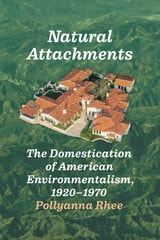
Natural Attachments
The Domestication of American Environmentalism, 1920–1970Pollyanna Rhee
University of Chicago Press, 2025
A massive oil spill in the Pacific Ocean near Santa Barbara, California, in 1969 quickly became a landmark in the history of American environmentalism, helping to inspire the creation of both the Environmental Protection Agency and Earth Day. But what role did the history of Santa Barbara itself play in this? As Pollyanna Rhee shows, the city’s past and demographics were essential to the portrayal of the oil spill as momentous. Moreover, well-off and influential Santa Barbarans were positioned to “domesticate” the larger environmental movement by embodying the argument that individual homes and families—not society as a whole—needed protection from environmental abuses. This soon would put environmental rhetoric and power to fundamentally conservative—not radical—ends.
Natural Attachments
The Domestication of American Environmentalism, 1920–1970Pollyanna Rhee
University of Chicago Press, 2025
A nuanced analysis takes a California oil spill as its point of departure to show how affluent homeowners pushed for an environmentalism that would protect not only the earth but also property and community norms.
A massive oil spill in the Pacific Ocean near Santa Barbara, California, in 1969 quickly became a landmark in the history of American environmentalism, helping to inspire the creation of both the Environmental Protection Agency and Earth Day. But what role did the history of Santa Barbara itself play in this? As Pollyanna Rhee shows, the city’s past and demographics were essential to the portrayal of the oil spill as momentous. Moreover, well-off and influential Santa Barbarans were positioned to “domesticate” the larger environmental movement by embodying the argument that individual homes and families—not society as a whole—needed protection from environmental abuses. This soon would put environmental rhetoric and power to fundamentally conservative—not radical—ends.
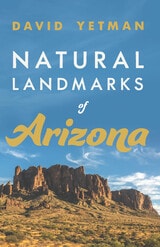
Natural Landmarks of Arizona
David Yetman
University of Arizona Press, 2021
Whether you have climbed these peaks many times, enjoy seeing them from your car window, or simply want to learn more about southwestern geology and history, reading Natural Landmarks of Arizona is a fascinating way to learn about the ancient and recent history of beloved places such as Cathedral Rock, Granite Dells, Kitt Peak, and many others. With Yetman as your guide, you can tuck this book into your glove box and hit the road with profound new knowledge about the towering natural monuments that define our beautiful Arizona landscapes.
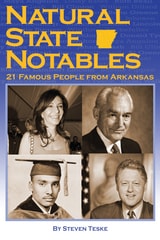
Natural State Notables
Twenty-One Famous People from ArkansasSteven Teske
Butler Center for Arkansas Studies, 2014
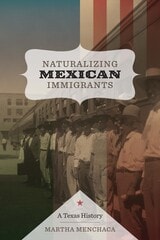
Naturalizing Mexican Immigrants
A Texas HistoryBy Martha Menchaca
University of Texas Press, 2011
2013 — NACCS Book Award – National Association for Chicana and Chicano Studies
During the nineteenth and early twentieth centuries, a majority of the Mexican immigrant population in the United States resided in Texas, making the state a flashpoint in debates over whether to deny naturalization rights. As Texas federal courts grappled with the issue, policies pertaining to Mexican immigrants came to reflect evolving political ideologies on both sides of the border.
Drawing on unprecedented historical analysis of state archives, U.S. Congressional records, and other sources of overlooked data, Naturalizing Mexican Immigrants provides a rich understanding of the realities and rhetoric that have led to present-day immigration controversies. Martha Menchaca's groundbreaking research examines such facets as U.S.-Mexico relations following the U.S. Civil War and the schisms created by Mexican abolitionists; the anti-immigration stance that marked many suffragist appeals; the effects of the Spanish American War; distinctions made for mestizo, Afromexicano, and Native American populations; the erosion of means for U.S. citizens to legalize their relatives; and the ways in which U.S. corporations have caused the political conditions that stimulated emigration from Mexico.
The first historical study of its kind, Naturalizing Mexican Immigrants delivers a clear-eyed view of provocative issues.
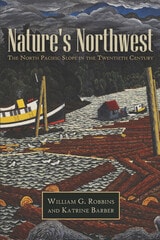
Nature's Northwest
The North Pacific Slope in the Twentieth CenturyWilliam G. Robbins and Katrine Barber
University of Arizona Press, 2011
With an emphasis on the region’s political economy, its environmental history, and its cultural and social heritage, this lively and colorful history of the Pacific Northwest—defined here as Oregon, Washington, Idaho, Montana, and southern British Columbia—places the narrative of this dynamic region within a national and international context.
Embracing both Canadian and American stories in looking at the larger region, renowned historians William Robbins and Katrine Barber offer us a fascinating regional history through the lens of both the environment and society. Understanding the physical landscape of the greater Pacific Northwest—and the watersheds of the Columbia, Fraser, Snake, and Klamath rivers—sets the stage for understanding the development of the area. Examining how this landscape spawned sawmills, fish canneries, railroads, logging camps, agriculture, and shared immigrant and ethnic traditions reveals an intricate portrait of the twentieth-century Northwest.
Impressive in its synthesis of myriad historical facts, this first-rate regional history will be of interest to historians studying the region from a variety of perspectives and an informative read for anyone fascinated by the story of a landscape rich in diversity, natural resources, and Native culture.

Nature's Yellowstone
Richard A. Bartlett
University of Arizona Press, 1974
"A timely work; its 'mission' is to make the reader wish 'to have seen Yellowstone before the people came.' The author must be commended for writing a scholarly book with appeal for a popular audience." —Journal of American History
"A joy for the recreational reader and a solid reference for scholarly researchers . . .The author has been both energetic and fortunate in gathering material from a rich variety of original accounts and later writings, and he has used them skillfully." —Western Historical Quarterly
Nauvoo
KINGDOM ON THE MISSISSIPPIRobert Bruce Flanders
University of Illinois Press, 1965
A history of what became a romantic
legend about a martyred prophet, a lost city, and religious persecution,
this volume tells the story of Nauvoo, the early Mormon Church, and the
temporal life of Joseph Smith. Nauvoo (1839-46) was a critical period in
Mormon history. The climax of Smith's career and the start of Brigham Young's,
it was here that Utah really had it's beginnings and that the pattern of
Mormon society in the West was laid.
"...the quality and quantity of research is commendable... an excellent
contribution to American mid-western history and to Mormoniana in general."
-- Journal of American History
Nearly Neighbors
Jane Addams, Johnny Powers, and the Progressive Political ImaginationTerrence J. McDonald
University of Chicago Press, 2026
Jane Addams was full of courage and goodwill when she opened Hull House in Chicago’s Nineteenth Ward in 1889. However, she failed to understand that her immigrant neighbors had been well-organized around mostly Catholic churches and schools for decades before her arrival. Her ultimate political rival, Johnny Powers, grew up in this culture but was no ethnic hero or deep political thinker. Nearly Neighbors is the first book to provide a contextualized history of their encounter, embedding it in the social and political culture and structures of Chicago and the Nineteenth Ward in the 1890s.
Terrence J. McDonald provides a crucial analysis of two pivotal figures in Chicago’s political history, in part by providing the first detailed assessment of Powers’s life and practices, but also by demonstrating Addams’s misconception of him and her neighbors—and why it matters for understanding her Progressive work overall. In both her political work and writings, Addams saw her ethnic neighbors as bundles of economic need, rather than bearers of ethnic culture. At the same time, she was recruited by elite allies into causes that appeared to be opposed by her neighbors. These views and practices permitted Powers to win in their climactic political battle in 1898 simply by claiming to be the neighborhood defender against Addams and her “downtown” allies. Nearly Neighbors offers a new way of understanding Addams and the complicated legacy of her famous political work and writings.

Necessarily Black
Cape Verdean Youth, Hip-Hop Culture, and a Critique of IdentityP. Khalil Saucier
Michigan State University Press, 2015
Necessary Courage
Iowa's Underground Railroad in the Struggle against SlaveryLowell J. Soike
University of Iowa Press, 2013

Necessary Evil
Settling Missouri with a Rope and a GunJoe Johnston
Missouri Historical Society Press, 2014
Necessary Evil is the first book to chronicle the implications of vigilantism in Missouri, ultimately showing that the state could never have been settled without a healthy dose of rebel justice. Packed with stories of popular gunslingers such as Wyatt Earp, Wild Bill Hickok, and Jesse James, this action-filled read will be of interest to crime enthusiasts and historians alike.
Negotiating Conquest
Gender and Power in California, 1770s to 1880sMiroslava Chávez-García
University of Arizona Press, 2004
Negotiating Conquest begins with an examination of how gender and ethnicity shaped the policies and practices of the Spanish conquest, showing that Hispanic women, marriage, and the family played a central role in producing a stable society on Mexico’s northernmost frontier. It then examines how gender, law, property, and ethnicity shaped social and class relations among Mexicans and native peoples, focusing particularly on how women dealt with the gender-, class-, and ethnic-based hierarchies that gave Mexican men patriarchal authority. With the American takeover in 1846, the text’s focus shifts to how the imposition of foreign legal, economic, linguistic, and cultural norms affected the status of Mexican women, male-female relations, and the family. Addressing such issues as divorce, legitimacy, and inheritance, it describes the manner in which the conquest weakened the economic position of both Mexican women and men while at the same time increasing the leverage of Mexican women in their personal and social relationships with men.
Drawing on archival materials—including dozens of legal cases—that have been largely ignored by other scholars, Chávez-García examines federal, state, and municipal laws across many periods in order to reveal how women used changing laws, institutions, and norms governing property, marriage and sexuality, and family relations to assert and protect their rights. By showing that mexicanas contested the limits of male rule and insisted that patriarchal relationships be based on reciprocity, Negotiating Conquest expands our knowledge of how patriarchy functioned and evolved as it reveals the ways in which conquest can transform social relationships in both family and community.

Negotiating Latinidad
Intralatina/o Lives in ChicagoFrances R. Aparicio
University of Illinois Press, 2019
Negro Education in Alabama
A Study in Cotton and SteelHorace Mann Bond
University of Alabama Press, 1994
WINNER OF THE SUSAN COLVER ROSENBERGER AWARD
A foundational work of educational history, Horace Mann Bond’s study reveals how race, labor, and power shaped Black schooling in Alabama—and why those lessons still matter today.
Originally published in 1939, Negro Education in Alabama: A Study in Cotton and Steel by Horace Mann Bond is a pioneering work of educational and social history. Drawing on extensive data and firsthand observation, Bond explores how the economic structures of the cotton South and the industrializing North influenced the development of Black education in Alabama. He examines disparities in funding, curriculum, and access, while also highlighting the resilience and agency of African American communities in pursuing educational advancement. This reissued edition preserves Bond’s critical insights and remains a vital resource for scholars of African American history, education policy, and Southern studies.
Negro Slavery in Arkansas
Orville Taylor
University of Arkansas Press, 2000
Long out of print and found only in rare-book stores, it is now available to a contemporary audience with this new paperback edition.
When slavery was abolished by the Emancipation Proclamation, there were slaves in every county of the state, and almost half the population was directly involved in slavery as either a slave, a slaveowner, or a member of an owner’s family. Orville Taylor traces the growth of slavery from John Law’s colony in the early eighteenth century through the French and Spanish colonial period, territorial and statehood days, to the beginning of the Civil War. He describes the various facets of the institution, including the slave trade, work and overseers, health and medical treatment, food, clothing, housing, marriage, discipline, and free blacks and manumission.
While drawing on unpublished material as appropriate, the book is, to a great extent, based on original, often previously unpublished, sources. Valuable to libraries, historians in several areas of concentration, and the general reader, it gives due recognition to the signficant place slavery occupied in the life and economy of antebellum Arkansas.
Neither Land nor Water
Planning Through Fringe Ecologies in the Meadowlands (1896–2020)Sevin Yildiz
University of Chicago Press, 2026
An urban and environmental history of the New Jersey Meadowlands, where marsh meets megamall.
The New Jersey Meadowlands, the vast marshes across the Hudson River from New York City, are a mysterious and complex wetland. Both strange and well-known to the millions of people who traverse the northeast corridor every year, this landscape is not well understood despite its familiarity. Seemingly natural and unnatural, human and nonhuman, the Meadowlands has long been shaped by urban development, industry, infrastructure, and countless dreams.
In Neither Land nor Water, Şevin Yıldız offers a close look at the planners, scientists, developers, politicians, industrialists, and others who have engaged with, dreamed about, or damaged this transitional ecology in different ways over the decades. She traces key periods in the area’s rich histories of urban planning and ecological thought, from the dispossession of the Lenape natives, through the dawn of ecological science, and onto both intensive industrial developments and environmental resistance to them. She examines as well how the Meadowlands exposes the inadequacies of today’s approaches to planning in the face of climate change and how they perhaps offer clues to a better future.
Nevada Place Names
A Geographical DictionaryHelen S. Carlson
University of Nevada Press, 1974
Author and researcher Helen Carlson spent almost fourteen years searching for the origins of Nevada’s place names, using the maps of explorers, miners, government surveyors, and city planners and poring through historical accounts, archival documents, county records, and newspaper files. The result of her labors is Nevada Place Names, a fascinating mixture of history spiced with folklore, legend, and obscure facts. Out of print for some years, the book was reprinted in 1999.
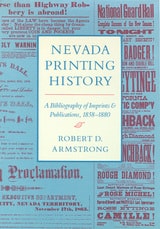
Nevada Printing History
A Bibliography Of Imprints And Publications, 1858-1880Robert D. Armstrong
University of Nevada Press, 1981
A detailed look at Nevada's printing history from 1858 through 1880. Includes proclamations, pamphlets, menus, government publications, church programs, and more. For Nevada historians, bibliographers, book collectors, and people who are interested in the printed records produced in Nevada toward the end of the nineteenth century.
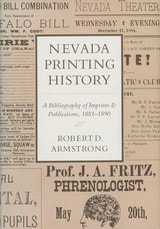
Nevada Printing History
A Bibliography Of Imprints And Publications, 1881-1890Robert D. Armstrong
University of Nevada Press, 1991
A detailed look at Nevada's printing history from 1881 through 1890. With over 1400 entries describing books, pamphlets, broadsides, state and local documents, fraternal and church publications, and a variety of other printed matter, this intriguing compilation serves as the companion volume to Armstrong's Nevada Printing History, 1858-1880. Armstrong includes annual summaries of events affecting the printing trade in Nevada as well as the locations and kinds of printing technology in use. This second volume also documents the planning and erection of a state printing office. Of particular interest are the summaries of individual publications that provide the reader with a picture of social, economic, and political viewpoints of the period. The author's research led him to more than 125 public institutions over a period of nearly twenty years. Historians, bibliographers, students of printing history and practice, collectors of Western Americana, antiquarian booksellers, and librarians will find this book to be an invaluable guide to Nevada's printing, its printers, and its history.
Nevada's Changing Wildlife Habitat
An Ecological HistoryGeorge E. Gruell
University of Nevada Press, 2013
For millennia the ecology of the Great Basin has evolved because of climate change and the impacts of human presence. Nevada’s Changing Wildlife Habitat is the first book to explain the transformations in the plants and animals of this region over time and how they came about. Using data gleaned from archaeological and anthropological studies, numerous historical documents, repeat photography, and several natural sciences, the authors examine changes in vegetation and their impact on wildlife species and the general health of the environment. They also outline the choices that current users and managers of rangelands face in being good stewards of this harsh but fragile environment and its wildlife.
Nevada's Environmental Legacy
Progress or PlunderJames W. Hulse
University of Nevada Press, 2009
Nevada's relatively brief history (it became a state in 1864) has been largely a story of the exploitation of its natural resources. Mining has torn down mountains and poisoned streams and groundwater. Uncontrolled grazing by vast herds of sheep and cattle has denuded grasslands and left them prey to the invasion of noxious plant species and vulnerable to wildfire. Clear-cut logging practices have changed the composition of forests and induced serious soil erosion. More recently, military testing, including hundreds of atomic blasts to determine the efficacy of nuclear weapons, has irreversibly polluted expanses of fragile desert landscape. And rampant development throughout the state over the past four decades, along with the public's growing demand for recreational facilities, has placed intolerable demands on the arid state's limited water resources and threatened the survival of numerous rare plant and animal species. Veteran historian and Nevada native James W. Hulse considers the state's complex environmental history as a series of Faustian bargains between the state's need for economic development and the industries, government agencies, and individuals that have exploited Nevada's natural resources with little concern for the long-term consequences of their activities. His survey covers all these issues, and examines public attitudes about the environment and the role of federal and state agencies in creating, interpreting, and enforcing environmental policies.
Nevada's Great Recession
Looking Back, Moving ForwardElliott Parker
University of Nevada Press, 2017
This is a different kind of economics book. Parker uses his expertise from doing research on the East Asian fiscal crisis to give profound insights into what happened and how to avoid future catastrophes. Marshall personalizes it by providing vignettes of what it was actually like to be in the trenches and fighting the inevitable political battles that came up, and counteracting some of the falsehoods that certain politicians were spreading about the recession.
Parker and Marshall’s book should be required reading for not only every single elected official in Nevada, but for any private citizen who cares about the public good.
Nevada's Historic Buildings
A Cultural LegacyRonald M. James
University of Nevada Press, 2009
Nevada’s Historic Buildings highlights ninety of these buildings, describing them in the context of the state’s history and the character of the people who created and used them. Here are reminders of mining boomtowns, historic ranches, transportation, the divorce and gaming industries, the New Deal, and the innovation of Las Vegas’s post-modern aesthetic. These buildings provide a cross-section of Nevada’s rich historic and cultural heritage and their survival offers everyone the experience of touching the past.
Nevada's Turbulent 50's
Decade Of Political And Economic ChangeAl Glass
University of Nevada Press, 1981
The 1950s marked a period of significant changes for Nevada--gambling came under national and local scrutiny, atomic bombs were tested regularly near Las Vegas, and labor disputes made national headlines. Glass examines the events of the decade and their impact on Nevada and on the rest of the country.
Nevada's Twentieth-Century Mining Boom
Tonopah, Goldfield, ElyRussell R. Elliott
University of Nevada Press, 1966
Nevada
A HistoryRobert Laxalt
University of Nevada Press, 1991
Nevada
A History of the Silver StateMichael S. Green
University of Nevada Press, 2015
Michael S. Green, a leading Nevada historian, provides a detailed survey of the Silver State’s past, from the arrival of the early European explorers, to the predominance of mining in the 1800s, to the rise of world-class tourism in the twentieth century, and to more recent attempts to diversify the economy.
Of the numerous themes central to Green’s analysis of Nevada’s history, luck plays a significant role in the state’s growth. The miners and gamblers who first visited the state all bet on luck. Today, the biggest contributor to Nevada’s tourist economy, gaming, still relies on that same belief in luck. Nevada’s financial system has generally been based on a “one industry” economy, first mining and, more recently, gaming. Green delves deeply into the limitations of this structure, while also exploring the theme of exploitation of the land and the overuse of the state’s natural resources. Green covers many more aspects of the Silver State’s narrative, including the dominance of one region of the state over another, political forces and corruption, and the citizens’ often tumultuous relationship with the federal government. The book will appeal to scholars, students, and other readers interested in Nevada history.

Nevada
A History of the Silver State, 2nd editionMichael S. Green
University of Nevada Press, 2024
Michael S. Green, a leading Nevada historian, provides a detailed survey of the Silver State’s past, from the arrival of the early European explorers, to the predominance of mining in the 1800s, to the rise of world-class tourism in the twentieth century, and to more recent attempts to diversify the economy.
Of the numerous themes central to Green’s analysis of Nevada’s history, luck plays a significant role in the state’s growth. The miners and gamblers who first visited the state all bet on luck. Today, the biggest contributor to Nevada’s tourist economy, gaming, still relies on that same belief in luck. Nevada’s financial system has generally been based on a “one industry” economy, first mining and, more recently, gaming. Green delves deeply into the limitations of this structure, while also exploring the theme of exploitation of the land and the overuse of the state’s natural resources. Green covers many more aspects of the Silver State’s narrative, including the dominance of one region of the state over another, political forces and corruption, and the citizens’ often tumultuous relationship with the federal government. The book will appeal to scholars, students, and other readers interested in Nevada history.
Never Justice, Never Peace
Mother Jones and the Miner Rebellion at Paint and Cabin CreeksGinny Savage Ayers
West Virginia University Press, 2018
In 1986 Lon Savage published Thunder in the Mountains: The West Virginia Mine War, 1920–21, a popular history now considered a classic. Among those the book influenced are Denise Giardina, author of Storming Heaven, and John Sayles, writer and director of Matewan. When Savage passed away, he left behind an incomplete book manuscript about a lesser-known Mother Jones crusade in Kanawha County, West Virginia. His daughter Ginny Savage Ayers drew on his notes and files, as well as her own original research, to complete Never Justice, Never Peace—the first book-length account of the Paint Creek–Cabin Creek Strike of 1912–13.
Savage and Ayers offer a narrative history of the strike that weaves together threads about organizer Mother Jones, the United Mine Workers union, politicians, coal companies, and Baldwin-Felts Detective Agency guards with the experiences of everyday men and women. The result is a compelling and in-depth treatment that brings to light an unjustly neglected—and notably violent—chapter of labor history. Introduced by historian Lou Martin, Never Justice, Never Peace provides an accessible glimpse into the lives and personalities of many participants in this critical struggle.
Never Seen the Moon
THE TRIALS OF EDITH MAXWELLSharon Hatfield
University of Illinois Press, 2004
Immediately granted celebrity status by the powerful Hearst press, Maxwell was also championed as a martyr by advocates of women's causes. National news magazines and even detective magazines picked up her story, Warner Brothers created a screen version, and Eleanor Roosevelt helped secure her early release from prison. Sharon Hatfield's brilliant telling of this true-crime story transforms a dusty piece of history into a vibrant thriller. Throughout the narrative, she discusses yellow journalism, the inequities of the jury system, class and gender tensions in a developing region, and a woman's right to defend herself from family violence.
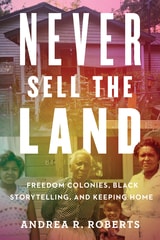
Never Sell the Land
Freedom Colonies, Black Storytelling, and Keeping HomeAndrea R. Roberts
University of Texas Press, 2027
Chronicling the stories and resilience of Texas freedom colonies facing erasure, and of the efforts of descendant community members to safeguard them.
Since Emancipation, Deep East Texas has been a place where Black Texans have experienced oppression yet also have created free Black communities. Well into the Jim Crow era, the area was home to communities where formerly enslaved people farmed their own land and ran their own affairs, now called freedom colonies. At one point, more than five hundred such communities existed in the state. Yet only a handful of these freedom colonies remain today, and they are in danger of disappearing from the record and from historical memory.
Never Sell the Land is a work about Black agency—specifically, how agency is secured through bottom-up planning and preservation in the face of unequal access. Andrea Roberts traces the efforts of descendant community members to safeguard the land and heritage of settlements in Jasper and Newton Counties, which abut the Louisiana border. She follows the descendants of these Black-built places as they deploy creative approaches to education and revitalization built on traditional community practices. Never Sell the Land tells the origin story of The Texas Freedom Colonies Atlas and Study and shows how preservation becomes self-determination—and how grassroots projects are exhuming the freedom colonies from history books, personal archives, and oral histories, and fighting to physically cement them within the landscape of Texas today.

Never a City So Real
A Walk in ChicagoAlex Kotlowitz
University of Chicago Press, 2019
The book is a tour of the people of Chicago, those who have been Kotlowitz’s guide into this city’s – and by inference, this country’s – heart. Chicago, after all, is America’s city. Kotlowitz introduces us to the owner of a West Side soul food restaurant who believes in second chances, a steelworker turned history teacher, the “Diego Rivera of the projects,” and the lawyers and defendants who populate Chicago’s Criminal Courts Building. These empathic, intimate stories chronicle the city’s soul, its lifeblood.
This new edition features a new afterword from the author, which examines the state of the city today as seen from the double-paned windows of a pawnshop. Ultimately, Never a City So Real is a love letter to Chicago, a place that Kotlowitz describes as “a place that can tie me up in knots but a place that has been my muse, my friend, my joy.”
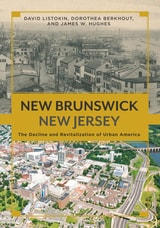
New Brunswick, New Jersey
The Decline and Revitalization of Urban AmericaListokin, David
Rutgers University Press, 2016