Results by title
131 books match the query 'Texts' and 5 start with n
Native American Verbal Art
Texts and ContextsWilliam M. Clements
University of Arizona Press, 1996
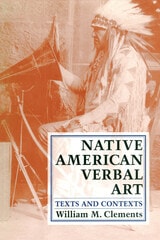
He examines in depth Henry Timberlake’s 1765 translation of a Cherokee war song that was probably the first printed English rendering of a Native American "poem." He discusses early-nineteenth-century textualizers and translators who saw in Native American verbal art a literature manqué that they could transform into a fully realized literature, with particular attention to the work of Henry Rowe Schoolcraft, an Indian agent and pioneer field collector who developed this approach to its fullest. He discusses the "scientific" textualizers of the late nineteenth century who viewed Native American discourse as a data source for historical, ethnographic, and linguistic information, and he examines the work of Natalie Curtis, whose field research among the Hopis helped to launch a wave of interest in Native Americans and their verbal art that continues to the present.
In addition, Clements addresses theoretical issues in the textualization, translation, and anthologizing of American Indian oral expression. In many cases the past records of Native American expression represent all we have left of an entire verbal heritage; in most cases they are all that we have of a particular heritage at a particular point in history. Covering a broad range of materials and their historical contexts, Native American Verbal Art identifies the agendas that have informed these records and helps the reader to determine what remains useful in them. It will be a welcome addition to the fields of Native American studies and folklore.
New Documents Illustrating Early Christianity 11A
Texts from EphesusJames R. Harrison
SBL Press, 2024
New Testament Greek Workbook
An Inductive Study of the Complete Text of the Gospel of JohnJames Arthur Walther
University of Chicago Press, 1981
Nivaclé Grammar
Lyle Campbell, Luis Díaz, and Fernando Ángel
University of Utah Press, 2020
This book offers an extensive description of Nivaclé, an indigenous language spoken in the Gran Chaco region of Argentina and Paraguay. Nivaclé’s phonology, morphology, and syntax are complex; the language has no tenses marked on verbs, essentially no prepositions, and a sizable number of lexical suffixes whose content is so concrete they would be expected to be independent words in most other languages. Nivaclé has a unique speech sound, /k͡ l/, known nowhere else. In some locations where it is spoken, multilingual conversations are the norm. These and other rare traits make Nivaclé an especially fascinating language for linguists, with many implications for language typology and linguistic theory. The book is based on dozens of audio and video recordings of narratives and on hundreds of hours of elicitation and analysis with native speakers. Four lengthy texts are included here to demonstrate the language in action. Scholars—whether in anthropology, folklore, geography, history, or language—will find value in the narratives included here and in the insights into Nivaclé life and culture found throughout the book.
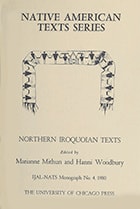
Northern Iroquoian Texts
Marianne Mithun and Hanni Woodbury
University of Chicago Press Journals, 1980