Results by title
303 books match the query 'Time' and 7 start with n

NARRATIVE DYNAMICS
ESSAYS ON TIME, PLOT, CLOSURE, AND FRAMEEdited by Brian Richardson
The Ohio State University Press, 2002
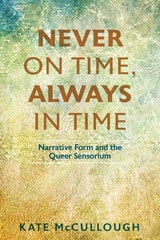
Never on Time, Always in Time
Narrative Form and the Queer SensoriumKate McCullough
The Ohio State University Press, 2024
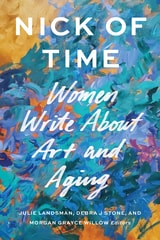
Nick of Time
Women Write about Art and AgingJulie Landsman
University of Minnesota Press, 2026
A bold, collective portrait of the sustaining force of art while aging
Nick of Time celebrates the artistic community of the Twin Cities and the wisdom that comes with age. Bringing together the voices of women creatives over the age of sixty-five, this collection is as varied as the artists’ vocations, spanning from narrative prose to poetry, essay, monologue, letters, historical reflection, and more. As the contributors examine their lived experiences, hopes and regrets, joy and grief while traversing their last decades of life, they serve as a guiding beacon for others navigating the intersection of creativity and aging—as well as a ballast against its inevitable challenges. They write with refreshing honesty about feeling invisible in older age, receiving late recognition, or being dismissed as hair turns gray and wrinkles appear. Their openness provides strength and support for us all.
A beautiful collection of pieces from established and emerging writers, painters, singers, photographers, musicians, playwrights, dancers, sculptors, and beyond, Nick of Time traces the contours of both the commonalities and the differences that can be found in the creative life of an aging artist. This generous book is a provocative meditation on finding power in age, demonstrating that creativity is an integral part of a full life as well as a lifelong pursuit.
Contributors: Shari Albers, Hend Al-Mansour, Hazel Belvo, Chris Cinque, Venus de Mars, Julia Dinsmore, Mary Moore Easter, Jan Elftmann, Georgia A. Greeley, Kathryn Haddad, Kim Hines, Carolyn Holbrook, Adar Kahin, Deborah Keenan, Amoke Kubat, Fiona McCrae, Teresa Ortiz, Rebecca Pavlenko, Marcie R. Rendon, Joyce Sutphen, Suzanne Thao, JoAnn Verburg, Diane Wilson, Mieko Yamazaki.
Retail e-book files for this title are screen-reader friendly.
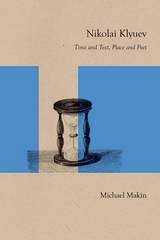
Nikolai Klyuev
Time and Text, Place and PoetMichael Makin
Northwestern University Press, 2009
Nikolai Klyuev is the first book in English to examine the life and work of this enigmatic poet. Klyuev (1884–1937) rose to prominence in the early twentieth century as the first of the so-called "new peasant poets" but later fell victim to Stalinist hostility to both his cultural ideology and his homosexuality. He was arrested and exiled in 1933, then shot in 1937.
Klyuev’s work incorporates rich elements of folklore, mysticism, politics, and religion, and he sometimes invokes arcane Russian syntax and vocabulary. Makin’s feat is particularly notable because Klyuev was often elusive in his own accounts of his life, and Makin successfully brings into focus the poet’s deliberate strategies of self-mythologization. Nikolai Klyuev is an indispensable guide to the life and the work of an important poet winning wider recognition outside of Russia.
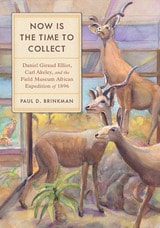
Now Is the Time to Collect
Daniel Giraud Elliot, Carl Akeley, and the Field Museum African Expedition of 1896Paul D. Brinkman
University of Alabama Press, 2024
The rediscovery of a curator’s lost journal illuminates the astonishing African journey that formed the basis of the Chicago Field Museum’s famed collections
“Now” Is the Time to Collect tells the fascinating story of the Chicago Field Museum of Natural History’s zoological expedition to Africa in 1896, the source of many of the museum’s foundational collections and an astounding episode in nineteenth-century science. After the well-publicized extinction of the dodo and Carolina parakeet and the collapse of the American bison population, late nineteenth-century naturalists expected many more vulnerable species to die out with spread of Western-style industrialization. This triggered a race to collect rare species of animals expected soon to be lost forever.
Established in 1893, Chicago’s ambitious Field Museum aimed to become a global center of study. Zoologist Daniel Giraud Elliot persuaded museum patrons to fund an immediate expedition to British Somaliland (contemporary Somalia). There, his team hunted and killed hundreds of animals for the growing collection. On the trip was groundbreaking taxonomist Carl Akeley. Back in Chicago, Akeley created captivating lifelike dioramas of rare animal groups that enhanced the museum’s fame and remain popular to this day.
Enriched with illuminated passages from Elliot’s journal, only recently rediscovered, “Now” Is the Time to Collect is the first book of its kind by an American museum and a case study in what author Paul D. Brinkman calls “salvage zoology”—the practice of aggressively collecting rare animal specimens for preservation just prior to the birth of the modern conservation movement. It is a riveting account of the expedition, the travelers’ experiences in Somalia during its colonial period, and the astonishing origins of one of Chicago’s classic museum experiences.

Now Is the Time!
Detroit Black Politics and Grassroots ActivismTodd C. Shaw
Duke University Press, 2009
Shaw uses the tools of social movement analysis, including the quantitative analysis of budgets, electoral data, and housing statistics, as well as historical research and personal interviews, to better understand the dilemmas, innovations, and dynamics of grassroots activism. He begins with a history of discriminatory housing practices and racial divisions that deeply affected Detroit following the Second World War and set the stage for the election of the city’s first black mayor, Coleman Young. By emphasizing downtown redevelopment, Mayor Young’s administration often collided with low-income housing advocates. Only through grassroots activism were those advocates able to delay or derail governmental efforts to demolish low-income housing in order to make way for more upscale development. Shaw then looks at present-day public housing activism, assessing the mixed success of the nationally sponsored HOPE VI project aimed at fostering home ownership in low-income areas. Descriptive and prescriptive, Now Is the Time! traces the complicated legacy of community activism to illuminate what is required for grassroots activists to be effective in demanding public accountability to poor and marginalized citizens.
Number and Time
Reflections Leading Toward a Unification of Depth Psychology and PhysicsMarie-Louise von Franz
Northwestern University Press, 1986
A classic on mind, matter, and the unified world model
C. G. Jung's work in his later years suggested that the seemingly divergent sciences of psychology and modern physics might, in fact, be approaching a unified world model in which the dualism of matter and psyche would be resolved into “one world” or Unus Mundus. Jung believed that the natural integers are the archetypal patterns that regulate the unitary realm of psyche and matter, and that number serves as a special instrument for man's becoming conscious of this unity.
Written in a clear style and replete with illustrations which help make the mathematical ideas visible, Number and Time is a piece of original scholarship which introduces a view of how "mind" connects with "matter" at the most fundamental level.