Results by title
90 books match the query 'Trees' and 5 start with n
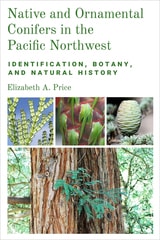
Native and Ornamental Conifers in the Pacific Northwest
Identification, Botany and Natural HistoryElizabeth A. Price
Oregon State University Press, 2022
Based on her experiences teaching workshops on conifer identification and cultivation, Elizabeth Price has developed Jargon-free photographic charts, which allow for side-by-side comparison of conifer features and guide the reader to species identification. The charts are detailed enough for specialists yet accessible to amateurs.
The book includes extensive material on the characteristics, botany, and natural history of conifer plant families, genera, and species, all illustrated with original photographs. Research across many disciplines is blended with direct observation and personal experience, creating a book that goes beyond identification and is both rigorous and engaging.
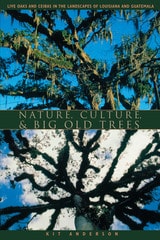
Nature, Culture, and Big Old Trees
Live Oaks and Ceibas in the Landscapes of Louisiana and GuatemalaBy Kit Anderson
University of Texas Press, 2004
Big old trees inspire our respect and even affection. The poet Walt Whitman celebrated a Louisiana live oak that was solitary "in a wide flat space, / Uttering joyous leaves all its life without a friend a lover near." Groves and alleys of live oaks remain as distinctive landscape features on Louisiana's antebellum plantations, while massive individuals still cast their shade over churches, graveyards, parks, and roads. Cajuns have adopted the "Evangeline Oak" as one of their symbols. And the attachment that Louisianians feel for live oaks is equaled by that of Guatemalans for ceibas, the national tree of Guatemala. Long before Europeans came to the Americas, the ceiba, tallest of all native species, was the Mayan world tree, the center of the universe. Today, many ceibas remain as centers of Guatemalan towns, spreading their branches over the central plaza and marketplace.
In this compelling book, Kit Anderson creates a vibrant portrait of the relationship between people and trees in Louisiana and Guatemala. Traveling in both regions, she examined and photographed many old live oaks and ceibas and collected the stories and symbolism that have grown up around them. She describes who planted the trees and why, how the trees have survived through many human generations, and the rich meanings they hold for people today. Anderson also recounts the natural history of live oaks and ceibas to show what human use of the landscape has meant for the trees. This broad perspective, blending cultural geography and natural history, adds a new dimension to our understanding of how big old trees and the places they help create become deeply meaningful, even sacred, for human beings.
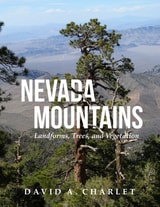
Nevada Mountains
Landforms, Trees, and VegetationDavid Alan Charlet
University of Utah Press, 2020
Divided into three parts, the book presents a simple system recognizing the primary landscape features of Nevada. Part I describes the methods used to define the boundaries of the ranges and divides the state into meaningful landforms. Part II describes the ecological life zones and their vegetation types. Part III describes the individual mountain ranges. Each mountain range entry contains a descriptive narrative and a data summary that includes the county or counties in which the range occurs, whether the author has visited and collected plants there, the highest point, the base elevation, a brief discussion of the geology, any historic settlements or post offices located in the range, the distribution of life zones, and a list of all conifers and flowering trees.
The result of over thirty years of exploration and study throughout the state, this is a long-overdue compendium of Nevada’s mountains and associated flora. This book is a required reference for anyone venturing out into the Nevada wilds.
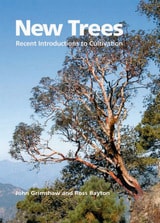
New Trees
Recent Introductions to CultivationJohn Grimshaw and Ross Bayton
Royal Botanic Gardens, Kew, 2009
This comprehensive volume, commissioned by the International Dendrology Society, covers more than eight hundred tree species that have been introduced to cultivation in the United Kingdom, Europe, and North America in recent decades. Up until now there has been no comparable source of information. Featuring horticultural notes from a network of growers and enthusiasts, backed up by data from recent scientific studies, the book presents a remarkable amount of information in a fashion accessible to amateurs as well as specialists. More than one hundred line drawings and nearly six hundred photographs—many portraying rarely seen trees—offer aids to identification. Introductory chapters covering conservation and modern techniques of tree-growing, and a comprehensive glossary and bibliography, round out the volume and make New Trees incomparable—and indispensable.
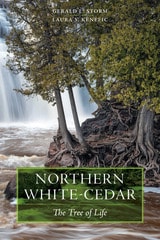
Northern White-Cedar
The Tree of LifeGerald L. Storm
Michigan State University Press, 2022