Results by title
2285 books match the query 'Women' and 46 start with n
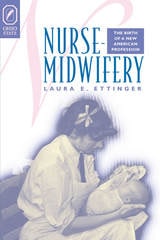
NURSE-MIDWIFERY
THE BIRTH OF A NEW AMERICAN PROFESSIONLaura E. Ettinger
The Ohio State University Press, 2006
Today, nurse-midwives have assumed a larger role in mainstream health care than before, yet they are still marginalized. As in the past, nurse-midwives’ futures will depend on continuing changes in American attitudes about childbirth, health care, and women professionals as well as on their own ability to adapt to the changes. The history of the profession suggests that nurse-midwives will continue to navigate in difficult waters in a middle space between the mainstream and the margins of medicine and between the nursing profession and midwifery traditions.
Naked Agency
Genital Cursing and Biopolitics in AfricaNaminata Diabate
Duke University Press, 2020
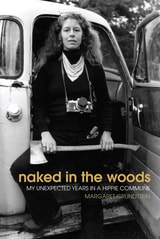
Naked in the Woods
My Unexpected Years in a Hippie CommuneMargaret Grundstein
Oregon State University Press, 2015
Naked in the Woods chronicles Grundstein’s shift from reluctant hippie to committed utopian—sacrificing phones, electricity, and running water to live on 160 acres of remote forest with nothing but a drafty cabin and each other. Grundstein, (whose husband left, seduced by “freer love”) faced tough choices. Could she make it as a single woman in man’s country? Did she still want to? How committed was she to her new life? Although she reveled in the shared transcendence of communal life deep in the natural world, disillusionment slowly eroded the dream. Brotherhood frayed when food became scarce. Rifts formed over land ownership. Dogma and reality clashed.
Many people, baby boomers and millennials alike, have romantic notions about the 1960s and 70s. Grundstein’s vivid account offers an unflinching, authentic portrait of this iconic and often misreported time in American history. Accompanied by a collection of distinctive photographs she took at the time, Naked in the Woods draws readers into a period of convulsive social change and raises timeless questions: how far must we venture to find the meaning we seek, and is it ever far out enough to escape our ingrained human nature?
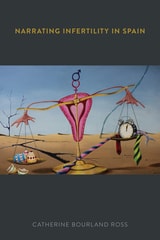
Narrating Infertility in Spain
Catherine Bourland Ross
Bucknell University Press, 2026
The drop in Spanish birth rates in 1998 to their lowest level of 1.1 births per woman was accompanied by a boom in publishing about motherhood. New narrative forms, ranging from blogs to diaries to comics, expressed women’s experiences, including ambivalence about motherhood in the face of societal pressures. Narrating Infertility in Spain, the first study of infertility in post-2008 female-authored texts, analyzes discussions of adoption, assisted reproduction, egg and sperm donation, and the decision not to have children due to economic or social instability. By examining the work of writers and vocal activists Silvia Nanclares, Raquel Sánchez-Silva, Samanta Villar, Laura Freixas, and Diana López Varela, Ross situates infertility in Spain within the cultural context of the Great Recession, while considering it as a business, a crisis, a stigma, and a class issue, and offering broader understandings of contemporary fertility challenges in Spain and beyond.
Published by Bucknell University Press. Distributed worldwide by Rutgers University Press.
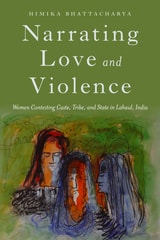
Narrating Love and Violence
Women Contesting Caste, Tribe, and State in Lahaul, IndiaBhattacharya, Himika
Rutgers University Press, 2017
The women in this book tell their stories through love, articulated as rejection, redefinition and reproduction of notions of violence and solidarity. Himika Bhattacharya centers the women’s narratives as a site of knowledge—beyond love and beyond violence. This book shows how women on the margins of tribe and caste know both, love and violence, as agents wishing to re-shape discourses of caste, tribe and community.
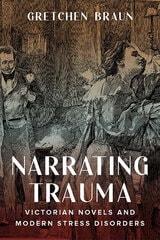
Narrating Trauma
Victorian Novels and Modern Stress DisordersGretchen Braun
The Ohio State University Press, 2022
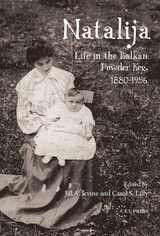
Natalija
Life in the Balkan Powder Keg, 1880-1956Natalija Matic-Zrnic
Central European University Press, 2009
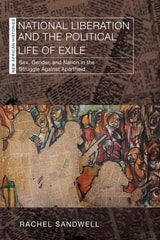
National Liberation and the Political Life of Exile
Sex, Gender, and Nation in the Struggle Against ApartheidRachel Sandwell
Ohio University Press, 2025
The first book-length study to reveal how women in exile shaped South Africa’s antiapartheid movement
This groundbreaking book explores the often-overlooked role of women in South Africa’s liberation movements, particularly within the African National Congress during its years in exile from 1960 to 1990. It examines how transformations in gender roles—though contested—were central to imagining a postapartheid South Africa.
Through an analysis of women’s diplomatic work and their advocacy for policies on sexual education, birth control, family life, and childcare, Rachel Sandwell challenges traditional narratives that have ignored or minimized women’s contributions. She highlights how South African women played a crucial role in connecting exiles to left-wing international organizations like the Women’s International Democratic Federation, positioning women as key figures in global anticolonial politics.
The book also explores how gender transformation was at the heart of the exiled antiapartheid movement’s vision for a free South Africa. Women fought for recognition beyond the role of “mothers of the nation,” sparking internal debates over revolutionary morality, the compatibility of motherhood with military service, and responses to sexual and domestic violence within the movement. These struggles mirrored broader ideological conflicts over nation building, belonging, and political identity as the African National Congress sought legitimacy as a government-in-exile.
Ultimately, National Liberation and the Political Life of Exile asks how we write histories of revolutionary movements—especially those that, despite their transformative ambitions, did not fully realize their goals. A vital contribution to feminist history, anticolonial studies, and the history of global liberation struggles, this book reshapes our understanding of gender and politics in the antiapartheid movement.
Natural Allies
Women's Associations in American HistoryAnne Firor Scott
University of Illinois Press, 1991
Negotiating Boundaries of Southern Womanhood
Dealing with the Powers That BeEdited & Intro by Janet L. Coryell, Thomas Appleton, Anastatia Sims, & Sandra Treadway
University of Missouri Press, 2000
In a time when most Americans never questioned the premise that women should be subordinate to men, and in a place where only white men enjoyed fully the rights and privileges of citizenship, many women learned how to negotiate societal boundaries and to claim a share of power for themselves in a male-dominated world.
Covering the early nineteenth through the early twentieth centuries, Negotiating Boundaries of Southern Womanhood describes the ways southern women found to advance their development and independence and establish their own identities in the context of a society that restricted their opportunities and personal freedom.
They confronted, cooperated with, and sometimes were co-opted by existing powers: the white and African American elite whose status was determined by wealth, family name, gender, race, skin color, or combinations thereof. Some women took action against established powers and, in so doing, strengthened their own communities; some bowed to the powers and went along to get along; some became the powers, using status to ensure their prosperity as well as their survival. All chose their actions based on the time and place in which they lived.
In these thought-provoking essays, the authors illustrate the complex intersections of race, class, and gender as they examine the ways in which southern women dealt with "the powers that be" and, in some instances, became those powers. Elitism, status, and class were always filtered through a prism of race and gender in the South, and women of both races played an important role in maintaining as well as challenging the hierarchies that existed.
Negotiating Pharmaceutical Uncertainty
Women's Agency in a South African HIV Prevention TrialEirik Saethre
Vanderbilt University Press, 2017
As embedded anthropologists, Saethre and Stadler provide a unique and nuanced perspective of the reality of a clinical trial that is often hidden from view.
Negotiating Power and Privilege
Career Igbo Women in Contemporary NigeriaPhilomina E. Okeke-Ihejirika
Ohio University Press, 2004
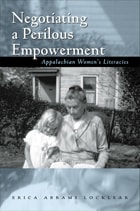
Negotiating a Perilous Empowerment
Appalachian Women’s LiteraciesErica Abrams Locklear
Ohio University Press, 2011
In many parts of Appalachia, family ties run deep, constituting an important part of an individual’s sense of self. In some cases, when Appalachian learners seek new forms of knowledge, those family ties can be challenged by the accusation that they have gotten above their raisings, a charge that can have a lasting impact on family and community acceptance. Those who advocate literacy sometimes ignore an important fact — although empowering, newly acquired literacies can create identity conflicts for learners, especially Appalachian women. In Negotiating a Perilous Empowerment, Erica Abrams Locklear explores these literacy-initiated conflicts, analyzing how authors from the region portray them in their fiction and creative nonfiction.
Abrams Locklear blends literacy studies with literary criticism to analyze the central female characters in the works of Harriette Simpson Arnow, Linda Scott DeRosier, Denise Giardina, and Lee Smith. She shows how these authors deftly overturn stereotypes of an illiterate Appalachia by creating highly literate characters, women who not only cherish the power of words but also push the boundaries of what literacy means.
Negotiating a Perilous Empowerment includes in-depth interviews with Linda Scott DeRosier and Lee Smith, making this an insightful study of an important literary genre.
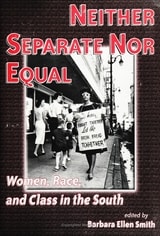
Neither Separate Nor Equal
edited by Barbara Ellen Smith
Temple University Press, 1999
Collecting in one volume the work of such well-known scholars on Appalachia and the South as Carl Stack, Mab Segrest, and Sally Maggard, among others, Neither Separate Nor Equal analyzes the complex and dramatic developments in the lives of contemporary Southern women. Case studies vividly portray women's diverse circumstances activities: from rural African American women in the Mississippi Delta taking on new roles as community builders to female textile workers in North Carolina contending with automation and reorganization of the mills.
Focusing on the South's historical legacies as they are manifested and contested in the lives of women today, including the tensions between long-lasting patterns of regional distinctiveness and the disruptions of globalizations, this collection approaches differences of race and class not as forms of separation among women, but as social -- be they often contentious, difficult, or exploitive -- relationships. Unifying around a theme of relationally, Neither Separate Nor Equal offers searching empirical studies of Southern women and a conceptual model for feminist scholarship as a whole.
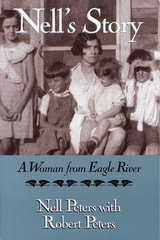
Nell's Story
A Woman from Eagle RiverNell Peters, with Robert Peters
University of Wisconsin Press, 1995
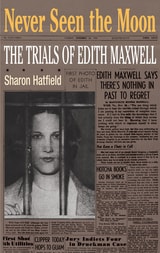
Never Seen the Moon
THE TRIALS OF EDITH MAXWELLSharon Hatfield
University of Illinois Press, 2004
Immediately granted celebrity status by the powerful Hearst press, Maxwell was also championed as a martyr by advocates of women's causes. National news magazines and even detective magazines picked up her story, Warner Brothers created a screen version, and Eleanor Roosevelt helped secure her early release from prison. Sharon Hatfield's brilliant telling of this true-crime story transforms a dusty piece of history into a vibrant thriller. Throughout the narrative, she discusses yellow journalism, the inequities of the jury system, class and gender tensions in a developing region, and a woman's right to defend herself from family violence.
New Media Futures
The Rise of Women in the Digital ArtsEdited by Donna J. Cox, Ellen Sandor, and Janine Fron
University of Illinois Press, 2018
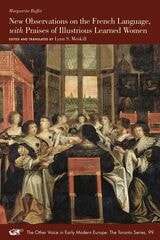
New Observations on the French Language, with Praises of Illustrious Learned Women
Marguerite Buffet
Iter Press, 2023
According to the few historical records that mention Marguerite Buffet, she lived her entire life in seventeenth-century Paris where she taught French to aristocratic women. Buffet’s vivid example of proper language use in New Observations on the French Language offers a rare glimpse into the life, habits, and culture of seventeenth-century France. She describes common errors in contemporary language use and gives examples of correct expressions for speaking and writing all the while encouraging women to aspire to higher levels of intellectual achievement.
In addition, her Praises of Illustrious Learned Women, a catalog of biographies of women who displayed exemplary intellect, wit, and conversation, includes a number of the author’s contemporaries such as Anna Maria van Schurman and Madeleine de Scudéry. Buffet’s collected praises of these women, many of whom were connected to the court of Louis XIV, show her unique position as both a participant in and historian of the intellectual and social world of the French salon.
This volume presents Buffet’s work in its near entirety for the first time in English, bringing to light Buffet’s unique contribution to the centuries-long debate concerning the status of women known as the querelle des femmes.
New Perspectives on Environmental Justice
Gender, Sexuality, and ActivismStein, Rachel
Rutgers University Press, 2004
Women make up the vast majority of activists and organizers of grassroots movements fighting against environmental ills that threaten poor and people of color communities. New Perspectives on Environmental Justice is the first collection of essays that pays tribute to the enormous contributions women have made in these endeavors.
The writers offer varied examples of environmental justice issues such as children's environmental health campaigns, cancer research, AIDS/HIV activism, the Environmental Genome Project, and popular culture, among many others. Each one focuses on gender and sexuality as crucial factors in women's or gay men's activism and applies environmental justice principles to related struggles for sexual justice. The contributors represent a wide variety of activist and scholarly perspectives including law, environmental studies, sociology, political science, history, medical anthropology, American studies, English, African and African American studies, women's studies, and gay and lesbian studies, offering multiple vantage points on gender, sexuality, and activism.
Feminist/womanist impulses shape and sustain environmental justice movements around the world, making an understanding of gender roles and differences crucial for the success of these efforts.
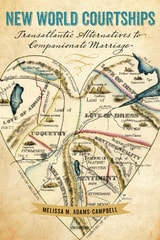
New World Courtships
Transatlantic Alternatives to Companionate MarriageMelissa M. Adams-Campbell
Dartmouth College Press, 2015
Newly Born Woman
Helene Cixous
University of Minnesota Press, 1986
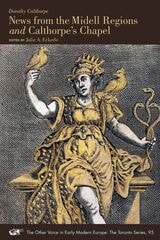
News from the Midell Regions and Calthorpe’s Chapel
Dorothy Calthorpe
Iter Press, 2022
This first print edition of two extant manuscripts by Dorothy Calthorpe (1648–1693) introduces a new seventeenth-century woman writer to the growing canon of early modern female authors. The edition provides transcriptions of the manuscripts and Calthorpe’s will, as well as a hefty apparatus that features a comprehensive introduction to Calthorpe, her family, and her work; a glossary of persons who figured in her writing and her life; and two genealogical charts. Calthorpe’s writings (including both prose and verse and ranging from Petrarchan love poems to roman à clef and devotional verse), and the thoughtfully constructed and illustrated volumes in which her texts appear, demonstrate the rich intellectual life of a previously unknown female writer and provide a compelling example of Restoration manuscript production.
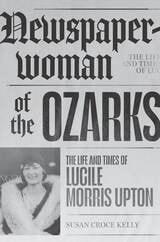
Newspaperwoman of the Ozarks
The Life and Times of Lucile Morris UptonSusan Croce Kelly
University of Arkansas Press, 2023
Lucile Morris Upton landed her first newspaper job out West in the early 1920s, then returned home to spend half a century reporting on the Ozarks world she knew best. Having come of age just as women gained the right to vote, she took advantage of opportunities that presented themselves in a changing world. During her years as a journalist, Upton rubbed shoulders with presidents, flew with aviation pioneer Wiley Post, covered the worst single killing of US police officers in the twentieth century, wrote an acclaimed book on the vigilante group known as the Bald Knobbers, charted the growth of tourism in the Ozarks, and spearheaded a movement to preserve iconic sites of regional history. Following retirement from her newspaper job, she put her experience to good use as a member of the Springfield City Council and community activist.
Told largely through Upton’s own words, this insightful biography captures the excitement of being on the front lines of newsgathering in the days when the whole world depended on newspapers to find out what was happening.
Winner, 2024 Missouri Literary Award
First Place, 2024 Missouri Professional Communicators Communications Contest
Finalist, Society of Midland Authors Book Award
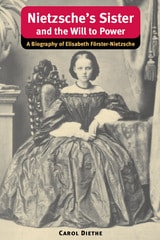
Nietzsche's Sister and the Will to Power
A Biography of Elisabeth Förster-NietzscheCarol Diethe
University of Illinois Press, 2002
In 1901, a year after her brother Friedrich's death, Elisabeth Förster-Nietzsche published The Will to Power, a hasty compilation of writings he had never intended for print. In Nietzsche's Sister and the Will to Power, Carol Diethe contends that Förster-Nietzsche's own will to power and her desire to place herself--not her brother--at the center of cultural life in Germany are centrally responsible for Nietzsche's reputation as a belligerent and proto-Fascist thinker.
Offering a new look at Nietzsche's sister from a feminist perspective, this spirited and erudite biography examines why Elisabeth Förster-Nietzsche recklessly consorted with anti-Semites, from her own husband to Hitler himself, out of convenience and a desire for revenge against a brother whose love for her waned after she caused the collapse of his friendship with Lou Salomé. The book also examines their family dynamics, Nietzsche's dismissal of his sister's early writing career, and the effects of limited education on intelligent women. Diethe concludes by detailing Förster-Nietzsche's brief marriage and her subsequent colonial venture in Paraguay, maintaining that her sporadic anti-Semitism was, like most things in her life, an expedient tool for cultivating personal success and status.
A volume in the series International Nietzsche Studies, edited by Richard Schacht
Nine Months Is a Year
At Baboquívari SchoolEulalia Bourne
University of Arizona Press, 1968
Niobes
Antiquity, Modernity, Critical TheoryEdited by Mario Telò and Andrew Benjamin
The Ohio State University Press, 2024
No Alternative
Childbirth, Citizenship, and Indigenous Culture in MexicoBy Rosalynn A. Vega
University of Texas Press, 2018
Recent anthropological scholarship on “new midwifery” centers on how professional midwives in various countries are helping women reconnect with “nature,” teaching them to trust in their bodies, respecting women’s “choices,” and fighting for women’s right to birth as naturally as possible. In No Alternative, Rosalynn A. Vega uses ethnographic accounts of natural birth practices in Mexico to complicate these narratives about new midwifery and illuminate larger questions of female empowerment, citizenship, and the commodification of indigenous culture, by showing how alternative birth actually reinscribes traditional racial and gender hierarchies.
Vega contrasts the vastly different birthing experiences of upper-class and indigenous Mexican women. Upper-class women often travel to birthing centers to be delivered by professional midwives whose methods are adopted from and represented as indigenous culture, while indigenous women from those same cultures are often forced by lack of resources to use government hospitals regardless of their preferred birthing method. Vega demonstrates that women’s empowerment, having a “choice,” is a privilege of those capable of paying for private medical services—albeit a dubious privilege, as it puts the burden of correctly producing future members of society on women’s shoulders. Vega’s research thus also reveals the limits of citizenship in a neoliberal world, as indigeneity becomes an object of consumption within a transnational racialized economy.
No Hand Held Mine
Stories — "Granny Wild Goose" and "The Root's Tale"Kim Soom
Rutgers University Press, 2026
An elderly Korean woman talking about being forced into sexual slavery during World War II. A modern Korean woman extricating herself from a failing relationship with an artist. Award-winning South Korean writer Kim Soom presents us with portraits of two women who couldn’t be more different but who both show resilience and compassion. No Hand Held Mine: Stories, containing one non-fiction piece and one short story, demonstrates the power and breadth of Kim’s writing. “Granny Wild Goose” uses former Comfort Woman Gil Won-Ok’s own words, recorded during conversations with Kim, to tell her life story of brutality, betrayal, and survival. In “The Root’s Tale,” the female protagonist comes to understand the strength of solitary women. Both devastating and reaffirming, No Hand Held Mine shows why Kim Soom has received every major literary award in Korea. Joon-Li Kim and Doo-Sun Ryu’s sensitive translation maintains Kim’s lyricism and exquisite imagery.
This book is published with the support of The Daesan Foundation.
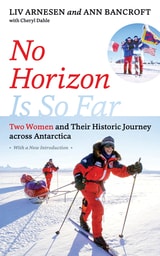
No Horizon Is So Far
Two Women and Their Historic Journey across AntarcticaLiv Arnesen
University of Minnesota Press, 2019
The extraordinary story of the first two women to cross Antarctica
The fascinating chronicle of Liv Arnesen and Ann Bancroft’s dramatic journey as the first two women to cross Antarctica, No Horizon Is So Far follows the explorers from the planning of their expedition through their brutal trek from the Norwegian sector all the way to McMurdo Station as they walked, skied, and ice-sailed for almost three months in temperatures reaching as low as -35°F, all while towing their 250-pound supply sledges across 1,700 miles of ice full of dangerous crevasses. Through website transmissions and satellite phone calls, Ann and Liv, two former schoolteachers, were able to broadcast their expedition to more than three million students in sixty-five countries to teach geography, science, and the importance of following your dreams.

No Longer Patient
Feminist Ethics and Health CareSusan Sherwin
Temple University Press, 1992

No Mexicans, Women, or Dogs Allowed
The Rise of the Mexican American Civil Rights MovementBy Cynthia E. Orozco
University of Texas Press, 2009
Founded by Mexican American men in 1929, the League of United Latin-American Citizens (LULAC) has usually been judged according to Chicano nationalist standards of the late 1960s and 1970s. Drawing on extensive archival research, including the personal papers of Alonso S. Perales and Adela Sloss-Vento, No Mexicans, Women, or Dogs Allowed presents the history of LULAC in a new light, restoring its early twentieth-century context.
Cynthia Orozco also provides evidence that perceptions of LULAC as a petite bourgeoisie, assimilationist, conservative, anti-Mexican, anti-working class organization belie the realities of the group's early activism. Supplemented by oral history, this sweeping study probes LULAC's predecessors, such as the Order Sons of America, blending historiography and cultural studies. Against a backdrop of the Mexican Revolution, World War I, gender discrimination, and racial segregation, No Mexicans, Women, or Dogs Allowed recasts LULAC at the forefront of civil rights movements in America.

No More Patients
A NovelSandra Cavallo Miller
University of Nevada Press, 2026
Once a free spirit, Vivian celebrated at Woodstock in her thirties and Burning Man in her eighties. Now she spends her time feuding with Marianne Dunwitty, her new rival from the Scrabble Klub. To help resolve her identity crisis, Vivian begins recording reflections on her life, revealing a deep despair that drives her to take on the Klub members, scorn the new cloud-watching man next door, and snoop into a suspected neighborhood homicide.
Norah and Vivian must find ways to deal with their out-of-balance lives, and—most importantly—each other. Picking up where Out of Patients left off, No More Patients is a heartfelt, humorous sequel that stands on its own, about the struggles of healing both patients and relationships alike.

No More Patients
A NovelSandra Cavallo Miller
University of Nevada Press, 2026
Once a free spirit, Vivian celebrated at Woodstock in her thirties and Burning Man in her eighties. Now she spends her time feuding with Marianne Dunwitty, her new rival from the Scrabble Klub. To help resolve her identity crisis, Vivian begins recording reflections on her life, revealing a deep despair that drives her to take on the Klub members, scorn the new cloud-watching man next door, and snoop into a suspected neighborhood homicide.
Norah and Vivian must find ways to deal with their out-of-balance lives, and—most importantly—each other. Picking up where Out of Patients left off, No More Patients is a heartfelt, humorous sequel that stands on its own, about the struggles of healing both patients and relationships alike.
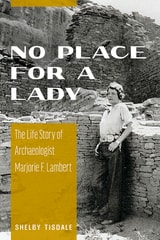
No Place for a Lady
The Life Story of Archaeologist Marjorie F. LambertShelby Tisdale
University of Arizona Press, 2023
In this delightful biography, we gain insight into a time when there were few women establishing full-time careers in anthropology, archaeology, or museums. Shelby Tisdale successfully combines Lambert’s voice from extensive interviews with her own to take us on a thought-provoking journey into how Lambert created a successful and satisfying professional career and personal life in a place she loved (the American Southwest) while doing what she loved.
Through Lambert’s life story we gain new insight into the intricacies and politics involved in the development of archaeology and museums in New Mexico and the greater Southwest. We also learn about the obstacles that young women had to maneuver around in the early years of the development of southwestern archaeology as a profession. Tisdale brings into focus one of the long-neglected voices of women in the intellectual history of anthropology and archaeology and highlights how gender roles played out in the past in determining the career paths of young women. She also highlights what has changed and what has not in the twenty-first century.
Women’s voices have long been absent throughout history, and Marjorie Lambert’s story adds to the growing literature on feminist archaeology.
No Stars in Jefferson Park
A MemoirMaggie Andersen
Northwestern University Press, 2026
A Chicagoan’s coming-of-age memoir finds courage in the face of immense loss
In her early twenties, Maggie Andersen was a founding ensemble member of Chicago’s storied Gift Theatre with her then-boyfriend, Michael Patrick Thornton. But after a series of spinal strokes left Thornton paralyzed, Andersen made the heart-wrenching decision to leave him, along with their growing company and, later, her beloved city. No Stars in Jefferson Park alternates between two narratives: the energy and excitement of making art in Chicago’s thriving storefront theater scene and the devastating day-to-day realities of rehabilitation and rebuilding—and somewhere in the middle finding the courage to choose yourself.
Over the past twenty-plus years, the Gift—now performing in the working-class neighborhood of Portage Park—has become one of the most vital storefront theaters in Chicago, with Thornton’s career taking him to Hollywood and Broadway. But Andersen’s story has brought her back home. No Stars in Jefferson Park is a testament to lifelong friendship, a love letter to Chicago, and a profound coming-of-age story about the pain and necessity of putting yourself first.
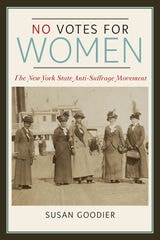
No Votes for Women
The New York State Anti-Suffrage MovementSusan Goodier
University of Illinois Press, 2013
Not June Cleaver
Women and Gender in Postwar America, 1945-1960June Meyerowitz
Temple University Press, 1994
Not Just a Housewife
Women Strike for Peace and the Cold War Women's Peace MovementJon Coburn
University of Massachusetts Press, 2025
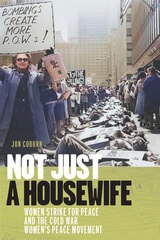
On November 1, 1961, thousands of middle-class white women took to the streets throughout the United States to demonstrate against atomic weapons. They were brought together by the group Women Strike for Peace (WSP), which grew from modest beginnings at a Georgetown cocktail party to become one of the most effective peace organizations in American history. Under the stewardship of children’s book illustrator Dagmar Wilson, and with indispensable support from figures such as Bella Abzug, a lawyer who would later help found the National Women’s Political Caucus and serve as US Representative for New York, WSP branches spread to cities and towns across the country, and the group influenced major arms-control treaties and successful antiwar efforts of the Cold War period. Single-handedly, WSP dismantled the McCarthyite House Un-American Activities Committee (HUAC), catalysed public support for the 1963 Nuclear Weapons Test Ban Treaty, and brokered unprecedented exchanges between American and Vietnamese women during the American War in Vietnam. WSP accomplished their political wins , in part, through a public image that stressed the inherent moral authority and sanctity of motherhood.
In Not Just a Housewife, Jon Coburn explores the fascinating story of WSP to argue that the group’s historic significance was much more complex than the maternal activism for which it is often remembered. He traces activists’ evolution through the Cold War’s cultural upheavals, uncovering the significance of forgotten episodes, such as the extraordinary self-immolation of 82-year-old Detroit activist Alice Herz and WSP’s unheralded contributions to the 1977 National Women’s Conference. In so doing, Coburn recovers WSP’s revolutionary politics and militant protests and contends that the organization fused this radical activism with the seeming respectability of motherhood. Through unprecedented access to organizational archives and oral histories, Not Just a Housewife details how WSP’s unique fusion of radicalism and respectability significantly shaped Cold War-era women’s peace movement history, as well as the broader American culture.
Not One More!
Feminicidio on the BorderNina Maria Lozano
The Ohio State University Press, 2019
Finding theories of new materialism inadequate to explain the feminicidios, Lozano critiques and extends this approach—advancing instead a new theoretical framework, border materialism, to argue that capitalist systems of neoliberalism and free trade are directly correlated to the killing of women on the US–Mexico border. Through the author’s fifteen-plus years of on-the-ground fieldwork, readers are presented with firsthand accounts, testimonies, and new social movement strategies from family members and activists attempting to stop these gendered crimes.
By offering concrete case studies—including analysis of maquiladoras/factories and free trade zones, public monuments and murals memorializing the victims, rastreos/searches by family members for victims’ DNA remains, and testimony from Mothers, family members, and activists—Not One More! lays bare the socioeconomic and geopolitical forces at work in the killing of women in Juárez.

Not at All What One Is Used To
The Life and Times of Isabella GardnerMarian Janssen
University of Missouri Press, 2026
Born in 1915 to one of New England’s elite wealthy families, Isabella Gardner was expected to follow a certain path in life—one that would take her from marriageable debutante to proper society lady. But that plan was derailed when at age eighteen, Isabella caused a drunk-driving accident. Her family, to shield her from disgrace, sent her to Europe for acting studies, not foreseeing how life abroad would fan the romantic longings and artistic impulses that would define the rest of Isabella’s years. In Not at All What One Is Used To, author Marian Janssen tells the story of this passionate, troubled woman, whose career as a poet was in constant compromise with her wayward love life and her impulsive and reckless character.
Notable Men and Women of Spanish Texas
By Donald E. Chipman and Harriett Denise Joseph
University of Texas Press, 1999
Winner, Presidio La Bahia Award, Sons of the Republic of Texas, 2000
Texas Old Missions and Forts Restoration Association Book Award, the Texas Old Missions and Fort Restoration Association and the Texas Catholic Historical Society, 2001
The Spanish colonial era in Texas (1528-1821) continues to emerge from the shadowy past with every new archaeological and historical discovery. In this book, years of archival sleuthing by Donald E. Chipman and Harriett Denise Joseph now reveal the real human beings behind the legendary figures who discovered, explored, and settled Spanish Texas.
By combining dramatic, real-life incidents, biographical sketches, and historical background, the authors bring to life these famous (and sometimes infamous) men of Spanish Texas:
- Alvar Núñez Cabeza de Vaca
- Alonso de León
- Francisco Hidalgo
- Louis Juchereau de St. Denis
- Antonio Margil
- The Marqués de Aguayo
- Pedro de Rivera
- Felipe de Rábago
- José de Escandón
- Athanase de Mézières
- The Marqués de Rubí
- Antonio Gil Ibarvo
- Domingo Cabello
- José Bernardo Gutiérrez de Lara
- Joaquín de Arredondo
The authors also devote a chapter to the women of Spanish Texas, drawing on scarce historical clues to tell the stories of both well-known and previously unknown Tejana, Indian, and African women.

Notable Women of Arkansas
From Hattie to Hillary, 100 Names to KnowNancy Hendricks
Butler Center for Arkansas Studies, 2016
Meet one Arkansas woman who was nominated for the Pulitzer Prize, Tony Award, and three Grammys. Learn about a female presidential candidate whose initials are not HRC. See beauty queens on the runway and a runaway beauty queen. Meet the trailblazing black actress who, if she had been born thirty years later, might have had a career like Halle Berry’s.
They are all Arkansas women, each with their own family, childhood, loves, losses, dreams, fears, hopes for the future, and ghosts from the past. These notable women—profiled together in one volume—have left an impressive legacy.
Nothing to Do but Stay
My Pioneer MotherCarrie Young
University of Iowa Press, 1991
Carrine Gafkjen was, as her daughter remembers, at once the most liberated and unliberated of women. If she had considered the subject at all she would have thought it a waste of time. She firmly believed in destiny; what fate planned for her she dealt with head-on.
In the early 1900s the twenty-five-year-old Gafkjen boarded a train from Minneapolis to claim a homestead for herself on the western North Dakota prairies. She lived alone in her claim shack, barred her door at night against the coyotes, existed on potatoes and salt, and walked five miles to the nearest creek to wash her clothes. A decade later she had, by her own ingenuity, doubled her landholdings and became a secure women of property. Then, at an age when most other women would have been declared spinsters, Carrine Gafkjen married Sever Berg and had six children.
Nothing to Do but Stay tells the story of this uncommon woman with warmth and good humor. It gives testimony to the lasting spirit of our pioneer heritage and, in these uncertain times, to the staying power of family and tradition. This book will appeal to all those with an interest in the settlement of the West, the history of the Great Plains, women's studies, and the perseverance of the early-twentieth-century farmers.
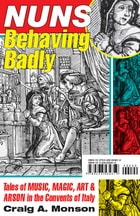
Nuns Behaving Badly
Tales of Music, Magic, Art, and Arson in the Convents of ItalyCraig A. Monson
University of Chicago Press, 2010
Witchcraft. Arson. Going AWOL. Some nuns in sixteenth- and seventeenth-century Italy strayed far from the paradigms of monastic life. Cloistered in convents, subjected to stifling hierarchy, repressed, and occasionally persecuted by their male superiors, these women circumvented authority in sometimes extraordinary ways. But tales of their transgressions have long been buried in the Vatican Secret Archive. That is, until now.
In Nuns Behaving Badly, Craig A. Monson resurrects forgotten tales and restores to life the long-silent voices of these cloistered heroines. Here we meet nuns who dared speak out about physical assault and sexual impropriety (some real, some imagined). Others were only guilty of misjudgment or defacing valuable artwork that offended their sensibilities. But what unites the women and their stories is the challenges they faced: these were women trying to find their way within the Catholicism of their day and through the strict limits it imposed on them. Monson introduces us to women who were occasionally desperate to flee cloistered life, as when an entire community conspired to torch their convent and be set free. But more often, he shows us nuns just trying to live their lives. When they were crossed—by powerful priests who claimed to know what was best for them—bad behavior could escalate from mere troublemaking to open confrontation.
In resurrecting these long-forgotten tales and trials, Monson also draws attention to the predicament of modern religious women, whose “misbehavior”—seeking ordination as priests or refusing to give up their endowments to pay for priestly wrongdoing in their own archdioceses—continues even today. The nuns of early modern Italy, Monson shows, set the standard for religious transgression in their own age—and beyond.
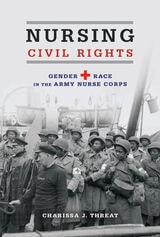
Nursing Civil Rights
Gender and Race in the Army Nurse CorpsCharissa J. Threat
University of Illinois Press, 2015
As Threat reveals, both groups viewed their circumstances with the Army Nurse Corps as a civil rights matter. Each conducted separate integration campaigns to end the discrimination they suffered. Yet their stories defy the narrative that civil rights struggles inevitably arced toward social justice. Threat tells how progressive elements in the campaigns did indeed break down barriers in both military and civilian nursing. At the same time, she follows conservative threads to portray how some of the women who succeeded as agents of change became defenders of exclusionary practices when men sought military nursing careers. The ironic result was a struggle that simultaneously confronted and reaffirmed the social hierarchies that nurtured discrimination.
Nursing Wounds
Nurse Practitioners, Doctors, Women Patients, and the Negotiation of MeaningFisher, Sue
Rutgers University Press, 1995
The rise of the nurse practitioner as a new kind of health care professional has blurred the traditional distinction between physicians and nurses. Nurse practitioners argue that they combine both the traditionally male health care delivery of the M.D. and the traditionally female caring attention of the R.N. In her previous work Sue Fisher has analyzed the difficulties that women patients have in getting doctors to listen to their medical concerns. Now she asks whether women fare any better with nurse practitioners.
Nursing Wounds takes us into the examining rooms of nurse practitioners and doctors to listen to how health care professionals and women patients communicate. The nurse practitioners, unlike the doctors, go beyond the medical problem to ask about the social context of the patients' lives. In these exchanges the doctors insist on reinforcing both their professional status and dominant cultural assumptions about women. While the nurse practitioners sometimes do this, they also distance themselves from their professional identities, respond to their patients woman to woman, and undermine traditional understandings about gender arrangements.These differences have important consequences for the delivery of health care.
This compelling and complex analysis employs a range of theoretical perspectives–-from sociolinguistic to postmodern and materialist. Fisher concludes by urging a health care policy that capitalizes on the special strengths of nurse practitioners as providers of primary care who pay real attention to what their patients are saying and who support an alternative, even oppositional, understanding of women's lives.