Results by title
141 books match the query 'World War I' and 2 start with n
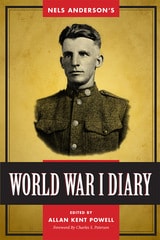
Nels Anderson’s World War I Diary
Allan Kent Powell
University of Utah Press, 2013
Nels Anderson’s World War I Diary provides a rare glimpse into the wartime experiences of one of the most well-respected sociologists of the twentieth century, the renowned author of The Hobo (1920) and Desert Saints: The Mormon Frontier in Utah (1942). Anderson, a keen observer of people, places, and events his entire life, joined the U.S. Army in 1918 at the age of 29 and was sent to Europe to fight as part of the Allied Expeditionary Force (AEF) under General Pershing. Because keeping a journal was strongly discouraged among American forces during WWI, particularly among the rank-and-file soldiers, Anderson’s diary stands as a rare gem. Furthermore, it is the only known account of war service during WWI by a member of the LDS Church. Anderson joined the Mormon faith after accepting the hospitality of an extended Mormon ranching family during his travels throughout the American West as a working hobo.
Anderson’s accounts of the St. Mihiel and Meuse-Argonne offensives are particularly remarkable given the challenges of keeping a detailed journal amidst the chaos and suffering of the war’s Western Front. His insights into the depravity and callousness of war are buttressed with intimate human portraits of those to whom he was closest. The war years provided many formative experiences that would prove to have a lasting influence on Anderson’s views regarding the working poor, authority, and human values; this would come to bear heavily on his later work as a pioneering sociologist at the University of Chicago, where he helped establish participant observation as a research method. The many introspective entries contained in this volume will be of reat interest to military historians and history buffs as well as to those in the social sciences looking to find the intellectual origins of Anderson’s later work in the burgeoning field of sociology.
Winner of the Army Historical Foundation Distinguished Writing Award for Journals, Memoirs, and Letters.
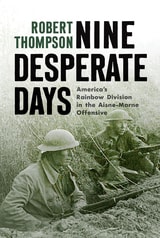
Nine Desperate Days
America's Rainbow Division in the Aisne-Marne OffensiveRobert Thompson
Westholme Publishing, 2022
American forces entered World War I combat in October 1917, but it was not until July 1918 that they went on the offensive for the first time. Among the units selected for this operation was the 42nd Division, or the “Rainbow Division” as it was known popularly. This division, which was composed of National Guard units from twenty-six states, including Joyce Kilmer’s 69th New York Infantry, would spend 164 days in combat, a number exceeded by only two other American divisions. However, it was the nine days from July 25 to August 2, 1918 that were the most terrible and heroic in the division’s history. General of the Army Douglas MacArthur, who served as the division’s chief of staff, later said of the Rainbow Division’s fighting during those pivotal days, “There was neither rest nor mercy.” During those nine days, the Rainbow Division would spearhead the Allied attack in the Aisne-Marne region, the final phase of the Second Battle of the Marne, which saw the last major German offensive on the Western Front defeated. Unfortunately, American leadership proved to be completely unprepared for a dynamic war of maneuver. Basing decisions on wildly inaccurate information about the Germans, senior commanders ordered the men of the Rainbow Division to make ill-advised assaults again and again with little support. Facing an enemy who was determined to hold itspositions, these National Guardsmen fought with courage and determination to gain what was often only yards of ground, and did so at a deadly cost.
In Nine Desperate Days: America’s Rainbow Division in the Aisne-Marne Offensive, historian Robert Thompson chronicles the hardships and tenacity of the men from the 42nd Division during this pivotal campaign. The Americans did not break despite heavy losses, and were able to drive the Germans back from territory they initially gained. The efforts of the Rainbow Division during Aisne-Marne were key to the ultimate Allied victory and are a symbol of American valor and sacrifice during the “war to end all wars.”