Results by title
2706 books match the query 'European' and 53 start with n
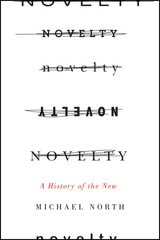
Novelty
A History of the NewMichael North
University of Chicago Press, 2013
In Novelty, Michael North takes us on a dazzling tour of more than two millennia of thinking about the problem of the new, from the puzzles of the pre-Socratics all the way up to the art world of the 1960s and ’70s. The terms of the debate, North shows, were established before Plato, and have changed very little since: novelty, philosophers argued, could only arise from either recurrence or recombination. The former, found in nature’s cycles of renewal, and the latter, seen most clearly in the workings of language, between them have accounted for nearly all the ways in which novelty has been conceived in Western history, taking in reformation, renaissance, invention, revolution, and even evolution. As he pursues this idea through centuries and across disciplines, North exhibits astonishing range, drawing on figures as diverse as Charles Darwin and Robert Smithson, Thomas Kuhn and Ezra Pound, Norbert Wiener and Andy Warhol, all of whom offer different ways of grappling with the idea of originality.
Novelty, North demonstrates, remains a central problem of contemporary science and literature—an ever-receding target that, in its complexity and evasiveness, continues to inspire and propel the modern. A heady, ambitious intellectual feast, Novelty is rich with insight, a masterpiece of perceptive synthesis.
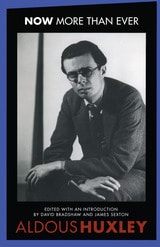
Now More Than Ever
By Aldous Huxley
University of Texas Press, 2000
Over the course of his career, British writer Aldous Huxley (1894-1963) shifted away from elitist social satires and an atheistic outlook toward greater concern for the masses and the use of religious terms and imagery. This change in Huxley's thinking underlies the previously unpublished play Now More Than Ever.
Written in 1932-1933 just after Brave New World, Now More Than Ever is a response to the social, economic, and political upheavals of its time. Huxley's protagonist is an idealistic financier whose grandiose schemes for controlling the means of production drive him to swindling and finally to suicide. His fate allows Huxley to expose the evils he perceives in free-market capitalism while pleading the case for national economic planning and the rationalization of Britain's industrial base.
This volume contains the full text of Now More Than Ever, which was believed to be lost until 1976, when a copy was found at the Harry Ransom Humanities Research Center of the University of Texas at Austin. A "thinker's play" that has never been produced on stage, it is the last previously unpublished piece of Huxley's major writings and immensely important to understanding his development as a writer. The editors of this volume have annotated the play for contemporary readers. Their introduction sets the play in the context of Huxley's intellectual life.
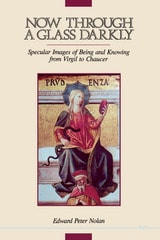
Now through a Glass Darkly
Specular Images of Being and Knowing from Virgil to ChaucerEdward Peter Nolan
University of Michigan Press, 1991
Now through a Glass Darkly brings both traditional medievalist and postmodernist approaches to bear in its attempt to understand both the powers and the limits of verbal art. Nolan explores the ways medieval writers and their Roman predecessors used formal and thematic mirrors to examine the implications of alterity in the face of similarity, arguing that these preoccupations were as central to the medieval sensibility as they are to our own. Now through a Glass Darkly frames several of the key issues in the current debate over the continued viability (or not) of the inherited canon of Western culture, such as the question whether there is any meaning at all to be rescued from such notions as “coherence” or “tradition” in Western literature.
Now through a Glass Darkly will appeal to the educated generalist interested in the relationships between literature and its surrounding intellectual and cultural contexts as well as to those more specifically interested in medieval poetry and poetics. For medievalists and those who work at the intersection of critical theory and medieval literature, Now through a Glass Darkly will be of critical importance.