Results by title
18284 books match the query 'United States' and 397 start with n
Necro Citizenship
Death, Eroticism, and the Public Sphere in the Nineteenth-Century United StatesRuss Castronovo
Duke University Press, 2001
Moving from medical engravings, séances, and clairvoyant communication to Supreme Court decisions, popular literature, and physiological tracts, Necro Citizenship explores how rituals of inclusion and belonging have generated alienation and dispossession. Castronovo contends that citizenship does violence to bodies, especially those of blacks, women, and workers. “Necro ideology,” he argues, supplied citizens with the means to think about slavery, economic powerlessness, or social injustice as eternal questions, beyond the scope of politics or critique. By obsessing on sleepwalkers, drowned women, and other corpses, necro ideology fostered a collective demand for an abstract even antidemocratic sense of freedom. Examining issues involving the occult, white sexuality, ghosts, and suicide in conjunction with readings of Harriet Jacobs, Ralph Waldo Emerson, Frederick Douglass, Nathaniel Hawthorne, and Frances Harper, Necro Citizenship successfully demonstrates why Patrick Henry's “give me liberty or give me death” has resonated so strongly in the American imagination.
Negative Liberties
Morrison, Pynchon, and the Problem of Liberal IdeologyCyrus R. K. Patell
Duke University Press, 2001
Pynchon and Morrison reveal the official narrative of individualism as encompassing a complex structure of contradiction held in abeyance. This narrative imagines that the goals of the individual are not at odds with the goals of the family or society and in fact obscures the existence of an unholy truce between individual liberty and forms of oppression. By bringing these two fiction writers into a discourse dominated by Ralph Waldo Emerson, Isaiah Berlin, John Rawls, George Kateb, Robert Bellah, and Michael Sandel, Patell unmasks the ways in which contemporary U.S. culture has not fully shed the oppressive patterns of reasoning handed down by the slaveholding culture from which American individualism emerged.
With its interdisciplinary approach, Negative Liberties will appeal to students and scholars of American literature, culture, sociology, and politics.
Negative Liberty
Public Opinion and the Terrorist Attacks on AmericaDarren W. Davis
Russell Sage Foundation, 2007
Neglected Policies
Constitutional Law and Legal Commentary as Civic EducationIra L. Strauber
Duke University Press, 2002
Strauber situates agnostic skepticism within contemporary legal thought, explaining how it draws upon sociological jurisprudence, legal realism, and critical legal studies. Through studies of cases involving pornography, adoption custody battles, flag burning, federalism, and environmental politics, he demonstrates how agnostic skepticism applies to constitutional issues. Strauber contends that training in skeptical critique will enable a new kind of civic education and culture—one in which citizens are increasingly tolerant of the ambiguities and contradictions inherent in the law and politics of a pluralistic society.
Using insights from the social sciences to examine the ways constitutional cases are studied and taught, Neglected Policies will interest scholars of jurisprudence, political science, and the sociology of law.
Negotiated Care
The Experience of Family Day Care ProvidersMargaret K. Nelson
Temple University Press, 1991
Weaving together numerous richly detailed interviews and surveys with recent feminist literature on the role of caregiving in women’s lives and investigations of women’s involvement in home-based work, this book explores the daily lives of family day care providers. Margaret K. Nelson uncovers the dilemmas providers face in their relationships with parents who bring children to them, with the children themselves, with the providers’ family members, and with representatives of the state’s regulatory system. She links these dilemmas to the contradiction between an increasing demand for personalized, cheap, informal child care services and a public policy that subjects child care providers to public scrutiny while giving them limited material and ideological support.
Nelson’s discussions with day care providers reveal considerable tensions that emerge over issues of control and intimacy. The dual motivation of business and family gives rise to problems, such as how to maintain enough distance from the parents to set limits on hours while providing personal service in a family setting. Family day care providers often enter this occupation as a way to engage in paid work and meet their own child care responsibilities. This book looks at how they manage to negotiate a setting that simultaneously involves money, trust, and caring.
Family day care represents one of the most prevalent sources of child care for working parents. It is an especially common form of care for very young children, yet it remains little studied. In the popular press, stereotypes—many of them negative—prevail. This book substitutes a thorough, detailed examination of this child care setting from a perspective that has generally been ignored-that of the caregiver. While providing useful insights into the role of caregiving in women’s lives and the phenomenon of home-based work, it contributes to the ongoing policy debates about child care.
In the series Women in the Political Economy, edited by Ronnie J. Steinberg.
Negotiated Reform
The Multilevel Governance of Financial RegulationEdited by Renate Mayntz
Campus Verlag, 2016
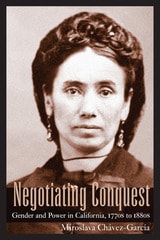
Negotiating Conquest
Gender and Power in California, 1770s to 1880sMiroslava Chávez-García
University of Arizona Press, 2004
Negotiating Conquest begins with an examination of how gender and ethnicity shaped the policies and practices of the Spanish conquest, showing that Hispanic women, marriage, and the family played a central role in producing a stable society on Mexico’s northernmost frontier. It then examines how gender, law, property, and ethnicity shaped social and class relations among Mexicans and native peoples, focusing particularly on how women dealt with the gender-, class-, and ethnic-based hierarchies that gave Mexican men patriarchal authority. With the American takeover in 1846, the text’s focus shifts to how the imposition of foreign legal, economic, linguistic, and cultural norms affected the status of Mexican women, male-female relations, and the family. Addressing such issues as divorce, legitimacy, and inheritance, it describes the manner in which the conquest weakened the economic position of both Mexican women and men while at the same time increasing the leverage of Mexican women in their personal and social relationships with men.
Drawing on archival materials—including dozens of legal cases—that have been largely ignored by other scholars, Chávez-García examines federal, state, and municipal laws across many periods in order to reveal how women used changing laws, institutions, and norms governing property, marriage and sexuality, and family relations to assert and protect their rights. By showing that mexicanas contested the limits of male rule and insisted that patriarchal relationships be based on reciprocity, Negotiating Conquest expands our knowledge of how patriarchy functioned and evolved as it reveals the ways in which conquest can transform social relationships in both family and community.
Negotiating Difference
Race, Gender, and the Politics of PositionalityMichael Awkward
University of Chicago Press, 1995
From Spike Lee's She's Gotta Have It to Michael Jackson's physical transmutations, from Toni Morrison's Song of Solomon to August Wilson's Fences, from male scholars' investments in feminism to white scholars' in black texts—Awkward explores cultural moments that challenge the exclusive critical authority of race and gender. In each instance he confronts the question: What do artists, scholars, and others concerned with representations of Afro-American life make of the view that gender, race, and sexuality circumscribe their own and others' lives and narratives? Throughout he demonstrates the perils and merits of the sort of "boundary crossing" this book ultimately makes: a black male feminism.
In pursuing a black male feminist criticism, Awkward's study acknowledges the complexities of interpretation in an age when a variety of powerful discourses have proliferated on the subject of racial, gendered, and sexual difference; at the same time, it identifies this proliferation as an opportunity to negotiate seemingly fixed cultural and critical positions.
Negotiating Disability
Disclosure and Higher EducationStephanie L. Kerschbaum, Laura T. Eisenman, and James M. Jones, Editors
University of Michigan Press, 2017
Negotiating Latinidad
Intralatina/o Lives in ChicagoFrances R. Aparicio
University of Illinois Press, 2019
Negotiating Relief
The Development of Social Welfare Programs in Depression-Era Michigan, 1930–1940Susan Stein-Roggenbuck
The Ohio State University Press, 2008
Guided by fiscal localism and a firm belief in home rule, local officials fought to retain control of relief. Stein-Roggenbuck argues that while significant changes occurred in welfare policy as a result of the New Deal, many continuities remained. Among those was the responsibility of families to provide financial support. Often forgotten were those on general relief—individuals who did not fit the federal programs such as Aid to Dependent Children (ADC) and Old Age Assistance (OAA). General relief became a third track of welfare.
Drawing on newspaper records, county and city board minutes, social welfare agency records, federal records, and case file records, Negotiating Relief gives voice to the numerous groups involved in welfare debates, particularly the recipients of relief. This book adds to our understanding of the local implementation of welfare policy in both rural and urban areas.
Negotiating Responsibility in the Criminal Justice System
Edited by Jack Kamerman. Foreword by Gilbert Geis
Southern Illinois University Press, 1998
With this collection of essays, Jack Kamerman presents the first sustained examination of one of the underpinnings of the operation of the criminal justice system: the issue of responsibility for actions and, as a consequence, the issue of accountability.
Unique in the breadth of its approach, this volume examines the issue of responsibility from the perspectives of criminal justice professionals, sociologists, philosophers, and public administrators from four countries. Attacking the problem on various levels, the essayists look first at the assumptions made by criminal justice institutions regarding offender responsibility, then turn to the views of offenders on the causes of their own actions and to the consequences of offenders either to accept or deny responsibility.
These scholars also examine the social and psychological circumstances under which people in general accept or deny responsibility for what they do, thus providing the basis for understanding the process of social distance as a major precondition for people to commit atrocities without seeing themselves as responsible. Understanding the circumstances under which people either distance themselves from or embrace responsibility enables criminologists to make grounded recommendations for reordering responsibility in the criminal justice system and, more generally, for restoring a sense of responsibility to organizations, occupations, and society.
Aside from Kamerman, the contributors are William C. Collins, Charles Fethe, Gilbert Geis, Robert J. Kelly, Alison Liebling, Jess Maghan, Mark Harrison Moore, Paul Neurath, John Rakis, William Rentzmann, and José E. Sánchez.
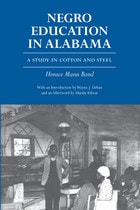
Negro Education in Alabama
A Study in Cotton and SteelHorace Mann Bond
University of Alabama Press, 1994
WINNER OF THE SUSAN COLVER ROSENBERGER AWARD
A foundational work of educational history, Horace Mann Bond’s study reveals how race, labor, and power shaped Black schooling in Alabama—and why those lessons still matter today.
Originally published in 1939, Negro Education in Alabama: A Study in Cotton and Steel by Horace Mann Bond is a pioneering work of educational and social history. Drawing on extensive data and firsthand observation, Bond explores how the economic structures of the cotton South and the industrializing North influenced the development of Black education in Alabama. He examines disparities in funding, curriculum, and access, while also highlighting the resilience and agency of African American communities in pursuing educational advancement. This reissued edition preserves Bond’s critical insights and remains a vital resource for scholars of African American history, education policy, and Southern studies.
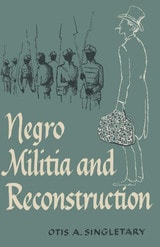
Negro Militia and Reconstruction
By Otis A. Singletary
University of Texas Press, 1957
Much of the violence that characterized Reconstruction was directly associated with the Negro militia movement organized by Radical politicians to support their precarious regimes in Southern states. This book is the story of that ill-fated movement, a story with important implication for later times.
Most Southern whites did not disguise their hostility toward the governments that were imposed on their states after Reconstruction entered its Radical phase. and Radical leaders lived in constant fear that this hostility would flare into open revolt. Organization of a loyal protective force was imperative if they were to remain in power.
Although planned originally as a defensive force, the Negro militia was quickly used by the Radicals for such purposes as controlling elections. The resentment of Southern whites resulting from this political activity was aggravated by crimes of violence, depredations, and minor social offenses committed by some of the militiamen. However, the white Southerner’s fundamental enmity toward the Negro militia stemmed from the racial implications of a policy that armed the Negroes and placed them in positions of authority over white men.
At first, opposition to the Negro militia movement took the form of legal stratagems and other measures short of force, but the final blow to the Negro militia was dealt by white volunteer rifle companies— illegal, armed counterforces that were at the very core of the White Line movement. The race riot as a political technique was born, the most notorious riot occurring at Hamburg, South Carolina, where, the author states, the policy of “disbandment through extermination” was successfully employed. Disintegration of the entire movement was inevitable.
“It is ironic,” Singletary states, “that the organization of this protective force, because of its racial implications, actually aided in the destruction of the very thing it was created to protect.”
Before its publication, Negro Militia and Reconstruction won the Moncado Prize, a cash award made biennially by the American Military Institute for “the best original book-length manuscript in any field of United States Military history.”
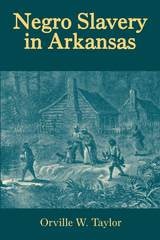
Negro Slavery in Arkansas
Orville Taylor
University of Arkansas Press, 2000
Long out of print and found only in rare-book stores, it is now available to a contemporary audience with this new paperback edition.
When slavery was abolished by the Emancipation Proclamation, there were slaves in every county of the state, and almost half the population was directly involved in slavery as either a slave, a slaveowner, or a member of an owner’s family. Orville Taylor traces the growth of slavery from John Law’s colony in the early eighteenth century through the French and Spanish colonial period, territorial and statehood days, to the beginning of the Civil War. He describes the various facets of the institution, including the slave trade, work and overseers, health and medical treatment, food, clothing, housing, marriage, discipline, and free blacks and manumission.
While drawing on unpublished material as appropriate, the book is, to a great extent, based on original, often previously unpublished, sources. Valuable to libraries, historians in several areas of concentration, and the general reader, it gives due recognition to the signficant place slavery occupied in the life and economy of antebellum Arkansas.
Negro Thought in America, 1880-1915
Racial Ideologies in the Age of Booker T. WashingtonAugust Meier
University of Michigan Press, 1963
Neighborhood Poverty
Context and Consequences for ChildrenJeanne Brooks-Gunn
Russell Sage Foundation, 1997
Neighborhood Poverty
Policy Implications in Studying NeighborhoodsJeanne Brooks-Gunn
Russell Sage Foundation, 1997
Neighborhood Recovery
Reinvestment Policy for the New HometownKromer, John
Rutgers University Press, 1999
How can we help distressed neighborhoods recover from a generation of economic loss and reposition themselves for success in today's economy? While many have proposed solutions to the problems of neighborhoods suffering from economic disinvestment, John Kromer has actually put them to work successfully as Philadelphia’s housing director. Part war story, part how-to manual, and part advocacy for more effective public policy, Neighborhood Recovery describes how a blending of public-sector leadership and community initiative can bring success to urban communities. Kromer’s framework for neighborhood recovery addresses issues such as
· neighborhood strategic planning
· home ownership and financing
· the role of community-based organizations
· public housing
· work-readiness and job training for neighborhood residents
· housing for homeless people and others with specialized needs
· the importance of advocacy in influencing and advancing
neighborhood reinvestment policy.
Neighborhood Recovery presents a policy approach that cities can use to improve the physical condition of their neighborhoods and help urban residents compete for good jobs in the metropolitan economy. Kromer’s experience in Philadelphia reveals challenges and opportunities that can decisively influence the future of neighborhoods in many other American cities.
Neither Black Nor White
Slavery and Race Relations in Brazil and the United StatesCarl Degler
University of Wisconsin Press, 1986
Carl Degler’s 1971 Pulitzer-Prize-winning study of comparative slavery in Brazil and the United States is reissued in the Wisconsin paperback edition, making it accessible for all students of American and Latin American history and sociology.
Until Degler’s groundbreaking work, scholars were puzzled by the differing courses of slavery and race relations in the two countries. Brazil never developed a system of rigid segregation, such as appeared in the United States, and blacks in Brazil were able to gain economically and retain far more of their African culture. Rejecting the theory of Giberto Freyre and Frank Tannenbaum—that Brazilian slavery was more humane—Degler instead points to a combination of demographic, economic, and cultural factors as the real reason for the differences.
“In the early 1970s when studies in social history were beginning to blossom on the North American scene, Carl Degler’s prize-winning contribution was a thoughtful provocative essay in comparative history. Its thoughtfulness has not diminished with the years. Indeed, it is as topical today as when it was first published. The Brazilian experience with rapid industrialization and its attempt to restore democratic government indicates that the issues which Degler treated in the early 1970s are more pertinent than ever today.”—Franklin W. Knight, Department of History, Johns Hopkins University.
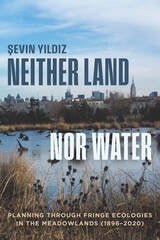
Neither Land nor Water
Planning Through Fringe Ecologies in the Meadowlands (1896–2020)Sevin Yildiz
University of Chicago Press, 2026
An urban and environmental history of the New Jersey Meadowlands, where marsh meets megamall.
The New Jersey Meadowlands, the vast marshes across the Hudson River from New York City, are a mysterious and complex wetland. Both strange and well-known to the millions of people who traverse the northeast corridor every year, this landscape is not well understood despite its familiarity. Seemingly natural and unnatural, human and nonhuman, the Meadowlands has long been shaped by urban development, industry, infrastructure, and countless dreams.
In Neither Land nor Water, Şevin Yıldız offers a close look at the planners, scientists, developers, politicians, industrialists, and others who have engaged with, dreamed about, or damaged this transitional ecology in different ways over the decades. She traces key periods in the area’s rich histories of urban planning and ecological thought, from the dispossession of the Lenape natives, through the dawn of ecological science, and onto both intensive industrial developments and environmental resistance to them. She examines as well how the Meadowlands exposes the inadequacies of today’s approaches to planning in the face of climate change and how they perhaps offer clues to a better future.
Neither Liberal nor Conservative
Ideological Innocence in the American PublicDonald R. Kinder and Nathan P. Kalmoe
University of Chicago Press, 2017
Well, American elites disagree fiercely. But average Americans do not. This, at least, was the position staked out by Philip Converse in his famous essay on belief systems, which drew on surveys carried out during the Eisenhower Era to conclude that most Americans were innocent of ideology. In Neither Liberal nor Conservative, Donald Kinder and
Nathan Kalmoe argue that ideological innocence applies nearly as well to the current state of American public opinion. Real liberals and real conservatives are found in impressive numbers only among those who are deeply engaged in political life. The ideological battles between American political elites show up as scattered skirmishes in the general public, if they show up at all.
If ideology is out of reach for all but a few who are deeply and seriously engaged in political life, how do Americans decide whom to elect president; whether affirmative action is good or bad? Kinder and Kalmoe offer a persuasive group-centered answer. Political preferences arise less from ideological differences than from the attachments and antagonisms of group life.

Neither Separate Nor Equal
Congress in the 1790sKenneth R. Bowling
Ohio University Press, 2000
Scholars today take for granted the existence of a “wall of separation” dividing the three branches of the federal government. Neither Separate nor Equal: Congress in the 1790s demonstrates that such lines of separation among the legislative, executive, and judicial branches, however, were neither so clearly delineated nor observed in the first decade of the federal government's history.
The first two essays describe the social and cultural milieu attending the movement of the republican court from New York to Philadelphia and the physical and social environment of Philadelphia in the 1790s. The following section examines the congressional career of New York's Egbert Benson, the senatorial career of Robert Morris as an expression of his economic interests, the vigorous opposition of Rep. William Branch Giles to the Federalist policies of the Washington administration, and finally the underappreciated role of congressional spouses.
The last five essays concentrate on areas of interbranch cooperation and conflict. In particular, they discuss the meaning of separation of powers in the 1790s, Washington as an active president with Congress, the contrast between Hamilton's and Jefferson's exercise of political influence with Congress, and John Adams's relationship with Congress during the Quasi-War crisis.
The essays in this collection, the second volume of the series Perspectives on the History of Congress, 1789-1801, originated in two conferences held in 1995 and 1996 by the United States Capitol Historical Society.

Nemerov's Door
EssaysRobert Wrigley
Tupelo Press, 2021
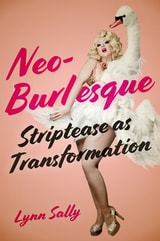
Neo-Burlesque
Striptease as TransformationLynn Sally
Rutgers University Press, 2022
Performance studies scholar and acclaimed burlesque artist Lynn Sally offers an inside look at the history, culture, and philosophy of New York’s neo-burlesque scene. Revealing how twenty-first century neo-burlesque is in constant dialogue with the classic burlesque of the nineteenth and twentieth centuries, she considers how today’s performers use camp to comment on preconceived notions of femininity. She also explores how the striptease performer directs the audience’s gaze, putting on layers of meaning while taking off layers of clothing.
Through detailed profiles of iconic neo-burlesque performers such as Dita Von Teese, Dirty Martini, Julie Atlas Muz, and World Famous *BOB*, this book makes the case for understanding neo-burlesque as a new sexual revolution. Yet it also examines the broader community of “Pro-Am” performers who use neo-burlesque as a liberating vehicle for self-expression. Raising important questions about what feminism looks like, Neo-Burlesque celebrates a revolutionary performing art and participatory culture whose acts have political reverberations, both onstage and off.
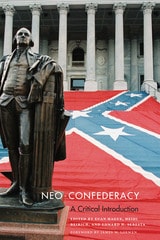
Neo-Confederacy
A Critical IntroductionEdited by Euan Hague, Heidi Beirich, and Edward H. Sebesta
University of Texas Press, 2008
A century and a half after the conclusion of the Civil War, the legacy of the Confederate States of America continues to influence national politics in profound ways. Drawing on magazines such as Southern Partisan and publications from the secessionist organization League of the South, as well as DixieNet and additional newsletters and websites, Neo-Confederacy probes the veneer of this movement to reveal goals far more extensive than a mere celebration of ancestry.
Incorporating groundbreaking essays on the Neo-Confederacy movement, this eye-opening work encompasses such topics as literature and music; the ethnic and cultural claims of white, Anglo-Celtic southerners; gender and sexuality; the origins and development of the movement and its tenets; and ultimately its nationalization into a far-reaching factor in reactionary conservative politics. The first book-length study of this powerful sociological phenomenon, Neo-Confederacy raises crucial questions about the mainstreaming of an ideology that, founded on notions of white supremacy, has made curiously strong inroads throughout the realms of sexist, homophobic, anti-immigrant, and often "orthodox" Christian populations that would otherwise have no affiliation with the regionality or heritage traditionally associated with Confederate history.
Neo-Passing
Performing Identity after Jim CrowEdited by Mollie Godfrey and Vershawn Ashanti Young: Foreword by Gayle Wald Afterword by Michele Elam
University of Illinois Press, 2018
Neocolonial Fictions of the Global Cold War
Steven Belletto and Joseph Keith
University of Iowa Press, 2019
Neoliberalism and Contemporary American Literature
Edited by Liam Kennedy and Stephen Shapiro
Dartmouth College Press, 2019
Networks of Champions
Leadership, Access, and Advocacy in the U.S. House of RepresentativesChristine A. DeGregorio
University of Michigan Press, 1999
Networks of Modernism
Reorganizing American NarrativeWesley Beal
University of Iowa Press, 2015
In this ferment of social upheaval and technological change, the moderns found what we would today term “the network,” though they did not have the vocabulary for it that we do now, to be a versatile model for their aesthetic experiments in representing social space and social relations. Whether they used the figuration of the network as a kind of formal experiment to negotiate the tensions between dispersal and unity, fragment and totality, or took the network as a subject in itself, as seen when dealing with crowds or public spaces, the network was a way for writers and artists to conceptualize and explore their rapidly changing society. Through readings of the works of Randolph Bourne, Jean Toomer, Anita Loos, John Dos Passos, and Nathanael West, Networks of Modernism positions the network as the defining figure of American modernist aesthetics and explores its use as a conceptual tool used to think through the rapid changes in American society.
Networks of Trust
The Social Costs of College and What We Can Do about ThemAnthony Simon Laden
University of Chicago Press, 2024
Higher education is a familiar battlefield in today’s culture wars. The right accuses colleges and universities of indoctrinating conservative students with liberal values; the left, with failing to be sufficiently inclusive. The anxieties expressed on both sides of the political spectrum have much in common, however, and they are triggered not by colleges’ failures but by their successes.
So argues philosopher Anthony Simon Laden in Networks of Trust. He highlights how a college education shapes students’ informational trust networks: the complex set of people and institutions they rely on for the information they use to think about and understand the world. While the networks that colleges build for students have great value, learning to inhabit them pulls some students away from their families and communities. If many people distrust institutions of higher education, this is one reason why. Networks of Trust offers a path forward, one that preserves the value while reducing the harms of a college education. It includes concrete suggestions for how colleges and universities can educate students in a manner that inspires and deserves trust: one that bridges rather than deepens our social divides.
Neurasthenic Nation
America's Search for Health, Happiness, and Comfort, 1869-1920Schuster, David G
Rutgers University Press, 2011
As the United States rushed toward industrial and technological modernization in the late nineteenth century, people worried that the workplace had become too competitive, the economy too turbulent, domestic chores too taxing, while new machines had created a fast-paced environment that sickened the nation. Physicians testified that, without a doubt, modern civilization was causing a host of ills—everything from irritability to insomnia, lethargy to weight loss, anxiety to lack of ambition, and indigestion to impotence. They called this condition neurasthenia.
Neurasthenic Nation investigates how the concept of neurasthenia helped doctors and patients, men and women, and advertisers and consumers negotiate changes commonly associated with “modernity.” Combining a survey of medical and popular literature on neurasthenia with original research into rare archives of personal letters, patient records, and corporate files, David Schuster charts the emergence of a “neurasthenic nation”—a place where people saw their personal health as inextricably tied to the pitfalls and possibilities of a changing world.

Neuromatic
Or, A Particular History of Religion and the BrainJohn Lardas Modern
University of Chicago Press, 2021
In Neuromatic, religious studies scholar John Lardas Modern offers a sprawling examination of the history of the cognitive revolution and current attempts to locate all that is human in the brain, including spirituality itself. Neuromatic is a wildly original take on the entangled histories of science and religion that lie behind our brain-laden present: from eighteenth-century revivals to the origins of neurology and mystic visions of mental piety in the nineteenth century; from cyberneticians, Scientologists, and parapsychologists in the twentieth century to contemporary claims to have discovered the neural correlates of religion.
What Modern reveals via this grand tour is that our ostensibly secular turn to the brain is bound up at every turn with the religion it discounts, ignores, or actively dismisses. In foregrounding the myths, ritual schemes, and cosmic concerns that have accompanied idealizations of neural networks and inquiries into their structure, Neuromatic takes the reader on a dazzling and disturbing ride through the history of our strange subservience to the brain.

Nevada Place Names
A Geographical DictionaryHelen S. Carlson
University of Nevada Press, 1974
Author and researcher Helen Carlson spent almost fourteen years searching for the origins of Nevada’s place names, using the maps of explorers, miners, government surveyors, and city planners and poring through historical accounts, archival documents, county records, and newspaper files. The result of her labors is Nevada Place Names, a fascinating mixture of history spiced with folklore, legend, and obscure facts. Out of print for some years, the book was reprinted in 1999.
Nevada Printing History
A Bibliography Of Imprints And Publications, 1858-1880Robert D. Armstrong
University of Nevada Press, 1981
A detailed look at Nevada's printing history from 1858 through 1880. Includes proclamations, pamphlets, menus, government publications, church programs, and more. For Nevada historians, bibliographers, book collectors, and people who are interested in the printed records produced in Nevada toward the end of the nineteenth century.
Nevada Printing History
A Bibliography Of Imprints And Publications, 1881-1890Robert D. Armstrong
University of Nevada Press, 1991
A detailed look at Nevada's printing history from 1881 through 1890. With over 1400 entries describing books, pamphlets, broadsides, state and local documents, fraternal and church publications, and a variety of other printed matter, this intriguing compilation serves as the companion volume to Armstrong's Nevada Printing History, 1858-1880. Armstrong includes annual summaries of events affecting the printing trade in Nevada as well as the locations and kinds of printing technology in use. This second volume also documents the planning and erection of a state printing office. Of particular interest are the summaries of individual publications that provide the reader with a picture of social, economic, and political viewpoints of the period. The author's research led him to more than 125 public institutions over a period of nearly twenty years. Historians, bibliographers, students of printing history and practice, collectors of Western Americana, antiquarian booksellers, and librarians will find this book to be an invaluable guide to Nevada's printing, its printers, and its history.

Nevada's Changing Wildlife Habitat
An Ecological HistoryGeorge E. Gruell
University of Nevada Press, 2013
For millennia the ecology of the Great Basin has evolved because of climate change and the impacts of human presence. Nevada’s Changing Wildlife Habitat is the first book to explain the transformations in the plants and animals of this region over time and how they came about. Using data gleaned from archaeological and anthropological studies, numerous historical documents, repeat photography, and several natural sciences, the authors examine changes in vegetation and their impact on wildlife species and the general health of the environment. They also outline the choices that current users and managers of rangelands face in being good stewards of this harsh but fragile environment and its wildlife.

Nevada's Environmental Legacy
Progress or PlunderJames W. Hulse
University of Nevada Press, 2009
Nevada's relatively brief history (it became a state in 1864) has been largely a story of the exploitation of its natural resources. Mining has torn down mountains and poisoned streams and groundwater. Uncontrolled grazing by vast herds of sheep and cattle has denuded grasslands and left them prey to the invasion of noxious plant species and vulnerable to wildfire. Clear-cut logging practices have changed the composition of forests and induced serious soil erosion. More recently, military testing, including hundreds of atomic blasts to determine the efficacy of nuclear weapons, has irreversibly polluted expanses of fragile desert landscape. And rampant development throughout the state over the past four decades, along with the public's growing demand for recreational facilities, has placed intolerable demands on the arid state's limited water resources and threatened the survival of numerous rare plant and animal species. Veteran historian and Nevada native James W. Hulse considers the state's complex environmental history as a series of Faustian bargains between the state's need for economic development and the industries, government agencies, and individuals that have exploited Nevada's natural resources with little concern for the long-term consequences of their activities. His survey covers all these issues, and examines public attitudes about the environment and the role of federal and state agencies in creating, interpreting, and enforcing environmental policies.
Nevada's Great Recession
Looking Back, Moving ForwardElliott Parker
University of Nevada Press, 2017
This is a different kind of economics book. Parker uses his expertise from doing research on the East Asian fiscal crisis to give profound insights into what happened and how to avoid future catastrophes. Marshall personalizes it by providing vignettes of what it was actually like to be in the trenches and fighting the inevitable political battles that came up, and counteracting some of the falsehoods that certain politicians were spreading about the recession.
Parker and Marshall’s book should be required reading for not only every single elected official in Nevada, but for any private citizen who cares about the public good.

Nevada's Historic Buildings
A Cultural LegacyRonald M. James
University of Nevada Press, 2009
Nevada’s Historic Buildings highlights ninety of these buildings, describing them in the context of the state’s history and the character of the people who created and used them. Here are reminders of mining boomtowns, historic ranches, transportation, the divorce and gaming industries, the New Deal, and the innovation of Las Vegas’s post-modern aesthetic. These buildings provide a cross-section of Nevada’s rich historic and cultural heritage and their survival offers everyone the experience of touching the past.
Nevada's Turbulent 50's
Decade Of Political And Economic ChangeAl Glass
University of Nevada Press, 1981
The 1950s marked a period of significant changes for Nevada--gambling came under national and local scrutiny, atomic bombs were tested regularly near Las Vegas, and labor disputes made national headlines. Glass examines the events of the decade and their impact on Nevada and on the rest of the country.
Nevada's Twentieth-Century Mining Boom
Tonopah, Goldfield, ElyRussell R. Elliott
University of Nevada Press, 1966
Nevada
A HistoryRobert Laxalt
University of Nevada Press, 1991

Nevada
A History of the Silver StateMichael S. Green
University of Nevada Press, 2015
Michael S. Green, a leading Nevada historian, provides a detailed survey of the Silver State’s past, from the arrival of the early European explorers, to the predominance of mining in the 1800s, to the rise of world-class tourism in the twentieth century, and to more recent attempts to diversify the economy.
Of the numerous themes central to Green’s analysis of Nevada’s history, luck plays a significant role in the state’s growth. The miners and gamblers who first visited the state all bet on luck. Today, the biggest contributor to Nevada’s tourist economy, gaming, still relies on that same belief in luck. Nevada’s financial system has generally been based on a “one industry” economy, first mining and, more recently, gaming. Green delves deeply into the limitations of this structure, while also exploring the theme of exploitation of the land and the overuse of the state’s natural resources. Green covers many more aspects of the Silver State’s narrative, including the dominance of one region of the state over another, political forces and corruption, and the citizens’ often tumultuous relationship with the federal government. The book will appeal to scholars, students, and other readers interested in Nevada history.

Nevada
A History of the Silver State, 2nd editionMichael S. Green
University of Nevada Press, 2024
Michael S. Green, a leading Nevada historian, provides a detailed survey of the Silver State’s past, from the arrival of the early European explorers, to the predominance of mining in the 1800s, to the rise of world-class tourism in the twentieth century, and to more recent attempts to diversify the economy.
Of the numerous themes central to Green’s analysis of Nevada’s history, luck plays a significant role in the state’s growth. The miners and gamblers who first visited the state all bet on luck. Today, the biggest contributor to Nevada’s tourist economy, gaming, still relies on that same belief in luck. Nevada’s financial system has generally been based on a “one industry” economy, first mining and, more recently, gaming. Green delves deeply into the limitations of this structure, while also exploring the theme of exploitation of the land and the overuse of the state’s natural resources. Green covers many more aspects of the Silver State’s narrative, including the dominance of one region of the state over another, political forces and corruption, and the citizens’ often tumultuous relationship with the federal government. The book will appeal to scholars, students, and other readers interested in Nevada history.
Never Ask "Why"
Football Players' Fight for Freedom in the NFLBy Ed Garvey; Edited by Chuck Cascio
Temple University Press, 2023
When pro football players formed a union to stand up against the NFL for their own interests, they chose lawyer Ed Garvey as their Executive Director. The NFL Players Association (NFLPA), would take on the NFL over player contracts, collective bargaining agreements, and antitrust suits. It lobbied for players’ free agency, contract rights, and impartial arbitration of disciplinary disputes. Garvey navigated strikes, lockouts, scabs, stooges, lies, as well as the sports media complex—to maintain players’ dignity. According to the league, the players were to take what they were given and “never ask why.”
In Never Ask “Why,” journalist Chuck Cascio presents the late Garvey’s rich account of the early years of the NFLPA, taking readers among the players as they held the league accountable to play fair. Learning from their mistakes, the NFLPA would succeed in curbing commissioner Pete Rozelle’s disciplinary power and striking down the Rozelle Rule’s absolute control over free agency.
Garvey tells the intimate stories of how pro football players, rivals on the field, rallied together to stand up for themselves. He worked tirelessly to change a system that exploited players and even controlled the media. In the end, Garvey shows how the NFLPA transformed the state of pro sports leagues today and how, even still, they work to keep down the players on whose backs they profit.
Never Done
A History of Women’s Work in Media ProductionHill, Erin
Rutgers University Press, 2016
Histories of women in Hollywood usually recount the contributions of female directors, screenwriters, designers, actresses, and other creative personnel whose names loom large in the credits. Yet, from its inception, the American film industry relied on the labor of thousands more women, workers whose vital contributions often went unrecognized.
For more information: http://erinhill.squarespace.com
Never Easy, Never Pretty
A Fan, A City, A Championship SeasonDean Bartoli Smith
Temple University Press, 2013
When the Ravens won Super Bowl XLVII in New Orleans, it was a joyous moment for fans and team alike. For Dean Bartoli Smith, a lifelong Baltimore football fan and writer for The Baltimore Brew and Press Box, it was especially sweet. In Never Easy, Never Pretty, he recalls the ups and downs and ultimate thrills of a special season while also showing how a football team impacts its fans and its city. Smith recounts the season from start to glorious finish while interweaving Baltimore’s professional football history, telling his own story of growing up with the Colts, then gradually transferring adult loyalties to the new team in town, the Ravens. Family, friends, and other fans share their recollections, too, letting us see how a football team becomes part of a community.
Smith’s game-by-game recounting of an improbable season brings back all the excitement and uncertainty as the team starts strong, wobbles, then finds its inspiration and character in the playoffs. For each game Never Easy, Never Pretty features a diverse array of quotes, interviews, and commentary from players, broadcasters, and executives, including Joe Flacco, Ray Lewis, Art Donovan, Kevin Byrne, Steve Bisciotti, and Ozzie Newsome.
Never Easy, Never Pretty highlights the Ravens’ electrifying season and celebrates a team, a city, and its emotional landscape during an unlikely run to a Super Bowl victory. The result is an insightful and poignant book about much more than a championship season.
Never Easy, Never Pretty includes:
•The 4th & 29 play by Ray Rice against the Chargers
•
The game-saving first down
•
The 70-yard bomb from Joe Flacco to Jacoby Jones known as the “Mile High Miracle”
•Interviews with Rob Burnett, Keith Mills, Lenny Moore, Sean Landeta, Terrell Suggs, Tom Matte, and many others
•Photographs by long-time Ravens photographer Phil Hoffmann

Never Givin' Up
The Life and Music of Al JarreauKurt Dietrich
Wisconsin Historical Society Press, 2023
This is the first biography to chronicle the life and career of one of the most distinguished and beloved musical artists to come out of Wisconsin: Al Jarreau. From his earliest days singing in the 1940s until his death in 2017, Jarreau defied categorization. While his biggest hit, “We’re In This Love Together,” is pure pop, he smashed music industry stereotypes as the first artist to win Grammy Awards in three genres: jazz, pop, and R&B.
Never Givin’ Up traces Jarreau’s singing career from humble beginnings in his hometown of Milwaukee to international fame. The narrative includes his formative student days at Ripon College and the University of Iowa, as well as the years spent honing his craft at nightspots in Milwaukee, San Francisco, and the Twin Cities. After he was signed by Warner Bros. Records in 1975 at the age of 35, Jarreau achieved stardom with his innovative vocal stylings and electric live performances.
This book includes more than 20 sidebars with bonus information about every Jarreau album and behind-the-scenes stories about the making of the records. Author Kurt Dietrich conducted interviews with dozens of Al's friends, fellow musicians, professional associates, and family members—most notably Al’s sister, Rose Marie Freeman, who was a major contributor to the project. Featuring 54 images spanning Jarreau’s life, from never-before-seen family snapshots to stills from his legendary stage performances, Never Givin’ Up celebrates a Milwaukee hometown hero and global sensation.
Silver Medal Winner for the 2023 Foreword INDIES Book of the Year Award for Performing Arts and Music
Finalist for the Association for Recorded Sound Collections’ Award for Best Historical Research in Recorded Jazz
“Kurt Dietrich has created a masterful book, revealing and depicting a detailed version of my brother, Al Jarreau, through his music and career. In these pages, I see Al’s determination and his admirable goal of ‘Never Givin’ Up’ on his joy of singing. It was my distinct pleasure to work with Kurt Dietrich in the process, establishing what has become a bond of family-like friendship that will endure for a lifetime and beyond.”
—Rose Marie (Jarreau) Freeman
“Dietrich captures Jarreau’s simultaneously gregarious and shy charm while revealing his own affection for this gifted and gracious performer. It’s his love letter to a Milwaukee legend.”
—Bill Milkowski, author of Jaco: The Extraordinary and Tragic Life of Jaco Pastorius and Ode to a Tenor Titan: The Life and Times and Music of Michael Brecker
"Written in an approachable style and carefully documented, this book will be valuable for fans and researchers of Jarreau’s music. Summing Up: Highly recommended."
—Choice Reviews