Results by title
28164 books match the query 'History' and 647 start with n
Newcomers
Gentrification and Its DiscontentsMatthew L. Schuerman
University of Chicago Press, 2019
In Newcomers, journalist Matthew L. Schuerman explains how a phenomenon that began with good intentions has turned into one of the most vexing social problems of our time. He builds a national story using focused histories of northwest Brooklyn, San Francisco’s Mission District, and the onetime site of Chicago’s Cabrini-Green housing project, revealing both the commonalities among all three and the place-specific drivers of change. Schuerman argues that gentrification has become a too-easy flashpoint for all kinds of quasi-populist rage and pro-growth boosterism. In Newcomers, he doesn’t condemn gentrifiers as a whole, but rather articulates what it is they actually do, showing not only how community development can turn foul, but also instances when a “better” neighborhood truly results from changes that are good. Schuerman draws no easy conclusions, using his keen reportorial eye to create sharp, but fair, portraits of the people caught up in gentrification, the people who cause it, and its effects on the lives of everyone who calls a city home.
Newman University Church, Dublin
Architectural Revivalism in the British Isles and the Authority of FormNiamh Bhalla
University College London, 2024
Newman University Church, Dublin charts the first ever analysis of University Church’s significance within the history of Victorian revivalist architecture. Author Niamh Bhalla explores the relationship between the church’s context as the first Catholic university in Ireland and the ambiguity of its “early Christian” style, providing an effective lens to understand the architectural revivalism of the nineteenth century, particularly basilican and Byzantine revivalist architectures in the British Isles.

Newport In Rockies
Life & Good Times OfMarshall Sprague
Ohio University Press, 1988
In the town's early years, rich easterners and Englishmen came seeking adventure, romance, and gentility. But when gold was discovered at nearby Cripple Creek in 1900, Colorado Springs became an instant boom town. A second major boom came several decades later, when local boosters persuaded the Army to choose Colorado Springs as the site for Fort Carson, a training center for 30,000 troops. Other military projects followed, including Peterson Field, Ent Air Force Base, the underground North American Air Defense Command Combat Operations Center, and in 1954, the U.S. Air Force Academy. More recent projects, discussed in a new final chapter, include the Olympic Training Center and the Olympic Hall of Fame, as well as high-tech industries and advances in culture, education, and recreation.
As the city sprawls eastward onto the prairie, it bears little resemblance to General Palmer's 1871 village. Yet the general's dream of a quality town in a quality environment has continued to inspire generations of administrators and boosters who have made Colorado Springs a model of urban prosperity.
News Parade
The American Newsreel and the World as SpectacleJoseph Clark
University of Minnesota Press, 2020
A fascinating look at the United States’ conflicted relationship with news and the media, through the lens of the newsreel
When weekly newsreels launched in the early twentieth century, they offered the U.S. public the first weekly record of events that symbolized “indisputable evidence” of the news. In News Parade, Joseph Clark examines the history of the newsreel and how it changed the way Americans saw the world. He combines an examination of the newsreel’s methods of production, distribution, and reception with an analysis of its representational strategies to understand the newsreel’s place in the history of twentieth-century American culture and film history.
Clark focuses on the sound newsreel of the 1930s and 1940s, arguing that it represents a crucial moment in the development of a spectacular society where media representations of reality became more fully integrated into commodity culture. Using several case studies, including the newsreel’s coverage of Charles Lindbergh’s transatlantic flight and the Sino–Japanese War, News Parade shows how news film transformed the relationship between its audience and current events, as well as the social and political consequences of these changes. It pays particular attention to how discourses of race and gender worked together with the rhetoric of speed, mobility, and authority to establish the power and privilege of newsreel spectatorship.
In the age of fake news and the profound changes to journalism brought on by the internet, News Parade demonstrates how new technologies and media reshaped the American public’s relationship with the news in the 1930s—a history that can help us to better understand the transformations happening today.
News and Frontier Consciousness in the Late Roman Empire
Mark W. Graham
University of Michigan Press, 2006
Approaching Roman frontiers with the aid of media studies as well as anthropological and sociological methodologies, Mark W. Graham chronicles and documents this significant transition in ancient thought, which coincided with, but was not necessarily dependent on, the Christianization of the Roman world.
Mark W. Graham is Assistant Professor of History at Grove City College.
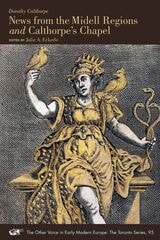
News from the Midell Regions and Calthorpe’s Chapel
Dorothy Calthorpe
Iter Press, 2022
This first print edition of two extant manuscripts by Dorothy Calthorpe (1648–1693) introduces a new seventeenth-century woman writer to the growing canon of early modern female authors. The edition provides transcriptions of the manuscripts and Calthorpe’s will, as well as a hefty apparatus that features a comprehensive introduction to Calthorpe, her family, and her work; a glossary of persons who figured in her writing and her life; and two genealogical charts. Calthorpe’s writings (including both prose and verse and ranging from Petrarchan love poems to roman à clef and devotional verse), and the thoughtfully constructed and illustrated volumes in which her texts appear, demonstrate the rich intellectual life of a previously unknown female writer and provide a compelling example of Restoration manuscript production.
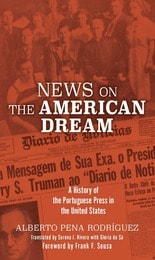
News on the American Dream
A History of the Portuguese Press in the United StatesAlberto Pena Rodríguez, Translated by Serena J. Rivera
Tagus Press, 2020
News on the American Dream traces the development of the Portuguese-American press from its beginnings in the late nineteenth century to the present, taking readers from the East Coast to Hawaii, with strategic stops in places with large Portuguese communities, including New Bedford, Massachusetts; Oakland, California; and Newark, New Jersey. Alberto Pena Rodríguez's nuanced analysis of the political, economic, social, and cultural roles played by these publications proves how important they were for the Portuguese-American community and the history of the ethnic press in the United States. Fascinating narratives about the founders, editors, and owners of these publications—and their challenges, squabbles, and successes—round out this engaging study.

News to Me
Adventures of an Accidental JournalistLaurie Hertzel
University of Minnesota Press, 2010
The story of a journalist’s coming of age in Duluth during the boom days of print
Laurie Hertzel wasn't yet a teenager in Duluth, Minnesota, when she started her first newspaper, which she appropriately christened Newspaper. Complete with the most sensational headlines of the day-MARGO FLUEGEL HAS ANOTHER BIRTHDAY!-and with healthy competition from her little brothers and their rival publication, Magapaper (a magazine and a newspaper), this venture would become Hertzel's first step toward realizing what her heart was already set on: journalism as her future.
News to Me is the adventurous story of Hertzel's journey into the bustling world of print journalism in the mid-1970s, a time when copy was still banged out on typewriters by chain-smoking men in fedoras and everybody read the paper. A coming-of-age tale in more ways than one, Hertzel's eighteen-year career at the Duluth News Tribune began when journalism was a predominantly male profession. And while the newspaper trade was booming, Duluth had fallen on difficult times as factories closed and more and more people moved away. Hertzel describes her climb up the ranks of the paper against the backdrop of a Midwestern city during a time of extraordinary change. She was there during major events like the Congdon murders, the establishment of the BWCA, and the rise of Indian treaty rights, and eventually follows the biggest story of her life to Soviet Russia-and completely blows her deadline.
Written with the insight and humor of someone who makes a living telling stories, News to Me is the chronicle of a small-city newspaper on the cusp of transformation, an affectionate portrait of Duluth and its people, and the account of a talented, persistent journalist who witnessed it all and was changing right along with it-whether she wanted to or not.
(Oh, Newspaper doggedly outlasted the full-color Magapaper).
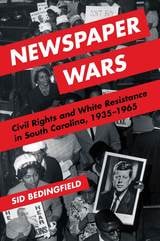
Newspaper Wars
Civil Rights and White Resistance in South Carolina, 1935-1965Sid Bedingfield
University of Illinois Press, 2017
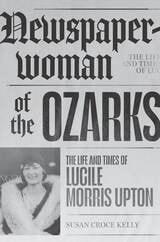
Newspaperwoman of the Ozarks
The Life and Times of Lucile Morris UptonSusan Croce Kelly
University of Arkansas Press, 2023
Lucile Morris Upton landed her first newspaper job out West in the early 1920s, then returned home to spend half a century reporting on the Ozarks world she knew best. Having come of age just as women gained the right to vote, she took advantage of opportunities that presented themselves in a changing world. During her years as a journalist, Upton rubbed shoulders with presidents, flew with aviation pioneer Wiley Post, covered the worst single killing of US police officers in the twentieth century, wrote an acclaimed book on the vigilante group known as the Bald Knobbers, charted the growth of tourism in the Ozarks, and spearheaded a movement to preserve iconic sites of regional history. Following retirement from her newspaper job, she put her experience to good use as a member of the Springfield City Council and community activist.
Told largely through Upton’s own words, this insightful biography captures the excitement of being on the front lines of newsgathering in the days when the whole world depended on newspapers to find out what was happening.
Winner, 2024 Missouri Literary Award
First Place, 2024 Missouri Professional Communicators Communications Contest
Finalist, Society of Midland Authors Book Award
Newsprint Metropolis
City Papers and the Making of Modern AmericansJulia Guarneri
University of Chicago Press, 2017
At the turn of the twentieth century, ambitious publishers like Joseph Pulitzer, William Randolph Hearst, and Robert McCormick produced the most spectacular newspapers Americans had ever read. Alongside current events and classified ads, publishers began running comic strips, sports sections, women’s pages, and Sunday magazines. Newspapers’ lavish illustrations, colorful dialogue, and sensational stories seemed to reproduce city life on the page.
Yet as Julia Guarneri reveals, newspapers did not simply report on cities; they also helped to build them. Metropolitan sections and civic campaigns crafted cohesive identities for sprawling metropolises. Real estate sections boosted the suburbs, expanding metropolitan areas while maintaining cities’ roles as economic and information hubs. Advice columns and advertisements helped assimilate migrants and immigrants to a class-conscious, consumerist, and cosmopolitan urban culture.
Newsprint Metropolis offers a tour of American newspapers in their most creative and vital decades. It traces newspapers’ evolution into highly commercial, mass-produced media, and assesses what was gained and lost as national syndicates began providing more of Americans’ news. Case studies of Philadelphia, New York, Chicago, and Milwaukee illuminate the intertwined histories of newspapers and the cities they served. In an era when the American press is under attack, Newsprint Metropolis reminds us how papers once hosted public conversations and nurtured collective identities in cities across America.
Newton
Kosmos - Bios - LogosIrena Stepánová
Karolinum Press, 2014
Next Time We Strike
Allan Kent Powell
Utah State University Press, 1992
A sensitive and in-depth portrayal of the efforts to unionize Utah's coal miners, The Next Time We Strike explores the ethnic tensions and nativistic sentiments that hampered unionization efforts even in the face of mine explosions and economic exploitation. Powell utilizes oral interviews, coal company reports, newspapers, letters, and union records to tell the story from the miners' perspective.
Next to Godliness
Confronting Dirt and Despair in Progressive Era New York CityDaniel Burnstein
University of Illinois Press, 2010
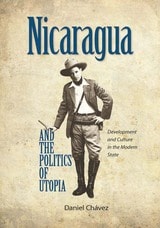
Nicaragua and the Politics of Utopia
Development and Culture in the Modern StateDaniel Chavez
Vanderbilt University Press, 2015
For each era, Chavez reveals the ways Nicaraguan popular culture adapted and interpreted the new political order, shaping, critiquing, or amplifying the regime's message of stability and prosperity for the people. These tactics of interpretation, otherwise known as meaning-making, became all-important for the Nicaraguan people, as they opposed the autocracy of Somocismo, or complemented the Sandinistas, or struggled to find their place in the Neoliberal era. In every case, Chavez shows the reflective nature of cultural production and its pursuit of utopian idealism.

Nicaragua's Mosquito Shore
The Years of British and American PresenceCraig L. Dozier
University of Alabama Press, 1985
An essential interdisciplinary study of culture, history, and identity on Nicaragua’s Caribbean frontier.
Separated from Nicaragua’s Pacific plain by mountains, the Atlantic coastal plain extends between 70 and 100 miles into the interior. Early Spanish settlers were ousted by the British, who engaged in the mahogany trade, and who also hoped for trade with Americans seeking a short route to California. In 1850, with the signing of the Clayton-Bulwer Treaty, the U.S. and Britain agreed that neither country would seek to acquire exclusive control over a Nicaraguan canal. Plans for the development of a Nicaraguan canal had a marked influence on the region for the next 100 years.
During the second half of the 19th century both rubber and bananas were produced commercially in eastern Nicaragua, and the Standard Fruit Company of New Orleans became the larges single commercial influence in the region. The first over American intervention in eastern Nicaragua occurred in 1912, when a contingent of Marines was dispatched to protect American commercial interests. The Marines remained for thirteen years.
Dozier develops the history of the current political troubles in Nicaragua, which had their origin in the early 1930s and which center about the control of the rich area inhabited by the Mosquitos. His book presents the historical background for the tragic events that are taking place in that region.
Nicaraguan Exceptionalism? Debating the Legacy of the Sandinista Revolution
Edited by Hilary Francis
University of London Press, 2019
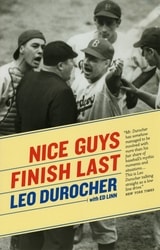
Nice Guys Finish Last
Leo Durocher with Ed Linn
University of Chicago Press, 2009
“I believe in rules. Sure I do. If there weren't any rules, how could you break them?”
The history of baseball is rife with colorful characters. But for sheer cantankerousness, fighting moxie, and will to win, very few have come close to Leo “the Lip” Durocher. Following a five-decade career as a player and manager for baseball’s most storied franchises, Durocher teamed up with veteran sportswriter Ed Linn to tell the story of his life in the game. The resulting book, Nice Guys Finish Last, is baseball at its best, brimming with personality and full of all the fights and feuds, triumphs and tricks that made Durocher such a success—and an outsized celebrity.
Durocher began his career inauspiciously, riding the bench for the powerhouse 1928 Yankees and hitting so poorly that Babe Ruth nicknamed him “the All-American Out.” But soon Durocher hit his stride: traded to St. Louis, he found his headlong play and never-say-die attitude a perfect fit with the rambunctious “Gashouse Gang” Cardinals. In 1939, he was named player-manager of the Brooklyn Dodgers—and almost instantly transformed the underachieving Bums into perennial contenders. He went on to manage the New York Giants, sharing the glory of one of the most famous moments in baseball history, Bobby Thomson’s “shot heard ’round the world,” which won the Giants the 1951 pennant. Durocher would later learn how it felt to be on the other side of such an unforgettable moment, as his 1969 Cubs, after holding first place for 105 days, blew a seemingly insurmountable 8-1/2-game lead to the Miracle Mets.
All the while, Durocher made as much noise off the field as on it. His perpetual feuds with players, owners, and league officials—not to mention his public associations with gamblers, riffraff, and Hollywood stars like George Raft and Larraine Day—kept his name in the headlines and spread his fame far beyond the confines of the diamond.
A no-holds-barred account of a singular figure, Nice Guys Finish Last brings the personalities and play-by-play of baseball’s greatest era to vivid life, earning a place on every baseball fan’s bookshelf.
Nietzsche on Language, Consciousness, and the Body
Christian J. Emden
University of Illinois Press, 2005
Emden situates Nietzsche’s writings on language and rhetoric within their wider historical context. He demonstrates that Nietzsche is not as radical in his thinking as has been often supposed, and that a number of problems with Nietzsche disappear when Nietzsche’s works are compared to works on the same subjects by writers of the 18th and 19th centuries. Further, the relevance of rhetoric and the history of rhetoric to philosophy and the history of philosophy is reasserted, in consonance with Nietzsche’s own statements and practices. Important in this regard are the role of fictions, descriptions, and metaphor.

Nietzsche's Perspectivism
Steven Hales and Rex Welshon
University of Illinois Press, 2000
Hales and Welshon present Nietzsche's treatment of perspectivism as both more complex and more fruitful than the common view of it as a doctrine that truth is not objective. Neither a metaphor nor a methodology, perspectivism emerges as a protean concept akin to a unifying theme; an alternative to the absolutism that recurs in science, philosophy, and religion; and a technique for revealing the unimagined possibilities open to every individual.
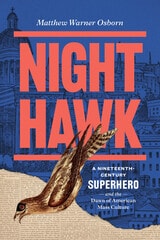
Night Hawk
A Nineteenth-Century Superhero and the Dawn of American Mass CultureMatthew Warner Osborn
University of Chicago Press, 2026
Unmasks the long-forgotten story of how a flying, superhuman vigilante played a pivotal role in the founding of the American labor movement.
On July 5, 1828, more than a century before Superman arrived on Earth, a superhero took flight in Philadelphia’s night sky. Buried on page three of a small local newspaper, the announcement of his arrival appeared under the title “The Night-Hawk, No. 1” with a cryptic epigraph from Romeo and Juliet: “I’ll be a candleholder and look on.” Who and what was the Night Hawk? As Matthew Warner Osborn reveals, this was the sobriquet of a mysterious columnist for the weekly Mechanics’ Free Press, the first radical socialist newspaper in America. Dressed in a mysterious cloak, the Night Hawk soared over Philadelphia, revealing the evil crimes of prominent gentlemen, fighting murderous criminals, and calling out fraudulent moral authorities.
The Night Hawk was the ingenious invention of an impoverished actor, Cornelius A. Logan, who created the character as a public champion of Philadelphia’s Working Men’s movement, the first successful American labor party. The Night Hawk’s nocturnal adventures transformed their socialist ideology into an entertaining fantasy that dramatized the struggle against industrial exploitation and the degradation of working people. The success of the character made Logan into a celebrity, and he went on to become a popular and innovative comedian on the antebellum stage.
A harbinger of the superheroes we know today, the Night Hawk promises to illuminate dark secrets from the past, but he can also shed light on our present. He ignites our need to see corrupt elites unmasked and held accountable for their actions, all while protecting the innocent and oppressed. Americans have always loved to fantasize about powerful superheroes who hide behind masks while chasing bad guys, and Osborn shows in this entertaining history how the Night Hawk was perhaps the first standard bearer for that enduring mystique.
Night Mother
A Personal and Cultural History of The ExorcistMarlena Williams
The Ohio State University Press, 2023
Night Riders of Reelfoot Lake
Paul Vanderwood
University of Alabama Press, 2003
Reelfoot Lake has been a hunting and fishing paradise from the time of its creation in 1812, when the New Madrid earthquake caused the Mississippi River to flow backward into low-lying lands. Situated in the northwestern corner of the state of Tennessee, it attracted westward-moving pioneers, enticing some to settle permanently on its shores.
Threatened in 1908 with the loss of their homes and livelihoods to aggressive, outsider capitalists, rural folk whose families had lived for generations on the bountiful lake donned hoods and gowns and engaged in “night riding,” spreading mayhem and death throughout the region as they sought vigilante justice. They had come to regard the lake as their own, by “squatters’ rights,” but now a group of entrepreneurs from St. Louis had bought the titles to the land beneath the shallow lake and were laying legal claim to Reelfoot in its entirety. People were hanged, beaten, and threatened and property destroyed before the state militia finally quelled the uprising. A compromise that made the lake public property did not entirely heal the wounds which continue to this day.
Paul Vanderwood reconstructs these harrowing events from newspapers and other accounts of the time. He also obtained personal interviews with participants and family members who earlier had remained mum, still fearing prosecution. The Journal of American History declares his book “the complete and authentic treatment” of the horrific dispute and its troubled aftermath.

Night Riders
Defending Community in the Black Patch, 1890–1915Christopher Waldrep
Duke University Press, 1993
Christopher Waldrep shows that, contrary to many accounts, these wealthy tobacco planters did not resist these new forces simply because of a nostalgia for a bygone time. Instead, many sought to become modern capitalists themselves--but on their own terms. The South's rural elite found their ability to hire and control black labor--the established racial practice of the community--threatened by the low prices offered by big companies for their raw materials. In response, farmers organized and demanded better prices for their tobacco. The tobacco companies then attempted to divide the farmers by offering higher prices to those willing to break with the others. When some cultivators succumbed, their betrayal awakened a deeply rooted vigilante tradition that called for the protection of community at all costs. Waldrep analyzes the spasm of violence that ensued in which horsemen, riding at night, destroyed tobacco barns and the warehouses where the companies stored their tobacco. But despite this fierce upheaval, the Black Patch community endured.
The most thorough treatment ever given to the Black Patch war, Night Riders illuminates a moment in history in which the traditional and the modern, the rural and the industrial, fought for the future--and past--of a community.
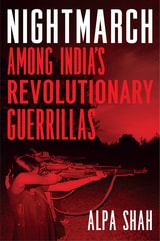
Nightmarch
Among India’s Revolutionary GuerrillasAlpa Shah
University of Chicago Press, 2019
Winner of the 2020 Association for Political and Legal Anthropology Book Prize
Shortlisted for the Orwell Prize
Shortlisted for the New India Foundation Book Prize
Anthropologist Alpa Shah found herself in an active platoon of Naxalites—one of the longest-running guerrilla insurgencies in the world. The only woman, and the only person without a weapon, she walked alongside the militants for seven nights across 150 miles of dense, hilly forests in eastern India. Nightmarch is the riveting story of Shah's journey, grounded in her years of living with India’s tribal people, an eye-opening exploration of the movement’s history and future and a powerful contemplation of how disadvantaged people fight back against unjust systems in today’s world.
The Naxalites have fought for a communist society for the past fifty years, caught in a conflict that has so far claimed at least forty thousand lives. Yet surprisingly little is known about these fighters in the West. Framed by the Indian state as a deadly terrorist group, the movement is actually made up of Marxist ideologues and lower-caste and tribal combatants, all of whom seek to overthrow a system that has abused them for decades. In Nightmarch, Shah shares some of their gritty untold stories: here we meet a high-caste leader who spent almost thirty years underground, a young Adivasi foot soldier, and an Adivasi youth who defected. Speaking with them and living for years with villagers in guerrilla strongholds, Shah has sought to understand why some of India’s poor have shunned the world’s largest democracy and taken up arms to fight for a fairer society—and asks whether they might be undermining their own aims.
By shining a light on this largely ignored corner of the world, Shah raises important questions about the uncaring advance of capitalism and offers a compelling reflection on dispossession and conflict at the heart of contemporary India.

Nightmare in the Pacific
The World War II Saga of Artie Shaw and His Navy BandMichael Doyle
University of North Texas Press, 2025
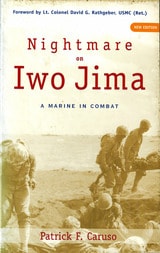
Nightmare on Iwo Jima
A Marine in CombatPatrick F. Caruso, with a foreword by David G. Rathgeber
University of Alabama Press, 2007
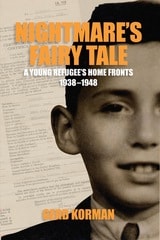
Nightmare's Fairy Tale
A Young Refugee's Home Fronts, 1938–1948Gerd Korman
University of Wisconsin Press, 2007
Fleeing the Nazis in the months before World War II, the Korman family scattered from a Polish refugee camp with the hope of reuniting in America. The father sailed to Cuba on the ill-fated St. Louis; the mother left for the United States after sending her two sons on a Kindertransport. One of the sons was Gerd Korman, whose memoir follows his own path—from the family’s deportation from Hamburg, through his time with an Anglican family in rural England, to the family’s reunited life in New York City. His memoir plumbs the depths of twentieth-century history to rescue the remarkable life story of one of its survivors.
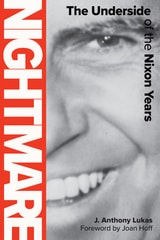
Nightmare
The Underside of the Nixon YearsJ. Anthony Lukas
Ohio University Press, 1999
In July 1973, for the first time in its history, the New York Times Magazine devoted a full issue to a single article: Pulitzer Prize–winning journalist J. Anthony Lukas’s account of the Watergate story to date. Six months later, a second installment ran in another full issue. Later the Times asked him to write a third issue, on the impeachment, which never appeared because of Nixon’s intervening resignation. But all of Lukas’s painstaking reporting on Nixon’s last months in office appears here, along with added information on every aspect of Watergate.
Widely acclaimed as a major text of the Watergate saga, J. Anthony Lukas’s Nightmare is a masterwork of investigation, highlighted by in-depth character sketches of the key players. For students of history coming to these events for the first time, this book reveals in depth the particular trauma of a nation in turmoil; for those who remember, the upheaval and what was at stake are once more brought to life.
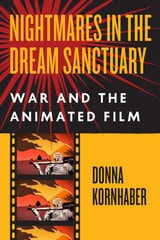
Nightmares in the Dream Sanctuary
War and the Animated FilmDonna Kornhaber
University of Chicago Press, 2019
Generation after generation, artists have turned to this most fantastical of mediums to capture real-life horrors they can express in no other way. From Chinese animators depicting the Japanese invasion of Shanghai to Bosnian animators portraying the siege of Sarajevo, from African animators documenting ethnic cleansing to South American animators reflecting on torture and civil war, from Vietnam-era protest films to the films of the French Resistance, from firsthand memories of Hiroshima to the haunting work of Holocaust survivors, the animated medium has for more than a century served as a visual repository for some of the darkest chapters in human history. It is a tradition that continues even to this day, in animated shorts made by Russian dissidents decrying the fighting in Ukraine, American soldiers returning from Iraq, or Middle Eastern artists commenting on the Israeli-Palestinian conflict, the Arab Spring, or the ongoing crisis in Yemen.
Nightmares in the Dream Sanctuary: War and the Animated Film vividly tells the story of these works and many others, covering the full history of animated film and spanning the entire globe. A rich, serious, and deeply felt work of groundbreaking media history, it is also an emotional testament to the power of art to capture the endurance of the human spirit in the face of atrocity.
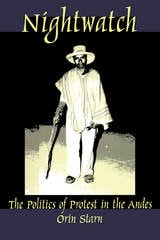
Nightwatch
The Politics of Protest in the AndesOrin Starn
Duke University Press, 1999
Drawing on fieldwork conducted over the course of a decade, Orin Starn chronicles the historical conditions that led to the formation of the rondas, the social and geographical expansion of the movement, and its gradual decline in the 1990s. Throughout this anecdotal yet deeply analytical account, the author relies on interviews with ronda participants, villagers, and Peru’s regional and national leaders to explore the role of women, the involvement of nongovernmental organizations, and struggles for leadership within the rondas. Starn moves easily from global to local contexts and from the fifteenth to the twentieth century, presenting this movement in a straightforward manner that makes it accessible to both specialists and nonspecialists.
An engagingly written story of village mobilization, Nightwatch is also a meditation on the nature of fieldwork, the representation of subaltern people, the relationship between resistance and power, and what it means to be politically active at the end of the century. It will appeal widely to scholars and students of anthropology, Latin American studies, cultural studies, history, subaltern studies, and those interested in the politics of social movements.
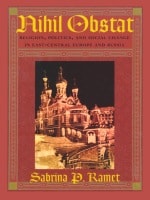
Nihil Obstat
Religion, Politics, and Social Change in East-Central Europe and RussiaSabrina P. Ramet
Duke University Press, 1998
Based on interview research in Germany, Austria, Slovenia, Croatia, Bosnia, Serbia, and Macedonia, and on materials published in German, Italian, Serbo-Croatian, Polish, Czech, Slovak, Russian, and English, Ramet paints a clear picture of the political and religious fragility of former communist states, which are experiencing some aspects of freedom and choice for the first time. With its comprehensive discussion of the largest religious institutions in the area, especially the Catholic and Orthodox Churches, and its extensive survey of nontraditional religious associations that have become active in the region since 1989, this study makes a distinct contribution to growing discussions about the rise of fundamentalism and the inner dilemmas of modernity. With its depth of information and thoughtful exploration of cultural traditions, Nihil Obstat uniquely presents the ramifications and complexities of European religion in a postcommunist world.

Nikkei Baseball
Japanese American Players from Immigration and Internment to the Major LeaguesSamuel Ragalado
University of Illinois Press, 2013

Nikkei in the Interior West
Japanese Immigration and Community Building, 1882–1945Eric Walz
University of Arizona Press, 2012
Eric Walz's Nikkei in the Interior West tells the story of more than twelve thousand Japanese immigrants who settled in the interior West--Arizona, Colorado, Idaho, Nebraska, and Utah. They came inland not as fugitives forced to relocate after Pearl Harbor but arrived decades before World War II as workers searching for a job or as picture brides looking to join husbands they had never met.
Despite being isolated from their native country and the support of larger settlements on the West Coast, these immigrants formed ethnic associations, language schools, and religious institutions. They also experienced persecution and discrimination during World War II in dramatically different ways than the often-studied immigrants living along the Pacific Coast. Even though they struggled with discrimination, these interior communities grew both in size and in permanence to become an integral part of the American West.
Using oral histories, journal entries, newspaper accounts, organization records, and local histories, Nikkei in the Interior West explores the conditions in Japan that led to emigration, the immigration process, the factors that drew immigrants to the interior, the cultural negotiation that led to ethnic development, and the effects of World War II. Examining not only the formation and impact of these Japanese communities but also their interaction with others in the region, Walz demonstrates how these communities connect with the broader Japanese diaspora.
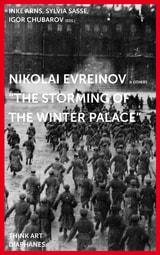
Nikolai Evreinov & Others
»The Storming of the Winter Palace«Edited by Inke Arns, Sylvia Sasse, and Igor Chubarov
Diaphanes, 2017
Nikolaj Evreinov: “The Storming of the Winter Palace” tells the fascinating story of this production. Taking readers through the relevant history, the authors describe the role of The Storming of the Winter Palace in commemorating Soviet power. With a wealth of illustrations, they also show how photographs of Evreinov’s theatrical storming eventually became historical documents of the October Revolution themselves.
Nimble Believing
Dickinson and the UnknownJames McIntosh
University of Michigan Press, 2004
--Harold Bloom, Genius
" . . . a truly literary study in the largest, most humane, sense. Instead of subjecting poems to the distortions of theory, it brings biography, theology, psychology, and cultural history to bear on the intricacies of language, where all the issues of the poet's life and work converge, contend, and seek resolution."
--Albert Gelpi, American Literature
" . . . insightful readings of many of Dickinson's difficult poems and . . . a significant contribution to Dickinson studies."
---Choice
"McIntosh shows the power of Dickinson's religious quest in word, in verse, and in truth. He shows that she was much more than an ever-adolescent angry rebel trying to subvert the religious oppression of benighted Amherst neighbors."
---Emily Dickinson Journal
Nine Desperate Days
America's Rainbow Division in the Aisne-Marne OffensiveRobert Thompson
Westholme Publishing, 2022
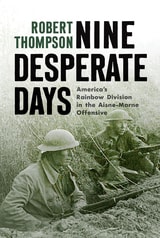
American forces entered World War I combat in October 1917, but it was not until July 1918 that they went on the offensive for the first time. Among the units selected for this operation was the 42nd Division, or the “Rainbow Division” as it was known popularly. This division, which was composed of National Guard units from twenty-six states, including Joyce Kilmer’s 69th New York Infantry, would spend 164 days in combat, a number exceeded by only two other American divisions. However, it was the nine days from July 25 to August 2, 1918 that were the most terrible and heroic in the division’s history. General of the Army Douglas MacArthur, who served as the division’s chief of staff, later said of the Rainbow Division’s fighting during those pivotal days, “There was neither rest nor mercy.” During those nine days, the Rainbow Division would spearhead the Allied attack in the Aisne-Marne region, the final phase of the Second Battle of the Marne, which saw the last major German offensive on the Western Front defeated. Unfortunately, American leadership proved to be completely unprepared for a dynamic war of maneuver. Basing decisions on wildly inaccurate information about the Germans, senior commanders ordered the men of the Rainbow Division to make ill-advised assaults again and again with little support. Facing an enemy who was determined to hold itspositions, these National Guardsmen fought with courage and determination to gain what was often only yards of ground, and did so at a deadly cost.
In Nine Desperate Days: America’s Rainbow Division in the Aisne-Marne Offensive, historian Robert Thompson chronicles the hardships and tenacity of the men from the 42nd Division during this pivotal campaign. The Americans did not break despite heavy losses, and were able to drive the Germans back from territory they initially gained. The efforts of the Rainbow Division during Aisne-Marne were key to the ultimate Allied victory and are a symbol of American valor and sacrifice during the “war to end all wars.”
Nine Months Is a Year
At Baboquívari SchoolEulalia Bourne
University of Arizona Press, 1968

Nineteenth Century Home Architecture of Iowa City
A Silver Anniversary EditionMargaret N. Keyes
University of Iowa Press, 1993
Nineteenth-Century China
Five Imperialist PerspectivesSelected by Dilip Basu. Edited with an introduction by Rhoads Murphey
University of Michigan Press, 1972
Nineteenth-Century English
Richard W. Bailey
University of Michigan Press, 1998
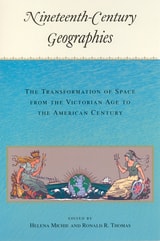
Nineteenth-Century Geographies
The Transformation of Space from the Victorian Age to the American CenturyThomas, Ronald R
Rutgers University Press, 2002
The nineteenth century was a time of unprecedented discovery and exploration throughout the globe, a period when the “blank spaces” of the earth were systematically investigated, occupied, and exploited by the major imperial powers of Western Europe and the United States. The lived experience of space was also changing in dramatic ways for people as a result of new developments in technology, communication, and transportation. As a result, the century was characterized by a new and intense interest in place, both local and global.
The collection is comprised of seventeen essays from various disciplines organized into four areas of geographic concern. The first, “Time Zones,” examines several ways that place gets expressed as time during the period, how geography becomes history. A second grouping, “Commodities and Exchanges,” explores the role of geographic origin as it was embodied in particular objects, from the souvenir map to imported tea. The set of essays on “Domestic Fronts” moves the discussion from the public to the private sphere by looking at how domestic space became defined in terms of its boundary with the foreign. The final section, “Orientations,” takes up the changing relations of bodies, identities, and the spaces they inhabit and through which they moved. The collection as a whole also traces the development of the discipline of geography with its different institutional and political trajectories in the United States and Great Britain.
Nineteenth-Century Rhetoric in North America
Nan Johnson
Southern Illinois University Press, 1991
Johnson argues that nineteenth-century rhetoric was primarily synthetic, derived from the combination of classical elements and eighteenth-century belletristic and epistemological approaches to theory and practice. She reveals that nineteenth-century rhetoric supported several rhetorical arts, each conceived systematically from a similar theoretical foundation.

Nineteenth-Century Scottish Rhetoric
The American ConnectionWinifred Bryan Horner
Southern Illinois University Press, 1992
Winifred Bryan Horner argues that an understanding of the changes that occurred in the content of nineteenth-century courses in logic, rhetoric, and belles lettres taught in Scottish universities provides important critical insight into the development of the twentieth-century American composition course, as well as courses in English literature and critical theory.
Because of the inaccessibility of primary materials documenting the changes in courses taught at Scottish universities, the impression remains that the nineteenth century represents a break with the traditional school curriculum rather than a logical transition to a new focus of study. Horner has discovered that the notes of students who attended these classes—meticulously transcribed records of the lectures that professors dictated in lieu of printed texts—provide reliable documentation of the content of courses taught during the period. Using these records, Horner traces the evolution of current traditional composition, developed in the United States in the first part of the twentieth century, from courses taught in nineteenth-century, northern Scottish universities. She locates the beginning of courses in English literature and belletristic composition in the southern schools, particularly Edinburgh.
Horner’s study opens new vistas for the study of the evolution of university curricula, especially the never before acknowledged influence of belletristric rhetoric on the development of the North American composition course.
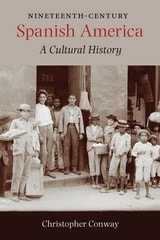
Nineteenth-Century Spanish America
A Cultural HistoryChristopher Conway
Vanderbilt University Press, 2015
The book opens with key themes that will help students and scholars understand the century, such as the civilization and barbarism binary, urbanism, the divide between conservatives and liberals, and transculturation. In the chapters that follow, Conway weaves transnational trends together with brief case studies and compelling snapshots that help us understand the period. How much did books and photographs cost in the nineteenth century? What was the dominant style in painting? What kinds of ballroom dancing were popular? Richly illustrated with striking photographs and lithographs, this is a book that invites the reader to rediscover a past age that is not quite past, still resonating into the present.

Nineteenth-Century Women at the Movies
Adapting Classic Women's Fiction to FilmBarbara Tepa Lupack
University of Wisconsin Press, 1999
This volume’s twelve essays offer critical insights not only into the visions of the novelist and the filmmaker but also into contemporary cultural concerns. The adaptations of novels by eight popular writers are analyzied: Mary Shelley, Jane Austen, Charlotte Brontë, Emily Brontë, Harriet Beecher Stowe, Louisa May Alcott, Ouida, and George Eliot.
Nineteenth-Century Women’s Movements and the Bible
Angela Berlis
SBL Press, 2024
Nineteenth-Century Women’s Movements and the Bible examines politically motivated women’s movements in the nineteenth century, including the legal, cultural, and ecclesiastical contexts of women. Focusing on the period beginning with the French Revolution in 1789 through the end of World War I in 1918, contributors explore the many ways that women’s lives were limited in both the public and domestic spheres. Essays consider the social, political, biblical, and theological factors that resulted in a multinational raising of awareness and emancipation for women in the nineteenth century and the strengthening of their international networks. The contributors include Angela Berlis, Kristin Kobes Du Mez, Ute Gerhard, Christiana de Groot, Arnfriður Guðmundsdóttir, Izaak J. de Hulster, Elisabeth Joris, Christine Lienemann-Perrin, Amanda Russell-Jones, Claudia Setzer, Aud V. Tønnessen, Adriana Valerio, and Royce M. Victor.

Ninety Degrees In The Shade
Clarence E. Cason
University of Alabama Press, 1983
In 1935, Cason collected his thoughts in a small book of essays titled 90° in the Shade. In it, he declared that climate and the relaxation afforded by field and stream had given southerners excellent reasons for their notoriously slow pace of life. Still, he wrote, "there is much work that ought to be done below the Potomac." Cason captured the pathos of race relations and other persistent problems and declared that the abominable practice of lynching would end when the best people of the South risked their personal and commercial standing to denounce it. Just days before the book's publication, however, Cason shot himself in his campus office. He left no explanation, but apparently he feared angry reaction from fellow citizens to his mild criticisms and gentle suggestions for change.
The University of Alabama Press brought the book back into print in 1983. This new edition of Cason's classic features an introduction by journalist and UA professor H. Bailey Thomson, allowing yet another generation the enjoyment of Cason's perceptive writing, not so much for any remedy he proposed but rather for the open-minded and loving way in which he addressed the region's tragic experience.
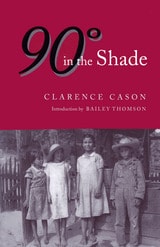
Ninety Degrees in the Shade
Clarence E. Cason
University of Alabama Press, 2001
A candid, courageous portrait of the South as told by a writer unafraid to confront its heat, its history, and its humanity.
Clarence Cason belonged to that restless generation of southern intellectuals who, between the world wars, questioned the South's stubborn traditionalism, even as they tried to explain and defend its distinctiveness. From his professorial perch at The University of Alabama, Cason wrote polished essays for leading national publications while contributing weekly editorials for newspaper readers. As a journalist in academia, he cultivated a broad audience for his eloquent though tentative observations about the "character" of a region that seemed to be a separate province of the nation.
In 1935, Cason collected his thoughts in a small book of essays titled 90° in the Shade. In it, he declared that climate and the relaxation afforded by field and stream had given southerners excellent reasons for their notoriously slow pace of life. Still, he wrote, "there is much work that ought to be done below the Potomac." Cason captured the pathos of race relations and other persistent problems and declared that the abominable practice of lynching would end when the best people of the South risked their personal and commercial standing to denounce it. Just days before the book's publication, however, Cason shot himself in his campus office. He left no explanation, but apparently he feared angry reaction from fellow citizens to his mild criticisms and gentle suggestions for change.
The University of Alabama Press brought the book back into print in 1983. This new edition of Cason's classic features an introduction by journalist and UA professor H. Bailey Thomson, allowing yet another generation the enjoyment of Cason's perceptive writing, not so much for any remedy he proposed but rather for the open-minded and loving way in which he addressed the region's tragic experience.
This second reprint edition of a classic work on southern culture will allow a new generation of readers to enjoy Cason's observant, graceful writing.