Results by title
482 books match the query '17th century' and 11 start with o
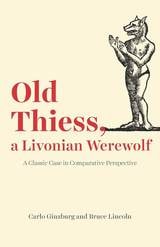
Old Thiess, a Livonian Werewolf
A Classic Case in Comparative PerspectiveCarlo Ginzburg and Bruce Lincoln
University of Chicago Press, 2020
In this book, eminent scholars Carlo Ginzburg and Bruce Lincoln offer a uniquely comparative look at the trial and startling testimony of Old Thiess. They present the first English translation of the trial transcript, in which the man’s own voice can be heard, before turning to subsequent analyses of the event, which range from efforts to connect Old Thiess to shamanistic practices to the argument that he was reacting against cruel stereotypes of the “Livonian werewolf” a Germanic elite used to justify their rule over the Baltic peasantry. As Ginzburg and Lincoln debate their own and others’ perspectives, they also reflect on broader issues of historical theory, method, and politics. Part source text of the trial, part discussion of historians’ thoughts on the case, and part dialogue over the merits and perils of their different methodological approaches, Old Thiess, a Livonian Werewolf opens up fresh insight into a remarkable historical occurrence and, through it, the very discipline of history itself.
On Descartes’ Passive Thought
The Myth of Cartesian DualismJean-Luc Marion
University of Chicago Press, 2018
Descartes has long been associated with mind-body dualism, but Marion argues here that this is a historical misattribution, popularized by Malebranche and popular ever since both within the academy and with the general public. Actually, Marion shows, Descartes held a holistic conception of body and mind. He called it the meum corpus, a passive mode of thinking, which implies far more than just pure mind—rather, it signifies a mind directly connected to the body: the human being that I am. Understood in this new light, the Descartes Marion uncovers through close readings of works such as Passions of the Soul resists prominent criticisms leveled at him by twentieth-century figures like Husserl and Heidegger, and even anticipates the non-dualistic, phenomenological concepts of human being discussed today. This is a momentous book that no serious historian of philosophy will be able to ignore.
On the Motive of the Incarnation
Dylan The Salmanticenses
Catholic University of America Press, 2019
Opening Scripture
Bible Reading and Interpretive Authority in Puritan New EnglandLisa M. Gordis
University of Chicago Press, 2003
What role did the Bible really play in Puritan New England? Many have treated it as a blunt instrument used to cudgel dissenters into submission, but Lisa M. Gordis reveals instead that Puritan readings of the Bible showed great complexity and literary sophistication—so much complexity, in fact, that controversies over biblical interpretation threatened to tear Puritan society apart.
Drawing on Puritan preaching manuals and sermons as well as the texts of early religious controversies, Gordis argues that Puritan ministers did not expect to impose their views on their congregations. Instead they believed that interpretive consensus would emerge from the process of reading the Bible, with the Holy Spirit assisting readers to understand God's will. Treating the conflict over Roger Williams, the Antinomian Controversy, and the reluctant compromises of the Halfway Covenant as symptoms of a crisis that was as much literary as it was social or spiritual, Opening Scripture explores the profound consequences of Puritan negotiations over biblical interpretation for New England's literature and history.
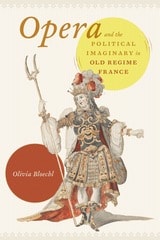
Opera and the Political Imaginary in Old Regime France
Olivia Bloechl
University of Chicago Press, 2018
In Opera and the Political Imaginary in Old Regime France, however, Olivia Bloechl reveals another layer of French opera’s political theater. The make-believe worlds on stage, she shows, involved not just fantasies of sovereign rule but also aspects of government. Plot conflicts over public conduct, morality, security, and law thus appear side-by-side with tableaus hailing glorious majesty. What’s more, opera’s creators dispersed sovereign-like dignity and powers well beyond the genre’s larger-than-life rulers and gods, to its lovers, magicians, and artists. This speaks to the genre’s distinctive combination of a theological political vocabulary with a concern for mundane human capacities, which is explored here for the first time.
By looking at the political relations among opera characters and choruses in recurring scenes of mourning, confession, punishment, and pardoning, we can glimpse a collective political experience underlying, and sometimes working against, ancienrégime absolutism. Through this lens, French opera of the period emerges as a deeply conservative, yet also more politically nuanced, genre than previously thought.
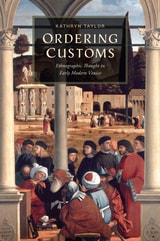
Ordering Customs
Ethnographic Thought in Early Modern VeniceKathryn Taylor
University of Delaware Press, 2023
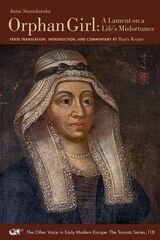
Orphan Girl
A Lament on a Life's MisfortunesAnna Stanislawska
Iter Press, 2026
A long-lost seventeenth-century poetic text exemplifying women's writing in the early modern period.
Written in 1685, Orphan Girl traces the life of the Polish noblewoman Anna Stanisławska (1651–1700) as she writes candidly and unsparingly about the course of her life, from her infancy to the time of her second widowhood, and ultimately her withdrawal from a world of which she no longer wants any part. Stanisławska was an incomparable memoirist, revealing the tumultuous course of her three marriages. Described as one of the nine female Polish writers you need to read before you die, she is a writer whose stridency and directness of authorial voice would not be matched until modern times.
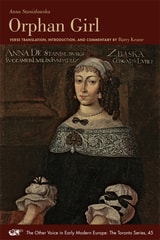
Orphan Girl
A Transaction, or an Account of the Entire Life of an Orphan Girl by way of Plaintful Threnodies in the Year 1685. The Aesop EpisodeAnna Stanislawska
Iter Press, 2016
Barry Keane's idiomatic and inventive verse translation brings to life this half-forgotten poetic account of a remarkable tale of triumph in the face of overwhelming oppression and allows Anna Stanislawska to take her place among the women poets of early modern Europe.
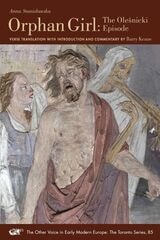
Orphan Girl
The Olesnicki Episode: One Body with Two Souls Entwined: An Epic Tale of Married Love in Seventeenth-Century PolandAnna Stanislawska
Iter Press, 2021
Written in 1685, Transaction or the Description of the Entire Life of an Orphan by Way of Plaintful Threnodies, often referred to as Orphan Girl, is a valuable, long-lost, seventeenth-century poetic text that documents women’s writing in the early modern period. In this autobiographical account, Anna Stanislawska speaks confessionally and unsparingly about her life, from her infancy to her widowhood and withdrawal from the world. Stanislawska was an incomparable memoirist, revealing the depths of her private life in a manner not to be matched until modern times. One Body with Two Souls Entwined brings together this spirited poetic account with an in-depth introductory and literary commentary by Barry Keane. Together the book offers a remarkable piece of scholarly, translational, and dramaturgical work and puts it in context amid the backdrop of Polish history.
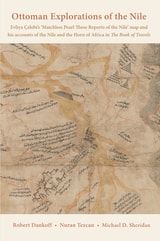
Ottoman Explorations of the Nile
Evliya Çelebi’s Map of the Nile and The Nile Journeys in the Book of Travels (Seyahatname)Robert Dankoff, Nuran Tezcan, and Michael D. Sheridan
Gingko, 2018
Evliya Çelebi’s account of his Nile journeys, in the tenth volume of his Book of Travels (Seyahatname), has been known to the scholarly world since 1938, when that volume was first published. The map, held in the Vatican Library, has been studied since at least 1949. Numerous new critical editions of both the map and the text have been published over the years, each expounding upon the last in an attempt to reach a definitive version. The Ottoman Explorations of the Nile provides a more accurate translation of the original travel account. Furthermore, the maps themselves are reproduced in greater detail and vivid color, and there are more cross-references to the text than in any previous edition. This volume gives equal weight and attention to the two parts that make up this extraordinary historical document, allowing readers to study the map or the text independently, while also using each to elucidate and accentuate the details of the other.
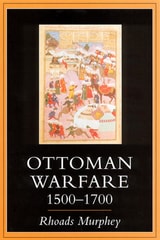
Ottoman Warfare 1500-1700
Murphey, Rhoads
Rutgers University Press, 1999