Results by title
336 books match the query 'Age' and 3 start with o

Oeconomies in the Age of Newton
2003 Supplement, Volume 35Margaret Schabas and Neil De Marchi
Duke University Press, 0
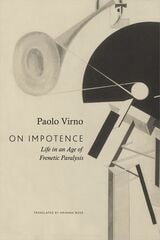
On Impotence
Life in an Age of Frenetic ParalysisPaolo Virno
Seagull Books, 2026
Contemporary life is marked by a paradoxical form of impotence. Whether in love, labor, or political struggle, we often find ourselves locked in a state of frenetic paralysis—unable to act as we wish or to endure what confronts us. This impotence is not born of lack, but of excess: an abundance of skills, capacities, and opportunities that, instead of taking form as coherent actions or speech, stagnate and turn in on themselves. In this thought-provoking meditation, philosopher Paolo Virno examines this strange impotence through the lens of classical thought, drawing especially on Aristotle and Marx.
To overcome this troubling state, Virno calls for a collective search for a shared spiritual and practical exercise aimed at reclaiming agency. He argues that only by learning to renounce renunciation can we cultivate deliberate words and timely decisions.

On Not Dying
Secular Immortality in the Age of TechnoscienceAbou Farman
University of Minnesota Press, 2020
An ethnographic exploration of technoscientific immortality
Immortality has long been considered the domain of religion. But immortality projects have gained increasing legitimacy and power in the world of science and technology. With recent rapid advances in biology, nanotechnology, and artificial intelligence, secular immortalists hope for and work toward a future without death.
On Not Dying is an anthropological, historical, and philosophical exploration of immortality as a secular and scientific category. Based on an ethnography of immortalist communities—those who believe humans can extend their personal existence indefinitely through technological means—and an examination of other institutions involved at the end of life, Abou Farman argues that secular immortalism is an important site to explore the tensions inherent in secularism: how to accept death but extend life; knowing the future is open but your future is finite; that life has meaning but the universe is meaningless. As secularism denies a soul, an afterlife, and a cosmic purpose, conflicts arise around the relationship of mind and body, individual finitude and the infinity of time and the cosmos, and the purpose of life. Immortalism today, Farman argues, is shaped by these historical and culturally situated tensions. Immortalist projects go beyond extending life, confronting dualism and cosmic alienation by imagining (and producing) informatic selves separate from the biological body but connected to a cosmic unfolding.
On Not Dying interrogates the social implications of technoscientific immortalism and raises important political questions. Whose life will be extended? Will these technologies be available to all, or will they reproduce racial and geopolitical hierarchies? As human life on earth is threatened in the Anthropocene, why should life be extended, and what will that prolonged existence look like?