Results by title
299 books match the query 'Arizona' and 6 start with o

Ocean Power
Poems from the DesertOfelia Zepeda
University of Arizona Press, 1995
Poet Ofelia Zepeda centers these poems on her own experiences growing up in a Tohono O'odham family, where desert climate profoundly influenced daily life, and on her perceptions as a contemporary Tohono O'odham woman. One section of poems deals with contemporary life, personal history, and the meeting of old and new ways. Another section deals with winter and human responses to light and air. The final group of poems focuses on the nature of women, the ocean, and the way the past relationship of the O'odham with the ocean may still inform present day experience. These fine poems will give the outside reader a rich insight into the daily life of the Tohono O'odham people.
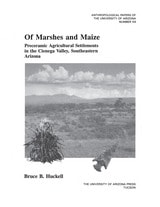
Of Marshes and Maize
Preceramic Agricultural Settlement in the Cienega Valley, Southeastern ArizonaBruce B. Huckell
University of Arizona Press, 1995
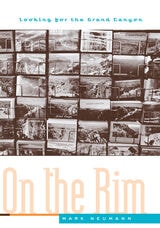
On The Rim
Looking for the Grand CanyonMark Neumann
University of Minnesota Press, 2001
Why do nearly five million people travel to the Grand Canyon each year? Mark Neumann answers this question with a book as compelling as the panoramic vistas of the canyon. In On the Rim, he describes how the Grand Canyon became an internationally renowned tourist attraction and cultural icon, and delves into the meanings the place holds for the individuals who live, work, and travel there.
Weaving history, ethnography, documentary photography, and autobiography, Neumann exposes the roots—the personal and social dimensions—of America’s pursuit of leisure. He shows how people visiting the Grand Canyon create their own experiences, even while they are affected by one hundred years of social history and cultural expectations. On the Rim examines the lines between progress and nostalgia, science and spirituality, nature and culture, authenticity and mass production, and work and leisure—all of which crisscross the tourist experience.
To support his argument, Neumann uses evidence from tourist registers and Park Service records, first-person narratives, interviews, and scenes from television shows, Hollywood movies, and popular novels. Heavily illustrated with historical and contemporary photographs, the narrative shifts back and forth between early descriptions of the canyon and modern tourist stories, the past illuminating the present at every step.
From Albert Einstein’s visit and the hunt for the fugitive Danny Horning to the everyday experiences of local Native Americans, park rangers, and vacationing families, Neumann reminds us that every trip to the Grand Canyon is a complex journey, fueled by shared expectations but always open to the possibility of surprise. On the Rim is a multilayered, nuanced study of the place and its many visitors.
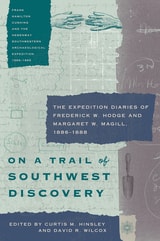
On a Trail of Southwest Discovery
The Expedition Diaries of Frederick W. Hodge and Margaret W. Magill, 1886–1888Curtis M. Hinsley and David R. Wilcox
University of Arizona Press, 2024
The Hemenway Southwestern Archaeological Expedition (1886–1889), directed by Frank Hamilton Cushing, was the first privately funded expedition to the American Southwest. This volume examines the expedition through the diaries of two participants who fell in love on the expedition: the field secretary, Fred Hodge, and the expedition artist, Margaret Magill—who was also Cushing’s sister-in-law. It also presents the first biographical treatment of Hodge, who became a major figure in early twentieth-century anthropology. The book’s first two sections chronicle the field operations of the expedition, while the third describes the long anthropological career of Hodge after the end of the expedition. Through deep research in primary and secondary sources and archival materials, the book details both the daily operations of the expedition and the growing romantic relationship between Hodge and Magill.
For those interested in settlements in early Arizona and Zuni Pueblo, the book provides rare insights into the lives of both men and women, offering an intimate view of an enterprise that is now considered a foundation of Hohokam archaeology—even as it reveals deep love and persistent personal conflicts.

Ordered West
The Civil War Exploits of Charles A. CurtisAlan D. Gaff
University of North Texas Press, 2017

Organ Pipe
Life on the EdgeText by Carol Ann Bassett; Photographs by Michael Hyatt
University of Arizona Press, 2004
A terrain where one learns to pay attention to the details: the tracks of a sidewinder in the sand, the tiny eggs of a cactus wren, the flash of a vermilion flycatcher against the azure sky.
Organ Pipe Cactus National Monument lies in southwestern Arizona on the Mexican border. It is an isolated park that for Carol Ann Bassett has long been a place of solitude—a silent refuge where she often camped out alone to capture the natural rhythms of the desert. Photographer Michael Hyatt hiked through Organ Pipe to visually document its subtle beauty in the Ajo Mountains and the valley of the Ajo, and at Quitobaquito, a rare desert oasis.
Few visitors may brave Organ Pipe during summer, when the temperature can reach 120 degrees, but for Bassett and Hyatt the searing heat is but a harbinger of rain, when normally dry arroyos surge with rust-colored water and desert tarantulas come out to mate. Bassett introduces readers to Organ Pipe’s cultural heritage as well: Spanish missionaries, Anglo settlers, and the Tohono O’odham and the Hia Ced O’odham people who still travel there to gather cactus fruit during Hasan Bakmasad, "saguaro moon." She also considers the changes taking place throughout the park, including the onrush of immigrants passing through in search of better lives in the United States.
This small, lyrical book is a sensitive reflection on the heart of the Sonoran Desert. It reminds us of the beauty to be found in unexpected places—and of our intimate connection with the wild.