Results by title
435 books match the query 'Asian American & Pacific Islander Studies' and 8 start with o
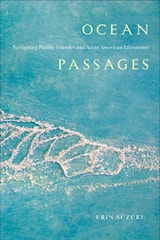
Ocean Passages
Navigating Pacific Islander and Asian American LiteraturesErin Suzuki
Temple University Press, 2021
In her pathbreaking book, Ocean Passages, Erin Suzuki explores how movement through—and travel across—the ocean mediates the construction of Asian American and Indigenous Pacific subjectivities in the wake of the colonial conflicts that shaped the modern transpacific. Ocean Passages considers how Indigenous Pacific scholars have emphasized the importance of the ocean to Indigenous activism, art, and theories of globalization and how Asian American studies might engage in a deconstructive interrogation of race in conversation with this Indigenous-centered transnationalism.
The ocean passages that Suzuki addresses include the U.S. occupation and militarization of ocean space; refugee passage and the history and experiences of peoples displaced from the Pacific Islands; migratory circuits and the labors required to cross the sea; and the different ways that oceans inform postcolonial and settler colonial nationalisms. She juxtaposes work by Indigenous Pacific and Asian American artists and authors including James George, Maxine Hong Kingston, Kathy Jetñil-Kijiner, lê thi diếm thúy, Ruth Ozeki, and Craig Santos Perez. In Ocean Passages, Suzuki explores what new ideas, alliances, and flashpoints might arise when comparing and contrasting Asian and Pacific Islander passages across a shared sea.
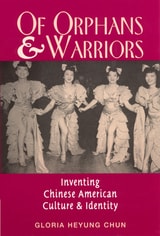
Of Orphans and Warriors
Inventing Chinese American Culture and IdentityChun, Gloria Heyung
Rutgers University Press, 1999
"We were as American as can be," states Jadin Wong in recalling the days when she used to dance at a San Francisco nightclub during the 1940s. Wong belonged to an all-Chinese chorus line at a time when all East Asians were called "Orientals." In this context, then, what did it mean for Wong, an American-born Chinese, to say that she thought of herself as an "American"? Of Orphans and Warriors explores the social and cultural history of largely urban, American-born Chinese from the 1930s through the 1990s, focusing primarily on those living in California. Chun thus opens a window onto the ways in which these Americans born of Chinese ancestry negotiated their identity over a half century.
Past scholarship has portrayed these individuals as desiring to assimilate into mainstream American culture, but being prevented from doing so by the immigrant parent generation. Taking a new approach, Chun uses memoirs, autobiographies, and fictional writings to unravel complex issues of ethnic identity as both culturally defined and individually negotiated. She concludes that, while indeed many Chinese Americans were caught between the lures of mainstream American culture and their parents' old-world values, this liminal position offered them unprecedented opportunities to carve out new identities for themselves from a position of strength.
Old China Through the Eyes of a Storyteller
Julie Moss Herrera
Parkhurst Brothers, Inc., 2012
“Having traveled on the same People to People Ambassador journey to China with Julie, I have seen Julie's anthology from inception to fruition. It is a masterful, engaging, informative and scholarly addition to our understanding and appreciation of Chinese culture, particularly storytelling and folk traditions, from ancient days to today. Practicing storytellers will especially appreciate her tips for telling and context clues at the end of each story.”
--Judith Heineman, storyteller, producer and Illinois Humanities Road Scholar

On Becoming Filipino
Selected Writings of Carlos BulosanE. San Juan
Temple University Press, 1995
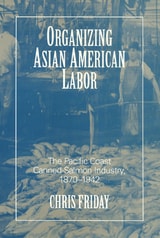
Organizing Asian-American Labor
The Pacific Coast Canned-Salmon Industry, 1870-1942Chris Friday
Temple University Press, 1995
Between 1870 and 1942, successive generations of Asians and Asian Americans—predominantly Chinese, Japanese, and Filipino—formed the predominant body of workers in the Pacific Coast canned-salmon industry.
This study traces the shifts in the ethnic and gender composition of the cannery labor market from its origins through it decline and examines the workers' creation of work cultures and social communities. Resisting the label of cheap laborer, these Asian American workers established formal and informal codes of workplace behavior, negotiated with contractors and recruiters, and formed alliances to organize the workforce.
Whether he is discussing Japanese women workers' sharing of child-care responsibilities or the role of Filipino workers in establishing the Cannery and Field Workers Union, Chris Friday portrays Asian and Asian American workers as people who, while enduring oppressive restrictions, continually attempted to shape their own lives.
In the series Asian American History and Culture, edited by Sucheng Chan, David Palumbo-Liu, Michael Omi, K. Scott Wong, and Linda Trinh Võ.
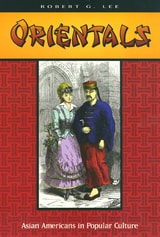
Orientals
Robert Lee
Temple University Press, 1999
The idea of Asians as mysterious strangers who could not be assimilated into the cultural mainstream was percolating to the surface of American popular culture in the mid-nineteenth century, when Chinese immigrant laborers began to arrive in this country in large numbers. Lee shows how the bewildering array of racialized images first proffered by music hall songsters and social commentators have evolved and become generalized to all Asian Americans, coalescing in particular stereotypes. Whether represented as Pollutant, Coolie, Deviant, Yellow Peril, Model Minority, or Gook, the Oriental is portrayed as alien and a threat to the American family -- the nation writ small.
Refusing to balance positive and negative stereotypes, Lee connects these stereotypes to particular historical moments, each marked by shifting class relations and cultural crises. Seen as products of history and racial politics, the images that have prevailed in songs, fiction, films, and nonfiction polemics are contradictory and complex. Lee probes into clashing images of Asians as (for instance) seductively exotic or devious despoilers of (white) racial purity, admirably industrious or an insidious threat to native laborers. When Lee dissects the ridiculous, villainous, or pathetic characters that amused or alarmed the American public, he finds nothing generated by the real Asian American experience; whether they come from the Gold Rush camps or Hollywood films or the cover of Newsweek, these inhuman images are manufactured to play out America's racial myths.
Orientals comes to grips with the ways that racial stereotypes come into being and serve the purposes of the dominant culture.

Our Southern Accents
Asian American Voices in the U.S. SouthThao Le-Thanh Ha
Rutgers University Press, 2027
This powerful anthology centers Asian American, Native Hawaiian, and Pacific Islander communities in the U.S. South, tracing their histories, struggles, and cultural impact. From early settlements to present day challenges, it reimagines the South through stories of resilience, identity, and belonging that have long been overlooked.
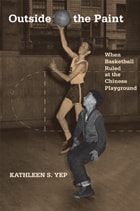
Outside the Paint
When Basketball Ruled at the Chinese PlaygroundKathleen S. Yep
Temple University Press, 2009
Outside the Paint takes readers back to the Chinese Playground of San Francisco in the 1930s and 1940s, the only public outdoor space in Chinatown. It was a place where young Chinese American men and women developed a new approach to the game of basketbal—with fast breaks, intricate passing and aggressive defense—that was ahead of its time.
Drawing on interviews with players and coaches, Kathleen Yep recounts some surprising stories. From the success of the Hong Wah Kues, a professional barnstorming men's basketball team and the Mei Wahs, a championship women’s amateur team, to Woo Wong, the first Chinese athlete to play in Madison Square Garden, and his extraordinarily talented sister Helen Wong, who is compared to Babe Didrikson.
Outside the Paint chronicles the efforts of these highly accomplished athletes who developed a unique playing style that capitalized on their physical attributes, challenged the prevailing racial hierarchy, and enabled them, for a time, to leave the confines of their segregated world. As they learned to dribble, shoot, and steal, they made basketball a source of individual achievement and Chinese American community pride.