Results by title
63 books match the query 'Bolivia' and 3 start with o
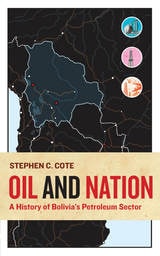
Oil and Nation
A History of Bolivia's Petroleum SectorStephen C. Cote
West Virginia University Press, 2016
Oil and Nation places petroleum at the center of Bolivia’s contentious twentieth-century history. Bolivia’s oil, Cote argues, instigated the largest war in Latin America in the 1900s, provoked the first nationalization of a major foreign company by a Latin American state, and shaped both the course and the consequences of Bolivia’s transformative National Revolution of 1952. Oil and natural gas continue to steer the country under the government of Evo Morales, who renationalized hydrocarbons in 2006 and has used revenues from the sector to reduce poverty and increase infrastructure development in South America’s poorest country.
The book advances chronologically from Bolivia’s earliest petroleum pioneers in the nineteenth century until the present, inserting oil into historical debates about Bolivian ethnic, racial, and environmental issues, and within development strategies by different administrations. While Bolivia is best known for its tin mining, Oil and Nation makes the case that nationalist reformers viewed hydrocarbons and the state oil company as a way to modernize the country away from the tin monoculture and its powerful backers and toward an oil-powered future.
The book advances chronologically from Bolivia’s earliest petroleum pioneers in the nineteenth century until the present, inserting oil into historical debates about Bolivian ethnic, racial, and environmental issues, and within development strategies by different administrations. While Bolivia is best known for its tin mining, Oil and Nation makes the case that nationalist reformers viewed hydrocarbons and the state oil company as a way to modernize the country away from the tin monoculture and its powerful backers and toward an oil-powered future.
[more]
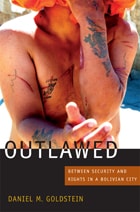
Outlawed
Between Security and Rights in a Bolivian CityDaniel M. Goldstein
Duke University Press, 2012
In Outlawed, Daniel M. Goldstein reveals how indigenous residents of marginal neighborhoods in Cochabamba, Bolivia, struggle to balance security with rights. Feeling abandoned to the crime and violence that grip their communities, they sometimes turn to vigilante practices, including lynching, to apprehend and punish suspected criminals. Goldstein describes those in this precarious position as "outlawed": not protected from crime by the law but forced to comply with legal measures in other areas of their lives, their solutions to protection criminalized while their needs for security are ignored. He chronicles the complications of the government's attempts to provide greater rights to indigenous peoples, including a new constitution that recognizes "community justice." He also examines how state definitions of indigeneity ignore the existence of marginal neighborhoods, continuing long-standing exclusionary practices. The insecurity felt by the impoverished residents of Cochabamba—and, more broadly, by the urban poor throughout Bolivia and Latin America—remains. Outlawed illuminates the complex interconnections between differing definitions of security and human rights at the local, national, and global levels.
[more]
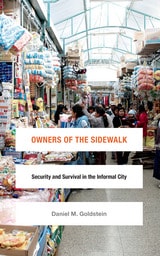
Owners of the Sidewalk
Security and Survival in the Informal CityDaniel M. Goldstein
Duke University Press, 2016
Many of Bolivia's poorest and most vulnerable citizens work as vendors in the Cancha mega-market in the city of Cochabamba, where they must navigate systems of informality and illegality in order to survive. In Owners of the Sidewalk Daniel M. Goldstein examines the ways these systems correlate in the marginal spaces of the Latin American city. Collaborating with the Cancha's legal and permanent stall vendors (fijos) and its illegal and itinerant street and sidewalk vendors (ambulantes), Goldstein shows how the state's deliberate neglect and criminalization of the Cancha's poor—a practice common to neoliberal modern cities—makes the poor exploitable, governable, and consigns them to an insecure existence. Goldstein's collaborative and engaged approach to ethnographic field research also opens up critical questions about what ethical scholarship entails.
[more]