Results by title
547 books match the query 'California' and 11 start with o
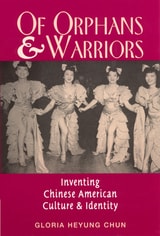
Of Orphans and Warriors
Inventing Chinese American Culture and IdentityChun, Gloria Heyung
Rutgers University Press, 1999
"We were as American as can be," states Jadin Wong in recalling the days when she used to dance at a San Francisco nightclub during the 1940s. Wong belonged to an all-Chinese chorus line at a time when all East Asians were called "Orientals." In this context, then, what did it mean for Wong, an American-born Chinese, to say that she thought of herself as an "American"? Of Orphans and Warriors explores the social and cultural history of largely urban, American-born Chinese from the 1930s through the 1990s, focusing primarily on those living in California. Chun thus opens a window onto the ways in which these Americans born of Chinese ancestry negotiated their identity over a half century.
Past scholarship has portrayed these individuals as desiring to assimilate into mainstream American culture, but being prevented from doing so by the immigrant parent generation. Taking a new approach, Chun uses memoirs, autobiographies, and fictional writings to unravel complex issues of ethnic identity as both culturally defined and individually negotiated. She concludes that, while indeed many Chinese Americans were caught between the lures of mainstream American culture and their parents' old-world values, this liminal position offered them unprecedented opportunities to carve out new identities for themselves from a position of strength.
Oil Beach
How Toxic Infrastructure Threatens Life in the Ports of Los Angeles and BeyondChristina Dunbar-Hester
University of Chicago Press, 2023
San Pedro Bay, which contains the contiguous Ports of Los Angeles and Long Beach, is a significant site for petroleum shipping and refining as well as one of the largest container shipping ports in the world—some forty percent of containerized imports to the United States pass through this so-called America’s Port. It is also ecologically rich. Built atop a land- and waterscape of vital importance to wildlife, the heavily industrialized Los Angeles Harbor contains estuarial wetlands, the LA River mouth, and a marine ecology where colder and warmer Pacific Ocean waters meet. In this compelling interdisciplinary investigation, award-winning author Christina Dunbar-Hester explores the complex relationships among commerce, empire, environment, and the nonhuman life forms of San Pedro Bay over the last fifty years—a period coinciding with the era of modern environmental regulation in the United States. The LA port complex is not simply a local site, Dunbar-Hester argues, but a node in a network that enables the continued expansion of capitalism, propelling trade as it drives the extraction of natural resources, labor violations, pollution, and other harms. Focusing specifically on cetaceans, bananas, sea birds, and otters whose lives are intertwined with the vitality of the port complex itself, Oil Beach reveals how logistics infrastructure threatens ecologies as it circulates goods and capital—and helps us to consider a future where the accumulation of life and the accumulation of capital are not in violent tension.

Opera for Everyone
The Industry's Experiments with American Opera in the Digital AgeMegan Steigerwald Ille
University of Michigan Press, 2024
Operation Fly Trap
L. A. Gangs, Drugs, and the LawSusan A. Phillips
University of Chicago Press, 2012
In 2003, an FBI-led task force known as Operation Fly Trap attempted to dismantle a significant drug network in two Bloods-controlled, African American neighborhoods in Los Angeles. The operation would soon be considered an enormous success, noted for the precision with which the task force targeted and removed gang members otherwise entrenched in larger communities. In Operation Fly Trap, Susan A. Phillips questions both the success of this operation and the methods used to conduct it. Based on in-depth ethnographic research with Fly Trap participants, Phillips’s work brings together police narratives, crime statistics, gang cultural histories, and extensive public policy analysis to examine the relationship between state persecution and the genesis of violent social systems.
Crucial to Phillips’s contribution is the presentation of the voices and perspectives of both the people living in impoverished communities and the agents that police them. Phillips positions law enforcement surveillance and suppression as a critical point of contact between citizen and state. She tracks the bureaucratic workings of police and FBI agencies and the language, ideologies, and methods that prevail within them, and shows how gangs have adapted, seeking out new locations, learning to operate without hierarchies, and moving their activities more deeply underground. Additionally, she shows how the targeted efforts of task forces such as Fly Trap wreak sweeping, sustained damage on family members and the community at large. Balancing her roles as even-handed reporter and public scholar, Phillips presents multiple flaws within the US criminal justice system and builds a powerful argument that many law enforcement policies in fact nurture, rather than prevent, violence in American society.
Organized Agriculture and the Labor Movement before the UFW
Puerto Rico, Hawai’i, CaliforniaBy Dionicio Nodín Valdés
University of Texas Press, 2011
Puerto Rico, Hawai'i, and California share the experiences of conquest and annexation to the United States in the nineteenth century and mass organizational struggles by rural workers in the twentieth. Organized Agriculture and the Labor Movement before the UFW offers a comparative examination of those struggles, which were the era's longest and most protracted campaigns by agricultural workers, supported by organized labor, to establish a collective presence and realize the fruits of democracy.
Dionicio Nodín Valdés examines critical links between the earlier conquests and the later organizing campaigns while he corrects a number of popular misconceptions about agriculture, farmworkers, and organized labor. He shows that agricultural workers have engaged in continuous efforts to gain a place in the institutional life of the nation, that unions succeeded before the United Farm Workers and César Chávez, and that the labor movement played a major role in those efforts. He also offers a window into understanding crucial limitations of institutional democracy in the United States, and demonstrates that the widespread lack of participation in the nation's institutions by agricultural workers has not been due to a lack of volition, but rather to employers' continuous efforts to prevent worker empowerment.
Organized Agriculture and the Labor Movement before the UFW demonstrates how employers benefitted not only from power and wealth, but also from imperialism in both its domestic and international manifestations. It also demonstrates how workers at times successfully overcame growers' advantages, although they were ultimately unable to sustain movements and gain a permanent institutional presence in Puerto Rico and California.
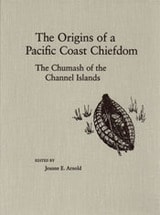
Origins Of A Pacific Coast Chiefdom
Jeanne E Arnold
University of Utah Press, 2001
When Europeans first visited California, they encountered one of the most culturally diverse regions of the New World. The coasts and ecologically richest areas were dotted with small polities which were supported not by horticulture but exclusively by hunting, fishing, and gathering, placing them among the more complex hunter-gatherer groups in the world.
The Origins of a Pacific Coast Chiefdom considers the Chumash, perhaps the most hierarchically organized of the California groups. It explores the final thousand years of coastal Chumash culture, which culminated in the complex society witnessed by the earliest Spanish explorers.
Chumash life was characterized by settled villages, massive production of prestige goods, sophisticated plank canoes, and extensive maritime exchange systems—features more characteristic of agricultural societies. Archaeological sites in the island Chumash area are exceptionally well preserved, permitting precise interpretations of both subtle and major changes in technologies, subsistence, prestige goods, and specialized shell and lithic industries. The data and interpretations presented here are the result of fifteen years of intensive investigation on the Channel Islands.
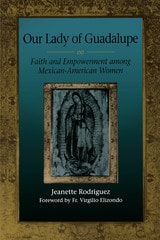
Our Lady of Guadalupe
Faith and Empowerment among Mexican-American WomenBy Jeanette Rodriguez
University of Texas Press, 1994
Our Lady of Guadalupe is the most important religious symbol of Mexico and one of the most powerful female icons of Mexican culture. In this study, based on research done among second-generation Mexican-American women, Rodriguez examines the role the symbol of Guadalupe has played in the development of these women. She goes beyond the thematic and religious implications of the symbol to delve into its relevance to their daily lives.
Rodriguez's study offers an important reinterpretation of one of the New World's most potent symbols. Her conclusions dispute the common perception that Guadalupe is a model of servility and suffering. Rather, she reinterprets the symbol of Guadalupe as a liberating and empowering catalyst for Mexican-American women.
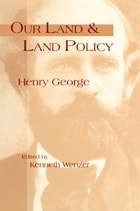
Our Land & Land Policy
Speeches Lectures, and Miscellaneous WritingsKenneth C. Wenzer
Michigan State University Press, 1999
Even before the publication of Progress and Poverty in 1879, San Francisco political economist and publisher Henry George (1839-1897) had written extensively about what he considered to be the causes for worldwide economic inequity—land monopolization and speculation by wealthy entrepreneurs and corrupt politicians. But his attacks on these evils were coupled with a plan for a possible brighter future, for a world in which disparities between people of different classes could be adjusted. By the time he died in 1897, his assessments of liberal 19th-century economic theory were critically acclaimed in Europe and the United States.
Michigan State University Press's new edition of Our Land and Land Policy includes the texts of speeches George delivered and essays he published during three decades of political activism. These pieces were chosen originally in 1901 by George's son, Henry George, Jr., to portray the expansiveness and depth of his father's philosophy and the sincerity with which the elder George struggled throughout his life for social justice.
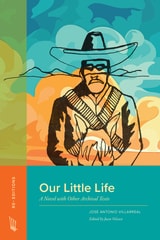
Our Little Life
A Novel with Other Archival TextsBy José Antonio Villarreal, edited by Juan Velasco
Lever Press, 2025
Our Little Life offers a much longer version of the Pocho story that extends a further 100 pages into the postwar period and follows Richard Rubio’s return from war and the changing shape of Mexican-American life in the 1940s. This newly discovered manuscript reveals Villarreal’s attention to Rubio’s struggles with PTSD and his efforts to depict a community and a family’s struggles with identity, belonging, and survival in postwar California. Our Little Life is an important work of archival recovery that sheds new light on Villarreal’s authorship and his place not only in Mexican-American literature but in the twentieth-century American literary canon.
This first publication of Our Little Life includes a scholarly introduction that places this unpublished novel in the landscape of contemporary Mexican-American literary studies and offers a brilliant examination of how novels grow and change. The volume also includes materials from the Villarreal Special Collection that recontextualize the writer’s vision, editing, and marketing of this and later novels. Our Little Life will be of interest not only to everyone in Mexican-American literary studies, but also to scholars of postwar America, women and gender studies, LGBTQ studies, ethnic studies, and migration and border studies.
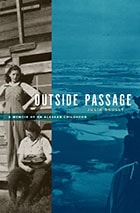
Outside Passage
A Memoir of an Alaskan ChildhoodJulia Scully
University of Alaska Press, 2010
Outside Passage is a lyrical and affecting memoir of those years, simultaneously an emotional account of a young girl’s first steps into adulthood and a unique portrait of a vanished frontier life.
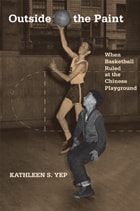
Outside the Paint
When Basketball Ruled at the Chinese PlaygroundKathleen S. Yep
Temple University Press, 2009
Outside the Paint takes readers back to the Chinese Playground of San Francisco in the 1930s and 1940s, the only public outdoor space in Chinatown. It was a place where young Chinese American men and women developed a new approach to the game of basketbal—with fast breaks, intricate passing and aggressive defense—that was ahead of its time.
Drawing on interviews with players and coaches, Kathleen Yep recounts some surprising stories. From the success of the Hong Wah Kues, a professional barnstorming men's basketball team and the Mei Wahs, a championship women’s amateur team, to Woo Wong, the first Chinese athlete to play in Madison Square Garden, and his extraordinarily talented sister Helen Wong, who is compared to Babe Didrikson.
Outside the Paint chronicles the efforts of these highly accomplished athletes who developed a unique playing style that capitalized on their physical attributes, challenged the prevailing racial hierarchy, and enabled them, for a time, to leave the confines of their segregated world. As they learned to dribble, shoot, and steal, they made basketball a source of individual achievement and Chinese American community pride.