Results by title
56 books match the query 'Chinese Americans' and 3 start with o
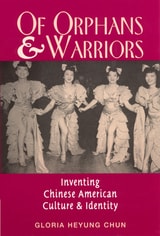
Of Orphans and Warriors
Inventing Chinese American Culture and IdentityChun, Gloria Heyung
Rutgers University Press, 1999
"We were as American as can be," states Jadin Wong in recalling the days when she used to dance at a San Francisco nightclub during the 1940s. Wong belonged to an all-Chinese chorus line at a time when all East Asians were called "Orientals." In this context, then, what did it mean for Wong, an American-born Chinese, to say that she thought of herself as an "American"? Of Orphans and Warriors explores the social and cultural history of largely urban, American-born Chinese from the 1930s through the 1990s, focusing primarily on those living in California. Chun thus opens a window onto the ways in which these Americans born of Chinese ancestry negotiated their identity over a half century.
Past scholarship has portrayed these individuals as desiring to assimilate into mainstream American culture, but being prevented from doing so by the immigrant parent generation. Taking a new approach, Chun uses memoirs, autobiographies, and fictional writings to unravel complex issues of ethnic identity as both culturally defined and individually negotiated. She concludes that, while indeed many Chinese Americans were caught between the lures of mainstream American culture and their parents' old-world values, this liminal position offered them unprecedented opportunities to carve out new identities for themselves from a position of strength.
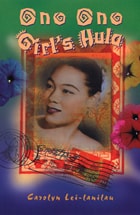
Ono Ono Girl's Hula
Carolyn Lei-lanilau
University of Wisconsin Press, 1997
Both playful and serious, this audacious riff on ethnic and sexual identity by Hawaiian-Hakka Chinese-American writer Carolyn Lei-lanilau revolves around the persona she calls “Ono Ono Girl,” an icon that interweaves and transcends Lucille Ball, Little Lulu, Tina Turner, and Spottie Dottie. Challenging assumptions about genre and gender, and acting out the notion that language is a function of the body, these essays are transforming soundbytes of Ono Ono Girl inventing herself.
“Just when you thought American literature was canonized and commodified beyond saving, Carolyn Lei-lanilau’s intertextual, irreverent work, Ono Ono Girl’s Hula, brings language and philosophy back to the table. Her book is a miracle delivery: a rebirth of poetry, Third World Spam, and love wrapped around the hybrid vigor of Hawaiian, Hakka, French, Latin, and English. Soulful, powerful, and wise.”—Russell Leong, editor of Amerasia Journal
“A book enjoyable equally for its fun as for its profundity, Carolyn Lei-lanilau’s Ono Ono Girl’s Hula is irresistible must reading for feminists, anthropologists, contemporary culture buffs, and anyone who wants a refreshing take on some of our more vexing current disputes. Down-to-earth and poetic, serious and hilarious at once, her unconventional voice invites the reader to understand the paradoxes of identity—sexual and ethnic—in new ways.”—Robin Lakoff, author of Talking Power
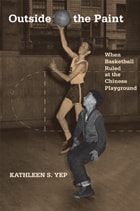
Outside the Paint
When Basketball Ruled at the Chinese PlaygroundKathleen S. Yep
Temple University Press, 2009
Outside the Paint takes readers back to the Chinese Playground of San Francisco in the 1930s and 1940s, the only public outdoor space in Chinatown. It was a place where young Chinese American men and women developed a new approach to the game of basketbal—with fast breaks, intricate passing and aggressive defense—that was ahead of its time.
Drawing on interviews with players and coaches, Kathleen Yep recounts some surprising stories. From the success of the Hong Wah Kues, a professional barnstorming men's basketball team and the Mei Wahs, a championship women’s amateur team, to Woo Wong, the first Chinese athlete to play in Madison Square Garden, and his extraordinarily talented sister Helen Wong, who is compared to Babe Didrikson.
Outside the Paint chronicles the efforts of these highly accomplished athletes who developed a unique playing style that capitalized on their physical attributes, challenged the prevailing racial hierarchy, and enabled them, for a time, to leave the confines of their segregated world. As they learned to dribble, shoot, and steal, they made basketball a source of individual achievement and Chinese American community pride.