80 books match the query 'Clergy' and 4 start with o
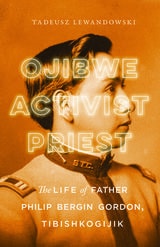
cover of Ojibwe, Activist, Priest: The Life of Father Philip Bergin Gordon, Tibishkogijik

Ojibwe, Activist, Priest

The Life of Father Philip Bergin Gordon, Tibishkogijik

Tadeusz Lewandowski

University of Wisconsin Press, 2019

Born in Wisconsin, Philip Bergin Gordon—whose Ojibwe name Tibishkogijik is said to mean Looking into the Sky—became one of the first Native Americans to be ordained as a Catholic priest in the United States. Gordon's devotion to Catholicism was matched only by his dedication to the protection of his people. A notable Native rights activist, his bold efforts to expose poverty and corruption on reservations and his reputation for agitation earned him the nickname "Wisconsin's Fighting Priest."
Drawing on previously unexplored materials, Tadeusz Lewandowski paints a portrait of a contentious life. Ojibwe, Activist, Priest examines Gordon's efforts to abolish the Bureau of Indian Affairs, his membership in the Society of American Indians, and his dismissal from his Ojibwe parish and exile to a tiny community where he'd be less likely to stir up controversy. Lewandowski illuminates a significant chapter in the struggle for Native American rights through the views and experiences of a key Native progressive.
[more]
cover of On the Formation of the Clergy

On the Formation of the Clergy

Bleeded Hrabanus Maurus

Catholic University of America Press, 2023
Among the intellectuals of the Carolingian Renaissance of the ninth century, few are as prolific and influential as Hrabanus Maurus (c.780-856), a monk and abbot of the monastery of Fulda and then archbishop of Mainz. Most famous among modern authors as the putative author of the hymn “Come, Holy Ghost,” Hrabanus was highly esteemed by generations of medieval intellectuals, including Dante, who located the archbishop among St. Bonaventure’s cohort in the sphere of the Sun. This volume presents for the first time in English translation Hrabanus’s pedagogical masterpiece On the Formation of Clergy (De institutione clericorum). Unveiled on the Feast of All Saints in 819, at the dedication of the great Salvator basilica, Hrabanus’ work addresses the most important focuses of the Carolingian Renaissance: education and ecclesiastical reform. The treatise promotes a careful balance between classical training and Christian ethics and features the robust pedagogy of the early medieval monastic curriculum. At points it even offers glimpses into the energetic environment of Fulda’s classrooms. On the Formation of Clergy also supplies a program for ecclesiastical reform. It provides readers with a primer on ecclesiastical hierarchy and liturgy, providing glosses on church offices and explanations of important church activities. Hrabanus divided his opus into three books. Book One explains Holy Orders. It lays out the distinctions between clergy and laity, enumerates the ranks of the priesthood, describes clerical vesture, and explores the sacraments. Book Two examines priestly life. It considers ascetic disciplines appropriate for priests at different grades, describes expected prayer routines, and identifies important doctrinal teachings and principal liturgical feasts. Book Three treats biblical studies and preaching. It lays out a curriculum for the liberal arts, connects the liberal arts to catechetics and homiletics, and integrates academic study with moral instruction. On the Formation of Clergy was widely read throughout the Middle Ages. Beyond its impact on the Carolingian Renaissance, the treatise guided legal analysis in Gratian’s Decretum, supplied examples for Peter Lombard’s Sentences, and is cited by theological titans from Rupert of Deutz to Thomas Aquinas to Gabriel Biel.
[more]
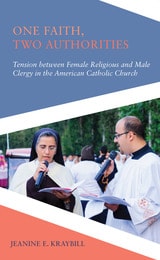
cover of One Faith, Two Authorities: Tension between Female Religious and Male Clergy in the American Catholic Church

One Faith, Two Authorities

Tension between Female Religious and Male Clergy in the American Catholic Church

Jeanine E. Kraybill

Temple University Press, 2019

While female religious have grown to possess a sense of personal authority in issues impacting the laity, and have come to engage in social-issue-oriented activities, religious institutions have traditionally viewed men as the decision-makers. One Faith, Two Authorities examines the tensions of policy and authority within the gendered nature of the Catholic Church. 

Jeanine Kraybilllooks at the influence of Catholic elites—specifically within the U.S. Conference of Catholic Bishops and the Leadership Conference of Women Religious—and their opinions on public policy and relevant gender dynamics with regard to healthcare, homosexuality, immigration, and other issues. She considers the female religious’ inclusive positions as well as their opposition to ACA for bills that would be rooted in institutional positions on procreation, contraception, or abortion. Kraybill also systematically examines the claims of the 2012 Doctrinal Assessment against the Leadership Conference of Women Religious.

One Faith, Two Authorities considerswhether the sisters and the male clergy are in fact in disagreement about social justice and healthcare issues and/or if women religious have influence.
[more]
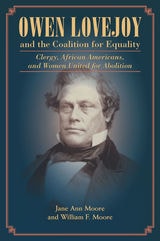
cover of Owen Lovejoy and the Coalition for Equality: Clergy, African Americans, and Women United for Abolition

Owen Lovejoy and the Coalition for Equality

Clergy, African Americans, and Women United for Abolition

Jane Ann Moore and William F. Moore

University of Illinois Press, 2019

Antislavery white clergy and their congregations. Radicalized abolitionist women. African Americans committed to ending slavery through constitutional political action. These diverse groups attributed their common vision of a nation free from slavery to strong political and religious values. Owen Lovejoy’s gregarious personality, formidable oratorical talent, probing political analysis, and profound religious convictions made him the powerful leader the coalition needed.

Owen Lovejoy and the Coalition for Equality examines how these three distinct groups merged their agendas into a single antislavery, religious, political campaign for equality with Lovejoy at the helm. Combining scholarly biography, historiography, and primary source material, Jane Ann Moore and William F. Moore demonstrate Lovejoy's crucial role in nineteenth-century politics, the rise of antislavery sentiment in religious spaces, and the emerging congressional commitment to end slavery. Their compelling account explores how the immorality of slavery became a touchstone of political and religious action in the United States through the efforts of a synergetic coalition led by an essential abolitionist figure.

[more]