Results by title
143 books match the query 'Crisis' and 5 start with o
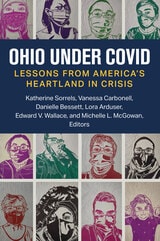
Ohio under COVID
Lessons from America's Heartland in CrisisKatherine Sorrels, Vanessa Carbonell, Danielle Bessett, Lora Arduser, Edward Wallace, and Michelle L. McGowan, Editors
University of Michigan Press, 2023
In early March of 2020, Americans watched with uncertain terror as the novel coronavirus pandemic unfolded. One week later, Ohio announced its first confirmed cases. Just one year later, the state had over a million cases and 18,000 Ohioans had died. What happened in that first pandemic year is not only a story of a public health disaster, but also a story of social disparities and moral dilemmas, of lives and livelihoods turned upside down, and of institutions and safety nets stretched to their limits.
Ohio under COVID tells the human story of COVID in Ohio, America’s bellwether state. Scholars and practitioners examine the pandemic response from multiple angles, and contributors from numerous walks of life offer moving first-person reflections. Two themes emerge again and again: how the pandemic revealed a deep tension between individual autonomy and the collective good, and how it exacerbated social inequalities in a state divided along social, economic, and political lines. Chapters address topics such as mask mandates, ableism, prisons, food insecurity, access to reproductive health care, and the need for more Black doctors. The book concludes with an interview with Dr. Amy Acton, the state’s top public health official at the time COVID hit Ohio. Ohio under COVID captures the devastating impact of the pandemic, both in the public discord it has unearthed and in the unfair burdens it has placed on the groups least equipped to bear them.
On the Frontlines of Crisis
Intensive Care and the Challenge of COVID-19Jason Rodriquez
Rutgers University Press, 2025
A dramatic spike in mental health distress among these healthcare workers was a consequence of the pandemic, but was also a result of the changing dynamics within the healthcare system itself. Here, Rodriquez examines the impact of the development of the contemporary focus on “clinical empathy.” This clinical method, while intended to improve patient care, had profound implications for healthcare workers during the pandemic, often blurring the lines between professional distance and personal involvement, increasing the emotional demands on staff and heightened their vulnerability to anxiety, depression, post-traumatic stress, and burnout. Through the personal stories of those who were in the ICU, On the Frontlines of Crisis offers a sobering reflection on the social and emotional costs of caring for patients.
One Semester Away from a Crisis
An Economist's Perspective on Leading Small CollegesWilliam T. Bogart
Rutgers University Press, 2026
Small colleges are a vital component of the United States higher education system. However, their unique characteristics are often overlooked in analyses that incorporate all colleges and universities. Many concepts familiar to economics professors but less familiar to more general audiences are helpful in understanding small colleges. These concepts include sophisticated ideas not typically covered in basic economics courses, such as regulatory capture, decision-making under uncertainty, and the logic of collective action. By combining economic theories with his own experiences leading small colleges, William T. Bogart provides a way for presidents, trustees, and other leaders of small colleges to more effectively help their institutions achieve their full potential.
Ornament as Crisis
Architecture, Design, and Modernity in Hermann Broch's "The Sleepwalkers"Sarah McGaughey
Northwestern University Press, 2015
Ornament as Crisis explores the ways in which the novels of Hermann Broch’s Sleepwalkers (Schlafwandler) trilogy participate in and employ the history of architecture and architectural theory.
Beginning with the visual and architectural experiences of the figures in each novel, Sarah McGaughey analyzes the role of architecture in the trilogy as a whole, while discussing work by Broch’s contemporaries on architecture. She argues that The Sleepwalkers allows us to better understand how literature responds and contributes to social, theoretical, and spatial concepts of architecture. Ornament as Crisis guides readers through the spaces of Broch’s mdernist masterpiece and the architectural debates of his time.

Overripe Economy
American Capitalism and the Crisis of DemocracyAlan Nasser
Pluto Press, 2018