Results by title
75 books match the query 'Death & Dying' and 3 start with o

On Not Dying
Secular Immortality in the Age of TechnoscienceAbou Farman
University of Minnesota Press, 2020
An ethnographic exploration of technoscientific immortality
Immortality has long been considered the domain of religion. But immortality projects have gained increasing legitimacy and power in the world of science and technology. With recent rapid advances in biology, nanotechnology, and artificial intelligence, secular immortalists hope for and work toward a future without death.
On Not Dying is an anthropological, historical, and philosophical exploration of immortality as a secular and scientific category. Based on an ethnography of immortalist communities—those who believe humans can extend their personal existence indefinitely through technological means—and an examination of other institutions involved at the end of life, Abou Farman argues that secular immortalism is an important site to explore the tensions inherent in secularism: how to accept death but extend life; knowing the future is open but your future is finite; that life has meaning but the universe is meaningless. As secularism denies a soul, an afterlife, and a cosmic purpose, conflicts arise around the relationship of mind and body, individual finitude and the infinity of time and the cosmos, and the purpose of life. Immortalism today, Farman argues, is shaped by these historical and culturally situated tensions. Immortalist projects go beyond extending life, confronting dualism and cosmic alienation by imagining (and producing) informatic selves separate from the biological body but connected to a cosmic unfolding.
On Not Dying interrogates the social implications of technoscientific immortalism and raises important political questions. Whose life will be extended? Will these technologies be available to all, or will they reproduce racial and geopolitical hierarchies? As human life on earth is threatened in the Anthropocene, why should life be extended, and what will that prolonged existence look like?
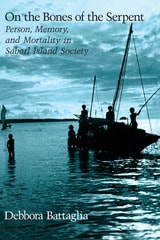
On the Bones of the Serpent
Person, Memory, and Mortality in Sabarl Island SocietyDebbora Battaglia
University of Chicago Press, 1990
The creative focus of Sabarl cultural life is a series of mortuary feasts and rituals known as segaiya. In assembling and disassembling commemorative food and objects in segaiya exchanges, Sabarl also assemble and disassemble the critical social relations such objects stand for. These commemorative acts create a collective memory yet also a collective experience of forgetting social bonds that are of no future use to the living. Sabarl anticipate this disaggregation in patterns of everyday life, which reveal the importance of categorical distinctions mapped in beliefs about the physical and metaphysical person.
Using remembrance and forgetting as an analytic lens, Battaglia is able to ask questions critical to understanding Melanesian social process. One of the "new ethnographies" addressing the limits of ethnographic representation and the fragmented nature of knowledge from an indigenous perspective, her finely wrought study explores the dynamics of cultural practices in which decontruction is integral to construction, allowing a new perspective on the ephermeral nature of sociality in Melanesia and new insight into the efficacy of cultural images more generally.
Our Grateful Dead
Stories of Those Left BehindVinciane Despret
University of Minnesota Press, 2021
An award-winning exploration of the presence of the dead in the lives of the living
A common remedy after suffering the loss of a loved one is to progress through the “stages of grief,” with “acceptance” as the final stage in the process. But is it necessary to leave death behind, to stop dwelling on the dead, to get over the pain? Vinciane Despret thinks not. In her fascinating, elegantly translated book, this influential thinker argues that, in practice, people in all cultures continue to enjoy a lively, inventive, positive relationship with their dead.
Through her unique storytelling woven from ethnographic sources and her own family history, Despret assembles accounts of those who have found ways to live their daily lives with their dead. She rejects the idea that one must either subscribe to “complete mourning” (in a sense, to get rid of the dead) or else fall into fantasy and superstition. She explores instead how the dead still play an active, tangible role through those who are living, who might assume their place in a family or in society; continue their labor or art; or thrive from a shared inheritance or an organ donation. This is supported by dreams and voices, novels, television and popular culture, the work of clairvoyants, and the everyday stories and activities of the living. For decades now, in the West, the dead have been discreet and invisible. Today, especially as a result of the Covid-19 pandemic, Despret suggests that perhaps we will be willing to engage with the dead in ways that bring us happiness despite our loss.
Despret’s unique method of inquiry makes her book both entertaining and instructive. Our Grateful Dead offers a new, pragmatic approach to social and cultural research and may indeed provide compassionate therapy for those of us coping with death.