Results by title
808 books match the query 'Drama' and 17 start with o
O'Neill's Shakespeare
Normand Berlin
University of Michigan Press, 1993
In O'Neill's Shakespeare , Normand Berlin explores the relationship of William Shakespeare and Eugene O'Neill through detailed, often surprising, intertextual readings of the two great playwrights' work. "Of course, it would have been impossible for O'Neill not to have been influenced by Shakespeare," acknowledges Berlin. But this is an influence of an unusual and extraordinary sort, "a family romance" that transcends their obvious differences—a romance that "takes in all O'Neill's life and art."
In the first book-length study of this crucial literary and dramatic relationship, Berlin probes far beyond the usual listing of allusions and references. This is the exploration of an "essential, basic, even natural" connection, in which Shakespeare is shown to have fundamentally shaped O'Neill's creative imagination. Following O'Neill's career chronologically, Berlin divides his study into two parts. The "first career" (culminating in Mourning Becomes Electra) is explored through recurring themes that evoke Shakespeare: the sea, black and white, and the family. O'Neill's "second career" (from Ah! Wilderness until the last plays) is examined through Shakespearean genre classifications: comedy, history, tragedy, and tragicomedy. Though always grounded in close textual readings, Berlin's analysis spirals outward to encompass O'Neill's artistic and psychological development and touches on the questions of tradition, transcendence, and human nature inevitably raised when such literary connections across history are drawn.
O'Neill's Shakespeare is more than a reminder that Shakespeare continues to haunt Western culture; it is a careful and fascinating analysis of a particular legacy in American drama. The book has insights to offer to specialists in Shakespeare and O'Neill, and to any reader interested in the transmission of ideas through Western culture. Berlin's study of the unconscious and conscious uses of Shakespeare by O'Neill provide a valuable new understanding of O'Neill's artistry. It is also an eloquent, thoughtful account that blends the transcendence of Shakespeare's influence with the particular ways in which every era must refashion Shakespeare so that "the past becomes the present."
Odysseys of Recognition
Performing Intersubjectivity in Homer, Aristotle, Shakespeare, Goethe, and KleistWiggins, Ellwood
Bucknell University Press, 2019
Published by Bucknell University Press. Distributed worldwide by Rutgers University Press.
Oedipus Rex
David Sophocles
University of Wisconsin Press, 2011
Oedipus Rex is the greatest of the Greek tragedies, a profound meditation on the human condition. The story of the mythological king, who is doomed to kill his father and marry his mother, has resonated in world culture for almost 2,500 years. But Sophocles’ drama as originally performed was much more than a great story—it was a superb poetic script and exciting theatrical experience. The actors spoke in pulsing rhythms with hypnotic forward momentum, making it hard for audiences to look away. Interspersed among the verbal rants and duels were energetic songs performed by the chorus.
Oedipus at Colonus
Sophocles, A verse translation by David Mulroy, with introduction and notes
University of Wisconsin Press, 2014
As in his previous translations of Oedipus Rex and Antigone, Mulroy combines scrupulous scholarship and textual accuracy with a fresh poetic style. He uses iambic pentameter for spoken passages and short rhymed stanzas for choral songs, resulting in a text that is accessible and fun to read and perform.
Oedipus the King
Sophocles
University of Chicago Press, 2010
Available for the first time as an independent work, David Grene’s legendary translation of Oedipus the King renders Sophocles’ Greek into cogent, vivid, and poetic English for a new generation to savor. Over the years, Grene and Lattimore’s Complete Greek Tragedies have been the preferred choice of millions of readers—for personal libraries, individual study, and classroom use. This new, stand-alone edition of Sophocles’ searing tale of jealousy, rage, and revenge will continue the tradition of the University of Chicago Press’s classic series.
Praise for David Grene and Richmond Lattimore’s Complete Greek Tragedies
“This is it. No qualifications. Go out and buy it everybody.”—Kenneth Rexroth, Nation
“The translations deliberately avoid the highly wrought and affectedly poetic; their idiom is contemporary. . . . They have life and speed and suppleness of phrase.”—Times Education Supplement
Oedipus the King, Second Edition
Sophocles
University of Chicago Press, 2013
Over the years, David Grene and Richmond Lattimore’s Complete Greek Tragedies have been the preferred translations of millions of readers—for personal libraries, individual study, and classroom use. Drawn from the authoritative third edition of the University of Chicago Press’s classic series, this updated stand-alone edition of Grene’s Oedipus the King renders the original Greek in clear, vivid, and poetic English for a new generation to savor.
Mark Griffith and Glenn W. Most’s introduction to Sophocles’s searing tale of jealousy, rage, and revenge provides essential information about the play’s first production, plot, and reception in antiquity and beyond.
Of Borders And Thresholds
Theatre History, Practice, and TheoryMichal Andrzej Kobialka
University of Minnesota Press, 1999
On Drama
Boundaries of Genre, Borders of SelfMichael Goldman
University of Michigan Press, 2000
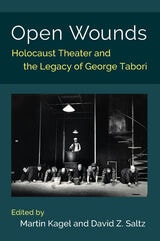
Open Wounds
Holocaust Theater and the Legacy of George TaboriEdited by Martin Kagel and David Z. Saltz
University of Michigan Press, 2022
This volume collects original essays on Hungarian-German playwright and screenwriter George Tabori (1914–2007) and his remarkable contributions to the stage. Tabori, a Jewish refugee and a truly transnational author, was best known for his work in New York theater that irreverently explored the Jewish experience, particularly the Holocaust. Although his illustrious career spanned a century, two continents, several languages, and a variety of literary genres, Tabori’s work has received scant attention in American letters, in spite of its significance for U.S. theater and Holocaust studies.
Until Tabori, most dramas about the Holocaust were either rooted in American domestic realism, striving to create a strong empathetic connection between the audience and Holocaust victims, or featured an unembellished documentary style. Tabori staked out a third position, beyond realism and documentation. The volume brings together the voices of international scholars to provide a comprehensive introduction to Tabori’s theater as well as in-depth analyses of his work, discussing all of his major plays. Individual essays address Tabori’s postdramatic theater in relation to sacrificial ritual, performance studies, and post-humanist approaches to the contemporary stage, as well as performance aspects of his productions, questions of ethics and aesthetics raised by his theater, and his plays’ relation to Holocaust representation in popular culture.

Opera for the People
Herbert Graf
University of Minnesota Press, 1951
Opera for the People was first published in 1951. Minnesota Archive Editions uses digital technology to make long-unavailable books once again accessible, and are published unaltered from the original University of Minnesota Press editions.
Everyone who enjoys opera will enjoy this book, and many who think they don't like opera will be delighted to discover how they can enjoy it. As Herbert Graf points out, opera in America today is not all it could be, and he shows how opera can be developed into something more vital—a real force in the musical life of communities.
As the long-time stage director of the Metropolitan Opera community, Dr. Graf is a foremost authority on opera production. From his wealth of practical experience, from his careful study of what others have done, and from his creative yet realistic thinking come his challenging proposals for a new kind of opera in America—opera for everyone.
The elements of opera production—the libretto, the music, the language, the sponsorship, the staging, the building—are discussed. American opera as it is performed on Broadway, in community civic companies, in school workshops, in motion pictures, and in television is surveyed. In conclusion, Dr. Graf draws his exciting blueprint for the opera of the future.
Illustrative anecdotes provide sidelights on many gamed musical personalities—Bruno Walter, Kurt Weill, Benjamin Britten, Lawrence Tibbett, Oscar Hammerstein II, and Gian Carlo Menotti, to name a few. Stories of many of the newer operas—how they came to be written and what they are about—are related.
Music lovers who yearn for a "new deal" in opera, civic leaders anxious to develop opera in their own communities, and schools and colleges offering opera training will find this book a stimulating guide.

Orphan Black
Performance, Gender, BiopoliticsEdited by Andrea Goulet and Robert A. Rushing
Intellect Books, 2018
Contributors come from a range of backgrounds and explore the digital innovations and technical interactions between human and machine that allow the show to challenge conventional notions of performance and identity, address family themes, and Orphan Black’s own textual genealogy within the contexts of science, reproductive technology, and the politics of gender, and extend their inquiry to the broader question of community in a "posthuman" world of biopolitical power. Mobilizing philosophy, history of science, and literary theory, scholars analyze the ways in which Orphan Black depicts resistance to the many forms of power that attempt to capture, monitor, and shape life today.
Orphism and Tragedy
Myth TransfiguredGianni Carchia
Seagull Books, 2026
A reimagining of the ancient Greek mystical movement Orphism.
What does it mean to step outside the civic order through poetry? Ever since it first emerged in Greece around the sixth century BC, Orphic doctrine has marked a powerful rupture with the ancient world. Its salvific practices, closely tied to a belief in the soul’s immortality, its resolute rejection of sacrificial ritual and embrace of vegetarianism, and its distinctive conception of time and memory all defined a way of life, the bios orphikos, that was at once poetic and political.
In this brief yet densely layered text, Gianni Carchia returns to Orphism in all its implications. It becomes clear that, for Carchia, Orphism is not merely a historiographical concern, but an aesthetic and political one. If tragedy constitutes one of the central pillars around which the polis was formed, Orphism represents a radically different path—an alternative to the polis itself—by placing the poetic word, in all its autonomous power, at its core. And if the relationship between philosophy and tragedy has long been a central theme in the history of Western thought, Carchia’s reflections here ask a different question: Is the Orphic path still accessible to us today?
Othello
William Shakespeare
Arizona Center for Medieval and Renaissance Studies, 2022
In her update of Shakespeare’s Othello, Mfoniso Udofia engages with the racial malice at the heart of the play. Udofia’s take on this complicated story emphasizes the rhythm and lyrical patterns of Othello’s speech. Opening up the text to modern ears, Udofia presents us with a code-switched Othello.
This translation of Othello was written as part of the Oregon Shakespeare Festival’s Play On! project, which commissioned new translations of thirty-nine Shakespeare plays. These translations present the work of “The Bard” in language accessible to modern audiences while never losing the beauty of Shakespeare’s verse. Enlisting the talents of a diverse group of contemporary playwrights, screenwriters, and dramaturges from diverse backgrounds, this project reenvisions Shakespeare for the twenty-first century. These volumes make these works available for the first time in print—a new First Folio for a new era.
Othello and Interpretive Traditions
Edward Pechter
University of Iowa Press, 1999

Our Moonlight Revels
"A Midsummer Night's Dream" in the TheatreGary Jay Williams
University of Iowa Press, 1997
Many ingenious theatrical worlds have been created for the fairy world of A Midsummer Night's Dream, from the baroque to the postmodern. This is the quintessential play for understanding the ways in which scenery, costumes, music, lighting, and playing spaces affect our experience of Shakespeare. A Midsummer Night's Dream also proves to be extraordinarily responsive to the cultural winds of each era, easily circulating a variety of sometimes competing social interests.
In his richly detailed, beautifully illustrated history of Shakespeare's most popular play—the first comprehensive study of A Midsummer Night's Dream in the theatre—Gary Jay Williams covers four hundred years of landmark productions in Europe, the United States, and Canada as well as important opera, dance, and film adaptations. Williams shows how the visual and musical vocabularies of production can be read as cultural texts and how these meditative texts determine this play's available meanings from generation to generation. His account, then, is the story of our imaginative and astonishing uses of Shakespeare's play.
Many famous theatre artists have been drawn to this play, and many of their productions have been turning points in theatre history. Williams offers detailed theatrical and cultural analyses of the productions of David Garrick, Ludwig Tieck, Elizabeth Vestris, Charles Kean, Harley Granville-Barker, Sir Herbert Beerbohm Tree, Max Reinhardt, Peter Brook, Liviu Ciulei, and other artists. His engaging, intelligent study will be invaluable to scholars and teachers of Shakespeare and theatre history and to professional directors, designers, critics, and actors.
•The Wedding-play Myth and the Dream in Full Play•Shakespeare Absolute: Fairies, Gods, and Oranges in Purcell's Fairy Queen
•“Signor Shakespearelli”
•The Scenic Language of Empire
•These Antique Fables . . . These Fairy Toys”
•The National and Natural Dream
•The Dream of Modernism: The “New Hieroglyphic Language of Scenery” and the Theology of the Text
•The Dream of Modernism: The Sacred and the Secular
•Postmodernism: “The Fierce Vexation of a Dream”
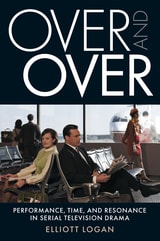
Over and Over
Performance, Time, and Resonance in Serial Television DramaElliott Logan
Rutgers University Press, 2026
How does serial drama earn, keep, and reward our attention for so long—over episodes, seasons, months, and years? While we know that characters are the focus of story and viewer interest in television fiction, scholars have for decades overlooked the way those characters are performed on-screen and the lure of performance as a key formal and thematic aspect of long-form television storytelling. In Over and Over, Elliott Logan offers close readings of performance in some of the most celebrated television dramas of the century, casting new light on the attractions and significance of the medium’s seriality. The book shows how the patterning and expressive resonance of performers on-screen binds together otherwise unconnected episodes of shows like The Sopranos and Mad Men. In doing so, it highlights the provisionality of identity and meaning as crucial to their interest in the sustenance of human relationships over long periods of time. In accounting for the resonance of performance over time in serial drama, this book shows, we find the terms of our own attachment to its compelling depictions of human life
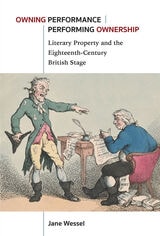
Owning Performance | Performing Ownership
Literary Property and the Eighteenth-Century British StageJane Wessel
University of Michigan Press, 2022
Owning Performance follows the careers of some of the 18th century’s most influential playwrights, actors, and theater managers as they vied for control over the period’s most popular shows. Without protection for dramatic literary property, these figures developed creative extra-legal strategies for controlling the performance of drama—quite literally performing their ownership. Their various strategies resulted in a culture of ephemerality, with many of the period’s most popular works existing only in performance and manuscript copies. Author Jane Wessel explores how playwrights and actors developed strategies for owning their works and how, in turn, theater managers appropriated these strategies, putting constant pressure on artists to innovate. Owning Performance reveals the wide-reaching effects of property law on theatrical culture, tracing a turn away from print that affected the circulation, preservation, and legacy of 18th century drama.