347 books match the query 'Early works to 1800' and 15 start with o
cover of On Benefits

On Benefits

Lucius Annaeus Seneca

University of Chicago Press, 2011

Lucius Annaeus Seneca (4 BCE–65 CE) was a Roman Stoic philosopher, dramatist, statesman, and advisor to the emperor Nero, all during the Silver Age of Latin literature. The Complete Works of Lucius Annaeus Seneca is a fresh and compelling series of new English-language translations of his works in seven accessible volumes. Edited by world-renowned classicists Elizabeth Asmis, Shadi Bartsch, and Martha C. Nussbaum, this engaging collection restores Seneca—whose works have been highly praised by modern authors from Desiderius Erasmus to Ralph Waldo Emerson—to his rightful place among the classical writers most widely studied in the humanities.

On Benefits, written between 56 and 64 CE, is a treatise addressed to Seneca’s close friend Aebutius Liberalis. The longest of Seneca’s works dealing with a single subject—how to give and receive benefits and how to express gratitude appropriately—On Benefits is the only complete work on what we now call “gift exchange” to survive from antiquity. Benefits were of great personal significance to Seneca, who remarked in one of his later letters that philosophy teaches, above all else, to owe and repay benefits well.
[more]
cover of On Difficulties in Sacred Scripture: The Responses to Thalassios

On Difficulties in Sacred Scripture

The Responses to Thalassios

Maximos St. Maximos the Confessor

Catholic University of America Press, 2018
Maximos the Confessor (ca. 580-662) is now widely recognized as one of the greatest theological thinkers, not simply in the entire canon of Greek patristic literature, but in the Christian tradition as a whole. A peripatetic monk and prolific writer, his penetrating theological vision found expression in an unparalleled synthesis of biblical exegesis, ascetic spirituality, patristic theology, and Greek philosophy, which is as remarkable for its conceptual sophistication as for its labyrinthine style of composition. On Difficulties in Sacred Scripture, presented here for the first time in a complete English translation (including the 465 scholia), contains Maximos’s virtuosic theological interpretations of sixty-five difficult passages from the Old and New Testaments. Because of its great length, along with its linguistic and conceptual difficulty, the work as a whole has been largely neglected. Yet alongside the Ambigua to John, On Difficulties in Sacred Scripture: The Responses to Thalassios deserves to be ranked as the Confessor’s greatest work and one of the most important patristic treatises on the interpretation of Scripture, combining the interconnected traditions of monastic devotion to the Bible, the biblical exegesis of Origen, the sophisticated symbolic theology of Dionysius the Areopagite, and the rich spiritual anthropology of Greek Christian asceticism inspired by the Cappadocian Fathers.
[more]
cover of On Genesis: Two Books on Genesis against the Manichees and On the Literal Interpretation of Genesis: An Unfinished Book

On Genesis

Two Books on Genesis against the Manichees and On the Literal Interpretation of Genesis: An Unfinished Book

Saint Augustine

Catholic University of America Press, 1991
No description available
[more]
cover of On Hysteria: The Invention of a Medical Category between 1670 and 1820

On Hysteria

The Invention of a Medical Category between 1670 and 1820

Sabine Arnaud

University of Chicago Press, 2015

These days, hysteria is known as a discredited diagnosis that was used to group and pathologize a wide range of conditions and behaviors in women. But for a long time, it was seen as a legitimate category of medical problem—and one that, originally, was applied to men as often as to women.

In On Hysteria, Sabine Arnaud traces the creation and rise of hysteria, from its invention in the eighteenth century through nineteenth-century therapeutic practice. Hysteria took shape, she shows, as a predominantly aristocratic malady, only beginning to cross class boundaries (and be limited to women) during the French Revolution. Unlike most studies of the role and status of medicine and its categories in this period, On Hysteria focuses not on institutions but on narrative strategies and writing—the ways that texts in a wide range of genres helped to build knowledge through misinterpretation and recontextualized citation.

Powerfully interdisciplinary, and offering access to rare historical material for the first time in English, On Hysteria will speak to scholars in a wide range of fields, including the history of science, French studies, and comparative literature.
[more]
cover of On Job, Volume 1

On Job, Volume 1

Franklin T. St. Albert The Great

Catholic University of America Press, 2019
Even prior to his death on 15 November 1280, the Dominican master Albert of Lauingen was legendary on account of his erudition. He was widely recognized for the depth and breadth of his learning in the philosophical disciplines as well as in the study of God, earning him the titles Doctor universalis and Doctor expertus. Moreover, his authoritative teaching merited him the moniker Magnus, an appellation bestowed on no other man of the High Middle Ages. This volume contains the first half of Albert the Great’s commentary On Job (on chs. 1-21), translated into English for the first time; a translation of the second half of the work will appear in a subsequent volume of the Fathers of the Church, Mediaeval Continuation series. Albert completed Super Iob in 1272 or 1274, when he was over seventy years old, at the Dominican Kloster of Heilige Kreuz in Cologne, where, as lector emeritus of the Order, he likely lectured on this profound biblical book. Significantly, Albert may have been inspired to produce On Job by his most famous student, Thomas Aquinas, who had written his own Joban commentary, the Expositio super Iob ad litteram, while serving as conventual lector at San Domenico in Orvieto from 1261 to 1264. Yet Albert occupies a unique position in the history of the interpretation of Job: he is the first and only exegete in history who explicitly reads the whole book as a debate in the mode of an academic or scholastic disputation among Job and his friends about divine providence concerning human affairs. The Introduction to this volume situates Albert’s On Job—its general approach and key exegetical features—in the broad context of Dominican theological education and pastoral formation in the thirteenth century.
[more]
cover of On Job, Volume 2

On Job, Volume 2

Franklin T. St. Albert the Great

Catholic University of America Press, 2025
Even prior to his death on 15 November 1280, the Dominican master Albert of Lauingen was legendary for his erudition. He was widely recognized for the depth and breadth of his learning in the philosophical disciplines as well as in the study of God, earning him the titles Doctor universalis and Doctor expertus. Moreover, his authoritative teaching merited him the moniker Magnus, an appellation bestowed on no other man of the High Middle Ages. This volume contains the second half of Albert the Great’s commentary On Job (on chs. 22-42), translated into English for the first time; a translation of the first half of the work appeared in an earlier volume of the Fathers of the Church, Mediaeval Continuation series (vol. 19, 2019). Albert completed Super Iob in 1272 or 1274, when he was over seventy years old, at the Dominican Kloster of Heilige Kreuz in Cologne, where, as lector emeritus of the Order, he likely lectured on this profound biblical book. Significantly, Albert may have been inspired to produce On Job by his most famous student, Thomas Aquinas, who had written his own Joban commentary, the Expositio super Iob ad litteram, while serving as conventual lector at San Domenico in Orvieto from 1261 to 1264. Yet Albert occupies a unique position in the history of the interpretation of Job: he is the first and only exegete in history who explicitly reads the whole book as a debate in the mode of an academic or scholastic disputation among Job and his friends about divine providence concerning human affairs. Albert understands God, in the final chapters of Job, to determine the disputed question in favor of Job and against his friends, namely declaring that He (i.e., God) rules human life with no consideration of human works, but rather that divine governance is dissimilar to every mode of human rule.
[more]
cover of On Monsters and Marvels

On Monsters and Marvels

Ambroise Pare

University of Chicago Press, 1983
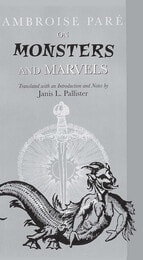
Ambroise Paré, born in France around 1510, was chief surgeon to both Charles IX and Henri III. In one of the first attempts to explain birth defects, Paré produced On Monsters and Marvels, an illustrated encyclopedia of curiosities, of monstrous human and animal births, bizarre beasts, and natural phenomena. Janice Pallister's acclaimed English translation offers a glimpse of the natural world as seen by an extraordinary Renaissance natural philosopher.
[more]
cover of On Repentance and Almsgiving

On Repentance and Almsgiving

Saint John Chrysostom

Catholic University of America Press, 1998
No description available
[more]
cover of On Slavery and the Slave Trade: <i>De Iustitia et lure</i>, Book 1, Treatise 2, Disputations 32-40

On Slavery and the Slave Trade

<i>De Iustitia et lure</i>, Book 1, Treatise 2, Disputations 32-40

Luis De Molina

Catholic University of America Press, 2023
In his monumental On Justice and Rights, the Jesuit Luis de Molina (1535-1600) discussed the legal and ethical aspects of the Portuguese trade in African and Asian enslaved persons. Molina surveys, develops, and problematizes the criteria necessary for the legitimate possession, sale, and purchase of human freedom. He insists that, even under legally valid slavery, persons who have sold or lost their freedom have inalienable rights as human beings, such as the freedom to make contracts, to marry, and even, under certain circumstances, to sue their owners in court. Molina also devotes attention to the ways in which slavery could be ended and whether and under what circumstances slaves had the right to escape from their owners. Well informed about the political structures and customs of many peoples in Africa, as well as Japan, China, and India, Molina paints a vivid and detailed picture of Portuguese trade. He gives specific accounts of the origins and development of the slave trade, region by region, and of the nature of the relationship between local rulers and the Portuguese kingdom. In doing so, he carefully describes the deception, coercion, and general indifference that pervades this trade regarding the rights to freedom of these people. It also attempts to identify the political, ecclesiastical, and market agents involved in this great injustice and their varying degrees of culpability. While Molina does not condemn slavery as a legal institution, the deeply flawed and even immoral behavior of sellers, buyers, regulators, and political rulers both in Portugal and in the slave-supplying regions that Molina denounces casts a heavy shadow on the morality of the trade.
[more]
cover of On Sunspots

On Sunspots

Galileo Galilei and Christoph Scheiner

University of Chicago Press, 2010

Galileo’s telescopic discoveries, and especially his observation of sunspots, caused great debate in an age when the heavens were thought to be perfect and unchanging. Christoph Scheiner, a Jesuit mathematician, argued that sunspots were planets or moons crossing in front of the Sun. Galileo, on the other hand, countered that the spots were on or near the surface of the Sun itself, and he supported his position with a series of meticulous observations and mathematical demonstrations that eventually convinced even his rival.


On Sunspots collects the correspondence that constituted the public debate, including the first English translation of Scheiner’s two tracts as well as Galileo’s three letters, which have previously appeared only in abridged form. In addition, Albert Van Helden and Eileen Reeves have supplemented the correspondence with lengthy introductions, extensive notes, and a bibliography. The result will become the standard work on the subject, essential for students and historians of astronomy, the telescope, and early modern Catholicism.
[more]
cover of On the Body of the Lord

On the Body of the Lord

Albert Albert the Great

Catholic University of America Press, 2017

Albert the Great wrote On the Body of the Lord in the 1270s, making it his final work of sacramental theology. A companion volume to his commentary on the Mass, On the Body of the Lord is a comprehensive discussion of Eucharistic theology. The treatise is structured around six names for the Eucharist taken from the Mass: grace, gift, food, communion, sacrifice, and sacrament. It emerges from the liturgy and is intended to draw the reader back to worship.

The overall movement of the treatise follows the order of God’s wisdom. Albert begins by discussing the Eucharist as a gift flowing from the goodness of the Trinity. He touches on its relation to redemption and the Church, including a rigorous Aristotelian analysis of Eucharistic change and presence before ending with a discussion of Mass rubrics. The most significant theological emphasis is on the Eucharist as food given to feed the people of God.

The style varies to suit the content: certain sections are terse; others are devotional, allowing the reader to enter the saint’s own prayer. Perhaps most characteristically Albertine is an extended meditation that compares the process of digestion to the incorporation of the Christian into the Body of Christ. The mixed style allows this work to integrate rigorous aspects of scholastic thought with a fervent love for God, making On the Body of the Lord one of Albert’s most human as well as one of his most beautiful works.

On the Body of the Lord was well received, particularly in areas that came to be influenced by the devotio moderna. By 1484, three separate Latin editions had been printed, two of which were the inaugural works on new presses. In the following century the Protestant Reformation brought an end to its popularity. On the Body of the Lord is here translated into English for the first time.
[more]
cover of On the Formation of the Clergy

On the Formation of the Clergy

Bleeded Hrabanus Maurus

Catholic University of America Press, 2023
Among the intellectuals of the Carolingian Renaissance of the ninth century, few are as prolific and influential as Hrabanus Maurus (c.780-856), a monk and abbot of the monastery of Fulda and then archbishop of Mainz. Most famous among modern authors as the putative author of the hymn “Come, Holy Ghost,” Hrabanus was highly esteemed by generations of medieval intellectuals, including Dante, who located the archbishop among St. Bonaventure’s cohort in the sphere of the Sun. This volume presents for the first time in English translation Hrabanus’s pedagogical masterpiece On the Formation of Clergy (De institutione clericorum). Unveiled on the Feast of All Saints in 819, at the dedication of the great Salvator basilica, Hrabanus’ work addresses the most important focuses of the Carolingian Renaissance: education and ecclesiastical reform. The treatise promotes a careful balance between classical training and Christian ethics and features the robust pedagogy of the early medieval monastic curriculum. At points it even offers glimpses into the energetic environment of Fulda’s classrooms. On the Formation of Clergy also supplies a program for ecclesiastical reform. It provides readers with a primer on ecclesiastical hierarchy and liturgy, providing glosses on church offices and explanations of important church activities. Hrabanus divided his opus into three books. Book One explains Holy Orders. It lays out the distinctions between clergy and laity, enumerates the ranks of the priesthood, describes clerical vesture, and explores the sacraments. Book Two examines priestly life. It considers ascetic disciplines appropriate for priests at different grades, describes expected prayer routines, and identifies important doctrinal teachings and principal liturgical feasts. Book Three treats biblical studies and preaching. It lays out a curriculum for the liberal arts, connects the liberal arts to catechetics and homiletics, and integrates academic study with moral instruction. On the Formation of Clergy was widely read throughout the Middle Ages. Beyond its impact on the Carolingian Renaissance, the treatise guided legal analysis in Gratian’s Decretum, supplied examples for Peter Lombard’s Sentences, and is cited by theological titans from Rupert of Deutz to Thomas Aquinas to Gabriel Biel.
[more]
cover of On the Incomprehensible Nature of God

On the Incomprehensible Nature of God

Saint John Chrysostom

Catholic University of America Press, 1984
No description available
[more]
cover of On the Moderation of Reason in Religious Matters

On the Moderation of Reason in Religious Matters

Ludovico Antonio Muratori

Catholic University of America Press, 2024
Lodovico Antonio Muratori (1672 –1750) was an Italian Catholic priest, notable as historian and a leading scholar of his age, and for his discovery of the Muratorian fragment, the earliest known list of New Testament books. No other book inspired Catholics of the 18th century more than Muratori's On the Moderation of Reason in Religious Matters. Ever since its publication in 1714, it had virtually a magisterial status by those who sought to revitalize the intellectual verve of Catholic theology. In essay form, Muratori addressed the fundamental challenges of doubt, authority, blind faith, the Copernican worldview, and the limitations of human reason. This work is a must-read for anyone looking to deepen their understanding of the intersection between religion and reason.
[more]
cover of On the Six Days of Creation

On the Six Days of Creation

Robin St. Gregory of Nyssa

Catholic University of America Press, 2021

The first volume of our new series, Fathers of the Church: Shorter Works, will be available in the summer of 2021. This series, to be printed only in paperback format, will offer English translations of treatises, homilies, poems, and letters of the Church Fathers in slim, easily affordable volumes. In this way a multitude of important writings will become accessible to scholars and students as well as the reading public. This is the first complete English translation of St. Gregory of Nyssa’s treatise On the Six Days of Creation (In Hexaemeron). It was probably written in 380-381, and is designed as both a defense and a critique of his recently deceased brother St. Basil’s better known homilies on the creation story as set out in the first chapter of Genesis. At the same time it incorporates Gregory’s own observations on the Genesis text, which reflect his desire to show the consistency between Scripture and the philosophy and natural science of his day A notable feature is Gregory’s presentation of God’s creation of the world as what has been called a “substantification” of God’s own will, creatio ex Deo rather than creatio ex nihilo. Other ideas of his seem interestingly to foreshadow those of modern science, notably his challenge to the idea that matter is a primary ontological category and his theory that the world as we know it developed through a process of “sequence” (akolouthia) from an originally simultaneous creation of everything. Gregory differs from Basil in maintaining that the “waters above the firmament” in Genesis 1 are spiritual rather than physical in nature. He uses a modified form of Aristotle’s theory of elements, together with some interesting observations on geography and meteorology, to construct a detailed and ingenious account of the “water cycle.” This description enables him to refute Basil’s notion that there needs to be an extra supply of physical water above the firmament so that the water lost from earthly seas and rivers through evaporation can be “topped up.”
[more]