Results by title
733 books match the query 'Environmental Conservation & Protection' and 32 start with o

Ocean Yearbook, Volume 1
Edited by Elisabeth Mann Borgese and Norton Ginsburg
University of Chicago Press, 1979
Ocean Yearbook, Volume 10
Edited by Elisabeth Mann Borgese, Norton Ginsburg, and Joseph R. Morgan
University of Chicago Press, 1993
Ocean Yearbook, Volume 11
Edited by Elisabeth Mann Borgese, Norton Ginsburg, and Joseph R. Morgan
University of Chicago Press, 1995
Volume 11 addresses the development of marine resources, along with recent transportation, communication, marine science, and technology developments. Twenty-four articles focus on such topics as sea-based nuclear issues, regional cooperation, transport of liquefied natural gas, along with an analysis of the UN conference on Straddling and Highly Migratory Fish Stocks.
Ocean Yearbook, Volume 12
Edited by Elisabeth Mann Borgese, Norton Ginsburg, and Joseph R. Morgan
University of Chicago Press, 1996
Volume 12 focuses on the sustainable development and use of the world's oceans and their resources. Major articles examine the managerial implications of sustainable development in different oceanic regions as well as how they relate to fisheries, coastal ecosystems and genetic and biochemical resources. Current problems associated with marine transportation are also addressed. In addition, the twelfth edition celebrates the entry into force of the United Nations Convention on the Law of the Sea and the recent conclusion of the agreement relating to the conservation and management of straddling and highly migratory fish stocks.
Ocean Yearbook, Volume 13
Edited by Elisabeth Mann Borgese, Aldo Chircop, Moira L. McConnell, and Joseph R
University of Chicago Press, 1998
Ocean Yearbook, Volume 14
Edited by Elisabeth Mann Borgese, Aldo Chircop, Moira L. McConnell, and Joseph R
University of Chicago Press, 1998
Ocean Yearbook, Volume 15
Edited by Elisabeth Mann Borgese, Aldo Chircop, and Moira L. McConnell
University of Chicago Press, 2002
Since its inception in 1978, the Ocean Yearbook has proven an invaluable research tool to marine biologists, oceanographers, ocean development specialists, students of international law, as well as analysts of foreign policy and international security.
Ocean Yearbook, Volume 2
Edited by Elisabeth Mann Borgese and Norton Ginsburg
University of Chicago Press, 1981
Ocean Yearbook, Volume 3
Edited by Elisabeth Mann Borgese and Norton Ginsburg
University of Chicago Press, 1982
Ocean Yearbook, Volume 4
Edited by Elisabeth Mann Borgese and Norton Ginsburg
University of Chicago Press, 1984
Ocean Yearbook, Volume 5
Edited by Elisabeth Mann Borgese and Norton Ginsburg
University of Chicago Press, 1985
Ocean Yearbook, Volume 6
Edited by Elisabeth Mann Borgese and Norton Ginsburg
University of Chicago Press, 1987
Ocean Yearbook, Volume 7
Edited by Elisabeth Mann Borgese, Norton Ginsburg, and Joseph R. Morgan
University of Chicago Press, 1989
Ocean Yearbook, Volume 8
Edited by Elisabeth Mann Borgese, Norton Ginsburg, and Joseph R. Morgan
University of Chicago Press, 1990
Ocean Yearbook, Volume 9
Edited by Elisabeth Mann Borgese, Norton Ginsburg, and Joseph R. Morgan
University of Chicago Press, 1992
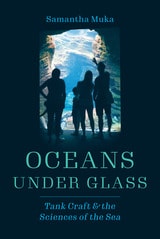
Oceans under Glass
Tank Craft and the Sciences of the SeaSamantha Muka
University of Chicago Press, 2023
Atlantic coral is rapidly disappearing in the wild. To save the species, they will have to be reproduced quickly in captivity, and so for the last decade conservationists have been at work trying to preserve their lingering numbers and figure out how to rebuild once-thriving coral reefs from a few survivors. Captive environments, built in dedicated aquariums, offer some hope for these corals. This book examines these specialized tanks, charting the development of tank craft throughout the twentieth century to better understand how aquarium modeling has enhanced our knowledge of the marine environment.
Aquariums are essential to the way we understand the ocean. Used to investigate an array of scientific questions, from animal behavior to cancer research and climate change, they are a crucial factor in the fight to mitigate the climate disaster already threatening our seas. To understand the historical development of this scientific tool and the groups that have contributed to our knowledge about the ocean, Samantha Muka takes up specialty systems—including photographic aquariums, kriesel tanks (for jellyfish), and hatching systems—to examine the creation of ocean simulations and their effect on our interactions with underwater life. Lively and engaging, Oceans under Glass offers a fresh history about how the aquarium has been used in modern marine biology and how integral it is to knowing the marine world.
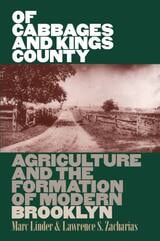
Of Cabbages and Kings County
Agriculture and the Formation of Modern BrooklynMarc Linder
University of Iowa Press, 1999
No one today thinks of Brooklyn, New York, as an agricultural center. Yet Kings County enjoyed over two centuries of farming prosperity. Even as late as 1880 it was one of the nation's leading vegetable producers, second only to neighboring Queens County.
In Of Cabbages and Kings County, Marc Linder and Lawrence Zacharias reconstruct the history of a lost agricultural community. Their study focuses on rural Kings County, the site of Brooklyn's tremendous expansion during the latter part of the nineteenth century. In particular, they question whether sprawl was a necessary condition of American industrialization: could the agricultural base that preceded and surrounded the city have survived the onrush of residential real estate speculation with a bit of foresight and public policies that the politically outnumbered farmers could not have secured on their own?
The first part of the book reviews the county's Dutch American agricultural tradition, in particular its conversion after 1850 from extensive farming (e.g., wheat, corn) to intensive farming of market garden crops. The authors examine the growing competition between local farmers and their southern counterparts for a share of the huge New York City market, comparing farming conditions and factors such as labor and transportation.
In the second part of the book, the authors turn their attention to the forces that eventually destroyed Kings County's farming—ranging from the political and ideological pressures to modernize the city's rural surroundings to unplanned, market-driven attempts to facilitate transportation for more affluent city dwellers to recreational outlets on Coney Island and, once transportation was at hand, to replace farms with residential housing for the city's congested population.
Drawing on a vast range of archival sources, the authors refocus the history of Brooklyn to uncover what was lost with the expansion of the city. For today, as urban planners, ecologists, and agricultural developers reevaluate urban sprawl and the need for greenbelts or agricultural-urban balance, the lost opportunities of the past loom larger.
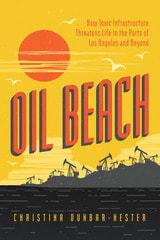
Oil Beach
How Toxic Infrastructure Threatens Life in the Ports of Los Angeles and BeyondChristina Dunbar-Hester
University of Chicago Press, 2023
San Pedro Bay, which contains the contiguous Ports of Los Angeles and Long Beach, is a significant site for petroleum shipping and refining as well as one of the largest container shipping ports in the world—some forty percent of containerized imports to the United States pass through this so-called America’s Port. It is also ecologically rich. Built atop a land- and waterscape of vital importance to wildlife, the heavily industrialized Los Angeles Harbor contains estuarial wetlands, the LA River mouth, and a marine ecology where colder and warmer Pacific Ocean waters meet. In this compelling interdisciplinary investigation, award-winning author Christina Dunbar-Hester explores the complex relationships among commerce, empire, environment, and the nonhuman life forms of San Pedro Bay over the last fifty years—a period coinciding with the era of modern environmental regulation in the United States. The LA port complex is not simply a local site, Dunbar-Hester argues, but a node in a network that enables the continued expansion of capitalism, propelling trade as it drives the extraction of natural resources, labor violations, pollution, and other harms. Focusing specifically on cetaceans, bananas, sea birds, and otters whose lives are intertwined with the vitality of the port complex itself, Oil Beach reveals how logistics infrastructure threatens ecologies as it circulates goods and capital—and helps us to consider a future where the accumulation of life and the accumulation of capital are not in violent tension.
Oil Beach
How Toxic Infrastructure Threatens Life in the Ports of Los Angeles and BeyondChristina Dunbar-Hester
University of Chicago Press, 2023
Can the stories of bananas, whales, sea birds, and otters teach us to reconsider the seaport as a place of ecological violence, tied to oil, capital, and trade?
San Pedro Bay, which contains the contiguous Ports of Los Angeles and Long Beach, is a significant site for petroleum shipping and refining as well as one of the largest container shipping ports in the world—some forty percent of containerized imports to the United States pass through this so-called America’s Port. It is also ecologically rich. Built atop a land- and waterscape of vital importance to wildlife, the heavily industrialized Los Angeles Harbor contains estuarial wetlands, the LA River mouth, and a marine ecology where colder and warmer Pacific Ocean waters meet. In this compelling interdisciplinary investigation, award-winning author Christina Dunbar-Hester explores the complex relationships among commerce, empire, environment, and the nonhuman life forms of San Pedro Bay over the last fifty years—a period coinciding with the era of modern environmental regulation in the United States. The LA port complex is not simply a local site, Dunbar-Hester argues, but a node in a network that enables the continued expansion of capitalism, propelling trade as it drives the extraction of natural resources, labor violations, pollution, and other harms. Focusing specifically on cetaceans, bananas, sea birds, and otters whose lives are intertwined with the vitality of the port complex itself, Oil Beach reveals how logistics infrastructure threatens ecologies as it circulates goods and capital—and helps us to consider a future where the accumulation of life and the accumulation of capital are not in violent tension.
Oil Culture
Ross Barrett
University of Minnesota Press, 2014
In the 150 years since the birth of the petroleum industry oil has saturated our culture, fueling our cars and wars, our economy and policies. But just as thoroughly, culture saturates oil. So what exactly is “oil culture”? This book pursues an answer through petrocapitalism’s history in literature, film, fine art, wartime propaganda, and museum displays. Investigating cultural discourses that have taken shape around oil, these essays compose the first sustained attempt to understand how petroleum has suffused the Western imagination.
The contributors to this volume examine the oil culture nexus, beginning with the whale oil culture it replaced and analyzing literature and films such as Giant, Sundown, Bernardo Bertolucci’s La Via del Petrolio, and Ben Okri’s “What the Tapster Saw”; corporate art, museum installations, and contemporary photography; and in apocalyptic visions of environmental disaster and science fiction. By considering oil as both a natural resource and a trope, the authors show how oil’s dominance is part of culture rather than an economic or physical necessity. Oil Culture sees beyond oil capitalism to alternative modes of energy production and consumption.
Contributors: Georgiana Banita, U of Bamberg; Frederick Buell, Queens College; Gerry Canavan, Marquette U; Melanie Doherty, Wesleyan College; Sarah Frohardt-Lane, Ripon College, Matthew T. Huber, Syracuse U; Dolly Jørgensen, Umeå U; Stephanie LeMenager, U of Oregon; Hanna Musiol, Northeastern U; Chad H. Parker, U of Louisiana at Lafayette; Ruth Salvaggio, U of North Carolina, Chapel Hill; Heidi Scott, Florida International U; Imre Szeman, U of Alberta; Michael Watts, U of California, Berkeley; Jennifer Wenzel, Columbia University; Sheena Wilson, U of Alberta; Rochelle Raineri Zuck, U of Minnesota Duluth; Catherine Zuromskis, U of New Mexico.
Old Farm
A HistoryJerry Apps
Wisconsin Historical Society Press, 2013
Olmsted's Riverside
Stewardship Meets Innovation in a Landmark VillageCathy Jean Maloney
Southern Illinois University Press, 2024
WINNER, Certificate of Excellence in “Scholarly Publications” from the Illinois State Historical Society’s 2025 Best of Illinois History Awards!
Honorable Mention, 2025 Society of Midland Authors Award in History!
The challenge to preserve Chicagoland’s unique haven
Just outside the bustling metropolis of Chicago lies the unlikely green oasis of Riverside, Illinois, a small village that has continued to directly influence American landscapes and suburbs since the 1870s. Once farmland, the location provided a blank canvas for preeminent designers Fredrick Law Olmsted and Calvert Vaux’s manifestation of a truly democratic society. Olmsted’s Riverside details the village’s historical significance, harmony with nature, and its nearly 150-year impact on American suburbs today.
Cathy Jean Maloney explores how Riverside’s layout and design presaged today’s urban planning goals of walkability, green space, public transportation access, sustainability, and resiliency. Houses in Riverside are set back from the road, sidewalks meander along gently curving roads, and public green spaces abound. Maloney shows how Riverside’s leaders and residents struggled with stewardship of Olmsted’s ideals by balancing competing interests in suburban development and Chicago sprawl from the 1870s to the 2020s. She details in chronological chapters how the village adapted to tragedies such as the Great Fire of 1871 and the Panic of 1873, as well as advancements in transportation, local civic life, urban policy, and environmental thought, all while staying true to the framework inherited from Olmsted and Vaux.
Olmsted’s Riverside provides engaging examples of how citizen involvement can protect a community’s ideals. This richly illustrated volume combines landscape architecture, regional history, and urban design to show how audacious civic planning and thoughtful conservation can provide a model for future American suburbs.

On Hunting
Roger Scruton
St. Augustine's Press, 2002
Among the most dramatic and ironic discoveries that On Hunting offers the typical American reader is that hunting is about a love and respect for animals, rather than a blood-thirsty hatred of them, and that the sport, far from being limited to an upper-class, old-monied aristocracy, is really one promoting an egalitarian meritocracy.
On the Brink
The Great Lakes in the 21st CenturyDave Dempsey
Michigan State University Press, 2004
As one of the world’s great natural treasures, the Great Lakes have also served in recent decades as an early warning system for many emerging environmental problems. In the early twenty-first century, as the Lakes face unprecedented challenges, we need to revisit both the wonder of the Lakes and the perils plaguing them, and to take action to protect this majestic ecosystem.
Dave Dempsey weaves the natural character and phenomena of the Great Lakes and stories of the schemes, calamities, and unusual human residents of the Basin with the history of their environmental exploitation and recovery. Contrasting the incomparable beauty and complexity of the Lakes, and the poetry, folklore, and citizen action they have inspired, with the disasters that short-sighted human folly has inflicted on the ecosystem, Dempsey makes this history both engaging and relevant to today’s debates and decisions.
Underlying the neglectful treatment of the Lakes are two irreconcilable and faulty human assumptions: that the Lakes are a system so big that human beings cannot do great harm to it, and that the Lakes are a resource that can be bent to the will of humankind. Dempsey finds evidence that, despite great changes in the laws governing the Lakes and public attitudes toward them in the last fifty years, government policy and institutions are still dominated by these dangerous attitudes.
A central theme of On the Brink is that citizens, who have displayed an increasing sense of commitment to the Lakes and a growing sense of place, must challenge their leaders to reform Great Lakes institutions. While everything from large-scale water exports to global climate change looms in the future of the Lakes, single-purpose solutions do not suffice—no more than a Band- aid would on a gaping wound. Dempsey shows that it is necessary to create a governing system that reflects the realities of life “on the ground” in communities and that taps into the passion and determination of citizens to protect these treasures.
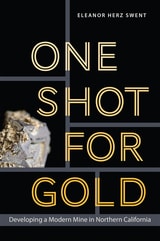
One Shot for Gold
Developing a Modern Mine in Northern CaliforniaEleanor Herz Swent
University of Nevada Press, 2021
An account of the creation of a modern, environmentally sensitive mine as told by the people who developed and worked it.
In 1978, a geologist working for the Homestake Mining Company discovered gold in a remote corner of California’s Napa County. This discovery led to the establishment of California’s most productive gold mine in the twentieth century. Named the McLaughlin Mine, it produced about 3.4 million ounces of gold between 1985 and 2002. The mine was also one of the first attempts at creating a new full-scale mine in California after the advent of environmental regulations and the first to use autoclaves to extract gold from ore.
One Shot for Gold traces the history of the McLaughlin Mine and how it transformed a community and an industry. This lively and detailed account is based largely on oral history interviews with a wide range of people associated with the mine, including Homestake executives, geologists, and engineers as well as local neighbors of the mine, officials from county governments, townspeople, and environmental activists. Their narratives— supported by thorough research into mining company documents, public records, newspaper accounts, and other materials—chronicle the mine from its very beginning to its eventual end and transformation into a designated nature reserve as part of the University of California Natural Reserve System.
A mine created at the end of the twentieth century was vastly different from the mines of the Gold Rush. New regulations and concerns about the environmental, economic, and social impacts of a large mine in this remote and largely rural region of the state-required decisions at many levels. One Shot for Gold offers an engaging and accessible account of a modern gold mine and how it managed to exist in balance with the environment and the human community around it.
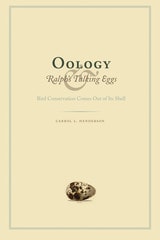
Oology and Ralph's Talking Eggs
Bird Conservation Comes Out of Its ShellBy Carrol L. Henderson
University of Texas Press, 2007
Before modern binoculars and cameras made it possible to observe birds closely in the wild, many people collected eggs as a way of learning about birds. Serious collectors called their avocation "oology" and kept meticulous records for each set of eggs: the bird's name, the species reference number, the quantity of eggs in the clutch, the date and location where the eggs were collected, and the collector's name. These documented egg collections, which typically date from the nineteenth and early twentieth centuries, now provide an important baseline from which to measure changes in the numbers, distribution, and nesting patterns of many species of birds.
In Oology and Ralph's Talking Eggs, Carrol L. Henderson uses the vast egg collection of Ralph Handsaker, an Iowa farmer, as the starting point for a fascinating account of oology and its role in the origins of modern birdwatching, scientific ornithology, and bird conservation in North America. Henderson describes Handsaker's and other oologists' collecting activities, which included not only gathering bird eggs in the wild but also trading and purchasing eggs from collectors around the world. Henderson then spotlights sixty of the nearly five hundred bird species represented in the Handsaker collection, using them to tell the story of how birds such as the Snowy Egret, Greater Prairie Chicken, Atlantic Puffin, and Wood Duck have fared over the past hundred years or so since their eggs were gathered. Photos of the eggs and historical drawings and photos of the birds illustrate each species account. Henderson also links these bird histories to major milestones in bird conservation and bird protection laws in North America from 1875 to the present.
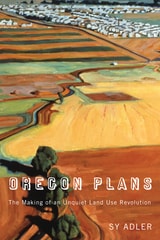
Oregon Plans
The Making of an Unquiet Land Use RevolutionSy Adler
Oregon State University Press, 2012
"Adler's story is about unusual conditions, purposeful action, dynamic personalities, and the messiness of democratic and bureaucratic processes. His conclusions reveal much about how Oregonians defined liveability in the late twentieth century." —William L. Lang, from the Preface
Our Energy Future
Lincoln Davies
University of Utah Press, 2025
In Our Energy Future, Lincoln Davies shines a bright light on the challenges the transition presents, including energy equity, political partisanship, the need for holistic solutions, and adaptability in the face of change. Our Energy Future makes the case for why the United States’ current transition to clean energy provides our world with something we so desperately need today: hope.
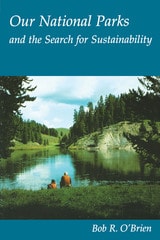
Our National Parks and the Search for Sustainability
By Bob R. O'Brien
University of Texas Press, 1999
"Yosemite Valley in July of 1967 would have had to be seen to be believed. There was never an empty campsite in the valley; you had to create a space for yourself in a sea of cars, tents, and humanity.... The camp next to ours had fifty people in it, with rugs hung between the trees, incense burning, and a stereo set going full volume."
Scenes such as this will probably never be repeated in Yosemite or any other national park, yet the urgent problem remains of balancing the public's desire to visit the parks with the parks' need to be protected from too many people and cars and too much development. In this book, longtime park visitor and professional geographer Bob O'Brien explores the National Park Service's attempt to achieve "sustainability"—a balance that allows as many people as possible to visit a park that is kept in as natural a state as possible.
O'Brien details methods the NPS has used to walk the line between those who would preserve vast tracts of land for "no use" and those who would tap the Yellowstone geysers to generate electricity. His case studies of six western "crown jewel" parks show how rangers and other NPS employees are coping with issues that impact these cherished public landscapes, including visitation, development, and recreational use.
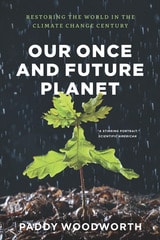
Our Once and Future Planet
Restoring the World in the Climate Change CenturyPaddy Woodworth
University of Chicago Press, 2013
But that paints an unbalanced—and overly disheartening—picture of what’s going on with environmental stewardship today. There are success stories, and Our Once and Future Planet delivers a fascinating account of one of the most impressive areas of current environmental experimentation and innovation: ecological restoration. Veteran investigative reporter Paddy Woodworth has spent years traveling the globe and talking with people—scientists, politicians, and ordinary citizens—who are working on the front lines of the battle against environmental degradation. At sites ranging from Mexico to New Zealand and Chicago to Cape Town, Woodworth shows us the striking successes (and a few humbling failures) of groups that are attempting to use cutting-edge science to restore blighted, polluted, and otherwise troubled landscapes to states of ecological health—and, in some of the most controversial cases, to particular moments in historical time, before widespread human intervention. His firsthand field reports and interviews with participants reveal the promise, power, and limitations of restoration.
Ecological restoration alone won’t solve the myriad problems facing our environment. But Our Once and Future Planet demonstrates the role it can play, and the hope, inspiration, and new knowledge that can come from saving even one small patch of earth.
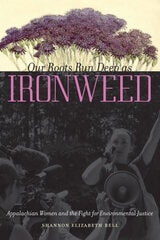
Our Roots Run Deep as Ironweed
Appalachian Women and the Fight for Environmental JusticeShannon Elizabeth Bell
University of Illinois Press, 2013
Motivated by a deeply rooted sense of place and community, Appalachian women have long fought against the damaging effects of industrialization. In this collection of interviews, sociologist Shannon Elizabeth Bell presents the voices of twelve Central Appalachian women, environmental justice activists fighting against mountaintop removal mining and its devastating effects on public health, regional ecology, and community well-being.
Each woman narrates her own personal story of injustice and tells how that experience led her to activism. The interviews--many of them illustrated by the women's "photostories"--describe obstacles, losses, and tragedies. But they also tell of new communities and personal transformations catalyzed through activism. Bell supplements each narrative with careful notes that aid the reader while amplifying the power and flow of the activists' stories. Bell's analysis outlines the relationship between Appalachian women's activism and the gendered responsibilities they feel within their families and communities. Ultimately, Bell argues that these women draw upon a broader "protector identity" that both encompasses and extends the identity of motherhood that has often been associated with grassroots women's activism. As protectors, the women challenge dominant Appalachian gender expectations and guard not only their families but also their homeplaces, their communities, their heritage, and the endangered mountains that surround them.
30% of the proceeds from the sale of this book will be donated to organizations fighting for environmental justice in Central Appalachia.
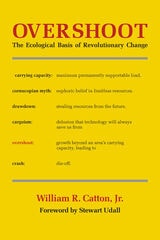
Overshoot
The Ecological Basis of Revolutionary ChangeWilliam R. Catton, Jr.
University of Illinois Press, 1980
A calm but unflinching realist, Catton suggests that we cannot stop this wave - for we have already overshot the Earth's capacity to support so huge a load. He contradicts those scientists, engineers, and technocrats who continue to write optimistically about energy alternatives. Catton asserts that the technological panaceas proposed by those who would harvest from the seas, harness the winds, and farm the deserts are ignoring the fundamental premise that "the principals of ecology apply to all living things." These principles tell us that, within a finite system, economic expansion is not irreversible and population growth cannot continue indefinitely. If we disregard these facts, our sagging American Dream will soon shatter completely.