Results by title
421 books match the query 'Evolution' and 9 start with o
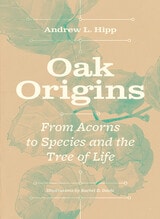
Oak Origins
From Acorns to Species and the Tree of LifeAndrew L. Hipp
University of Chicago Press, 2024
An oak begins its life with the precarious journey of a pollen grain, then an acorn, then a seedling. A mature tree may shed millions of acorns, but only a handful will grow. One oak may then live 100 years, 250 years, or even 13,000 years. But the long life of an individual is only a part of these trees’ story.
With naturalist and leading researcher Andrew L. Hipp as our guide, Oak Origins takes us through a sweeping evolutionary history, stretching back to a population of trees that lived more than 50 million years ago. We travel to the ancient tropical Earth to see the ancestors of the oaks evolving side by side with the dinosaurs. We journey from the oaks’ childhood in the once-warm forests of the Arctic to the montane cloud forests of Mexico and the broad-leaved evergreen forests of Southeast Asia. We dive into current research on oak genomes to see how scientists study genes’ movement between species and how oaks evolve over generations—spanning tens of millions of years. Finally, we learn how oak evolutionary history shapes the forests we know today, and how it may even shape the forests of the future.
Oaks are familiar to almost everyone, and beloved. They are embedded in our mythology. They have fed us, housed us, provided wood for our ships and wine barrels and homes and halls, planked our roads, and kept us warm. Every oak also has the potential to feed thousands of birds, squirrels, and mice and host countless insects, mosses, fungi, and lichens. But as Oak Origins makes clear, the story of the oaks’ evolution is not just the story of one important tree. It is the story of the Tree of Life, connecting all organisms that have ever lived on Earth, from oaks’ last common ancestor to us.
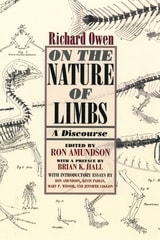
On the Nature of Limbs
A DiscourseRichard Owen
University of Chicago Press, 2007
Just as Darwin’s ideas continue to propel the modern study of adaptation, so too will Owen’s contributions fuel the new interest in homology, organic form, and evolutionary developmental biology. His theory of the archetype and his views on species origins were first offered to the general public in On the Nature of Limbs, published in 1849. It reemerges here in a facsimile edition with introductory essays by prominent historians, philosophers, and practitioners from the modern evo-devo community.

On the Origin of Phyla
James W. Valentine
University of Chicago Press, 2004
One of the twentieth century's most distinguished paleobiologists, Valentine here integrates data from molecular genetics, evolutionary developmental biology, embryology, comparative morphology, and paleontology into an analysis of interest to scholars from any of these fields. He begins by examining the sorts of evidence that can be gleaned from fossils, molecules, and morphology, then reviews and compares the basic morphology and development of animal phyla, emphasizing the important design elements found in the bodyplans of both living and extinct phyla. Finally, Valentine undertakes the monumental task of developing models to explain the origin and early diversification of animal phyla, as well as their later evolutionary patterns.
Truly a magnum opus, On the Origin of Phyla will take its place as one of the classic scientific texts of the twentieth century, affecting the work of paleontologists, morphologists, and developmental, molecular, and evolutionary biologists for decades to come.
"Truly a magnum opus, On the Origin of Phyla has already taken its place as one of the classic scientific texts of the twentieth century, affecting the work of paleontologists, morphologists, and developmental, molecular, and evolutionary biologists for decades to come."—Ethology, Ecology & Evolution
"Valentine is one of the Renaissance minds of our time. . . . Darwin wisely called his best-known work On the Origin of the Species; the origin of the phyla is an even stickier problem, and Valentine deserves credit for tackling it at such breadth . . . . A magnificient book."—Stefan Bengtson, Nature

On the Origins of Life and Its Infectious Nature
Life in a Cosmic ContextJosé Quintáns
University of Chicago Press, 2013

Organizing for Equality
The Evolution of Women's and Racial-Ethnic Organizations in America, 1955-1985Minkoff, Debra C
Rutgers University Press, 1995
Women and racial-ethnic minorities have had long histories of mobilizing for equality in U.S. society, but recent decades have witnessed an unprecedented expansion in the number and visibility of voluntary and activist organizations committed to challenging gender and racial-ethnic discrimination. What conditions have encouraged this growth? Going beyond more familiar accounts of social movement development, Debra Minkoff uses multivariate techniques to demonstrate that there is an ecology of organizational evolution that has shaped the formation and survival of national women's, African-American, Asian American, and Latino social and political organizations. Changes in the environment for action during the 1960s promoted the creation of a niche for women's and minority organizational activity, and this sector continued to expand even as the climate for social action became increasingly conservative during the 1970s and 1980s. Drawing on recent advances in both social movement and organizational theory and research, Minkoff offers an organizational analysis of the evolution of the women's and racial-ethnic social change sector since the mid-1950s. She provides an original synthesis of social movement and organizational theory, and unique analysis of the development of these women's and minority organizations from the civil rights era to the present.

Origin and Evolution of Planetary and Satellite Atmospheres
Edited by S. K. Atreya, J. B. Pollack, and M.S. Matthews
University of Arizona Press, 1989

Origins of Psychopathology
The Phylogenetic and Cultural Basis of Mental IllnessFábrega Jr., Horacio
Rutgers University Press, 2002
In Origins of Psychopathology, Horacio Fárega Jr. employs principles of evolutionary biology to better understand the significance of mental illness. He explores whether what psychiatry has categorized as mental disorders could have existed during earlier phases of human evolution. Fábrega approaches the prominent features of mental disorders as adaptive responses to the environment and life’s circumstances, which in turn can only be understood in the context of our evolutionary past. Taking his cue from theoretical issues raised by research into primate behavior and early hominid evolution, he poses the question: What, if any, aspects of mental illness are rooted in our evolution? Does mental illness occur in primates and other animals, and if so, what does this tell us about mental illness in human evolution? How has mental illness played an adaptive role? How has the development of language and higher cognitive functions affected characteristics of psychopathology? Fábrega synthesizes insights from both the clinical and the evolutionary points of view. This facet of psychopathology, which involves its origins and manifestations viewed across the expanse of human evolution, has, until now, been largely neglected in psychiatric education, theory, and practice.
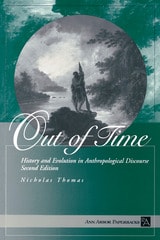
Out of Time
History and Evolution in Anthropological DiscourseNicholas Thomas
University of Michigan Press, 1996
Despite the enormous amount of work that has attempted to combine historical and anthropological approaches in recent years, few books have outlined the underlying premises that make integration of the two fields difficult. In Out of Time, Nicholas Thomas argues that a "historical perspective" cannot simply be added to conventional anthropology, which systematically takes ethnography "out of time." Drawing examples from the Polynesian anthropological literature, he points to discredited social evolutionary ideas that have persisted even after apparently dramatic theoretical shifts and to the need to take seriously sources that anthropologists have previously dismissed. When it was first published in 1989, Out of Time generated much-needed discussion on the appropriate models for historical anthropology. Thomas considered that both the historical structuralism of Marshall Sahlins and neo-Marxist regional systems theory had failed to transcend crucial limitations of conventional anthropology. Yet they provided elements of a more stimulating and critical perspective, which would also take account of contemporary political developments in the Pacific region. For this second edition, Thomas has added an afterword that reflects on the book's initial reception and brings its critique up to date. He suggests a need to historicize the professionalization of anthropology as a discipline to understand shifts in practice and the need to acknowledge the historical specificity and limits of all forms of cultural knowledge, whether "Western" or indigenous. Out of Time will be a useful text for graduate courses in anthropology, history, and cultural studies. "This book displays rare integrity: Thomas' intellectual stance toward the theoretical approaches of others is fully consistent with his own discursive practices." --Contemporary Pacific.
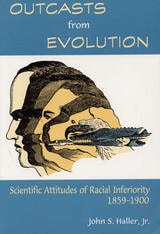
Outcasts from Evolution
Scientific Attitudes of Racial Inferiority, 1859 - 1900John S. Haller, Jr.
Southern Illinois University Press, 1996
In the only book to date to explore the period between the 1859 publication of Darwin’s Origin of Species and the discovery in 1900 of Gregor Mendel’s experiments in genetics, John S. Haller, Jr., shows the relationship between scientific "conviction" and public policy. He focuses on the numerous liberally educated American scientists who were caught up in the triumph of evolutionary ideas and who sought to apply those ideas to comparative morality, health, and the physiognomy of nonwhite races.
During this period, the natural and social scientists of the day not only accepted without question the genetic and cultural superiority of the Caucasian; they also asserted that the Caucasian race held a monopoly on evolutionary progress, arguing that "inferior races" were no more than evolutionary survivors doomed by their genetic legacy to remain outcasts from evolution.
Hereditarians and evolutionists believed that "less fit" human races were perishing from the rigors of civilization’s struggle and competition. Indeed, racial inferiority lay at the very foundation of the evolutionary framework and, remaining there, rose to the pinnacle of "truth" with the myth of scientific certainty.