Results by title
130 books match the query 'Gay men' and 8 start with o
On Christopher Street
Life, Sex, and Death after StonewallMichael Denneny
University of Chicago Press, 2023
The Stonewall Riots of 1969 and the AIDS crisis of the 1980s have been captured in minute detail, and rightly memorialized in books, on tv, and in film as pivotal and powerful moments in queer history. Yet what about the moments in between—the tumultuous decade post-Stonewall when the queer community’s vitality and creativity exploded across the country, even as the AIDS crisis emerged?
Michael Denneny was there for it all. As a founder and editor of the wildly influential magazine Christopher Street and later as the first openly gay editor at a major publishing house, Denneny critically shaped publishing around gay subjects in the 1970s and beyond. At St. Martin’s Press, he acquired a slew of landmark titles by gay authors—many for his groundbreaking Stonewall Inn Editions—propelling queer voices into the mainstream cultural conversation. On Christopher Street is Denneny’s time machine, going back to that heady period to lay out the unfolding geographies and storylines of gay lives and capturing the raw immediacy of his and his contemporaries’ daily lives as gay people in America. Through forty-one micro-chapters, he uses his journal writings, articles, interviews, and more from the 1970s and ‘80s to illuminate the twists and turns of a period of incomparable cultural ferment.
One of the few surviving voices of his generation, Denneny transports us back in time to share those vibrant in-between moments in gay lives—the joy, sorrow, ecstasy, and energy—across three decades of queer history.
One Breath from Drowning
Kent Quaney
University of Wisconsin Press, 2022
The two men find moments of joy and humor together in Sydney, but arrests, infidelities, and addictions force them to finally face the issues holding them back. Though it initially presents as a love story, One Breath from Drowning is a tale of spiritual bildungsroman told in parallel. Ryan and Sam’s conflict and love ultimately push each of them to evolve, their transformation not the result of reckless acts of escape but the product of the fitful and difficult work of grappling with their complex realities.
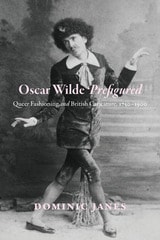
Oscar Wilde Prefigured
Queer Fashioning and British Caricature, 1750-1900Dominic Janes
University of Chicago Press, 2016
Oscar Wilde Prefigured is a study of the prehistory of this “queer moment” in 1895. Janes explores the complex ways in which men who desired sex with men in Britain had expressed such interests through clothing, style, and deportment since the mid-eighteenth century. He supplements the well-established narrative of the inscription of sodomitical acts into a homosexual label and identity at the end of the nineteenth century by teasing out the means by which same-sex desires could be signaled through visual display in Georgian and Victorian Britain. Wilde, it turns out, is not the starting point for public queer figuration. He is the pivot by which Georgian figures and twentieth-century camp stereotypes meet. Drawing on the mutually reinforcing phenomena of dandyism and caricature of alleged effeminates, Janes examines a wide range of images drawn from theater, fashion, and the popular press to reveal new dimensions of identity politics, gender performance, and queer culture.
Out In The South
edited by Carlos L. Dews and Carolyn Leste Law
Temple University Press, 2001
In this book gays and lesbians from the Deep South to East Texas and Appalachia speak from vivid personal experience and turn an analytical eye on the South and its culture. Some contributors examine the power of traditional Southern attitudes toward race and religion, and consider the "don't ask, don't tell" attitude about homosexuality in some communities (the "public secret"). Other contributors show how gay culture is thriving in the form of women's festivals, gay bars, and unusual networks like that of Asian and Pacific Islanders in Atlanta.
Out in the South is organized into sections that focus on a central metaphor of space and location. This grounds the book in the sense of the South as a special region and in the inside/outside dilemma faced by many gay and lesbian Southerners as they negotiate their place in an often-inhospitable homeland.
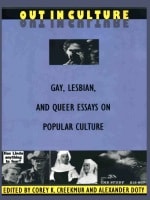
Out in Culture
Gay, Lesbian and Queer Essays on Popular CultureCorey K. Creekmur and Alexander Doty, eds.
Duke University Press, 1995
Uniquely accessible, Out in Culture presents such popular writers as B. Ruby Rich, Essex Hemphill, and Michael Musto as well as influential critics such as Richard Dyer, Chris Straayer, and Julia Lesage, on topics ranging from the queer careers of Agnes Moorehead and Pee Wee Herman to the cultural politics of gay drag, lesbian style, the visualization of AIDS, and the black snap! queen experience. Of particular interest are two "dossiers," the first linking essays on the queer content of Alfred Hitchcock’s films, and the second on the production and reception of popular music within gay and lesbian communities. The volume concludes with an extensive bibliography—the most comprehensive currently available—of sources in gay, lesbian, and queer media criticism.
Out in Culture explores the distinctive and original ways in which gays, lesbians, and queers have experienced, appropriated, and resisted the images and artifacts of popular culture. This eclectic anthology will be of interest to a broad audience of general readers and scholars interested in gay and lesbian issues; students of film, media, gender, and cultural studies; and those interested in the emerging field of queer theory.
Contributors. Sabrina Barton, Edith Becker, Rhona J. Berenstein, Nayland Blake, Michelle Citron, Danae Clark, Corey K. Creekmur, Alexander Doty, Richard Dyer, Heather Findlay, Jan Zita Grover, Essex Hemphill, John Hepworth, Jeffrey Hilbert, Lucretia Knapp, Bruce La Bruce, Al LaValley, Julia Lesage, Michael Moon, Michael Musto, B. Ruby Rich, Marlon Riggs, Arlene Stein, Chris Straayer, Anthony Thomas, Mark Thompson, Valerie Traub, Thomas Waugh, Patricia White, Robin Wood
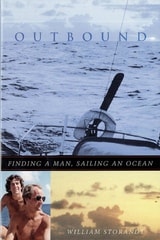
Outbound
Finding a Man, Sailing an OceanWilliam Storandt
University of Wisconsin Press, 2001
is the story of two voyages: an Atlantic crossing in the 33-foot cutter
Clarity, bound for Scotland; and the hard voyage of self-discovery that finally brought Bill Storandt to his life partner.
Storandt’s account of the adventure he had carefully planned with longtime partner Brian Forsyth and their friend Bob soon turns into a white-knuckled sailing tale, as they encounter a fierce storm four hundred miles from the Irish coast that tests their courage and all their sailing skills. The sea story, vividly evoking life in a small boat on a big ocean, is interwoven with Storandt’s flashbacks to his earlier life. Outbound delivers its share of excitement, but it’s also a moving reflection on how circuitous our paths can be, even when the destination is clear and beckoning.
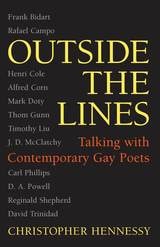
Outside the Lines
Talking with Contemporary Gay PoetsChristopher Hennessy, Editor
University of Michigan Press, 2005
---Bernard Cooper, author of Maps to Anywhere
Editor Christopher Hennessy gathers interviews with some of the most significant figures in contemporary American poetry. While each poet is gay, these encompassing, craft-centered interviews reflect the diversity of their respective arts and serve as a testament to the impact gay poets have had and will continue to have on contemporary poetics.
The book includes twelve frank, intense interviews with some of America's best-known and loved poets, who have not only enjoyed wide critical acclaim but who have had lasting impact on both the gay tradition and the contemporary canon writ large, for example, Frank Bidart, the late Thom Gunn, and J. D. McClatchy. Some of the most honored and respected poets, still in the middle of their careers, are also included, for example, Mark Doty, Carl Phillips, and Reginald Shepherd. Each interview explores the poet's complete work to date, often illuminating the poet's technical evolution and emotional growth, probing shifts in theme, and even investigating links between verse and sexuality.
In addition to a selected bibliography of works by established poets, the book also includes a list of works by newer and emerging poets who are well on their way to becoming important voices of the new millennium.
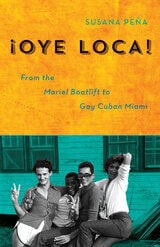
Oye Loca
From the Mariel Boatlift to Gay Cuban MiamiSusana Peña
University of Minnesota Press, 2013
During only a few months in 1980, 125,000 Cubans entered the United States as part of a massive migration known as the Mariel boatlift. The images of boats of all sizes, in various conditions, filled with Cubans of all colors and ages, triggered a media storm. Fleeing Cuba’s repressive government, many homosexual men and women arrived in the United States only to face further obstacles. Deemed “undesirables” by the U.S. media, the Cuban state, and Cuban Americans already living in Miami, these new entrants marked a turning point in Miami’s Cuban American and gay histories.
In Oye Loca, Susana Peña investigates a moment of cultural collision. Drawing from first-person stories of Cuban Americans as well as government documents and cultural texts from both the United States and Cuba, Peña reveals how these discussions both sensationalized and silenced the gay presence, giving way to a Cuban American gay culture. Through an examination of the diverse lives of Cuban and Cuban American gay men, we learn that Miami’s gay culture was far from homogeneous. By way of in-depth interviews, participant observation, and archival analysis, Peña shows that the men who crowded into small apartments together, bleached their hair with peroxide, wore housedresses in the street, and endured ruthless insults challenged what it meant to be Cuban in Miami.
Making a critical incision through the study of heteronormativity, homosexualities, and racialization, ultimately Oye Loca illustrates how a single historical event helped shape the formation of an entire ethnic and sexual landscape.