Results by title
522 books match the query 'Gender' and 11 start with o
Odd Couples
Friendships at the Intersection of Gender and Sexual OrientationAnna Muraco
Duke University Press, 2012
Of Beasts and Beauty
Gender, Race, and Identity in ColombiaBy Michael Edward Stanfield
University of Texas Press, 2013
All societies around the world and through time value beauty highly. Tracing the evolutions of the Colombian standards of beauty since 1845, Michael Edward Stanfield explores their significance to and symbiotic relationship with violence and inequality in the country. Arguing that beauty holds not only social power but also economic and political power, he positions it as a pacific and inclusive influence in a country “ripped apart by violence, private armies, seizures of land, and abuse of governmental authority, one hoping that female beauty could save it from the ravages of the male beast.” One specific means of obscuring those harsh realities is the beauty pageant, of which Colombia has over 300 per year. Stanfield investigates the ways in which these pageants reveal the effects of European modernity and notions of ethnicity on Colombian women, and how beauty for Colombians has become an external representation of order and morality that can counter the pathological effects of violence, inequality, and exclusion in their country.
On Edge
Gender and Genre in the Work of Shirley Jackson, Patricia Highsmith, and Leigh BrackettAshley Lawson
The Ohio State University Press, 2024
Honorable Mention, 2025 PCA Emily Toth Award For Best Single Work In Women’s Studies
Finalist, 2025 Mystery Writers of America's Edgar Awards, Best Critical/Biographical Category
Finalist, Bouchercon New Orleans 2025 Anthony Awards, Best Critical/Non-Fiction
Nominated for the 2025 Macavity Awards, Best Mystery-related Nonfiction/Critical
Ashley Lawson’s On Edge presents a new picture of postwar American literature, arguing that biases against genre fiction have unfairly disadvantaged the legacies of authors like Shirley Jackson, Patricia Highsmith, and Leigh Brackett. Each of these women navigated a male-dominated postwar publishing world without compromising their values. Their category-defying treatment of gender roles and genre classifications created suspense in their work that spoke to the tensions of the “Age of Anxiety.” Lawson engages with foundational voices in American literature, genre theory, and feminism to argue that, by merging the dominant mode of literary realism with fantastical or heightened elements, Brackett, Jackson, and Highsmith responded to the big questions of their era with startling and unnerving answers. By elevating genre play to a marker of literary skill, Lawson contends, we can secure these writers a more prominent place within the canon of midcentury American literature and open the door for the recovery of their similarly innovative peers.
On Gender, Labor, and Inequality
Ruth Milkman
University of Illinois Press, 2016
Milkman's introduction frames a career-spanning scholarly project: her interrogation of historical and contemporary intersections of class and gender inequalities in the workplace, and the efforts to challenge those inequalities. Early chapters focus on her pioneering work on women's labor during the Great Depression and the World War II years. In the book's second half, Milkman turns to the past fifty years, a period that saw a dramatic decline in gender inequality even as growing class imbalances created greater-than-ever class disparity among women. She concludes with a previously unpublished essay comparing the impact of the Great Depression and the Great Recession on women workers.
A first-of-its-kind collection, On Gender, Labor, and Inequality is an indispensable text by one of the world's top scholars of gender, equality, and work.
On The Man Question
Gender and Civic Virtue in AmericaMark E. Kann
Temple University Press, 1991
Focusing on Seventeenth-Century English political philosophy and Nineteenth-Century American culture, Mark Kann challenges the widely-held view that American political institutions are grounded in the primacy of individualism. Liberal thinkers have long been concerned that men are too passionate and selfish to exercise individual rights without causing social chaos. Kann demonstrates how a desperate search to answer the man question began to revolutionize gender relations He examines "the other liberal tradition in America" which downplays the value of individualism, elevates the ongoing significance of an "engendered civic virtue," and incorporates classical republicanism into the fabric of modern political discourse.
The author traces the cultural conditioning of the white middle class that produced the ideal of self-sacrificing wives whose lives were devoted to creating a haven for their husbands and a school of virtue for their sons. Upon leaving home, these young men were to be schooled in manliness in the military in order to be capable of assuming positions of power as they were vacated by their fathers’ generation. Thus, in the norms of fatherhood, fraternity, womanhood, and militarism, the male’s individualism was conditioned with a strong dose of civic virtue.

On the Edge of the Auspicious
GENDER AND CASTE IN NEPALMary M. Cameron
University of Illinois Press, 1998
been noticeably absent from ethnographic accounts of the Himalayan region.
Starting from the perspective of lower-caste Hindu women, Mary M. Cameron
offers a long-overdue study of artisans and farmers in western Nepal.
On the Edge of the Auspicious skillfully shows the connections
between caste hierarchy and gender relations leading to domestic, economic,
and religious power of lower-caste women. Situating her study in the history
of land ownership and contemporary family and work relations, Cameron
explains how and why patriarchal ideology associated with high-caste families
in Nepal does not apply to women of lower caste. Drawing on data from
work, family, and religious domains, this ethnography goes further than
other current studies of caste hierarchy in South Asia to show the everyday
material and ideological dimensions of domination and lower-caste people's
resistance to them..
Opposing Ambitions
Gender and Identity in an Alternative OrganizationSherryl Kleinman
University of Chicago Press, 1996
In Opposing Ambitions we meet the members of Renewal as individuals; learn about the differences in power, prestige, and respect they are accorded; why they talked endlessly about money; and how they related to each other. Kleinman shows how members' attempts to see themselves as unconventional, but also as serious operators of a legitimate health care organization, led them to act in ways that undermined their egalitarian goals. She draws out the lessons Renewal offers for understanding the problems women face in organizations, the failure of social movements to live up to their ideals, and how it is possible for progressives to avoid reproducing the inequalities they claim to oppose.
Oral Literature, Gender, and Precedence in East Timor
Metaphysics in NarrativeDavid Hicks
National University of Singapore Press, 2020
Original Copy
Ekphrasis, Gender, and the National Imagination in Nineteenth-Century American LiteratureChrista Holm Vogelius
University of Massachusetts Press, 2025
When critics of poet Phillis Wheatley, the first African American to publish a collection of poetry, dismiss her work as derivative, they fail to see her writing as part of a new creative pantheon, sitting alongside other works that, like the popular copybooks in antebellum America, are structured as a conversation between artistic allies. Different kinds of copying in this period were distinctly feminized practices, such as artistic copying, pedagogical recitation, and literary imitation. Ekphrasis, the literary description of a work of visual art, reveals a particularly interesting form of copying, as the artwork in question becomes a kind of mediated space between author and reader; this practice, then, becomes the emblematic form of literature as collective production.
Original Copy frames ekphrasis and other forms of literary and visual copy-work as key concepts for understanding the discussions of nationalism, originality, and gender that dominated US literary circles during the first half of the nineteenth century. Christa Holm Vogelius focuses on four major writers of the period—Phillis Wheatley, Margaret Fuller, Sophia Hawthorne, and Henry Longfellow—to offer a narrative of a self-consciously feminine antebellum literary culture that was equally invested in literary nationality and convention. The explicitly feminized forms of the copy between and within media, she argues, became a productive means by which writers across a variety of genres interrogated the ill-defined but ubiquitous idea of an “original” American literature. Original Copy bridges three bodies of scholarship that have remained largely distinct—studies of literary nationalism and transnationalism, scholarship on gender in nineteenth century literary culture, and aesthetic and media theory—to argue for the significance of both imitation and intimate author-reader relations to the development of an American literature.
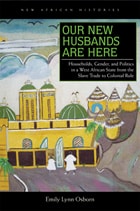
Our New Husbands Are Here
Households, Gender, and Politics in a West African State from the Slave Trade to Colonial RuleEmily Lynn Osborn
Ohio University Press, 2011
In Our New Husbands Are Here, Emily Lynn Osborn investigates a central puzzle of power and politics in West African history: Why do women figure frequently in the political narratives of the precolonial period, and then vanish altogether with colonization? Osborn addresses this question by exploring the relationship of the household to the state. By analyzing the history of statecraft in the interior savannas of West Africa (in present-day Guinea-Conakry), Osborn shows that the household, and women within it, played a critical role in the pacifist Islamic state of Kankan-Baté, enabling it to endure the predations of the transatlantic slave trade and become a major trading center in the nineteenth century. But French colonization introduced a radical new method of statecraft to the region, one that separated the household from the state and depoliticized women’s domestic roles. This book will be of interest to scholars of politics, gender, the household, slavery, and Islam in African history.
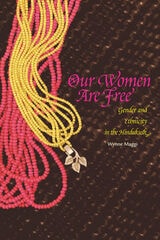
Our Women Are Free
Gender and Ethnicity in the HindukushWynne Maggi
University of Michigan Press, 2001
Yet despite their obvious religious differences with nearby communities, when asked what makes the Kalasha unique, both men and women often reply, "Our women are free" (homa istrizia azat asan). The concept that Kalasha women are "free" (azat), that they have "choice" (chit), is a topic of spirited conversation among the Kalasha. It touches at the heart of both individual women's identities and the collective identity of the community.
Our Women are Free introduces the historical and cultural landscape of the Kalasha and describes the role that "women's freedom" plays as an ethnic marker for the entire community. Throughout the narrative, Wynne Maggi stays close to conversations and events that illustrate the daily life of the community, focusing particularly on the Kalasha people's sense of humor; on the pleasure they take in work, children, ritual, and relationships; as well as on the complexity and seriousness of their social lives.
Accessible and thought-provoking, Our Women are Free will be of interest to professional anthropologists, area scholars, and other social scientists.
Wynne Maggi teaches anthropology and women's studies at the University of Colorado.