Results by title
438 books match the query 'Hispanic & Latino' and 11 start with o
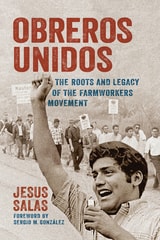
Obreros Unidos
The Roots and Legacy of the Farmworkers MovementJesus Salas
Wisconsin Historical Society Press, 2023
Taking inspiration from César Chávez, as a young man Salas and others led a historic march from Wautoma to Madison to demand that lawmakers address rampant violations of Wisconsin’s minimum wage laws and housing codes. These young labor leaders founded Obreros Unidos—Workers United—to continue the fight for fairness and respect, as well as to provide much-needed services to migrant families. This memoir of a movement details how their work went beyond the fields to have lasting impacts on representation in community organizations and access to education, empowering later generations to demand better.
Winner of the 2024 Benjamin Franklin Award for Multicultural Books
Winner of the 2024 Hamlin Garland Prize in Popular History from the Midwest History Association
“In recounting the story of Tejano settlement and struggle in Wisconsin, Salas unsettles this story line and, in the process, demonstrates the power of personal narrative and the lasting political implications of retrieving and restoring Latino history.”
—Sergio M. González, author of Mexicans in Wisconsin
“Salas’s story is an essential chapter in the history of Wisconsin and Milwaukee and mirrors the growth, progress and dreams of the Latinx community. His reflections speak to not only the importance of the Latinx community, but the need to build alliances across lines of race and gender and fulfill the promise of a multiracial democracy.”
—Barbara Miner, Milwaukee Magazine
Odalisque in Pieces
Carmen Giménez Smith
University of Arizona Press, 2009
In these poems we encounter such strange beauties as a girl assembling and disassembling, a moth trapped in a glass of water, new-age fairy godmothers, and a lark who sings for the milkman. Yet we are also made aware of how these beauties reflect the speaker’s troubles—her effort to employ, in the words of one of her most memorable poems, “Only the invisible post where she writes the encounters / with air’s lusters. Only the imagined hour / with which she’s made a fragile craft.”
Vivid and charged with an inner light, these are poems that linger and expand in the mind and memory.
Of Space and Mind
Cognitive Mappings of Contemporary Chicano/a FictionBy Patrick L. Hamilton
University of Texas Press, 2011
Chicano/a fiction is often understood as a literature of resistance to the dominant U.S. Anglo culture and society. But reducing this rich literary production to a single, binary opposition distorts it in fundamental ways. It conflates literature with life, potentially substituting a literature of protest for social activism that could provoke real changes in society. And it overlooks the complex range of responses to Anglo society that actually animates Chicano/a fiction.
In this paradigm-shifting book, Patrick L. Hamilton analyzes works by Rudolfo Anaya, Ana Castillo, Denise Chávez, Rolando Hinojosa, Arturo Islas, John Rechy, Alfredo Véa, and Helena María Viramontes to expand our understandings of the cultural interactions within the United States that are communicated by Chicano/a fiction. He argues that the narrative ethics of "resistance" within the Chicano/a canon is actually complemented by ethics of "persistence" and "transformation" that imagine cultural differences within the United States as participatory and irreducible to simple oppositions. To demonstrate these alternative ethics, Hamilton adapts the methodology of cognitive mapping; that is, he treats the chosen fictional texts as mental maps that are constructed around and communicative of the narrative's ethics. As he reads these cognitive maps, which envision Chicano/a culture as being part of U.S. society rather than as "resistant" and separate, Hamilton asserts that the authors' conception of cultural difference speaks more usefully to current sociopolitical debates, such as those about gay marriage and immigration reform, than does the traditional "resistant" paradigm.
Ojo en Celo / Eye in Heat
PoemsMargarita Pintado Burgos; Translated by Alejandra Quintana Arocho
University of Arizona Press, 2024
Aflame with desire, the eye conjures, dreams, invents itself, sees what it wants. The eye sees what it is able to see.
Ojo en celo / Eye in Heat brings into sharp relief the limits of our gaze. It shows us what it is to escape the mirror and move beyond mirages. Margarita Pintado Burgos invites us to ponder the impasse while showing us ways to see better, to break the habit of lying, and to confront images along with language.
With devastating clarity, Pintado Burgos’s poems, presented in both Spanish and English, give voice to the world within and beyond sight: the plants, the trees, the birds, the ocean waves, the fruit forgotten in the kitchen, the house’s furniture. Light takes on new dimensions to expose, manipulate, destroy, and nourish. Alejandra Quintana Arocho’s sensitive English translation renders the stark force of these poems without smoothing over the language of the original.
This collection is for anyone who has felt the weight of beauty that remains hidden. It is for those who have left behind a mother, a father, a country. It is for those who know that there is no way out of the poem, for those who have had to live off a house of words and need that house to be as real as possible. Pintado Burgos writes as a woman, exile, daughter, sister, lover, and artist empowered by the restorative potential of the creative phenomenon.
Old Music Island
Odette Alonso
Seagull Books, 2026
A translated collection from one of the defining poetic voices in Cuban and Mexican literature.
Old Music Island is a sensuous, dreamlike poetry collection by Odette Alonso, a leading voice in contemporary Cuban and Mexican literature. Born in Santiago de Cuba and living in Mexico since 1992, Alonso is an award-winning poet whose work transforms exile, desire, and memory into sites of lyrical and emotional intensity.
These poems move to the rhythm of nostalgia and smoke. The collection begins with a dream of light and song. The intimate encounter, always an island, is surrounded by the sea experience, and an exchange of glances is but a threshold into the vast expanse. Then comes fear, the fuss of hands, brackish tongue, a conflagration. Only those daring to enter will learn the patterns of the tide and the arrhythmia of the heart. The collection is a somatic encounter of tastes, touch, comings and goings, surprise, and seduction.
Translated by Liz Rose, whose work bridges lyric practice, trans theory, and feminist thought, Old Music Island offers an English-language rendering that honors the book’s lush musicality and charged physical presence. This is poetry of fleeting contact and lasting imprint—an invitation to listen closely, and to cross the threshold.
On Tuesday, When the Homeless Disappeared
Marcos McPeek Villatoro
University of Arizona Press, 2004
Villatoro is a writer with a keen political sensibility and a sense of humor besides. After confronting the reader with weighty issues, he pauses to have an encounter with a curandera in a cornfield; to speculate on a visit from extraterrestrials; and to pay tribute to his free-spirited, loose-living Uncle Jack, who "chewed forest mushrooms like a rabbit, / Then howled at a California night / While whispering querida above open thighs." Combining Borgean logic, the grit of Neruda, and a heady dose of Zen, Villatoro offers a primer on how to integrate a history of brutality and injustice with the privilege and comfort of life in America. A final section of poems is presented in Spanish only—a statement of ascendance, a strategy for identity preservation, a gift to the cognoscenti.
Reading On Tuesday, When the Homeless Disappeared may make you shift in your seat—perhaps even toss in your sleep—as you encounter a poignant human voice that is unafraid to speak from the heart.
One Island, Many Voices
Conversations with Cuban-American WritersEduardo R. del Rio
University of Arizona Press, 2008
From playwright Dolores Prida to author and literary critic Gustavo Pérez Firmat, these voices run the gamut of both genre and personality. In addition to the essential facts of literary accomplishment, the interviews include a wealth of insight into each writer’s history, motivations, concerns, and relationship to language. These personal details serve to humanize and illuminate the unique circumstances and realities that have shaped both the authors and their work.
What del Rio has ultimately brought together is a series of intimate sketches that will not only serve as an important reference for any discussion of the literature but will also help readers to develop for themselves a sense of what Cuban-American writing is, and what it is not.
CONTENTS
Preface
Acknowledgments
Introduction
Nilo Cruz
Roberto Fernández
Cristina García
Carolina Hospital
Eduardo Machado
Dionisio Martínez
Pablo Medina
Achy Obejas
Ricardo Pau-Llosa
Gustavo Pérez Firmat
Dolores Prida
Virgil Suárez
Epilogue
Notes
Bibliography
Index
Other Letters to Milena / Otras cartas a Milena
Reina María Rodríguez
University of Alabama Press, 2014
A parallel translation of a mixed-genre work by acclaimed Cuban writer Reina María Rodríguez in which poetry merges into creative nonfiction, culminating in a series of essays.
Published in Spanish as Otras cartas a Milena, Other Letters to Milena shows Rodríguez confronting pressing issues at the turn of the twenty-first century. These involve a new post-Soviet world and the realities of diasporic existence, which have a profound effect even on people like Rodríguez who have not migrated but continue to live and work in their home nation. The book’s title references Franz Kafka, whose Letters to Milena was published after his death in 1952. This signals that Rodríguez participates in her city’s long cosmopolitan tradition asserted by Cuban writers and scholars of Cuban literature. Rodríguez’s youngest daughter, featured most prominently in the letters making up the collection’s centerpiece, “A Girl’s Story,” was named after Milena Jesenská, the recipient of Kafka’s letters.
With the poems provided in a bilingual format, the collection will be of interest both to English readers in general (this will be the first English translation of a complete Rodríguez collection not excerpted from a larger work) and to Spanish readers unable to obtain the collection in any form, given the difficulty of distributing Cuban literature outside that country.
As an introduction to the book, Dykstra has included a critical commentary. It clarifies many of the author’s references, such as details pertaining to her family history—items Dykstra learned during lengthy discussions with the author about her work—and influences about her choices in the translation.
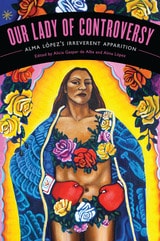
Our Lady of Controversy
Alma López's “Irreverent Apparition”Edited by Alicia Gaspar de Alba and Alma López
University of Texas Press, 2011
Months before Alma López's digital collage Our Lady was shown at the Museum of International Folk Art in 2001, the museum began receiving angry phone calls from community activists and Catholic leaders who demanded that the image not be displayed. Protest rallies, prayer vigils, and death threats ensued, but the provocative image of la Virgen de Guadalupe (hands on hips, clad only in roses, and exalted by a bare-breasted butterfly angel) remained on exhibition.
Highlighting many of the pivotal questions that have haunted the art world since the NEA debacle of 1988, the contributors to Our Lady of Controversy present diverse perspectives, ranging from definitions of art to the artist's intention, feminism, queer theory, colonialism, and Chicano nationalism. Contributors include the exhibition curator, Tey Marianna Nunn; award-winning novelist and Chicana historian Emma Pérez; and Deena González (recognized as one of the fifty most important living women historians in America).
Accompanied by a bonus DVD of Alma López's I Love Lupe video that looks at the Chicana artistic tradition of reimagining la Virgen de Guadalupe, featuring a historic conversation between Yolanda López, Ester Hernández, and Alma López, Our Lady of Controversy promises to ignite important new dialogues.
Our Little Life
A Novel with Other Archival TextsBy José Antonio Villarreal, edited by Juan Velasco
Lever Press, 2025
Our Little Life offers a much longer version of the Pocho story that extends a further 100 pages into the postwar period and follows Richard Rubio’s return from war and the changing shape of Mexican-American life in the 1940s. This newly discovered manuscript reveals Villarreal’s attention to Rubio’s struggles with PTSD and his efforts to depict a community and a family’s struggles with identity, belonging, and survival in postwar California. Our Little Life is an important work of archival recovery that sheds new light on Villarreal’s authorship and his place not only in Mexican-American literature but in the twentieth-century American literary canon.
This first publication of Our Little Life includes a scholarly introduction that places this unpublished novel in the landscape of contemporary Mexican-American literary studies and offers a brilliant examination of how novels grow and change. The volume also includes materials from the Villarreal Special Collection that recontextualize the writer’s vision, editing, and marketing of this and later novels. Our Little Life will be of interest not only to everyone in Mexican-American literary studies, but also to scholars of postwar America, women and gender studies, LGBTQ studies, ethnic studies, and migration and border studies.
Oyster Saloon
Desirée Alvarez
Omnidawn, 2026
Poetry that considers art, family history, and creativity.
This collection charts the life of an artist and her passion for nature through the making of a painting. Poems revel in the space humans occupy within the natural world, considering ways of living that range from harmonious to extractive. Alvarez reflects on petroleum, plastic, robots, monsters, and a swath of art history and family history—from her Latino father's time working as an artist in Andy Warhol’s Factory to the teachings of Hokusai. Acting asa séance conjuring the voices of the dead as a guide, the book is part elegy to the poet’s mother, who was a painter and gardener. Steeped in the rural New England countryside of the poet’s childhood and the lore of her indigenous ancestral family in Puerto Rico and Mexico, Oyster Saloon straddles contrasting heritage and landscapes and considers what it means to live a creative life.