131 books match the query 'History, Local' and 6 start with o

cover of Old Blue's Road: A Historian's Motorcycle Journeys in the American West

Old Blue's Road

A Historian's Motorcycle Journeys in the American West

James Whiteside

University Press of Colorado, 2014

In Old Blue’s Road, historian James Whiteside shares accounts of his motorcycle adventures across the American West. He details the places he has seen, the people he has met, and the personal musings those encounters prompted on his unique journeys of discovery.
 
In 2005, Whiteside bought a Harley Davidson Heritage Softail, christened it “Old Blue,” and set off on a series of far-reaching motorcycle adventures. Over six years he traveled more than 15,000 miles. Part travelogue and part historical tour, this book takes the reader along for the ride.  Whiteside’s travels to the Pacific Northwest, Yellowstone, Dodge City, Santa Fe, Wounded Knee, and many other locales prompt consideration of myriad topics—the ongoing struggle between Indian and mainstream American culture, the meaning of community, the sustainability of the West's hydraulic society, the creation of the national parks system, the Mormon experience in Utah, the internment of Japanese Americans during World War II, and more.

Delightfully funny and insightful, Old Blue’s Road links the colorful history and vibrant present from Whiteside’s unique vantage point, recognizing and reflecting on the processes of change that made the West what it is today. The book will interest the general reader and western historian alike, leading to new appreciation for the complex ways in which the American West's past and present come together.

[more]
cover of Old Farm: A History

Old Farm

A History

Jerry Apps

Wisconsin Historical Society Press, 2013
One of the Midwest's best-loved authors tells the story of his land, from the last great glacier that dug out its valleys and formed its hills, to his own family's 40 year relationship with the beloved farm they call Roshara. In this quiet but epic tale, Apps describes the Native Americans who lived on the land for hundreds of years, tapping the maple trees and fishing the streams and lakes, as well as the first white settlers who tilled its sandy acres, plowing the native grasses that grew taller than their teams of oxen. For all their work, the farm proved tough to tame. Hardscrabble farming methods and hard luck often brought failure.
 
"From land that provided only a marginal living for its early owners, this place we call Roshara has provided much for my family and me," writes Apps. He and his wife and their children have cared for the farm not so much to make a living as to enhance their lives. Apps chronicles the family's efforts — always earnest, if sometimes ill-advised — to restore an old granary into living space, develop a productive vegetable garden, manage the woodlots, reestablish a prairie, and enjoy nature's sounds and silences. Breathtakingly beautiful color photographs by Apps's son, Steve (a professional photographer), highlight the ever-changing beauty of the land in every season and hint at the spiritual gifts that are the true bounty this family reaps from Roshara.
 
Central to Apps' work is his belief that the land is something to cherish and revere. Like Aldo Leopold before him, Apps sounds an inspirational call to readers to preserve wild and rural places, leaving them in better condition than we found them for future generations.
[more]
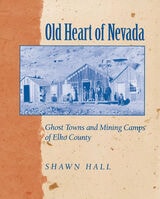
cover of Old Heart Of Nevada: Ghost Towns And Mining Camps Of Elko County

Old Heart Of Nevada

Ghost Towns And Mining Camps Of Elko County

Shawn Hall

University of Nevada Press, 1998

Elko County, in the old heart of Nevada, is rich in historic sites, many of them hitherto uncharted and some verging on disappearing. For the first time, historian Shawn Hall identifies and locates the ghost towns and old mining camps of Elko County and recounts their colorful histories. Following a guidebook format, Hall divides the county into five easily accessible regions, then lists the historic sites within each region and provides directions to reach them. He offers a brief history of each site as well as a description of its extant structures and their present condition. The result is a lively compilation of local history and mining and ranching lore that records the dramatic past of Nevada’s northeast corner, its pioneers and prospectors, its towns and mines, its outlaws, ranchers, merchants, mining concerns, and civic leaders. The book offers never-before available information about the old heart of Nevada and the people who settled there. It will be of enduring value to tourists and weekend explorers, historic preservationists, and all those interested in the history and artifacts of this region.

[more]
cover of On Time Delivery: The Dog Team Mail Carriers

On Time Delivery

The Dog Team Mail Carriers

William S. Schneider

University of Alaska Press, 2012
From the turn of the twentieth century in interior Alaska, dog team mail carriers were charged with maintaining the trail systems and carrying the mail until they were replaced in the late 1930s and ’40s by airplane mail service. With the advent and widespread adoption of aviation, many of the trails were abandoned, and a generation of rural Alaskans has now grown up with few ties to the overland trail system that supported their grandparents and inspired modern traditions such as the world-famous Iditarod Race.
In addition to chronicling the history of this unique postal service, On Time Delivery pays tribute to the men who carried the mail and the families who supported them, and considers the changing nature of how people experience the country where they live—and how this is affected by the systems of communication and transportation upon which they depend. 
[more]
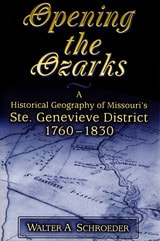
cover of Opening the Ozarks: A Historical Geography of Missouri's Ste. Genevieve District, 1760-1830

Opening the Ozarks

A Historical Geography of Missouri's Ste. Genevieve District, 1760-1830

Walter A. Schroeder

University of Missouri Press, 2002

As the oldest European settlement in Missouri, Ste. Genevieve was the funnel through which the eastern Ozarks (the 5,000 square miles beyond Ste. Genevieve’s location on the Mississippi) was established. A magisterial account of the settlement of this area from 1760 through 1830, Opening the Ozarks focuses on the acquisition and occupation of land, the transformation of the environment, the creation of cohesive settlements, and the building of neighborhoods and eventually organized counties.

The study begins with the French Creole settlement at Old Ste. Genevieve in the middle of the eighteenth century. It describes the movement of the French into the Ozark hills during the rest of that century and continues with that of the American immigrants into Upper Louisiana after 1796, ending with the Americanization of the district after the Louisiana Purchase. Walter Schroeder examines the cultural transition from a French society, operating under a Spanish administration, to an American society in which French, Indians, and Africans formed minorities.

Schroeder used thousands of French- and Spanish-language documents, including the Archives of the Indies in Seville, Spain, as well as documents from Ste. Genevieve and St. Louis to gather his information. He also utilized thousands of land records from the American period, including deeds of land sales and sales from the public domain, and plats from both the Spanish and American periods. In addition, Schroeder performed years of fieldwork and perused aerial photography of the area, interviewing residents and searching for vestiges of the past in the landscape.

As the only study to deal with the cradle of Missouri and the first trans-Mississippi expansion of the Anglo-American frontier, Opening the Ozarks will be invaluable to anyone interested in America’s geographical history, particularly that of Missouri.
[more]
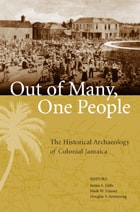
cover of Out of Many, One People: The Historical Archaeology of Colonial Jamaica

Out of Many, One People

The Historical Archaeology of Colonial Jamaica

Edited by James A. Delle, Mark W. Hauser, and Douglas W. Armstrong

University of Alabama Press, 2011

Normal0falsefalsefalseEN-USX-NONEX-NONEMicrosoftInternetExplorer4

As a source of colonial wealth and a crucible for global culture, Jamaica has had a profound impact on the formation of the modern world system. From the island's economic and military importance to the colonial empires it has hosted and the multitude of ways in which diverse people from varied parts of the world have coexisted in and reacted against systems of inequality, Jamaica has long been a major focus of archaeological studies of the colonial period.
 
This volume assembles for the first time the results of nearly three decades of historical archaeology in Jamaica. Scholars present research on maritime and terrestrial archaeological sites, addressing issues such as: the early Spanish period at Seville la Nueva; the development of the first major British settlement at Port Royal; the complexities of the sugar and coffee plantation system, and the conditions prior to, and following, the abolition of slavery in Jamaica. The everyday life of African Jamaican people is examined by focusing on the development of Jamaica's internal marketing system, consumer behavior among enslaved people, iron-working and ceramic-making traditions, and the development of a sovereign Maroon society at Nanny Town.
 
Out of Many, One People paints a complex and fascinating picture of life in colonial Jamaica, and demonstrates how archaeology has contributed to heritage preservation on the island.
[more]