Results by title
220 books match the query 'Israel' and 14 start with o
Observing America’s Jews
Marshall Sklare
Brandeis University Press, 1993

Occupied Minds
A Journey Through the Israeli PsycheArthur Nelsen
Pluto Press, 2006
Israel's founders sought to create a nation of new Jews who would never again go meekly to the death camps. Yet Israel's strength has become synonymous with an oppression of the Palestinians that provokes anger throughout the Muslim world and beyond. How are Israelis able to see themselves as victims while victimizing others? What does Israeli Jewish identity mean today?
Arthur Neslen explores the dynamics, distortions and incredible diversity of Israeli society. From the mouths of soldiers, settlers, sex workers and the victims of suicide attacks, Occupied Minds is the story of a national psyche that has become scarred by mental security barriers, emotional checkpoints and displaced outposts of self-righteousness and aggression.
From vignettes to in-depth interviews, more than fifty Israelis offer their accounts. What they reveal is in turn powerful, haunting, subtle and disturbing. Illustrated throughout with photographs, this unique book offers an unrivalled insight into Israeli consciousness, private and public.
It charts the evolution of a communal self-image based on cultural and religious values towards one formed around a single militaristic imperative: national security.
Of God and Gods
Egypt, Israel, and the Rise of MonotheismJan Assmann
University of Wisconsin Press, 2008
For thousands of years, our world has been shaped by biblical monotheism. But its hallmark—a distinction between one true God and many false gods—was once a new and radical idea. Of God and Gods explores the revolutionary newness of biblical theology against a background of the polytheism that was once so commonplace.
Jan Assmann, one of the most distinguished scholars of ancient Egypt working today, traces the concept of a true religion back to its earliest beginnings in Egypt and describes how this new idea took shape in the context of the older polytheistic world that it rejected. He offers readers a deepened understanding of Egyptian polytheism and elaborates on his concept of the “Mosaic distinction,” which conceives an exclusive and emphatic Truth that sets religion apart from beliefs shunned as superstition, paganism, or heresy.
Without a theory of polytheism, Assmann contends, any adequate understanding of monotheism is impossible.
Best Books for General Audiences, selected by the American Association of School Librarians, and Best Books for Special Interests, selected by the Public Library Association
On the Arab-Jew, Palestine, and Other Displacements
Selected Writings of Ella ShohatElla Shohat
Pluto Press, 2017
Spanning several decades, Ella Shohat's work has introduced conceptual frameworks that fundamentally challenged conventional understandings of Palestine, Zionism and the Middle East, focusing on the pivotal figure of the Arab-Jew. This book gathers together her most influential political essays, interviews, speeches, testimonies and memoirs, as well as previously unpublished material.
Defying the binarist and Eurocentric Arab-versus-Jew rendering of the Israeli/Palestinian conflict, Shohat's work has dared to engage with the deeper historical and cultural questions swirling around colonialism, Orientalism and nationalism. Shohat's paradigm-shifting work unpacks such fraught issues as the anomalies of the national/colonial in Zionist discourse; the narrating of Jewish pasts in Muslim spaces; the links and distinctions between the dispossession of the Nakba and the dislocation of Arab-Jews; the traumatic memories triggered by partition and border-crossing; the echoes within Islamophobia of the anti-Semitic figure of 'the Jew'; and the efforts to imagine a possible future inter-communal 'convivencia'.
Shohat's transdisciplinary perspective illuminates the cultural politics in and around the Middle East. Juxtaposing texts of various genres written in divergent contexts, the book offers a vivid sense of the author's intellectual journey.
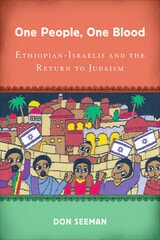
One People, One Blood
Ethiopian-Israelis and the Return to JudaismSeeman, Don
Rutgers University Press, 2010
But today, along with those Ethiopians who have been recognized as Jews by the State of Israel, many who are called "Feres Mura," the descendants of Ethiopian Jews whose families converted to Christianity but have now reasserted their Jewish identity, still await full acceptance in Israel. Since the 1990s, they have sought homecoming through Israel's "Law of Return," but have been met with reticence and suspicion on a variety of fronts. One People, One Blood expertly documents this tenuous relationship and the challenges facing the Feres Mura.
Distilling more than ten years of ethnographic research, Don Seeman depicts the rich culture of the group, as well as their social and cultural vulnerability, and addresses the problems that arise when immigration officials, religious leaders, or academic scholars try to determine the legitimacy of Jewish identity or Jewish religious experience.
Open Secrets
Israeli Foreign and Nuclear PoliciesIsrael Shahak
Pluto Press, 1997
‘As a critic of Zionism and as an opponent of Jewish exclusivity, Israel Shahak is special. He possesses in-depth knowledge of Israeli society, Jewish culture and the history of his people. His humanitarian concerns and commitments are extensive; his work as a human rights campaigner ... is enormous ... Shahak provides insights [in Open Secrets] that are often far more penetrating than what has been written by others ... Little of the information and few of the insights in Open Secrets can be found in other books that focus on Israel and the Middle East ... Open Secrets is an excellent book for required reading in History, political science and/or international affairs courses in which there is consideration of Israel in the Middle East.’ The Washington Report on Middle East Affairs
Open Your Hand
Teaching as a Jew, Teaching as an AmericanIlana M. Blumberg
Rutgers University Press, 2019
Operation Defensive Shield
Witnesses to Israeli War CrimesEdited by Muna Hamzeh and Todd June
Pluto Press, 2003
On March 29, 2002 the Israeli army launched Operation Defensive Shield, the largest military offensive against Palestinian civilians since the 1948 Arab-Israeli War. During the operation, the military used the most advanced weaponry at its disposal: Merkava tanks, Apache attack helicopters and F-15 fighter jets. When the operation ended on April 21, Israel had destroyed the Palestinian economic and social infrastructure, leveled large swathes of residential area, killed 220 people, injured hundreds more and arrested thousands.
This book documents these events through a collection of electronic witness narratives written by Palestinians who were under attack and by Israeli and international peace activists who witnessed the results of these attacks. Deeply moving and courageous, these narratives offer a uniquely powerful and intimate account of the daily reality for Palestinians who endured Ariel Sharon's military strategy, and the death and destruction that strategy has caused throughout the Occupied Territories.
Most important, the witnesses' voices bring to life the aggressive nature of this strategy -- they belie the noble motives ascribed to Sharon and those in his government and military who designed and carried it out. The editors argue that Operation Defensive Shield is a prelude to Israel's ethnic cleansing of the Palestinians. They provide historical context, a chronology, and an analysis of the conflict that situates the horror of these days in their proper perspective.
Operation Defensive Shield: Witnesses to Israeli War Crimes is an essential record for those who want to understand what happened in the West Bank in the spring of 2002, and what it portends for the future of the region.
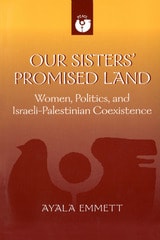
Our Sisters' Promised Land
Women, Politics, and Israeli-Palestinian CoexistenceAyala Emmett
University of Michigan Press, 2003
Our Way to Fight
Peace-Work Under Siege in Israel-PalestineMichael Riordon
Pluto Press, 2011
Michael Riordon takes us to thousand year-old olive groves, besieged villages, refugee camps, checkpoints and barracks. In the face of deepening conflict, Our Way to Fight offers courageous grassroots action on both sides of the wall, and points the way to a liveable future.
Out of the Frame
The Struggle for Academic Freedom in IsraelIlan Pappe
Pluto Press, 2010
Even before he wrote his bestselling book The Ethnic Cleansing of Palestine, historian Ilan Pappe was a controversial figure in Israel. In Out of the Frame, he gives a full account of his break with mainstream Israeli scholarship and its consequences.
Here he traces his journey of discovery from the whispers of Palestinian classmates to his realisation that the 'enemy's' narrative of the events of 1948 was correct. After completing his thesis at Oxford University in the early 1980s, he returned to Palestine determined to protect the memory of the Nakbah. For the first time he gives the details of the formidable opposition he faced in Israel, including death threats fed by the media, denunciations by the Knesset and calls for him to be sacked from his post at Haifa university.
This revealing work, written with dignity and humour, highlights Israel's difficulty in facing up to its past and forging a peaceful, inclusive future in Palestine.
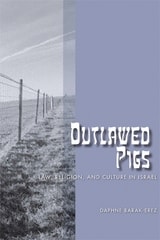
Outlawed Pigs
Law, Religion, and Culture in IsraelDaphne Barak-Erez
University of Wisconsin Press, 2007
Daphne Barak-Erez specifically traces the course of two laws, one that authorized municipalities to ban the possession and trading in pork within their jurisdiction and another law that forbids pig breeding throughout Israel, except for areas populated mainly by Christians. Her analysis offers a comprehensive, decade-by-decade discussion of the overall relationship between law and culture since the inception of the Israeli nation-state.
By examining ever-fluctuating Israeli popular opinion on Israel's two laws outlawing the trade and possession of pigs, Barak-Erez finds an interesting and accessible way to explore the complex interplay of law, religion, and culture in modern Israel, and more specifically a microcosm for the larger question of which lies more at the foundation of Israeli state law: religion or cultural tradition.
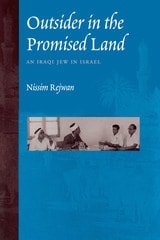
Outsider in the Promised Land
An Iraqi Jew in IsraelBy Nissim Rejwan
University of Texas Press, 2006
In 1951, Israel was a young nation surrounded by hostile neighbors. Its tenuous grip on nationhood was made slipperier still by internal tensions among the various communities that had immigrated to the new Jewish state, particularly those between the politically and socially dominant Jewish leadership hailing from Eastern Europe and the more numerous Oriental Jews from the Middle East and North Africa. Into this volatile mix came Nissim Rejwan, a young Iraqi Jewish intellectual who was to become one of the country's leading public intellectuals and authors.
Beginning with Rejwan's arrival in 1951 and climaxing with the tensions preceding Israel's victory in the Six-Day War of 1967, this book colorfully chronicles Israel's internal and external struggles to become a nation, as well as the author's integration into a complex culture. Rejwan documents how the powerful East European leadership, acting as advocates of Western norms and ideals, failed to integrate Israel into the region and let the country take its place as a part of the Middle East. Rejwan's essays and occasional articles are an illuminating example of how minority groups use journalism to gain influence in a society. Finally, the letters and diary entries reproduced in Outsider in the Promised Land are full of lively, witty meditations on history, literature, philosophy, education, and art, as well as one man's personal struggle to find his place in a new nation.
Overcoming Zionism
Creating a Single Democratic State in Israel/PalestineJoel Kovel
Pluto Press, 2007
Joel Kovel argues that the inner contradictions of Zionism have led Israel to a ‘state-sponsored racism’ fully as incorrigible as that of apartheid South Africa and deserving of the same resolution. Only a path toward a single-state secular democracy can provide the justice essential to healing the wounds of the Middle East.
Kovel is well-known writer on the Middle East conflict. This book draws on his detailed knowledge to show that Zionism and democracy are essentially incompatible. He offers a thoughtful account of the emergence and disintegration of Zionism that integrates psychological, political, cultural, economic, and ideological levels.
Ultimately, Kovel argues, a two-state solution is essentially hopeless as it concedes too much to the regressive forces of nationalism, wherein lie the roots of continued conflict.