Results by title
56 books match the query 'Jurisprudence' and 2 start with o
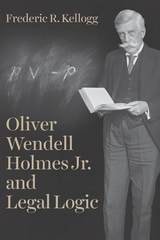
Oliver Wendell Holmes Jr. and Legal Logic
Frederic R. Kellogg
University of Chicago Press, 2018
Conventional legal logic tends to focus on the role of judges in deciding cases. Holmes recognized input from outside the law—the importance of the social dimension of legal and logical induction: how opposing views of “many minds” may converge. Drawing on analogies from the natural sciences, Holmes came to understand law as an extended process of inquiry into recurring problems.
Rather than vagueness or contradiction in the meaning or application of rules, Holmes focused on the relation of novel or unanticipated facts to an underlying and emergent social problem. Where the meaning and extension of legal terms are disputed by opposing views and practices, it is not strictly a legal uncertainty, and it is a mistake to expect that judges alone can immediately resolve the larger issue.
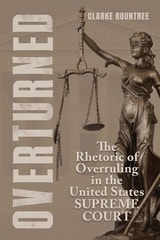
Overturned
The Rhetoric of Overruling in the United States Supreme CourtClarke Rountree
University of Alabama Press, 2025
A timely and lively summary and analysis of the Supreme Court’s justifications for overruling nearly 300 prior rulings in its history
An audacious US Supreme Court is overturning a number of long-standing precedents, and Overturned offers a lively account of the court’s history of overturning prior cases and examples and analyses of 300 cases overruled in its history.
The immense controversy surrounding the case of Dobbs v. Jackson Women’s Health Organization in 2022, which overruled Roe v. Wade and erased the constitutional right to abortion in the United States, has focused public attention on how and why the Supreme Court knocks down long-established precedents.
In his vivid and accessible style, scholar Clarke Rountree recounts the rhetorical pirouettes and linguistic acrobatics the court has deployed to explain its reversal of Dobbs and numerous other landmark decisions. He reviews strategies the court uses to undermine a previous court’s standing without undermining its own. He analyzes overrulings across time, by type (constitutional cases versus statutory and common law cases), by the ages of the overturned precedents, with changes in the court’s membership, and through other variables.
Rountree gives engrossing accounts of pivotal overrulings in the past, such as when Lincoln’s Treasury Secretary Salmon Chase used the Legal Tender Act in 1862 to raise money for the Civil War then ruled the same law unconstitutional in 1870 when he served as chief justice. Rountree retells Thomas Edison’s attempt to monopolize the burgeoning film industry, which was stopped only when the Supreme Court overturned an earlier patent-rights case in 1917. Finally, Rountree applies his myriad insights to the politically fraught Dobbs case.
Overturned makes a valuable contribution to law, rhetoric, politics, and history, and readers interested in the role and function of America’s highest court will find Rountree’s account fast-paced, lively, and engaging.