Results by title
372 books match the query 'Language' and 8 start with o
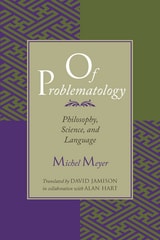
Of Problematology
Philosophy, Science, and LanguageMichel Meyer
University of Chicago Press, 1995
For Meyer, philosophy does not solve problems or give answers but instead shows how propositions are related to a whole field of questions that give them meaning. Reason is identified not with answers but with the question-answer process. Meyer pursues this new theory of reason and meaning in a critique of Western philosophy from Socrates, Plato, and Aristotle through Heidegger, Wittgenstein, and Foucault. He provides a detailed analysis of Descartes' notion of radical doubt and demonstrates its implications for the subsequent philosophical tradition that ignored the questioning process while pursuing an unshakable foundation for knowledge. Meyer argues that recent work in rhetoric points toward a theory of radical questioning and claims that the methods of rhetoric and argumentation must be turned back on philosophy itself in order to recover the original significance of metaphysics as the science of ultimate questions.
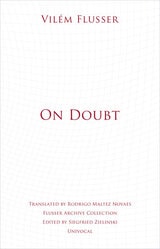
On Doubt
Vilém Flusser
University of Minnesota Press, 2014
In On Doubt, Vilém Flusser refines Martin Heidegger’s famous declaration that “language is the dwelling of Being.” For Flusser, “the word is the dwelling of being,” because in fact, in the beginning, there was the word.
On Doubt is a treatise on the human intellect, its relation to language, and the reality-forming discourses that subsequently emerge. For Flusser, the faith that the modern age places in Cartesian doubt plays a role similar to the one that faith in God played in previous eras—a faith that needs to be challenged. Descartes doubts the world through his proposition cogito ergo sum, but leaves doubt itself untouched as indubitable and imperious. His cogito ergo sum may have proved to the Western intellect that thoughts exist, but it did not prove the existence of that which thinks: one can eliminate thinking and yet continue being.
Therefore, should we not doubt doubt itself? Should we not try to go beyond this last step of Cartesian doubt and look for a new faith? The twentieth century has seen many attempts to defeat Cartesian doubt, however, this doubt of doubt has instead generated a complete loss of faith, which the West experiences as existential nihilism. Hence, the emergent emptying of values that results from such extreme doubt. Everything loses its meaning. Can this climate be overcome? Will the West survive the modern age?
On Heidegger and Language
Edited and Translated by Joseph J. Kockelmans
Northwestern University Press, 1980
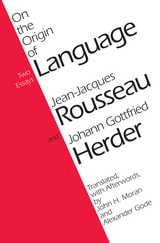
On the Origin of Language
Jean-Jacques Rousseau and Johann Gottfried Herder
University of Chicago Press, 1986
One or Two Words
Language and Politics in the Toraja Highlands of IndonesiaAurora Donzelli
National University of Singapore Press, 2020
Ordinary Meaning
A Theory of the Most Fundamental Principle of Legal InterpretationBrian G. Slocum
University of Chicago Press, 2015
Legal interpretation is built around one key question: by what standard should legal texts be interpreted? The traditional doctrine is that words should be given their “ordinary meaning”: words in legal texts should be interpreted in light of accepted standards of communication. Yet often, courts fail to properly consider context, refer to unsuitable dictionary definitions, or otherwise misconceive how the ordinary meaning of words should be determined. In this book, Brian Slocum builds his argument for a new method of interpretation by asking glaring, yet largely ignored, questions. What makes one particular meaning the “ordinary” one, and how exactly do courts conceptualize the elements of ordinary meaning? Ordinary Meaning provides a much-needed, revised framework, boldly instructing those involved with the law in how the components of ordinary meaning should properly be identified and developed in our modern legal system.
Original Signs
Gesture, Sign, and the Sources of LanguageDavid F. Armstrong
Gallaudet University Press, 2002
In the ongoing debate about evolution, scholars frequently argue either the perspective that humans stand as the end product of a deliberate process or that they derive from a series of random acts of natural selection. David F. Armstrong’s new book Original Signs embraces the Darwinian concept of natural selection and extends it to apply to the formation of language. While most current linguistic theory envisions language as a system for translating the contents of the mind into linear strings of arbitrary symbols, Armstrong asserts that this model does not characterize signed languages. He shows that language is inherently a multichannel activity, of which the two primary channels are auditory and visual.
Original Signs employs a more expansive notion of language that takes into account the full range of human communicative behavior. By making no strict separation between language and gesture, this thought-provoking work reveals that the use by deaf people of signs to create a fully formed language is also a natural facet of communication development for hearing people.
Armstrong explores the influences of Plato and Descartes on modern linguistics, and delineates the theories of earlier anthropological linguists Edward Sapir and Benjamin Lee Whorf, who thought of language as natural experiments connected to individual cultures. This exceptional work of scholarship methodically demonstrates that the intricacies of how languages develop, whether they depend upon words or signs, and that the complexity among languages that contact one another cannot be accounted for by the sequential hierarchical processes previously put forth by linguists and logicians. Original Signs will prove to be a fascinating, watershed work invaluable to linguists, anthropologists, and all other scholars and students engaged in the search for the origin of language.
Ossium Carnes Multae e Marci Tullii Ciceronis Epistulis / The Bones’ Meats Abundant from the Epistles of Marcus Tullius Cicero
Reginaldus Thomas Foster
Catholic University of America Press, 2021