Results by title
4030 books match the query 'Language Arts & Disciplines' and 74 start with o
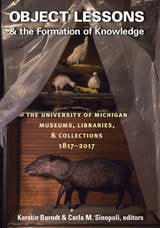
Object Lessons and the Formation of Knowledge
The University of Michigan Museums, Libraries, and Collections 1817–2017Kerstin Barndt and Carla M. Sinopoli, editors
University of Michigan Press, 2017

Object Reuse and Exchange (OAI-ORE)
Michael Witt
American Library Association, 2010
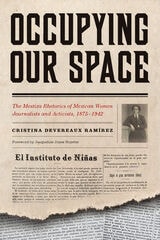
Occupying Our Space
The Mestiza Rhetorics of Mexican Women Journalists and Activists, 1875–1942Cristina Devereaux Ramírez; Foreword by Jacqueline Jones Royster
University of Arizona Press, 2015
Occupying Our Space sheds new light on the contributions of Mexican women journalists and writers during the late nineteenth and early twentieth centuries, marked as the zenith of Mexican journalism. Journalists played a significant role in transforming Mexican social and political life before and after the Revolution (1910–1920), and women were a part of this movement as publishers, writers, public speakers, and political activists. However, their contributions to the broad historical changes associated with the Revolution, as well as the pre- and post-revolutionary eras, are often excluded or overlooked.
This book fills a gap in feminine rhetorical history by providing an in-depth look at several important journalists who claimed rhetorical puestos, or public speaking spaces. The book closely examines the writings of Laureana Wright de Kleinhans (1842–1896), Juana Belén Gutiérrez de Mendoza (1875–1942), the political group Las mujeres de Zitácuaro (1900), Hermila Galindo (1896–1954), and others. Grounded in the overarching theoretical lens of mestiza rhetoric, Occupying Our Space considers the ways in which Mexican women journalists negotiated shifting feminine identities and the emerging national politics of the late nineteenth and early twentieth centuries. With full-length Spanish primary documents along with their translations, this scholarship reframes the conversation about the rhetorical and intellectual role women played in the ever-changing political and identity culture in Mexico.
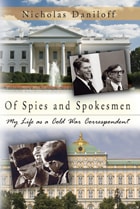
Of Spies and Spokesmen
My Life as a Cold War CorrespondentNicholas Daniloff
University of Missouri Press, 2008
An American reporter of Russian heritage assigned to Soviet-era Moscow might seem to have an edge on his colleagues, but when he’s falsely accused of spying, any advantage quickly evaporates. . . . .
As a young UPI correspondent in Moscow during the early 1960s, Nicholas Daniloff hoped to jump-start his career in his father’s homeland, but he soon learned that the Cold War had its own rules of engagement. In this riveting memoir, he describes the reality of journalism behind the Iron Curtain: how Western reporters banded together to thwart Soviet propagandists, how their “official sources” were almost always controlled by the KGB—and how those sources would sometimes try to turn newsmen into collaborators.
Leaving Moscow for Washington in 1965, Daniloff honed his skills at the State Department, then returned to Moscow in 1981 to find a more open society. But when the FBI nabbed a Soviet agent in 1986, Daniloff was arrested in retaliation and thrown into prison as a spy—an incident that threatened to undo the Reykjavik summit until top aides to Reagan and Gorbachev worked out a solution.
In addition to recounting a career in the thick of international intrigue, Of Spies and Spokesmen is brimming with inside information about historic events. Daniloff tells how the news media played a crucial role in resolving the Cuban Missile Crisis, recalls the emotional impact of the JFK assassination on Soviet leadership, and describes the behind-the-scenes struggles that catapulted Mikhail Gorbachev to power. He even shares facts not told to the public: how the SAC would warn Moscow that its submarines were too close to American shores, why the Soviets shot down the KAL airliner without visual identification, and how American reporters in Moscow sometimes did dangerous favors for our government that could easily have been mistaken for espionage.
Daniloff sheds light not only on prominent figures such as Nikita Khrushchev and Henry Kissinger but also on suspected spies Frederick Barghoorn, John Downey, and ABC correspondent Sam Jaffe—unfairly branded a Soviet agent by the FBI. In addition, he assesses the performance of Henry Shapiro, dean of American journalists in Moscow, whose forty years in the adversary’s capital often provoke questions about his role and reputation.
In describing how the Western press functioned in the old Soviet Union—and how it still functions in Washington today—Daniloff shows that the Soviet Russia he came to know was far more complex than the “evil empire” painted by Ronald Reagan: a web of propaganda and manipulation, to be sure, but also a place of hospitality and friendship. And with Russia still finding its way toward a new social and political order, he reminds us that seventy years of Communist rule left a deep impression on its national psyche. As readable as it is eye-opening, Of Spies and Spokesmenprovides a new look at that country’s heritage—and at the practice of journalism in times of crisis.
Of Two Minds
Hypertext Pedagogy and PoeticsMichael Joyce
University of Michigan Press, 1996
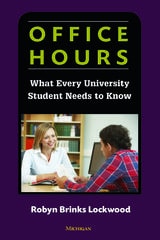
Office Hours
What Every University Student Needs to KnowRobyn Brinks Lockwood
University of Michigan Press, 2019
This task-based book also describes the five moves, or parts, of an office hour interaction and provides many examples and tasks to help guide students through this important communicative aspect of academic life. It seeks to ensure that every office hour interaction ends on a positive note.
Reflection questions for new teaching assistants are included throughout, making this ideal for TA workshops. Four analysis tasks are included to accompany the four videos that explore various student-professor interactions. The videos are available online at www.press.umich.edu/elt/compsite/officehours.
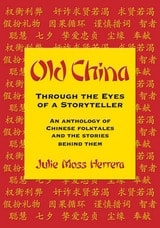
Old China Through the Eyes of a Storyteller
Julie Moss Herrera
Parkhurst Brothers, Inc., 2012
“Having traveled on the same People to People Ambassador journey to China with Julie, I have seen Julie's anthology from inception to fruition. It is a masterful, engaging, informative and scholarly addition to our understanding and appreciation of Chinese culture, particularly storytelling and folk traditions, from ancient days to today. Practicing storytellers will especially appreciate her tips for telling and context clues at the end of each story.”
--Judith Heineman, storyteller, producer and Illinois Humanities Road Scholar
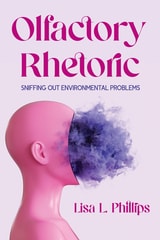
Olfactory Rhetoric
Sniffing Out Environmental ProblemsLisa L. Phillips
The Ohio State University Press, 2025
Human senses have the potential to play a significant role in inspiring action to combat climate change. When we smell pollutants in the air, for example, or feel the blast of a polar vortex, we are more likely to act in response to these changes in environmental conditions. However, the sensorium—and particularly our sense of smell—is often downplayed when we consider the rhetorics of environmental crises. In Olfactory Rhetoric, Lisa L. Phillips argues that how we sense the world around us should be a crucial piece of rhetorical evidence when evaluating environmental injustices. Specifically, Phillips elevates olfaction (what we smell) and olfactory rhetoric (how we talk about and experience what we smell) when discussing three contemporary environmental crises set in historically marginalized communities: the Sriracha sauce factory controversy, the Salton Sea scent events, and the Blue Ridge Landfill emissions problem. On a broader scale, Phillips develops an intersectional ecofeminist sensory-rhetorical approach for evaluating how olfactory and sensory persuasions work and how they can be used to advocate for environmental justice and a more breathable future.
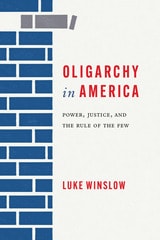
Oligarchy in America
Power, Justice, and the Rule of the FewLuke Winslow
University of Alabama Press, 2024
Roderick P. Hart Outstanding Book Award for the National Communication Association's Political Communication Division
A fascinating survey of the history of political and economic ideas in the US that have led to an increasingly entrenched ultra-rich class of oligarchs.
To an American, oligarchy is something that happens somewhere else. In Oligarchy in America, Luke Winslow reveals oligarchy’s deep intellectual roots and alarming growth in America. The book provides conceptual tools the lack of which have prevented Americans from recognizing oligarchy at home.
Winslow argues that generic labels like “billionaires” for a class of ultra-rich masks the pervasive structures that entrench their power. He introduces instead the concept of democratic oligarchy—an institutional arrangement in which the ultra-rich form a class consciously creating and leveraging state power to accumulate wealth.
Like a master class in political ideas, Winslow traces the intellectual lineage of oligarchy in the US. His lively and compulsively readable survey examines key rhetorical sources such as Herbert Spencer, Andrew Carnegie, Friedrich Hayek, Lewis Powell, Milton Friedman, Charles Koch, Donald Trump, Tucker Carlson, and others.
Oligarchy in America maps the connective web of oligarchic ideas uniting these disparate figures. By offering a lucid framework through which to view oligarchic ideas ambient in American culture, Winslow makes a vital contribution to readers and scholars of communication and rhetorical studies, public address, economics, and political science.
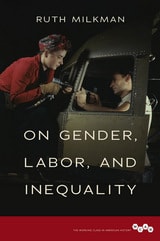
On Gender, Labor, and Inequality
Ruth Milkman
University of Illinois Press, 2016
Milkman's introduction frames a career-spanning scholarly project: her interrogation of historical and contemporary intersections of class and gender inequalities in the workplace, and the efforts to challenge those inequalities. Early chapters focus on her pioneering work on women's labor during the Great Depression and the World War II years. In the book's second half, Milkman turns to the past fifty years, a period that saw a dramatic decline in gender inequality even as growing class imbalances created greater-than-ever class disparity among women. She concludes with a previously unpublished essay comparing the impact of the Great Depression and the Great Recession on women workers.
A first-of-its-kind collection, On Gender, Labor, and Inequality is an indispensable text by one of the world's top scholars of gender, equality, and work.
On Location
Theory and Practice in Classroom-Based Writing Tutoringedited by Candace Spigelman & Laurie Grobman
Utah State University Press, 2005
Classroom-based writing tutoring is a distinct form of writing support, a hybrid instructional method that engages multiple voices and texts within the college classroom. Tutors work on location in the thick of writing instruction and writing activity.
On Location is the first volume to discuss this emerging practice in a methodical way. The essays in this collection integrate theory and practice to highlight the alliances and connections on-location tutoring offers while suggesting strategies for resolving its conflicts. Contributors examine classroom-based tutoring programs located in composition courses as well as in writing intensive courses across the disciplines.
On Metaphor
Edited by Sheldon Sacks
University of Chicago Press, 1979
Because of its comprehensive scope, the volume is useful both as a resource for those interested in contemporary philosophy and theories of language and as a text for courses in such areas as the philosophy of language, critical theory, and the philosophy of knowledge. Originally published as a special issue of Critical Inquiry, the present collection includes two new contributions by Max Black and Nelson Goodman, along with a comprehensive index to the work.
On Particle Verbs and Similar Constructions in German
Anke Lüdeling
CSLI, 2001
Particle verbs have previously been analyzed as morphological objects or as phrasal constructions, but neither approach fits cleanly within its chosen framework. The resolution presented here is that particle verbs should be seen as lexicalized phrasal constructions. Emphasizing morphological and syntactic testability, over a hundred colloquial examples are shown to break the rules of previous approaches while remaining consistent with this book's proposition. To distinguish particle verbs from similar constructions, and to demonstrate how structural and morphological factors have been misidentified in the past, preverb verb constructions (PVCs) are introduced and diagrammed. This reveals the roles of listedness and non-transparency in word formation and clarifies the conclusion that particle verbs do not form a definable class of words.
On Revision
The Only Writing That CountsWilliam Germano
University of Chicago Press, 2021
So you’ve just finished writing something? Congratulations! Now revise it. Because revision is about getting from good to better, and it’s only finished when you decide to stop. But where to begin? In On Revision, William Germano shows authors how to take on the most critical stage of writing anything: rewriting it.
For more than twenty years, thousands of writers have turned to Germano for his insider’s take on navigating the world of publishing. A professor, author, and veteran of the book industry, Germano knows what editors want and what writers need to know: Revising is not just correcting typos. Revising is about listening and seeing again. Revising is a rethinking of the principles from the ground up to understand why the writer is doing something, why they’re going somewhere, and why they’re taking the reader along with them.
On Revision steps back to take in the big picture, showing authors how to hear their own writing voice and how to reread their work as if they didn’t write it. On Revision will show you how to know when your writing is actually done—and, until it is, what you need to do to get it there.
On Teacher Neutrality
Politics, Praxis, and PerformativityDaniel P. Richards
Utah State University Press, 2020
Higher education itself and its stakeholders are continually exploring the role of teachers in the classroom and the extent to which it is possible or ethical to engage in neutrality. Amplifying voices from teachers in underrepresented positions and institutions in discussions of teacher ideology, On Teacher Neutrality shapes the discourse around these topics both within the writing classroom and throughout higher education. The book offers a rich array of practices, pedagogies, and theories that will help ground instructors and posits a way forward toward better dialogue and connections with the various stakeholders of higher education in the United States.
Contributors:
Tristan Abbott, Kelly Blewett, Meaghan Brewer, Christopher Michael Brown, Chad Chisholm, Jessica Clements, Jason C. Evans, Heather Fester, Romeo García, Yndalecio Isaac Hinojosa, Mara Holt, Erika Johnson, Tawny LeBouef Tullia, Lauren F. Lichty, Adam Pacton, Daniel P. Richards, Patricia Roberts-Miller, Karen Rosenberg, Allison L. Rowland, Robert Samuels, David P. Stubblefield, Jennifer Thomas, John Trimbur
On The Condition of Anonymity
Unnamed Sources and the Battle for JournalismMatt Carlson
University of Illinois Press, 2012
On Visual Rhetoric
Christa J. Olson and Brandee Easter
University of Michigan Press, 2026
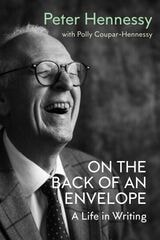
On the Back of an Envelope
A Life in WritingPeter Hennessy
Haus Publishing, 2025
As one of Britain’s foremost constitutional experts and contemporary historians, Peter Hennessy has spent his professional life unpicking the arcane world of Whitehall and Westminster. He began his career as a journalist for the Times, the Economist, and the Financial Times, developing a network of insider contacts who helped him shine a light on some of the dustiest corners of the British establishment. As a journalist, prize-winning contemporary historian, and political commentator, he has chronicled the workings of the British state with wit, affection, and a healthy sense of the absurd over a five-decade career. Now a crossbench peer, he has, in his own words, “moved in with his exhibits.” Hennessy is also a stalwart of BBC election night coverage and a regular commentator on BBC Radio 4, bringing a historical and constitutional perspective on current events.
In this new volume, he brings together selected journalism, unpublished lectures, and new writing alongside personal recollections and reflections on his time observing postwar Britain, how it is governed, and those who do the governing. He reflects on the making and unmaking of prime ministers from Attlee to Truss, life in the House of Lords, and the changing constitutional landscape in the wake of Brexit and amid uncertainty about the future of the Union. Interspersed with lectures, journalism, and new pieces, Hennessy also looks back at a fascinating career, reflecting on his own experiences as a young green graduate navigating the hard-nosed world of Fleet Street in the 1970s, bringing to life a cast of characters from a world now largely gone. He revisits his time as a public historian, academic, and crossbench peer with a levity reflected in his belief that history is “gossip with footnotes.”

On the Communicative Turn in Philosophy
Exploring Intersubjectivity, Community and the Ethics of DialogueClaude Mangion
Intellect Books, 2025
Philosophy has long grappled with questions of meaning and human connection, yet communication itself remains an underexplored concept in the field. Claude Mangion shifts the focus by examining how communication has shaped debates on intersubjectivity and ethics.
By tracing its role across key philosophical discussions, this book offers a new outlook on how dialogue informs our understanding of self and society. Accessible and rigorously argued, it bridges the gap between philosophy and communication theory, making it a useful reference for students and scholars alike. This work provides a compelling argument for thinking about communication as a philosophical practice, whether you’re exploring community, the ethics of dialogue, or the foundations of intersubjectivity.
On the Frontier of Science
An American Rhetoric of Exploration and ExploitationLeah Ceccarelli
Michigan State University Press, 2013
On the Origin of Language
Jean-Jacques Rousseau and Johann Gottfried Herder
University of Chicago Press, 1986
On the Placement and Morphology of Clitics
Aaron Halpern
CSLI, 1995
Once Upon a Cuento
Bilingual Storytimes in English and SpanishJamie Campbell Naidoo
American Library Association, 2016
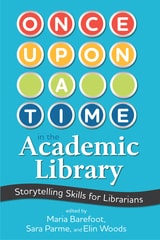
Once Upon a Time in the Academic Library
Storytelling Skills for LibrariansMaria Barefoot
American Library Association, 2022
Academic librarians can apply storytelling in the same way that teachers, entertainers, lawyers, and businesspeople have done for centuries, as education within information literacy instruction and as communication in the areas of reference, outreach, management, assessment, and more. Once Upon a Time in the Academic Library explores applications of storytelling across academic librarianship in three sections:
- The Information Literacy Classroom
- The Stacks
- Physical and Virtual Library Spaces
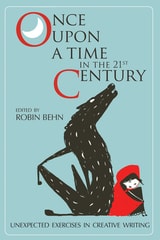
Once Upon a Time in the Twenty-First Century
Unexpected Exercises in Creative WritingEdited by Robin Behn
University of Alabama Press, 2020
Inspiring writers through creativity, experimentation, and unexpected discovery.
Once Upon a Time in the Twenty-First Century: Unexpected Exercises in Creative Writing is a unique creative writing text that will appeal to a wide range of readers and writers—from grade nine through college and beyond. Successful creative writers from numerous genres constructed these exercises, including poetry, fiction, and creative nonfiction to one-act plays, song lyrics, genre fiction, travel guides, comics and beyond. The exercises use a broad range of creative approaches, aesthetics, and voices, all with an emphasis on demystifying the writing process and having fun.
Editor Robin Behn has divided the book into three writing sections: Genres and Forms, Sources and Methods, and Style and Subject. In each section, Behn offers a brief introduction which explains how to get started and specific ways to develop one’s writing. Each introduction is followed by extensive exercises that draw on literature from classic to contemporary, as well as other art forms and popular culture. Examples range from Flannery O’Connor and Langston Hughes to Allen Ginsberg and Gertrude Stein, from Jamaica Kincaid and James Joyce to Arlo Guthrie and Harryette Mullen. Integrated within the exercises are apt examples of student writings that have emerged from actual use of the exercises in both the classroom and in writing groups. The book concludes with general advice and direction on how to get published.
Based on years of hands-on experiences in the teaching of creative writing in high schools, colleges, and after-school writing clubs, this volume of exercises offers inestimable value to students and teachers in the traditional classroom, as well as a growing number of homeschoolers, those who are part of a writing club or group, and independent writers and learners of all ages.
One Book/Five Ways
The Publishing Procedures of Five University PressesEdited by the Association of American University Presses and Joyce Kachergis
University of Chicago Press, 1994
With a new Foreword discussing changes in publishing since 1978 and an Afterword commenting on the actual publication of No Time for Houseplants, One Book/Five Ways is a unique educational tool for anyone interested in the publishing process.
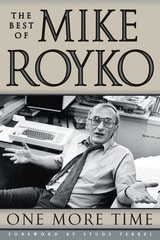
One More Time
The Best of Mike RoykoMike Royko
University of Chicago Press, 1999
"A treasure trove lies between these covers. Royko was in a class by himself. He was a true original."—Ann Landers
"The joy of One More Time is Royko in his own words."—Mary Eileen O'Connell, New York Times Book Review
"Reading a collection of Royko's columns is even more of a pleasure than encountering them one by one, and that is a large remark for he rarely wrote a piece that failed to wake you up with his hard-earned moral wit. Three cheers for Royko!"—Norman Mailer
"Powerful, punchy, amazingly contemporary."—Neil A. Grauer, Cleveland Plain Dealer
"This crackling collection of his own favorite columns as well as those beloved by his fans reminds us just how much we miss the gruff, compassionate voice of Mike Royko."—Jane Sumner, Dallas Morning News
"A marvelous road map through four decades of America."—Elizabeth Taylor, Chicago Tribune Books
"Royko was an expert at finding universal truths in parochial situations, as well as in the larger issues—war and peace, justice and injustice, wealth and poverty—he examined. Think of One More Time as one man's pungent commentary on life in these United States over the last few decades."—Booklist
"Royko was one of the most respected and admired people in the business, by readers and colleagues alike. . . . Savor [his sketches] while you can."—Jonathan Yardley, Washington Post Book World
"Book collections of columns aren't presumed to be worth reading. This one is, whether or not you care about newspapering or Chicago."—Neil Morgan, San Diego Union-Tribune
"A treasure house for journalism students, for would-be writers, for students of writing styles, for people who just like to laugh at the absurdity of the human condition or, as Studs Terkel said, for those who will later seek to learn what it was really like in the 20th century."—Georgie Anne Geyer, Washington Times
"Full of astonishments, and the greatest of these is Royko's technical mastery as a writer."—Hendrik Hertzberg, New Yorker
"A great tribute to an American original, a contrarian blessed with a sense of irony and a way with words."—Bob Minzesheimer, USA Today
"In this posthumous collection of his columns, journalist Royko displays the breezy wit that made him so beloved in the Windy City."—People
One or Two Words
Language and Politics in the Toraja Highlands of IndonesiaAurora Donzelli
National University of Singapore Press, 2020
One-Person Puppetry Streamlined and Simplified
With 38 Folk-Tale ScriptsYvonne Amar Frey
American Library Association, 2004
Online Community Information
Creating a Nexus at Your LibraryJoan Coachman Durrance
American Library Association, 2002
Open Access
Walt Crawford
American Library Association, 2011
Open Access Literature in Libraries
Principles and PracticesKaren Brunsting, Caitlin Harrington, and Rachel E. Scott
American Library Association, 2022
- the origins and growth of OA, how to define it, and some of the ways in which librarians have made connections to OA;
- where OA diverges from the historic role of library collection development policies and ways to bring OA into alignment with an institution's collection development principles and practices;
- real-world examples of how libraries have supported or integrated OA into their collections, including strategies for selecting and activating OA titles and collections for inclusion, offering open educational resources (OER) to students, samples of collection management workflows, and ideas for aligning collections with institutional repositories or other Green OA initiatives;
- guidance on financially supporting OA content, initiatives, and platforms;
- how OA publishing does and does not harmonize with diversity, equity, and inclusion initiatives; and
- tips for using ongoing assessment and evaluation to continuously support the library’s path to an open future.

Open And Equitable Scholarly Communication Creating A More
Nancy Maron
Assoc of College & Research Libraries, 2019
Open Educational Resources
CLIPP #45Mary Francis
Assoc of College & Research Libraries, 2021
Open Hand
Arguing as an Art of PeaceBarry M. Kroll
Utah State University Press, 2013
Kroll cultivates a bodily investigation of noncombative argument, offering direct pedagogical strategies anchored in three modalities of learning—conceptual-procedural, kinesthetic, and contemplative—and projects, activities, assignments, informal responses, and final papers for students. Kinesthetic exercises derived from martial arts and contemplative meditation and mindfulness practices are key to the approach, with Kroll specifically using movement as a physical analogy for tactics of arguing.
Collaboration, mediation, and empathy are important yet overlooked values in communicative exchange. This practical, engaging, and accessible guide for teachers contains clear examples and compelling discussions of pedagogical strategies that teach students not only how to write persuasively but also how to deal with personal conflict in their daily lives.
Open House
Essays on Community in Literary ArtsEdited by Kristina Marie Darling
Tupelo Press, 2025
This book offers a practical guide to building community, fostering collaboration, and inspiring generosity through the creative arts. This collection of original essays features an accomplished roster of contributors with backgrounds in diverse fields, including literary translation, magazine editing, publishing, higher education, and curriculum design. By featuring successful writers who represent such a wide range of skillsets and career paths, this book helps students envision themselves as leaders in the university and well beyond its boundaries.
In a cultural moment where graduates often seek meaningful careers outside of academia, this essay collection also offers an introduction to alt-ac career paths and the unique opportunities for effecting social change in these roles. Focusing on techniques that have broad applications for high school teachers, nonprofit leaders, community outreach organizations, and college classrooms, each chapter includes an original essay from a contemporary writer, editor, or nonprofit leader in the arts, culminating in a set of exercises for individuals and groups, which focus on empathy, citizenship, and community stewardship.
Contributors include Traci Brimhall, Chris Campanioni, Wendy Chen, Kristina Marie Darling, Ming Lauren Holden, John James, Dean Rader, and Zach Savich.
Open Praxis, Open Access
Digital Scholarship In ActionDarren Chase
American Library Association, 2020
Many in the world of scholarship share the conviction that open access will be the engine of transformation leading to more culture, more research, more discovery, and more solutions to small and big problems. This collection brings together librarians, scholars, practitioners, policymakers, and thinkers to take measure of the open access movement. The editors meld critical essays, research, and case studies to offer an authoritative exploration of
- the concept of openness in scholarship, with an overview of how it is evolving in the US, Canada, Europe, and Asia;
- open access publishing, including funding models and the future of library science journals;
- the state of institutional repositories;
- Open Educational Resources (OER) at universities and a consortium, in subject areas ranging from literary studies to textbooks; and
- open science, open data, and a pilot data catalog for raising the visibility of protected data.
Open Secrets
The Ultimate Guide to Marketing Your BookTupelo Press
Tupelo Press, 2021
• This handbook will prepare you to take the lead in executing your own publicity plan. It is designed to guide you, step-by-step, through the process of making a success of your book. It’s jam-packed with the essential tools, ideas, and resources you’ll need to achieve that goal, from an independent publisher who has provided a launching pad for authors like Ilya Kaminsky, Aimee Nezhukumatathil, Jennifer Michael Hecht, Maggie Smith, Matthew Zapruder, and 250 others.
• Thoroughly and joyfully embrace the notion of self-promotion, knowing that it’s the book—your book—you’re breathing life into. You wouldn’t have written and published your book if you didn’t believe in it, and in yourself, as a writer with important artistic talent to share. Your publisher believes in you. Your family and friends believe in you. Your current readers believe in you. And future readers will believe in you.
Jeffrey Levine, Publisher, Tupelo Press
You’ll learn the essentials for book marketing as an indie author in a digital age:
• Develop your author image and brand across social channels
• Create an engaging social media presence
• Grow your audience and meaningfully connect with them
• Build an attractive, searchable website—no coding skills needed
• Launch a publicity campaign that gets you reviews
• Ensure your book is on bookstore and library shelves
• Practice mindful literary citizenship
• Learn from Tupelo authors (who were in your shoes not too long ago!)
Open-Domain Question Answering from Large Text Collections
Marius Pasca
CSLI, 2003
Better than an index, and much better than a keyword search, are the high-precision computerized question-answering systems explored in this book. Marius Pasca presents novel and robust methods for capturing the semantics of natural language questions and for finding the most relevant portions of texts. This research has led to a fully implemented and rigorously evaluated architecture that has produced experimental results showing great promise for the future of internet search technology.
Opening Up Library Systems Through Web Services and Soa
Hype, or Reality?Marshall American Library Association
American Library Association, 0
Optimal Communication
Edited by Reinhard Blutner, Helen de Hoop and Petra Hendriks
CSLI, 2005
Optimality-Theoretic Syntax
A Declarative ApproachJonas Kuhn
CSLI, 2003
Along with the standard OT architecture, which is based on a generation metaphor, Kuhn also formalizes parsing-based OT, and goes on to discuss possible combinations of these two architectures. This is followed by an examination of assumptions under which the computational tasks of generation and parsing are decidable for an OT-syntactic grammar.
Optimizing Structure in Context
Scrambling and Information StructureHye-Won Choi
CSLI, 1999
Oratorical Culture in Nineteenth-Century America
Transformations in the Theory and Practice of RhetoricGregory Clark and S. Michael Halloran
Southern Illinois University Press, 1993
Gregory Clark and S. Michael Halloran bring together nine essays that explore change in both the theory and the practice of rhetoric in the nineteenth-century United States.
In their introductory essay, Clark and Halloran argue that at the beginning of the nineteenth century, rhetoric encompassed a neoclassical oratorical culture in which speakers articulated common values to establish consensual moral authority that directed community thought and action. As the century progressed, however, moral authority shifted from the civic realm to the professional, thus expanding participation in the community as it fragmented the community itself. Clark and Halloran argue that this shift was a transformation in which rhetoric was reconceived to meet changing cultural needs.
Part I examines the theories and practices of rhetoric that dominated at the beginning of the century. The essays in this section include "Edward Everett and Neoclassical Oratory in Genteel America" by Ronald F. Reid, "The Oratorical Poetic of Timothy Dwight" by Gregory Clark, "The Sermon as Public Discourse: Austin Phelps and the Conservative Homiletic Tradition in Nineteenth-Century America" by Russel Hirst, and "A Rhetoric of Citizenship in Nineteenth-Century America" by P. Joy Rouse.
Part 2 examines rhetorical changes in the culture that developed during that century. The essays include "The Popularization of Nineteenth-Century Rhetoric: Elocution and the Private Learner" by Nan Johnson, "Rhetorical Power in the Victorian Parlor: Godey’s Lady’s Book and the Gendering of Nineteenth-Century Rhetoric" by Nicole Tonkovich, "Jane Addams and the Social Rhetoric of Democracy" by Catherine Peaden, "The Divergence of Purpose and Practice on the Chatauqua: Keith Vawter’s Self-Defense" by Frederick J.Antczak and Edith Siemers, and "The Rhetoric of Picturesque Scenery: A Nineteenth-Century Epideictic" by S. Michael Halloran.
Ordinary Meaning
A Theory of the Most Fundamental Principle of Legal InterpretationBrian G. Slocum
University of Chicago Press, 2015
Legal interpretation is built around one key question: by what standard should legal texts be interpreted? The traditional doctrine is that words should be given their “ordinary meaning”: words in legal texts should be interpreted in light of accepted standards of communication. Yet often, courts fail to properly consider context, refer to unsuitable dictionary definitions, or otherwise misconceive how the ordinary meaning of words should be determined. In this book, Brian Slocum builds his argument for a new method of interpretation by asking glaring, yet largely ignored, questions. What makes one particular meaning the “ordinary” one, and how exactly do courts conceptualize the elements of ordinary meaning? Ordinary Meaning provides a much-needed, revised framework, boldly instructing those involved with the law in how the components of ordinary meaning should properly be identified and developed in our modern legal system.
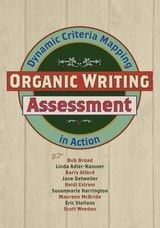
Organic Writing Assessment
Dynamic Criteria Mapping in ActionBob Broad, Linda Adler-Kassner, Barry Alford, Jane Detweiler, Heidi Estrem, Susanmarie Harrington, Maureen McBride, Eric Stalions, and Scott Weeden
Utah State University Press, 2009
For the authors of Organic Writing Assessment, the DCM experience provided not only an authentic assessment of their own programs, but a nuanced language through which they can converse in the always vexing, potentially divisive realm of assessment theory and practice. Of equal interest are the adaptations these writers invented for Broad’s original process, to make DCM even more responsive to local needs and exigencies.
Organic Writing Assessment represents an important step in the evolution of writing assessment in higher education. This volume documents the second generation of an assessment model that is regarded as scrupulously consistent with current theory; it shows DCM’s flexibility, and presents an informed discussion of its limits and its potentials.
Organizational Storytelling for Librarians
Using Stories for Effective LeadershipKate American Library Association
American Library Association, 2011
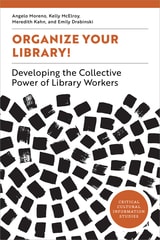
Organize Your Library!
Developing the Collective Power of Library WorkersAngelo Moreno, Kelly McElroy, Meredith Kahn, and Emily Drabinski
American Library Association, 2025
Interest in unions and the real, day-to-day benefits they secure for employees is on the rise—including among library workers, who are beginning to realize that on their own they have little leverage. But with a union they have the power of numbers, and their working conditions are decided by a collectively negotiated agreement rather than by the malleable judgement of an individual administrator or library board. This handbook will equip readers with the knowledge, skills, and strategies necessary for organizing and maintaining a union at their library. Peppered throughout by illuminating stories from successful library union leaders and members, this book
- discusses why library workers need unions and explores some of the benefits that a collective bargaining agreement can assure, such as job security, increased salaries, codification of the rules for overtime pay and time off, and protection from harassment by patrons;
- explains why a contract won't limit employees' autonomy;
- walks readers through how to launch a union drive, including the basics of talking with co-workers, combating apathy and fear, and running a campaign;
- offers an overview of the steps involved in building a new union, from forming an organizing committee to getting recognition and setting up a governance structure;
- sketches out the key issues relating to contracts, the details of bargaining and negotiation, and arbitration;
- lays out approaches and strategies for dealing with supervisors and administrators in the context of your union work, including effective communication between labor and management, contract enforcement, and handling bad behavior such as unfair labor practices and retaliation;
- gives advice on pursuing changes in your workplace in a right-to-work state;
- explores the constructive roles that bosses can play to support the union efforts of the workers who organize them; and
- provides an Action Plan at the end of each chapter with suggested readings, questions for reflection, and activities designed to help deepen your knowledge, broaden your network, and practice important skills.
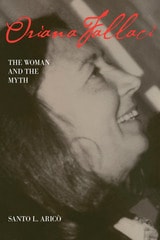
Oriana Fallaci
The Woman and the MythSanto L. Aricò
Southern Illinois University Press, 1998
Internationally acclaimed as a journalist, war correspondent, interviewer, and novelist, Oriana Fallaci’s public persona reached almost mythic proportions. It is a myth Fallaci herself created, according to Santo L. Aricò, who probes the psychological forces that motivated one of the twentieth century’s most famous and successful women writers.
Using his own extensive interviews with the writer, Aricò maps out Fallaci’s journey through life, paying particular attention to her ongoing and painstaking attempts to establish her own mythical status. He first examines her career as a literary journalist, emphasizing the high quality of her writing. From there, he concentrates on how Fallaci’s personal image began to emerge in her writings, as well as the way in which, through her powerful narratives, she catapulted herself into the public eye as her own main character.
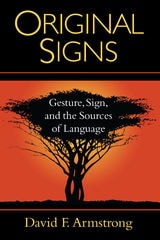
Original Signs
Gesture, Sign, and the Sources of LanguageDavid F. Armstrong
Gallaudet University Press, 2002
In the ongoing debate about evolution, scholars frequently argue either the perspective that humans stand as the end product of a deliberate process or that they derive from a series of random acts of natural selection. David F. Armstrong’s new book Original Signs embraces the Darwinian concept of natural selection and extends it to apply to the formation of language. While most current linguistic theory envisions language as a system for translating the contents of the mind into linear strings of arbitrary symbols, Armstrong asserts that this model does not characterize signed languages. He shows that language is inherently a multichannel activity, of which the two primary channels are auditory and visual.
Original Signs employs a more expansive notion of language that takes into account the full range of human communicative behavior. By making no strict separation between language and gesture, this thought-provoking work reveals that the use by deaf people of signs to create a fully formed language is also a natural facet of communication development for hearing people.
Armstrong explores the influences of Plato and Descartes on modern linguistics, and delineates the theories of earlier anthropological linguists Edward Sapir and Benjamin Lee Whorf, who thought of language as natural experiments connected to individual cultures. This exceptional work of scholarship methodically demonstrates that the intricacies of how languages develop, whether they depend upon words or signs, and that the complexity among languages that contact one another cannot be accounted for by the sequential hierarchical processes previously put forth by linguists and logicians. Original Signs will prove to be a fascinating, watershed work invaluable to linguists, anthropologists, and all other scholars and students engaged in the search for the origin of language.