Results by title
155 books match the query 'Legislators' and 6 start with o
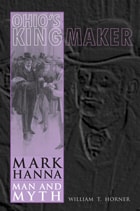
Ohio’s Kingmaker
Mark Hanna, Man and MythWilliam T. Horner
Ohio University Press, 2010
For a decade straddling the turn of the twentieth century, Mark Hanna was one of the most famous men in America. Portrayed as the puppet master controlling the weak-willed William McKinley, Hanna was loved by most Republicans and reviled by Democrats, in large part because of the way he was portrayed by the media of the day. Newspapers and other media outlets that supported McKinley reported positively about Hanna, but those sympathetic to William Jennings Bryan, the Democrats’ presidential nominee in 1896 and 1900, attacked Hanna far more aggressively than they attacked McKinley himself. Their portrayal of Hanna was wrong, but powerful, and this negative image of him survives to this day.
In this study of Mark Hanna’s career in presidential politics, William T. Horner demonstrates the flaws inherent in the ways the news media cover politics. He deconstructs the myths that surround Hanna and demonstrates the dangerous and long-lasting effect that inaccurate reporting can have on our understanding of politics. When Karl Rove emerged as the political adviser to George W. Bush’s presidential campaigns, the reporters quickly began to compare Rove to Hanna even a century after Hanna’s death. The two men played vastly different roles for the presidents they served, but modern reporters consistently described Rove as the second coming of Mark Hanna, another political Svengali.
Ohio’s Kingmaker is the story of a fascinating character in American politics and serves to remind us of the power of (mis)perceptions.
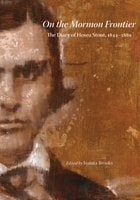
On the Mormon Frontier
The Diary of Hosea Stout, 1844-1889Juanita Brooks
University of Utah Press, 2009
This edition of On the Mormon Frontier presents Stout’s diary in a single volume, proving that it continues to be an essential work in the study of Mormon and American history.
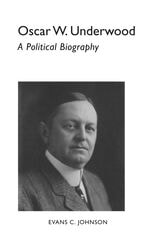
Oscar W. Underwood
A Political BiographyEvans C. Johnson
University of Alabama Press, 2006
Although Oscar W. Underwood was considered a titan of his age, few American political figures have suffered such neglect as he. Except for his candidacy for the Democratic nomination in 1924, his political career is largely forgotten even in Alabama. The one place in which Underwood is well remembered is in the folklore of Congress, where he is widely regarded as a great party leader who had mastered the rules perhaps as thoroughly as any member of Congress. This mastery, together with steady work, personal magnetism, and a willingness to compromise, made him effective as chairman of the Ways and Means Committee in formulating a majority program after the Democrats seized control of the House in 1910. Pat Harrison, Underwood's lieutenant as minority leader, referred to Underwood as the "greatest natural parliamentarian, the greatest leader of a law-making body that I ever saw."
--from the Preface to Oscar W. Underwood: A Political Biography
Our Politics
Reflections on Political LifeDouglas Kane, with a foreword by Mike Lawrence
Southern Illinois University Press, 2019
In Our Politics Kane reflects on his nearly fifty years of active engagement in state and local politics. In a series of essays, he seeks to understand the forces, motivations, incentives and technologies that shape our politics and produce the consequences that we live with every day. He describes how candidates and officeholders deal with the fundamental contradictions inherent in the democratic process, and how and why the political power structure has changed. He also explores the personal experience of being a legislator, from deciding how to vote to building relationships with party leaders, fellow legislators, the governor, and the voters in the district. Kane concludes by considering the possibility of change, how it might happen, and the steps that candidates, political parties, activists and others might take to better our politics with results more to our liking.
While many journalists record politics from the outside, and numerous political memoirs focus on personalities and what happened to whom and when, this book gives an insider’s view of politics at the level of state government. This book is not about those politicians but about our politics, which together we have created and together we must deal with.
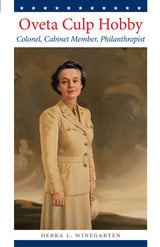
Oveta Culp Hobby
Colonel, Cabinet Member, PhilanthropistBy Debra L. Winegarten
University of Texas Press, 2014
This young adult biography introduces middle school readers to a remarkable woman who founded the Women’s Army Corps, served as Secretary of Health, Education, and Welfare, and ran a media empire that included the Houston Post newspaper and radio and TV stations.
Winner, Gold Medal for Biography, Military Writers Society of America, 2015
Oveta Culp Hobby (1905–1995) had a lifetime of stellar achievement. During World War II, she was asked to build a women’s army from scratch—and did. Hobby became Director of the Women’s Army Corps and the first Army woman to earn the rank of colonel. President Eisenhower chose her as Secretary of Health, Education, and Welfare, making her the second woman in history to be appointed to a president’s cabinet. When she wasn’t serving in the government, Hobby worked with her husband, former Texas governor William P. Hobby, to lead a media empire that included the Houston Post newspaper and radio and TV stations. She also supported the Houston community in many ways, from advocating for civil rights for African Americans to donating generously to the Houston Symphony and the Museum of Fine Arts.
Oveta Culp Hobby is the first biography of this important woman. Written for middle school readers, it traces her life from her childhood in Killeen to her remarkable achievements in Washington, DC, and Houston. Debra Winegarten provides the background to help young adult readers understand the times in which Hobby lived and the challenges she faced as a woman in nontraditional jobs. She shows how Hobby opened doors for women to serve in the military and in other professions that still benefit women today. Most of all, Oveta Culp Hobby will inspire young adults to follow their own dreams and turn them into tangible reality.
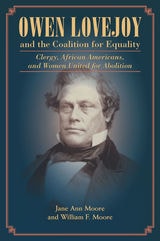
Owen Lovejoy and the Coalition for Equality
Clergy, African Americans, and Women United for AbolitionJane Ann Moore and William F. Moore
University of Illinois Press, 2019
Owen Lovejoy and the Coalition for Equality examines how these three distinct groups merged their agendas into a single antislavery, religious, political campaign for equality with Lovejoy at the helm. Combining scholarly biography, historiography, and primary source material, Jane Ann Moore and William F. Moore demonstrate Lovejoy's crucial role in nineteenth-century politics, the rise of antislavery sentiment in religious spaces, and the emerging congressional commitment to end slavery. Their compelling account explores how the immorality of slavery became a touchstone of political and religious action in the United States through the efforts of a synergetic coalition led by an essential abolitionist figure.