Results by title
275 books match the query 'Letters' and 3 start with o
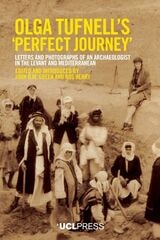
Olga Tufnell's “Perfect Journey”
Letters and Photographs of an Archaeologist in the Levant and MediterraneanEdited by John D.M. Green and Henry Ros
University College London, 2021
Olga Tufnell was a British archaeologist working in Egypt, Cyprus, and Palestine in the 1920s and 1930s—a period often described as a golden age of archaeological discovery. For the first time, this book presents Tufnell’s account of her experiences in her own words. Based largely on letters, the text is accompanied by dozens of photographs that shed light on her personal experiences of travel and dig life at this extraordinary time. Introductory material by John D.M. Green and Ros Henry provides the social, historical, biographical, and archaeological context, as the letters offer new insights into the social and professional networks and history of archaeological research in Palestine under the British Mandate. They provide insights into the role of foreign archaeologists, relationships with local workers and inhabitants, and the colonial framework within which they operated during turbulent times. This book will be an important resource for those studying the history of archaeology in the Eastern Mediterranean, particularly for the sites of Qau el-Kebir, Tell Fara, Tell el-‘Ajjul and Tell ed-Duweir (ancient Lachish). Moreover, Tufnell’s lively style makes this a fascinating personal account of archaeology and travel in the interwar era.
On the Shoulders of Giants
The Post-Italianate EditionRobert K. Merton
University of Chicago Press, 1993
"This book is the delightful apotheosis of donmanship: Merton parodies scholarliness while being faultlessly scholarly; he scourges pedantry while brandishing his own abstruse learning on every page. The most recondite and obscure scholarly squabbles are transmuted into the material of comedy as the ostensible subject is shouldered to one side by yet another hobby horse from Merton's densely populated stable. He has created a jeu d'esprit which is profoundly suggestive both in detail and as a whole."—Sean French, Times Literary Supplement
Other Letters to Milena / Otras cartas a Milena
Reina María Rodríguez
University of Alabama Press, 2014
A parallel translation of a mixed-genre work by acclaimed Cuban writer Reina María Rodríguez in which poetry merges into creative nonfiction, culminating in a series of essays.
Published in Spanish as Otras cartas a Milena, Other Letters to Milena shows Rodríguez confronting pressing issues at the turn of the twenty-first century. These involve a new post-Soviet world and the realities of diasporic existence, which have a profound effect even on people like Rodríguez who have not migrated but continue to live and work in their home nation. The book’s title references Franz Kafka, whose Letters to Milena was published after his death in 1952. This signals that Rodríguez participates in her city’s long cosmopolitan tradition asserted by Cuban writers and scholars of Cuban literature. Rodríguez’s youngest daughter, featured most prominently in the letters making up the collection’s centerpiece, “A Girl’s Story,” was named after Milena Jesenská, the recipient of Kafka’s letters.
With the poems provided in a bilingual format, the collection will be of interest both to English readers in general (this will be the first English translation of a complete Rodríguez collection not excerpted from a larger work) and to Spanish readers unable to obtain the collection in any form, given the difficulty of distributing Cuban literature outside that country.
As an introduction to the book, Dykstra has included a critical commentary. It clarifies many of the author’s references, such as details pertaining to her family history—items Dykstra learned during lengthy discussions with the author about her work—and influences about her choices in the translation.