Results by title
458 books match the query 'Literature' and 5 start with o
O'Neill's Shakespeare
Normand Berlin
University of Michigan Press, 1993
In O'Neill's Shakespeare , Normand Berlin explores the relationship of William Shakespeare and Eugene O'Neill through detailed, often surprising, intertextual readings of the two great playwrights' work. "Of course, it would have been impossible for O'Neill not to have been influenced by Shakespeare," acknowledges Berlin. But this is an influence of an unusual and extraordinary sort, "a family romance" that transcends their obvious differences—a romance that "takes in all O'Neill's life and art."
In the first book-length study of this crucial literary and dramatic relationship, Berlin probes far beyond the usual listing of allusions and references. This is the exploration of an "essential, basic, even natural" connection, in which Shakespeare is shown to have fundamentally shaped O'Neill's creative imagination. Following O'Neill's career chronologically, Berlin divides his study into two parts. The "first career" (culminating in Mourning Becomes Electra) is explored through recurring themes that evoke Shakespeare: the sea, black and white, and the family. O'Neill's "second career" (from Ah! Wilderness until the last plays) is examined through Shakespearean genre classifications: comedy, history, tragedy, and tragicomedy. Though always grounded in close textual readings, Berlin's analysis spirals outward to encompass O'Neill's artistic and psychological development and touches on the questions of tradition, transcendence, and human nature inevitably raised when such literary connections across history are drawn.
O'Neill's Shakespeare is more than a reminder that Shakespeare continues to haunt Western culture; it is a careful and fascinating analysis of a particular legacy in American drama. The book has insights to offer to specialists in Shakespeare and O'Neill, and to any reader interested in the transmission of ideas through Western culture. Berlin's study of the unconscious and conscious uses of Shakespeare by O'Neill provide a valuable new understanding of O'Neill's artistry. It is also an eloquent, thoughtful account that blends the transcendence of Shakespeare's influence with the particular ways in which every era must refashion Shakespeare so that "the past becomes the present."
Of Two Minds
Hypertext Pedagogy and PoeticsMichael Joyce
University of Michigan Press, 1996

On Moral Personhood
Philosophy, Literature, Criticism, and Self-UnderstandingRichard Eldridge
University of Chicago Press, 1989
Eldridge presents an extensive new interpretation of Kantian ethics that is deeply informed by Kant's aesthetics. He defends a revised version of Kantian universalism and a Kantian conception of the content of morality. Eldridge then turns to literature armed not with any a priori theory but with an interpretive stance inspired by Hegel's phenomenology of self-understanding, more or less naturalized, and by Wittgenstein's work on self-understanding as ongoing narrative-interpretive activity, a stance that yields Kantian results about the universal demands our nature places on itself.
Eldridge goes on to present readings of novels by Conrad and Austen and poetry by Wordsworth and Coleridge. In each text protagonists are seen to be struggling with moral conflicts and for self-understanding as moral persons. The route toward partial resolution of their conflicts is seen to involve multiple and ongoing activities of reading and interpreting. The result of this kind of interpretation is that such literature—literature that portrays protagonists as themselves readers and interpreters of human capacities for morality—is a primary source for the development of morally significant self-understanding. We see in the careers of these protagonists that there can be genuine and fruitful moral deliberation and valuable action, while also seeing how situated and partial any understanding and achievement of value must remain.
On Moral Personhood at once delineates the moral nature of persons; shows various conditions of the ongoing, contextualized, partial acknowledgment of that nature and of the exercise of the capacities that define it; and enacts an important way of reading literature in relation to moral problems. Eldridge's work will be important reading for moral philosophers (especially those concerned with Kant, Hegel, and issues dividing moral particularists from moral universalists), literary theorists (especially those concerned with the value of literature and its relation to philosophy and to moral problems), and readers and critics of Conrad, Wordsworth, Coleridge, and Austen.
Operation Valhalla
Writings on War, Weapons, and MediaFriedrich Kittler. Edited and translated by Ilinca Iurascu, Geoffrey Winthrop-Young, and Michael Wutz
Duke University Press, 2021
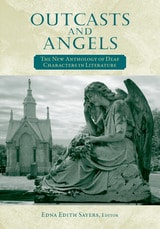
Outcasts and Angels
The New Anthology of Deaf Characters in LiteratureEdna Edith Sayers
Gallaudet University Press, 2012
In 1976, Trent Batson and Eugene Bergman released their classic Angels and Outcasts: An Anthology of Deaf Characters in Literature. In it, they featured works from the 19th and 20th centuries by well-known authors such as Charles Dickens and Eudora Welty. They also presented less-well-known deaf authors, and they prefaced each excerpt with remarks on context, societal perceptions, and the dignity due to deaf people. Since then, much has transpired, turning around the literary criticism regarding portrayals of deaf people in print. Edna Edith Sayers reflects these changes in her new collection Outcasts and Angels: The New Anthology of Deaf Characters in Literature.
Sayers mines the same literary vein as the first volume with rich new results. Her anthology also introduces rare works by early masters such as Daniel Defoe. She includes three new deaf authors, Charlotte Elizabeth, Howard T. Hofsteater, and Douglas Bullard, who offer compelling evidence of the attitudes toward deaf people current in their eras. In search of commonalities and comparisons, Sayers reveals that the defining elements of deaf literary characters are fluid and subtly different beyond the predominant dueling stereotypes of preternaturally spiritual beings and thuggish troglodytes.
Outcasts and Angels demonstrates these subtle variations in writings by Ambrose Bierce, Isak Dinesen, Nadine Gordimer, and Flannery O’Connor. Stories by Juozas Grušas, Julian Barnes, and many other international authors broaden the scope of this updated inquiry into the deaf literary character. Sayer’s preface and closing essay bring any disparate parts together, completing Outcasts and Angels as a fitting, contemporary companion to the original classic collection.