Results by title
31 books match the query 'Musicals'

100 Years of Kurt Weill, Volume 30
Tom Sellar, ed.
Duke University Press, 0
100 Years of Kurt Weill makes a notable addition to the commemoration of the anniversary with the English-language publication of two major Weill librettos, both translated and introduced by international opera director Jonathan Eaton. Written in 1925, Royal Palace is a one-act opera with a libretto by surrealist/expressionist poet-playwright Yvan Goll. It was one of the first operas to incorporate film. The other work, Die Bürgschaft (The Pledge), was inspired by a dark social parable by Johann Gottfried von Herder and written in collaboration with Caspar Neher. The piece was banned in 1933 by the Nazi regime because of its controversial content and was not restaged in its original form until Eaton’s 1998 and 1999 productions in Bielefeld, Germany, and at the Spoleto Festival U.S.A.
This special issue specifically addresses the theatrical context of Weill’s music, exploring new perspectives on the artist and his work and on recent developments in Weill scholarship. These articles, combined with the previously unpublished works, make 100 Years of Kurt Weill a considerable and unique contribution to the centenary commemoration of his birth.
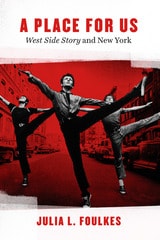
A Place for Us
“West Side Story” and New YorkJulia L. Foulkes
University of Chicago Press, 2016
That vision of postwar New York is at the heart of Julia L. Foulkes’s A Place for Us. A lifelong fan of the show, Foulkes became interested in its history when she made an unexpected discovery: scenes for the iconic film version were shot on the demolition site destined to become part of the Lincoln Center redevelopment area—a crowning jewel of postwar urban renewal. Foulkes interweaves the story of the creation of the musical and film with the remaking of the Upper West Side and the larger tale of New York’s postwar aspirations. Making unprecedented use of director and choreographer Jerome Robbins’s revelatory papers, she shows the crucial role played by the political commitments of Robbins and his fellow gay, Jewish collaborators, Leonard Bernstein and Arthur Laurents. Their determination to evoke life in New York as it was actually lived helped give West Side Story its unshakable sense of place even as it put forward a vision of a new, vigorous, determinedly multicultural American city.
Beautifully written and full of surprises for even the most dedicated West Side Story fan, A Place for Us is a revelatory new exploration of an American classic.
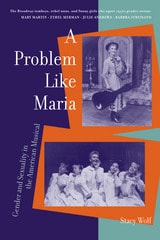
A Problem Like Maria
Gender and Sexuality in the American MusicalStacy Wolf
University of Michigan Press, 2002
Chapter by chapter, the book analyzes the stars' best-known and best-loved roles, including Martin as Nellie in South Pacific, Merman as Momma Rose in GypsyAndrews as Eliza in My Fair Lady and Guinevere in Camelot, and Streisand as Fanny Brice in Funny Girl. The final chapter scrutinizes the Broadway and film versions of The Sound of Music, illuminating its place in the hearts of lesbian spectators and the "delicious queerness" of Andrews's troublesome nun. As the first feminist and lesbian study of the American Broadway musical, A Problem Like Maria is a groundbreaking contribution to feminist studies, queer studies, and American studies and a delight for fans of musical theater.
Stacy Wolf is Associate Professor of Theatre and Dance, University of Texas, Austin.
Blues Mamas and Broadway Belters
Black Women, Voice, and the Musical StageMasi Asare
Duke University Press, 2024
Broadway Rhythm
Imaging the City in SongDominic Symonds
University of Michigan Press, 2017
Through musicological analyses of works by Gershwin, Bernstein, Copland, Sondheim and others, the author proposes that performance cartography is a versatile methodology for urban theory, and establishes a methodological approach that uses the idea of the map in three ways: as an impetus, a metaphor, and a tool for exploring the city.
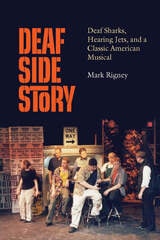
Deaf Side Story
Deaf Sharks, Hearing Jets, and a Classic American MusicalMark Rigney
Gallaudet University Press, 2003
The 1957 classic American musical West Side Story has been staged by countless community and school theater groups, but none more ambitious than the 2000 production by MacMurray College, a small school in Jacksonville, Illinois. Diane Brewer, the new drama head at the college, determined to add an extra element to the usual demands of putting on a show by having deaf students perform half of the parts. Deaf Side Story presents a fascinating narrative of Brewer and the cast’s efforts to mount this challenging play.
Brewer turned to the Illinois School for the Deaf (ISD) to cast the Sharks, the Puerto Rican gang at odds with the Anglo Jets in this musical version of Romeo and Juliet set in the slums of New York. Hearing performers auditioned to be the Jets, and once Brewer had cast her hearing Tony and deaf Maria, then came the challenge of teaching them all to sing/sign and dance the riveting show numbers for which the musical is renowned. She also had to manage a series of sensitive issues, from ensuring the seamless incorporation of American Sign Language into the play to reassuring ISD administrators and students that the production would not be symbolic of any conflict between Deaf and hearing people.
Author Mark Rigney portrays superbly the progress of the production, including the frustrations and triumphs of the leads, the labyrinthine campus and community politics, and the inevitable clashes between the deaf high school cast members and their hearing college counterparts. His representations of the many individuals involved are real and distinguished. The ultimate success of the MacMurray production reverberates in Deaf Side Story as a keen depiction of how several distinct individuals from as many cultures could cooperate to perform a classic American art form brilliantly together.
Here for the Hearing
Analyzing the Music in Musical TheaterMichael Buchler and Gregory J. Decker, Editors
University of Michigan Press, 2023
Winner of the Society for Music Theory's Outstanding Multi-Author Collection Award
This book offers a series of essays that show the integrated role that musical structure (including harmony, melody, rhythm, meter, form, and musical association) plays in making sense of what transpires onstage in musicals. Written by a group of music analysts who care deeply about musical theater, this collection provides new understanding of how musicals are put together, how composers and lyricists structure words and music to complement one another, and how music helps us understand the human relationships and historical and social contexts. Using a wide range of musical examples, representing the history of musical theater from the 1920s to the present day, the book explores how music interacts with dramatic elements within individual shows and other pieces within and outside of the genre. These essays invite readers to consider issues that are fundamental both to our understanding of musical theater and to the multiple ways we engage with music.
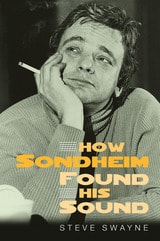
How Sondheim Found His Sound
Steve Swayne
University of Michigan Press, 2010
---Richard Crawford, author of America's Musical Life: A History
"Sondheim's career and music have never been so skillfully dissected, examined, and put in context. With its focus on his work as composer, this book is surprising and welcome."
---Theodore S. Chapin, President and Executive Director, The Rodgers & Hammerstein Organization
"What a fascinating book, full of insights large and small. An impressive analysis and summary of Sondheim's many sources of inspiration. All fans of the composer and lovers of Broadway in general will treasure and frequently refer to Swayne's work."
---Tom Riis, Joseph Negler Professor of Musicology and Director of the American Music Research Center, University of Colorado
Stephen Sondheim has made it clear that he considers himself a "playwright in song." How he arrived at this unique appellation is the subject of How Sondheim Found His Sound---an absorbing study of the multitudinous influences on Sondheim's work.
Taking Sondheim's own comments and music as a starting point, author Steve Swayne offers a biography of the artist's style, pulling aside the curtain on Sondheim's creative universe to reveal the many influences---from classical music to theater to film---that have established Sondheim as one of the greatest dramatic composers of the twentieth century.
Sondheim has spoken often and freely about the music, theater, and films he likes, and on occasion has made explicit references to how past works crop up in his own work. He has also freely acknowledged his eclecticism, seeing in it neither a curse nor a blessing but a fact of his creative life.
Among the many forces influencing his work, Sondheim has readily pointed to a wide field: classical music from 1850 to 1950; the songs of Tin Pan Alley, Broadway, and Hollywood; the theatrical innovations of Oscar Hammerstein II and his collaborators; the cinematic elements found in certain film schools; and the melodramatic style of particular plays and films. Ultimately, Sondheim found his sound by amalgamating these seemingly disparate components into his unique patois.
How Sondheim Found His Sound is the first book to provide an overview of his style and one of only a few to account for these various components, how they appear in Sondheim's work, and how they affect his musical and dramatic choices.
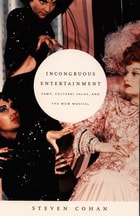
Incongruous Entertainment
Camp, Cultural Value, and the MGM MusicalSteven Cohan
Duke University Press, 2005
In addition to examining the spectatorship of the mgm musical, Cohan investigates the genre’s production and marketing, paying particular attention to the studio’s employment of a largely gay workforce of artists and craftspeople. He reflects on the role of the female stars—including Judy Garland, Debbie Reynolds, Esther Williams, and Lena Horne—and he explores the complex relationship between Gene Kelley’s dancing and his masculine persona. Cohan looks at how, in the decades since the 1950s, the marketing and reception of the mgm musical have negotiated the more publicly recognized camp value attached to the films. He considers the status of Singin’ in the Rain as perhaps the first film to be widely embraced as camp; the repackaging of the musicals as nostalgia and camp in the That’s Entertainment! series as well as on home video and cable; and the debates about Garland’s legendary gay appeal among her fans on the Internet. By establishing camp as central to the genre, Incongruous Entertainment provides a new way of looking at the musical.
Loving Repeating
A Musical Adapted from the Writings of Gertrude SteinFrank Galati
Northwestern University Press, 2009
Lying in the Middle
Musical Theater and Belief at the Heart of AmericaJake Johnson
University of Illinois Press, 2021
Vibrant and strikingly original, Lying in the Middle discovers some of the most potent musical theater taking place in the hoping, beating hearts of Americans.
Lyric Personhood
On the Aesthetics of Being Someone in the WestDan Wang
University of Chicago Press, 2025
What does it mean to be a person? One might think of the possession of certain rights, having the capacity for love, or being self-determined. But if words like “person” or “love” seem to carry an internal meaning, where does this meaningfulness come from? Lyric Personhood contends that to be encultured in the modern West is to learn, on top of everything else, an unspoken and mostly felt sense of what it means to be someone, a sense transmitted not only in language but also through encounters with aesthetic form. Through close readings that span nineteenth-century European opera, commercial cinema, and amateur YouTube proposal videos, Dan Wang shows that a “person” has become an aesthetic concept—and not just a legal, moral, political, or philosophical one—in the last two hundred years of Western culture.
It’s hard to let go of the organizing promise of romantic love, the dream of therapeutic “health,” and the aspiration to belong to national culture, Wang argues, because these longings have been shaped by an archive of sentimental and melodramatic works that trains people's expectations for life, genre, and even the knowing promised in theory itself. Tracing a surprisingly continuous imagination of personhood through opera and film aesthetics, Lyric Personhood introduces modes of reading audiovisual works that allow a longer story to be told about the forms that make personhood sensible in the West.
Making Light
Haydn, Musical Camp, and the Long Shadow of German IdealismRaymond Knapp
Duke University Press, 2018
Mormons, Musical Theater, and Belonging in America
Jake Johnson
University of Illinois Press, 2019
On Broadway
Art and Commerce on the Great White WaySteven Adler
Southern Illinois University Press, 2004
At a critical, transitional moment in the history of Broadway—and, by extension, of American theatre itself—former Broadway stage manager Steven Adlerenlists insider perspectives from sixty-six practitioners and artists to chronicle the recent past and glimpse the near future of the Great White Way. From marquee names to behind-the-scenes power brokers, Adler has assembled a distinctly knowledgeable cast of theatre’s elite, including Stephen Sondheim, Arthur Laurents, Des McAnuff, Frank Rich, Robin Wagner, Rocco Landesman, Robert Longbottom, Todd Haimes, Bernard Gersten, and Alan Eisenberg.
On Broadway: Art and Commerce on the Great White Way spotlights the differing vantage points of performers, artists, writers, managers, producers, critics, lawyers, theatre owners, union leaders, city planners, and other influential players. Each details his or her firsthand account of the creative and economic forces that have wrought extraordinary changes in the way Broadway theatre is conceived, produced, marketed, and executed. Once the paramount site of American theatre, Broadway today is becoming a tourist-driven, family-friendly, middle-class entertainment oasis in Midtown, an enterprise inextricably bound to the larger mosaic of national and international professional theatre.
Accounting for this transformation and presaging Broadway’s identity for the twenty-first century, Adler and his interviewees assess the impact of the advent of corporate producers, the ascendance of not-for-profit theatres on Broadway, and the growing interdependence between regional and Broadway productions. Also critiqued are the important roles of the radical urban redevelopment staged in Times Square and the changing demographics and appetites of contemporary theatre audiences in New York and around the globe.
Actors and administrators, performers and producers, theatre students and theatregoers will all benefit from the perceptive insights in this authoritative account of theatre making for the new millennium.
Our Musicals, Ourselves
A Social History of the American Musical TheatreJohn Bush Jones
Brandeis University Press, 2004
Seriously Mad
Mental Distress and the Broadway MusicalAleksei Grinenko
University of Michigan Press, 2023
Theatermakers in the United States have long been drawn to madness as a source of dramatic spectacle. During the Broadway musical’s golden age in the mid-twentieth century, creative teams used the currently in-vogue psychoanalytic ideas about mental life to construct troubled characters at odds with themselves and their worlds. As the clinical and cultural profile of madness transformed over the twentieth century, musicals continued to delve into the experience of those living with mental pain, trauma, and unhappiness.
Seriously Mad offers a dynamic account of stage musicals’ engagement with historically significant theories about mental distress, illness, disability, and human variance in the United States. By exploring who is considered mad and what constitutes madness at different moments in U.S. history, Aleksei Grinenko shows how, in attempts to bring the musicals closer to highbrow sophistication, theater dramatized serious medical conditions and social problems. Among the many Broadway productions discussed are Next to Normal, A Strange Loop, Sweeney Todd, Man of La Mancha, Gypsy, Oklahoma!, and Lady in the Dark.
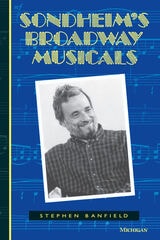
Sondheim's Broadway Musicals
Stephen Banfield
University of Michigan Press, 1995
Sondheim's Broadway Musicals is the first book to take an in-depth look at Sondheim's work. Stephen Banfield examines each of Sondheim's musicals for Broadway, from West Side Story and Gypsy to the 1987 musical Into the Woods, and includes A Funny Thing Happened on the Way to the Forum, Company, Follies, Anyone Can Whistle, A Little Night Music, Pacific Overtures, Merrily We Roll Along, Sweeney Todd, and Sunday in the Park with George. Banfield also discusses Sondheim's other work, such as the 1991 show Assassins and his music for the 1990 film Dick Tracy--for which "Sooner or Later" won him an Academy Award for Best Song.
"Banfield seems almost to hear Sondheim's music with Sondheim's ears. This extremely valuable work discusses Sondheim's early training and subsequent career, his general compositional concerns, and his style. The meat of the book is a musical-dramatic analysis of his musicals . . . . For each musical, Banfield places the work and its components in a historical and typological text. He also treats in welcome detail the musical profile or universe of each show: Sondheim's use of generative intervals or interval complexes as source material, motifs that reappear in various guises in various songs, the sound world that defines the musical's emotional mind. The book will be as useful to those who are cool to Sondheim's work as to his fans." --Choice
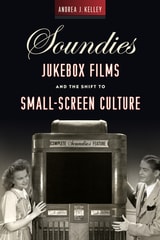
Soundies Jukebox Films and the Shift to Small-Screen Culture
Kelley, Andrea J
Rutgers University Press, 2018

Stagestruck
Theater, AIDS, and the Marketing of Gay AmericaSarah Schulman
Duke University Press, 1998
Closely recounting her discovery of the ways in which Rent took materials from her own novel, Schulman takes us on her riveting and infuriating journey through the power structures of New York theater and media, a journey she pursued to seek legal restitution and make her voice heard. Then, to provide a cultural context for the emergence of Rent—which Schulman experienced first-hand as a weekly theater critic for the New York Press at the time of Rent’s premiere—she reveals in rich detail the off- and off-off-Broadway theater scene of the time. She argues that these often neglected works and performances provide more nuanced and accurate depictions of the lives of gay men, Latinos, blacks, lesbians and people with AIDS than popular works seen in full houses on Broadway stages. Schulman brings her discussion full circle with an incisive look at how gay and lesbian culture has become rapidly commodified, not only by mainstream theater productions such as Rent but also by its reduction into a mere demographic made palatable for niche marketing. Ultimately, Schulman argues, American art and culture has made acceptable a representation of “the homosexual” that undermines, if not completely erases, the actual experiences of people who continue to suffer from discrimination or disease. Stagestruck’s message is sure to incite discussion and raise the level of debate about cultural politics in America today.
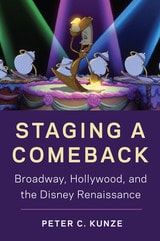
Staging a Comeback
Broadway, Hollywood, and the Disney RenaissancePeter C. Kunze
Rutgers University Press, 2023

Tenement Songs
The Popular Music of the Jewish ImmigrantsMark Slobin
University of Illinois Press, 1982
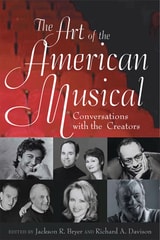
The Art of the American Musical
Conversations With the CreatorsBryer, Jackson R
Rutgers University Press, 2019
Musical theater has captivated American audiences from its early roots in burlesque stage productions and minstrel shows to the million-dollar industry it has become on Broadway today. What is it about this truly indigenous American art form that has made it so enduringly popular? How has it survived, even thrived, alongside the technology of film and the glitz and glamour of Hollywood? Will it continue to evolve and leave its mark on the twenty-first century?
Bringing together exclusive and previously unpublished interviews with nineteen leading composers, lyricists, librettists, directors, choreographers, and producers from the mid-1900s to the present, this book details the careers of the individuals who shaped this popular performance art during its most prolific period. The interviewees discuss their roles in productions ranging from On the Town (1944) and Finian's Rainbow (1947) to The Producers (2001) and Bounce (2003).
Readers are taken onto the stage, into the rehearsals, and behind the scenes. The nuts and bolts, the alchemy, and the occasional agonies of the collaborative process are all explored. In their discussions, the artists detail their engagements with other creative forces, including such major talents as Leonard Bernstein, Jerome Robbins, Bob Fosse, Liza Minnelli, Judy Garland, Barbra Streisand, Jule Styne, Richard Rodgers and Oscar Hammerstein, Alan Jay Lerner, Zero Mostel, and Gwen Verdon. They speak candidly about their own work and that of their peers, their successes and failures, the creative process, and how a show progresses from its conception through rehearsals and tryouts to opening night.
Taken together, these interviews give fresh insight into what Oscar Hammerstein called "a nightly miracle"—the creation of the American musical.
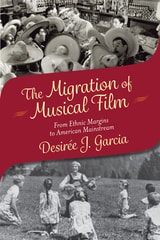
The Migration of Musical Film
From Ethnic Margins to American MainstreamGarcia, Desirée J
Rutgers University Press, 2014
The Migration of Musical Film shows how the folk musical was rooted in the challenges faced by immigrants and migrants who had to adapt to new environments, balancing American individualism with family values and cultural traditions. Uncovering fresh material from film industry archives, Garcia considers how folk musicals were initially marginal productions, designed to appeal to specific minority audiences, and yet introduced themes that were gradually assimilated into the Hollywood mainstream.
No other book offers a comparative historical study of the folk musical, from the first sound films in the 1920s to the genre’s resurgence in the 1970s and 1980s. Using an illustrative rather than comprehensive approach, Garcia focuses on significant moments in the sub-genre and rarely studied films such as Allá en el Rancho Grande along with familiar favorites that drew inspiration from earlier folk musicals—everything from The Wizard of Oz to Zoot Suit. If you think of movie musicals simply as escapist mainstream entertainment, The Migration of Musical Film is sure to leave you singing a different tune.
The Movie Musical
Desirée J. Garcia
Rutgers University Press, 2021

The Musical Comedy Films of Grigorii Aleksandrov
Laughing MattersRimgaila Salys
Intellect Books, 2009
Grigorii Aleksandrov’s musical comedy films, created with composer Isaak Dunaevskii, were the most popular Russian cinema of the 1930s and ’40s. Drawing on studio documents, press materials, and interviews with surviving film crew members, The Musical Comedy Films of Grigorii Aleksandrov presents the untold production history of the films. Salys explores how Aleksandrov’s cinema preserved the paradigms of the American musical, including its comedic tradition, using both to inscribe the foundation myths of the Stalin era in the national consciousness. As the first major study to situate these films in the cultural context of the era, this book will be essential to courses on Russian cinema and Soviet culture.
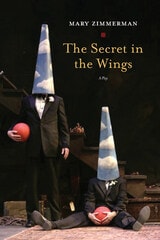
The Secret in the Wings
A PlayMary Zimmerman
Northwestern University Press, 2014
A dark and mysterious homage to lesser-known fairy tales
Mary Zimmerman’s The Secret in the Wings adapts a group of lesser-known fairy tales to create a theatrical work that sets their dark mystery against her signature wit and humor. The framing story concerns a child and the frightening babysitter with whom her parents leave her. As the babysitter reads from a book, the characters in each of the tales materialize, with each tale breaking off just at its bleakest moment before giving way to the next one.
The central tale is told without interruption, after which each previous tale is successively resumed, with each looming disaster averted. As in Zimmerman’s other productions, here she uses costumes, props, sets, and lighting to brilliant effect, creating images and feelings that render the fairy tales in all their elemental and enduring power.
The Song Is You
Musical Theatre and the Politics of Bursting into Song and DanceBradley Rogers
University of Iowa Press, 2020
Musicals, it is often said, burst into song and dance when mere words can no longer convey the emotion. This book argues that musicals burst into song and dance when one body can no longer convey the emotion. Rogers shows how the musical’s episodes of burlesque and minstrelsy model the kinds of radical relationships that the genre works to create across the different bodies of its performers, spectators, and creators every time the musical bursts into song. These radical relationships—borne of the musical’s obsessions with “bad” performances of gender and race—are the root of the genre’s progressive play with identity, and thus the source of its subcultural power. However, this leads to an ethical dilemma: Are the musical’s progressive politics thus rooted in its embrace of regressive entertainments like burlesque and minstrelsy?
The Song Is You shows how musicals return again and again to this question, and grapple with a guilt that its joyous pleasures are based on exploiting the laboring bodies of its performers. Rogers argues that the discourse of “integration”—which claims that songs should advance the plot—has functioned to deny the radical work that the musical undertakes every time it transitions into song and dance. Looking at musicals from The Black Crook to Hamilton, Rogers confronts the gendered and racial dynamics that have always under-girded the genre, and asks how we move forward.
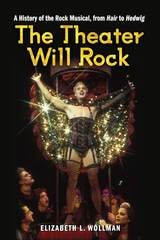
The Theater Will Rock
A History of the Rock Musical, from Hair to HedwigElizabeth L. Wollman
University of Michigan Press, 2010
"A much-needed study of the impact of rock music on the musical theater and its resulting challenges, complexities, failures, and successes. Anyone interested in Broadway will learn a great deal from this book."
---William Everett, author of The Musical: A Research Guide to Musical Theatre
"As Wollman weaves her historical narrative, she compellingly returns to . . . the conflict between the aesthetics and ideologies of rock music and the disciplined and commercial practices of the musical stage."
---Theatre Research International
"This well-written account puts the highs and lows of producing staged rock musicals in New York City into perspective and is well worth reading for the depth of insight it provides."
---Studies in Musical Theatre
Despite the genre’s influence and fame, there are still some critics who claim that the term “rock musical” is an oxymoron. The relationship between rock and the musical theater has been stormy from the start, and even the comparatively recent success of Rent has done little to convince theater producers that rock musicals are anything but highly risky ventures. Elizabeth L. Wollman explores the reasons behind these problematic connections and looks at the socioeconomic forces that underlie aesthetic decisions. She weighs the influence on the rock musical by mass media, sound, and recording technology, and the economic pressures that have affected New York theater in general over the past three decades. Finally, Wollman offers a meditation on the state of the musical, its relation to rock, and, ultimately, its future.
Packed with candid commentary by members of New York's vibrant theater community, The Theater Will Rock traces the rock musical’s evolution over nearly fifty years, in popular productions such as Hair, The Who's Tommy, Jesus Christ Superstar, The Rocky Horror Picture Show, Little Shop of Horrors, Rent, and Mamma Mia!—and in notable flops such as The Capeman.
Elizabeth L. Wollman is Assistant Professor of Music at Baruch College of the City University of New York.
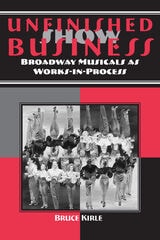
Unfinished Show Business
Broadway Musicals as Works-in-ProcessBruce Kirle
Southern Illinois University Press, 2005
In this fresh approach to musical theatre history, Bruce Kirle challenges the commonly understood trajectory of the genre. Drawing on the notion that the world of the author stays fixed while the world of the audience is ever-changing, Kirle suggests that musicals are open, fluid products of the particular cultural moment in which they are performed. Incomplete as printed texts and scores, musicals take on unpredictable lives of their own in the complex transformation from page to stage.
Using lenses borrowed from performance studies, cultural studies, queer studies, and ethnoracial studies, Unfinished Show Business: Broadway Musicals as Works-in-Process argues that musicals are as interesting for the provocative issues they raise about shifting attitudes toward American identity as for their show-stopping song-and-dance numbers and conveniently happy endings. Kirle illustrates how performers such as Ed Wynn, Fanny Brice, and the Marx Brothers used their charismatic personalities and quirkiness to provide insights into the struggle of marginalized ethnoracial groups to assimilate. Using examples from favorites including Oklahoma!, Fiddler on the Roof, A Chorus Line, and Les Misérables, Kirle demonstrates Broadway’s ability to bridge seemingly insoluble tensions in society, from economic and political anxiety surrounding World War II to generational conflict and youth counterculture to corporate America and the “me” generation. Enlivened by a gallery of some of Broadway’s most memorable moments—and some amusing, obscure ones as well—this study will appeal to students, scholars, and lifelong musical theatre enthusiasts.
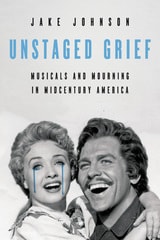
Unstaged Grief
Musicals and Mourning in Midcentury AmericaJake Johnson
University of Illinois Press, 2025
Often dismissed as escapism, screen musicals of the 1960s in fact tapped into unspoken sadness about an America that was slipping away. Jake Johnson delves into film and television musicals of the era to examine their place in networks of grieving in America, for America, and about America.
The Golden Age of musical theater ended just as Elisabeth Kübler-Ross’s On Death and Dying debuted, and Johnson uses Kübler-Ross’s five stages to frame the intertwining of musicals and grief. He analyzes films like Seven Brides for Seven Brothers and State Fair alongside paintings, poetry, and other images and texts to reveal how the musical theater engine built in the first half of the century broke down just as a new language emerged to describe the melancholy felt by people facing the end of the world they had known.
Nuanced and original, Unstaged Grief plumbs the grief, loss, and hope behind the Technicolor spectacle and rousing showstoppers.