Results by title
128 books match the query 'Men' and 7 start with o

Of "Good Laws" and "Good Men"
Law and Society in the Delaware Valley, 1680-1710William M. Offutt, Jr.
University of Illinois Press, 1995
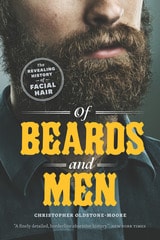
Of Beards and Men
The Revealing History of Facial HairChristopher Oldstone-Moore
University of Chicago Press, 2015
Of Beards and Men makes the case that today’s bearded renaissance is part of a centuries-long cycle in which facial hairstyles have varied in response to changing ideals of masculinity. Christopher Oldstone-Moore explains that the clean-shaven face has been the default style throughout Western history—see Alexander the Great’s beardless face, for example, as the Greek heroic ideal. But the primacy of razors has been challenged over the years by four great bearded movements, beginning with Hadrian in the second century and stretching to today’s bristled resurgence. The clean-shaven face today, Oldstone-Moore says, has come to signify a virtuous and sociable man, whereas the beard marks someone as self-reliant and unconventional. History, then, has established specific meanings for facial hair, which both inspire and constrain a man’s choices in how he presents himself to the world.
This fascinating and erudite history of facial hair cracks the masculine hair code, shedding light on the choices men make as they shape the hair on their faces. Oldstone-Moore adeptly lays to rest common misperceptions about beards and vividly illustrates the connection between grooming, identity, culture, and masculinity. To a surprising degree, we find, the history of men is written on their faces.
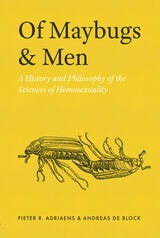
Of Maybugs and Men
A History and Philosophy of the Sciences of HomosexualityPieter R. Adriaens and Andreas De Block
University of Chicago Press, 2022
Questions about the naturalness or unnaturalness of homosexuality are as old as the hills, and the answers have often been used to condemn homosexuals, their behaviors, and their relationships. In the past two centuries, a number of sciences have involved themselves in this debate, introducing new vocabularies, theories, arguments, and data, many of which have gradually helped tip the balance toward tolerance and even acceptance. In this book, philosophers Pieter R. Adriaens and Andreas De Block explore the history and philosophy of the gay sciences, revealing how individual and societal values have colored how we think about homosexuality.
The authors unpack the entanglement of facts and values in studies of male homosexuality across the natural and human sciences and consider the extent to which science has mitigated or reinforced homonegative mores. The focus of the book is on homosexuality’s assumed naturalness. Geneticists rephrased naturalness as innateness, claiming that homosexuality is innate—colloquially, that homosexuals are born gay. Zoologists thought it a natural affair, documenting its existence in myriad animal species, from maybugs to men. Evolutionists presented homosexuality as the product of natural selection and speculated about its adaptive value. Finally, psychiatrists, who initially pathologized homosexuality, eventually appealed to its naturalness or innateness to normalize it.
Discussing findings from an array of sciences—comparative zoology, psychiatry, anthropology, evolutionary biology, social psychology, developmental biology, and machine learning—this book is essential reading for anyone interested in what science has to say about homosexuality.

Of Men and Marshes
Paul Errington
University of Iowa Press, 1957
This classic of twentieth-century nature writing, a landmark work that is still a joy to read, offers a stirring portrait of the Midwest’s endangered glacial marshland ecosystems by one of the most influential biologists of his day. A cautionary book whose advice has not been heeded, a must-read of American environmental literature, Of Men and Marshes should inspire a new generation of conservationists.
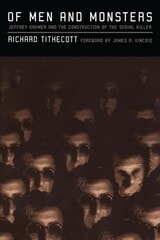
Of Men and Monsters
Jeffrey Dahmer and the Construction of the Serial KillerRichard Tithecott
University of Wisconsin Press, 1998
Of Men and Monsters examines the serial killer as an American cultural icon, one that both attracts and repels. Richard Tithecott suggests that the stories we tell and the images we conjure of serial killers—real and fictional—reveal as much about mainstream culture and its values, desires, and anxieties as they do about the killers themselves.
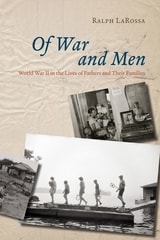
Of War and Men
World War II in the Lives of Fathers and Their FamiliesRalph LaRossa
University of Chicago Press, 2011
Fathers in the fifties tend to be portrayed as wise and genial pipe-smokers or distant, emotionless patriarchs. This common but limited stereotype obscures the remarkable diversity of their experiences and those of their children. To uncover the real story of fatherhood during this transformative era, Ralph LaRossa takes the long view—from the attack on Pearl Harbor up to the election of John F. Kennedy—revealing the myriad ways that World War II and its aftermath shaped men.
Offering compelling accounts of people both ordinary and extraordinary, Of War and Men digs deep into the terrain of fatherhood. LaRossa explores the nature and aftereffects of combat, the culture of fear during the Cold War, the ways that fear altered the lives of racial and sexual minorities, and how the civil rights movement affected families both black and white. Overturning some calcified myths, LaRossa also analyzes the impact of suburbanization on fathers and their kids, discovering that living in the suburbs often strengthened their bond. And finally, looking beyond the idealized dad enshrined in TV sitcoms, Of War and Men explores the brutal side of family life in the postwar years. LaRossa’s richly researched book dismantles stereotypes while offering up a fascinating and incisive chronicle of fatherhood in all its complexity.
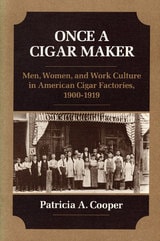
Once a Cigar Maker
Men, Women, and Work Culture in American Cigar Factories, 1900-1919Patricia A. Cooper
University of Illinois Press, 1987