Results by title
1210 books match the query 'Mexico' and 28 start with o
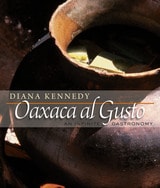
Oaxaca al Gusto
An Infinite GastronomyBy Diana Kennedy
University of Texas Press, 2010
No one has done more to introduce the world to the authentic, flavorful cuisines of Mexico than Diana Kennedy. Acclaimed as the Julia Child of Mexican cooking, Kennedy has been an intrepid, indefatigable student of Mexican foodways for more than fifty years and has published several classic books on the subject, including The Cuisines of Mexico (now available in The Essential Cuisines of Mexico, a compilation of her first three books), The Art of Mexican Cooking, My Mexico, and From My Mexican Kitchen. Her uncompromising insistence on using the proper local ingredients and preparation techniques has taught generations of cooks how to prepare—and savor—the delicious, subtle, and varied tastes of Mexico.
In Oaxaca al Gusto, Kennedy takes us on an amazing journey into one of the most outstanding and colorful cuisines in the world. The state of Oaxaca is one of the most diverse in Mexico, with many different cultural and linguistic groups, often living in areas difficult to access. Each group has its own distinctive cuisine, and Diana Kennedy has spent many years traveling the length and breadth of Oaxaca to record in words and photographs "these little-known foods, both wild and cultivated, the way they were prepared, and the part they play in the daily or festive life of the communities I visited." Oaxaca al Gusto is the fruit of these labors—and the culmination of Diana Kennedy's life's work.
Organized by regions, Oaxaca al Gusto presents some three hundred recipes—most from home cooks—for traditional Oaxacan dishes. Kennedy accompanies each recipe with fascinating notes about the ingredients, cooking techniques, and the food's place in family and communal life. Lovely color photographs illustrate the food and its preparation. A special feature of the book is a chapter devoted to the three pillars of the Oaxacan regional cuisines—chocolate, corn, and chiles. Notes to the cook, a glossary, a bibliography, and an index complete the volume.
An irreplaceable record of the infinite world of Oaxacan gastronomy, Oaxaca al Gusto belongs on the shelf of everyone who treasures the world's traditional regional cuisines.
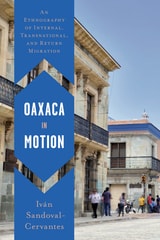
Oaxaca in Motion
An Ethnography of Internal, Transnational, and Return MigrationIván Sandoval-Cervantes
University of Texas Press, 2022
Migration is typically seen as a transnational phenomenon, but it happens within borders, too. Oaxaca in Motion documents a revealing irony in the latter sort: internal migration often is global in character, motivated by foreign affairs and international economic integration, and it is no less transformative than its cross-border analogue.
Iván Sandoval-Cervantes spent nearly two years observing and interviewing migrants from the rural Oaxacan town of Santa Ana Zegache. Many women from the area travel to Mexico City to work as domestics, and men are encouraged to join the Mexican military to fight the US-instigated “war on drugs” or else leave their fields to labor in industries serving global supply chains. Placing these moves in their historical and cultural context, Sandoval-Cervantes discovers that migrants’ experiences dramatically alter their conceptions of gender, upsetting their traditional notions of masculinity and femininity. And some migrants bring their revised views with them when they return home, influencing their families and community of origin. Comparing Oaxacans moving within Mexico to those living along the US West Coast, Sandoval-Cervantes clearly demonstrates the multiplicity of answers to the question, “Who is a migrant?”
Oaxaca
Arqueología de una Región MesoamericanaNelly M. Robles García
University Press of Colorado, 2019
Obliging Need
Rural Petty Industry in Mexican CapitalismBy Scott Cook and Leigh Binford
University of Texas Press, 1990
For centuries throughout large portions of the globe, petty agriculturalists and industrialists have set their physical and mental energies to work producing products for direct consumption by their households and for exchange. This twofold household reproduction strategy, according to both Marxist and neoclassical approaches to development, should have disappeared from the global economy as labor was transformed into a producer as well as a consumer of capitalist commodities. But in fact, during the twentieth century, only the United States and Britain seem to have approximated this predicted scenario. Tens of millions of households in contemporary Asia, Africa, and Latin America and millions more in industrialized capitalist economies support themselves through petty commodity production alone or in combination with petty industry wage labor.
Obliging Need provides a detailed and comprehensive analysis of small-scale peasant and artisan enterprise in the Oaxaca Valley of Mexico. The authors show how commodity production is organized and operates in different craft industries, as well as the ways in which it combines with other activities such as household chores, agriculture, wage labor, and petty commerce. They demonstrate how—contrary to developmentalist dogma—small-scale capitalism develops from within Mexico's rural economy.
These findings will be important for everyone concerned with improving the lives and economic opportunities of countryfolk in the Third World. As the authors make clear, political mobilization in rural Mexico will succeed only as it addresses the direct producers' multiple needs for land, credit, more jobs, health insurance, and, most importantly, more equitable remuneration for their labor and greater rewards for their enterprise.
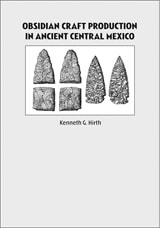
Obsidian Craft Production in Ancient Central Mexico
Kenneth Hirth
University of Utah Press, 2006
The appearance of such craft specialists—who produced large quantities of goods for other households—represented a significant and fundamental change in the structure of prehistoric economies. In central Mexico one particularly important craft specialty was the making of obsidian prismatic blades, the cutting tools of choice.
Unlike most other craft activities, obsidian craft production can be studied using archaeological techniques. Obsidian Craft Production in Ancient Central Mexico examines the obsidian craft industry found at the site of Xochicalco, Morelos, between A.D. 650 and 900, the Gobernador or Epiclassic period when independent city-states appeared throughout central Mexico to fill the political vacuum left by the decline of Teotihuacan. Because the demand for obsidian tools remained constant, author Kenneth Hirth contends that obsidian can serve as a general model for discussing craft production and economic organization on a broader theoretical level.
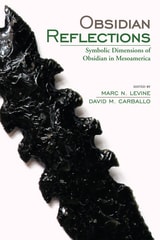
Obsidian Reflections
Symbolic Dimensions of Obsidian in MesoamericaDavid M. Carballo
University Press of Colorado, 2014
Exploring the materiality of this volcanic glass rather than only its functionality, this book considers the interplay among people, obsidian, and meaning and how these relationships shaped patterns of procurement, exchange, and use. An international group of scholars hailing from Belize, France, Japan, Mexico, and the United States provides a variety of case studies from Mexico, Guatemala, Belize, and Honduras. The authors draw on archaeological, iconographic, ethnographic, and ethnohistoric data to examine obsidian as a touchstone for cultural meaning, including references to sacrificial precepts, powerful deities, landscape, warfare, social relations, and fertility.
Obsidian Reflections underscores the necessity of understanding obsidian from within its cultural context—the perspective of the indigenous people of Mesoamerica. It will be of great interest to Mesoamericanists as well as students and scholars of lithic studies and material culture.
Occupying Our Space
The Mestiza Rhetorics of Mexican Women Journalists and Activists, 1875–1942Cristina Devereaux Ramírez; Foreword by Jacqueline Jones Royster
University of Arizona Press, 2015
Occupying Our Space sheds new light on the contributions of Mexican women journalists and writers during the late nineteenth and early twentieth centuries, marked as the zenith of Mexican journalism. Journalists played a significant role in transforming Mexican social and political life before and after the Revolution (1910–1920), and women were a part of this movement as publishers, writers, public speakers, and political activists. However, their contributions to the broad historical changes associated with the Revolution, as well as the pre- and post-revolutionary eras, are often excluded or overlooked.
This book fills a gap in feminine rhetorical history by providing an in-depth look at several important journalists who claimed rhetorical puestos, or public speaking spaces. The book closely examines the writings of Laureana Wright de Kleinhans (1842–1896), Juana Belén Gutiérrez de Mendoza (1875–1942), the political group Las mujeres de Zitácuaro (1900), Hermila Galindo (1896–1954), and others. Grounded in the overarching theoretical lens of mestiza rhetoric, Occupying Our Space considers the ways in which Mexican women journalists negotiated shifting feminine identities and the emerging national politics of the late nineteenth and early twentieth centuries. With full-length Spanish primary documents along with their translations, this scholarship reframes the conversation about the rhetorical and intellectual role women played in the ever-changing political and identity culture in Mexico.
Octavio Paz
A MeditationIlan Stavans
University of Arizona Press, 2001
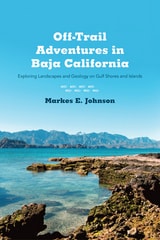
Off-Trail Adventures in Baja California
Exploring Landscapes and Geology on Gulf Shores and IslandsMarkes E. Johnson
University of Arizona Press, 2014
Off-Trail Adventures in Baja California describes—and maps and illustrates—nine hikes along outcrops on islands and peninsular shores where geography, geology, and ecology meet in singular ways. Each spot tells a story about the nature of the place—the cumulative effects of millions of years of natural forces at work. During the course of his long teaching career, Markes E. Johnson has hiked much of Baja California, often with students in tow. He brings a lifetime of study to his simple descriptions of the stories that are revealed by looking closely at natural phenomena framed by rocks and fossils.
This hiking guide offers a wealth of stories that seem to encompass everything, and can clearly communicate Johnson’s deep understanding of how our planet’s ecosystems function. Whether you like to hike with your boots on or from the comfort of your favorite chair, this book is a must-have for anyone who has visited or hopes to visit Baja California’s Gulf Coast.
Oil, Banks, and Politics
The United States and Postrevolutionary Mexico, 1917–1924By Linda B. Hall
University of Texas Press, 1995
Mexico was second only to the United States as the world's largest oil producer in the years following the Mexican Revolution. As the revolutionary government became institutionalized, it sought to assure its control of Mexico's oil resources through the Constitution of 1917, which returned subsoil rights to the nation. This comprehensive study explores the resulting struggle between oil producers, many of which were U.S. companies, and the Mexican government.
Linda Hall goes beyond the diplomacy to look at the direct impact of a powerful, highly profitable foreign-controlled industry on a government and a nation trying to recover from a major civil war. She draws on extensive research in Mexican archives, including both government sources and the private papers of Presidents Alvaro Obregón and Plutarco Elías Calles, as well as U.S. government and private sources.
Since the North American Free Trade Agreement has expanded United States business ties to Mexico, this study of a crucial moment in U.S.-Mexican business relations will be of interest to a wide audience in business, diplomatic, and political history.
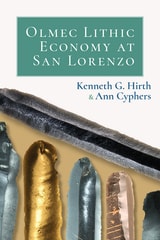
Olmec Lithic Economy at San Lorenzo
Kenneth Hirth
University Press of Colorado, 2020
The obsidian blade was the cutting tool of choice across Mesoamerica and used in a wide range of activities, from domestic food preparation to institutional ritual activities. Hirth and Cyphers conducted a three-decade investigation of obsidian artifacts recovered at Puerto Malpica, the earliest known workshop, and seventy-six other sites on San Lorenzo Island, where these tools were manufactured for local and regional distribution. Evidence recovered from these excavations provides some of the first information on how early craft specialists operated and how the specialized technology used to manufacture obsidian blades spread across Mesoamerica. The authors use geochemical analyses to identify thirteen different sources for obsidian during San Lorenzo’s occupation. This volcanic glass, not locally available, was transported over great distances, arriving in nodular and finished blade form.
Olmec Lithic Economy at San Lorenzo offers a new way to analyze the Preclassic lithic economy—the procurement, production, distribution, and consumption of flaked stone tools—and shows how the study of lithics aids in developing a comprehensive picture of the internal structure and operation of Olmec economy. The book will be significant for Mesoamericanists as well as students and scholars interested in economy, lithic technology, and early complex societies.
Olmec to Aztec
Settlement Patterns in the Ancient Gulf LowlandsBarbara L. Stark
University of Arizona Press, 1997
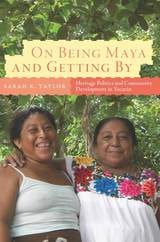
On Being Maya and Getting By
Heritage Politics and Community Development in YucatánSarah R. Taylor
University Press of Colorado, 2018
The book explores how Ek’Balam villagers negotiate and maneuver through a web of social programs, tourists, volunteers, and expectations while living their daily lives. Focusing on the active processes in which residents choose to participate, author Sarah R. Taylor provides insights into how the ideological conflicts surrounding economic development play out in the negotiations between internal community politics and external social actors. The conflicts implicit to conceptions of “community” as a target for development are made explicit through the systematic questioning of what exactly it means to be a member of a local, indigenous, or sustainable community in the process of being developed.
On Being Maya and Getting By is a rich description of how one community is actively negotiating with tourism and development and also a call for a more complex analysis of how rural villages are connected to greater urban, national, and global forces.
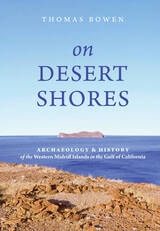
On Desert Shores
Archaeology and History of the Western Midriff Islands in the Gulf of CaliforniaThomas Bowen
University of Utah Press, 2022
Bowen draws on a wide range of sources, including the first archaeological field work ever conducted on the islands, written accounts dating back to the sixteenth century, oral histories of native people, contemporary interviews, and his own firsthand experiences. Among those cast in the islands’ historical drama are the Seri (Comcaac) people of Sonora, the extinct Cochimís of Baja California, Spanish explorers, Jesuit missionaries, pearl fishers, egg collectors, guano miners, hydrographers, cartographers, small-scale Mexican fishermen, recreational anglers, writers, photographers, ecotourists, shipwreck victims, and, most importantly, scientists. The final chapter documents the impact of this human activity on the islands’ ecosystems and examines conservation efforts now underway. Compelling and richly illustrated, this broadly based work provides a unique picture of these extraordinary islands.
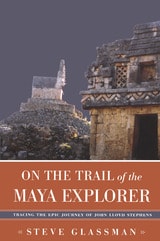
On the Trail of the Maya Explorer
Tracing the Epic Journey of John Lloyd StephensSteve Glassman
University of Alabama Press, 2003
A Mesoamerican travel book from two perspectives and two centuries.
In 1839 John Lloyd Stephens, then 31 years old, and his traveling companion, artist Frederick Catherwood, disappeared into the vast rain forest of eastern Guatemala. They had heard rumors that remains of a civilization of incomparable artistic and cultural merit were moldering in the steamy lowland jungles. They braved Indian uprisings, road agents, heat, and biting insects to eventually encounter what is today known as the lost civilization of the Maya.
In 1841 Stephens published Incidents of Travel in Central America, Chiapas, and Yucatan to instant acclaim with both American and international audiences. His conversational style was fresh and crisp and his subject matter, the search for lost cities on the Central American isthmus, was romantic and adventurous. Stephens's book has been characterized as the "great American nonfiction narrative of the 19th century." Indeed, what Stephens wrote about the Maya makes a major contribution to Maya studies.
Steve Glassman retraces Stephens's route, visiting the same archaeological sites, towns, markets, and churches and meeting along the way the descendants of those people Stephens described, from mestizo en route to the cornfields to town elders welcoming the Norte Americanos. Glassman's work interlaces discussion of the history, natural environment, and architecture of the region with descriptions of the people who live and work there. Glassman compares his 20th-century experience with Stephens's 19th-century exploration, gazing in awe at the same monumental pyramids, eating similar foods, and avoiding the political clashes that disrupt the governments and economies of the area.
Stephens's books are still widely available, but his importance to literary professionals has been overlooked. With this new travelogue, Glassman reaffirms Stephens's reputation and brings his work to wider critical and public attention.
Opera and its Voices in Utah
Walter Rudolph
Utah State University Press, 2018
The Arrington Lecture series, established by one of the twentieth-century West's most distinguished historians, Leonard Arrington, has become a leading forum for prominent historians to address topics related to Mormon history. Utah State University hosts the Leonard J. Arrington Mormon History Lecture Series through the Merrill-Cazier Library Special Collections and Archives department.

Organic Coffee
Sustainable Development by Mayan FarmersMaria Elena Martinez-Torres
Ohio University Press, 2006
Maria Elena Martinez-Torres explains how Mayan farmers have built upon their ethnic networks to make a crucial change in their approach to agriculture. Taking us inside Chiapas, Mexico's poorest state and scene of the 1994 Zapatista uprising, she examines the anatomy of the ongoing organic coffee boom and the fair-trade movement. The organic coffee boom arose as very poor farmers formed cooperatives, revalued their ethnic identity, and improved their land through organic farming. The result has been significant economic benefits for their families and ecological benefits for the future sustainability of agriculture in the region.
Organic Coffee refutes the myth that organic farming is less productive than chemical-based agriculture and gives us reasons to be hopeful for indigenous peoples and peasant farmers

Organized Labour and Politics in Mexico
Changes, Continuities and ContradictionsGraciela Bensusan and Kevin J. Middlebrook
University of London Press, 2012
This state of affairs - especially the failure to enact progressive labor law reform since democratic regime change in 2000 - limits democracy and imposes heavy costs on society as a whole.
Origins of Instability in Early Republican Mexico
Donald F. Stevens
Duke University Press, 1991
Donald F. Stevens’ revisionist account challenges traditional historiography to examine the nature and origins of Mexico’s political instability. Turning to quantitative methods as a way of providing a framework for examining existing hypotheses concerning Mexico’s instability, the author dissects the relationship between instability and economic cycles; contradicts the notion that Mexico’s social elite could have increased political stability by becoming more active; and argues that the principal political fissures were not liberal vs. conservative but were among radical, moderate, and conservative.
Ultimately, Stevens maintains, the origins of that country’s instability are to be found in the contradictions between liberalism and Mexico’s traditional class structure, and the problems of creating an independent republic from colonial, monarchical, and authoritarian traditions.
Origins of the War with Mexico
The Polk-Stockton IntrigueBy Glenn W. Price
University of Texas Press, 1967
In the spring of 1846 James K. Polk announced that the Mexican Army had invaded United States territory and had “shed American blood upon the American soil.” This political rhetoric, as Glenn W. Price establishes in Origins of the War with Mexico: The Polk-Stockton Intrigue, is part of the myth of American innocence. It represents the “internal contradiction between professed values and patterns of action,” perpetuated by American historical writing that emphasizes national consequences of the acquisition of foreign territory and minimizes both its international significance and the importance of the diplomatic and military methods used.
A conflict with Mexico, leading to territorial expansion of the United States, was not unwanted. California was Polk’s prime objective from the beginning of his administration, and this Mexican province was to be acquired by conquest in a war initiated on the Texas-Mexican border. To this end Polk sent several agents to Texas, but the man at the center of the war intrigue was Commodore Robert F. Stockton, independently wealthy, prominent in politics, and the head of great business enterprises.
Sufficient evidence exists to substantiate in every important particular the steps in Polk’s path of intrigue: his attempts to bribe Mexican officials; his efforts to encourage revolutionary forces in the Mexican provinces; his use of the threat of force to frighten Mexico into selling California; his attempt to initiate a war by proxy through the government of Texas and Anson Jones.
If Polk was unwilling to assume responsibility for aggressive war, Stockton was not; he arrived in Galveston with a squadron of naval vessels in May of 1845, prepared to finance an army of three thousand men from his personal funds to avoid the overt involvement of the government of the United States. But, says Price, for all the internationally dangerous implications of such a maneuver, the two men who played the chief roles in the war intrigue of 1845 are representative in their written and spoken expression of faith in American righteousness of action and in the American tradition of the divine mission.
Based on extensive research into the written and spoken words of the people who were involved, directly and indirectly, in the events, this analysis (which will be considered revisionist) of the origins of the War with Mexico is the result of the kind of objective approach to national history for which the author makes a plea in his preface and conclusion and in his interpretive comments throughout the work. The historian, Price believes, “has the extraordinary advantage of being able to examine mankind from that distance and elevation and detachment which so often reveals, as it is designed to reveal, the gulf between pretension and performance.”
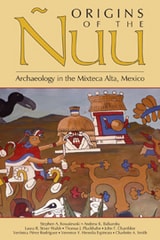
Origins of the Ñuu
Archaeology in the Mixteca Alta, MexicoStephen A. Kowalewski
University Press of Colorado, 2009
The ñuu - the kingdoms of the famous Mixtec codices - are traced back through the Postclassic and Classic periods to their beginnings in the first states of the Terminal Formative, revealing their origin, evolution, and persistence through two cycles of growth and collapse. Challenging assumptions that the Mixtec were peripheral to better-known peoples such as the Aztecs or Maya, the book asserts that the ñuu were a major demographic and economic power in their own right.
Older explanations of multiregional or macroregional systems often portrayed civilizations as rising in a cradle or hearth and spreading outward. New macroregional studies show that civilizations are products of more complex interactions between regions, in which peripheries are not simply shaped by cores but by their interactions with multiple societies at varying distances from major centers. Origins of the Ñuu is a significant contribution to this emerging area of archaeological research.
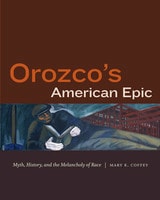
Orozco's American Epic
Myth, History, and the Melancholy of RaceMary K. Coffey
Duke University Press, 2020
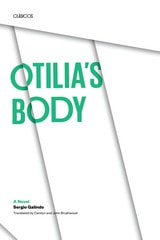
Otilia's Body
A NovelBy Sergio Galindo
University of Texas Press, 1994
From reviews of the Spanish edition:
"...among the best works that Mexican fiction has produced."
—Héctor Gally, Sábado
"With homely features, but with a body so shapely and exciting that it sets men (priests included) aflame throughout the novel, with an incandescent voluptuousness and delightful amorality (surely explosive in the conservative Mexican society of her time and place) ...Otilia Rauda could be the protagonist of a Greek tragedy or of a soap opera made of improbable happenings and as many turns of fate as there are chapters used to tell the story of her life."
—Jorge Ruffinelli, Punto y Aparte
Winner of Mexico's prestigious Xavier Villaurrutia prize in 1986, Otilia Rauda is here translated into English for the first time as Otilia's Body. Widely considered Sergio Galindo's best work, the novel dramatizes a sexually liberated woman's obsession with an outlaw lover, played against the backdrop of Mexican history from 1910 to 1940. A fine example of "intimist" fiction, Otilia's Body is noteworthy for its penetratingly described characters who transcend time and place to become universally recognizable.
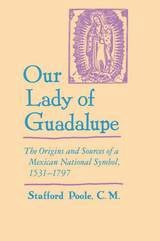
Our Lady of Guadalupe
The Origins and Sources of a Mexican National Symbol, 1531–1797Stafford Poole
University of Arizona Press, 1995
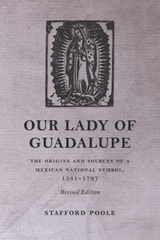
Our Lady of Guadalupe
The Origins and Sources of a Mexican National Symbol, 1531–1797Stafford Poole
University of Arizona Press, 2017
Outside Theater
Alliances That Shape MexicoStuart A. Day
University of Arizona Press, 2017
Taking a cue from influential French philosopher Jacques Rancière, who in The Emancipated Spectator rejects the idea of the passive, ignorant, duped spectators in need of instruction to become active, Stuart A. Day’s goal in Outside Theater is to highlight written words and performances that exemplify effective strategies, past and present, to reveal and promote civic engagement, to provoke disruptions, or to highlight fissures—and opportunities—in oppressive social structures.
Through the study of one or two primary models per chapter, as well as multiple examples in the introduction and conclusion, Day presents Mexican plays from 1905 to 2015, including the 2010 Mexico City performance of Zoot Suit by Chicano playwright Luis Valdez. Using these plays, Day explores the concept of “outside theater,” where people or groups translate the tools of the theatrical trade to a different stage, outside the walls of the theater, and play the part of fictional or real life Celestinas—matchmakers who unite seemingly disparate entities to promote social awareness and social action by working the borders between life and art.
Each work in this innovative analysis reveals productive social connections that, with the help of crucial artistic alliances, contradict the perception that art is somehow secondary to or disconnected from the public sphere of influence and the struggles of everyday life. With this book, Day shows that Mexican theater can and does bolster civil society and thus the country’s fragile democracy.
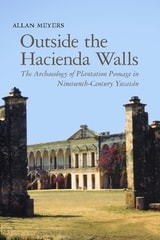
Outside the Hacienda Walls
The Archaeology of Plantation Peonage in Nineteenth-Century YucatánAllan Meyers
University of Arizona Press, 2012
Drawing on a dozen years of archaeological and historical investigation, Allan Meyers breaks new ground in the study of Yucatán haciendas. He explores a plantation village called San Juan Bautista Tabi, which once stood at the heart of a vast sugar estate. Occupied for only a few generations, the village was abandoned during the revolutionary upheaval. Its ruins now lie within a state-owned ecological reserve.
Through oral histories, archival records, and physical remains, Meyers examines various facets of the plantation landscape. He presents original data and fresh interpretations on settlement organization, social stratification, and spatial relationships. His systematic approach to "things underfoot," small everyday objects that are now buried in the tropical forest, offers views of the hacienda experience that are often missing in official written sources. In this way, he raises the voices of rural, mostly illiterate Maya speakers who toiled as laborers. What emerges is a portrait of hacienda social life that transcends depictions gleaned from historical methods alone.
Students, researchers, and travelers to Mexico will all find something of interest in Meyers's lively presentation. Readers will see the old haciendas—once forsaken but now experiencing a rebirth as tourist destinations—in a new light. These heritage sites not only testify to social conditions that prevailed before the Mexican Revolution, but also remind us that the human geography of modern Yucatán is as much a product of plantation times as it is of more ancient periods.
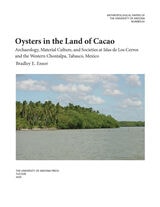
Oysters in the Land of Cacao
Archaeology, Material Culture, and Societies at Islas de Los Cerros and the Western Chontalpa, Tabasco, MexicoBradley E. Ensor
University of Arizona Press, 2020
This book synthesizes data from multiyear investigations at a coastal site complex in Tabasco—Islas de Los Cerros (ILC)—providing the first modern, systematic descriptions and analyses of material culture that challenge preconceptions while enabling new perspectives on cultural developments from the Formative to Late Classic periods through the lens of regional comparisons and contemporary theoretical trends. Ensor introduces a political ecological understanding of the environment and archaeological features, overturns a misconception that the latter were formative shell middens, provides an alternative pottery classification more appropriate for the materials and for contemporary theory, and introduces new approaches for addressing formation processes and settlement history.
Building on the empirical analyses and discussions of problems in Mesoamerican archaeology, this book contributes new approaches to practice and agency perspectives, holistically integrating intra- and interclass agency, kinship strategies, gender and age dynamics, layered cultural identities, landscapes, social memory, and foodways and feasting. Oysters in the Land of Cacao addresses issues important to coastal archaeology within and beyond Mesoamerica. It delivers an overdue regional synthesis and new observations on settlement patterns, elite power, and political economies.