Results by title
210 books match the query 'Missouri' and 3 start with o
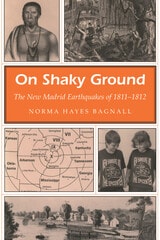
On Shaky Ground
The New Madrid Earthquakes of 1811-1812Norma Hayes Bagnall
University of Missouri Press, 1996
Although most Americans associate earthquakes with California, the tremors that shook the Mississippi valley in southeast Missouri from December 16, 1811, through February 7, 1812, are among the most violent quakes to hit the North American continent in recorded history. Collectively known as the New Madrid earthquakes, these quakes affected more than 1 million square miles. By comparison, the 1906 San Francisco earthquake affected only 60,000 square miles, less than one-sixteenth the area of the New Madrid earthquakes.
Scientists believe that each of the three greatest tremors would have measured more than 8.0 on the Richter scale, had that measuring device been in place in 1811. Vibrations were felt from the Rocky Mountains to the Atlantic coast and from Mexico to Canada. The quake zone was in constant movement during this period. Five towns in three states disappeared, islands vanished in the Mississippi River, lakes formed where there had been none before, and the river flowed backward for a brief period.
Providing eyewitness accounts from people both on the land and on the river, Bagnall captures the fears of the residents through their tales about the smells and dark vapors that filled the air, the cries of the people, the bawling of animals, and the constant roar of the river and its collapsing banks. On Shaky Ground also traces the history of the founding of New Madrid and considers the impact of the earthquakes on population and land in southeast Missouri. Predictions for future earthquakes along the New Madrid fault, as well as instructions on preparing for and surviving a quake, are also included.
Informative, clearly written, and well illustrated, On Shaky Ground will be of interest to all general readers, especially those interested in earthquakes or Missouri history.

Opening the Ozarks
A Historical Geography of Missouri's Ste. Genevieve District, 1760-1830Walter A. Schroeder
University of Missouri Press, 2002
The study begins with the French Creole settlement at Old Ste. Genevieve in the middle of the eighteenth century. It describes the movement of the French into the Ozark hills during the rest of that century and continues with that of the American immigrants into Upper Louisiana after 1796, ending with the Americanization of the district after the Louisiana Purchase. Walter Schroeder examines the cultural transition from a French society, operating under a Spanish administration, to an American society in which French, Indians, and Africans formed minorities.
Schroeder used thousands of French- and Spanish-language documents, including the Archives of the Indies in Seville, Spain, as well as documents from Ste. Genevieve and St. Louis to gather his information. He also utilized thousands of land records from the American period, including deeds of land sales and sales from the public domain, and plats from both the Spanish and American periods. In addition, Schroeder performed years of fieldwork and perused aerial photography of the area, interviewing residents and searching for vestiges of the past in the landscape.
As the only study to deal with the cradle of Missouri and the first trans-Mississippi expansion of the Anglo-American frontier, Opening the Ozarks will be invaluable to anyone interested in America’s geographical history, particularly that of Missouri.
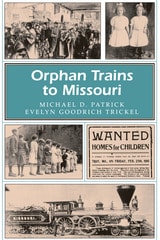
Orphan Trains to Missouri
Michael D. Patrick & Evelyn Goodrich Trickel
University of Missouri Press, 1997
As an "orphan train" crossed the country, it left part of its cargo at each stop, a few children in one small town and a few in another. Even though farmers needed many hands for labor, most of the small farm communities could not or would not take all of the children on the train. As the train moved to its next stop, those children not taken feared no one would ever want them.
Early immigration laws encouraged the poor of Europe to find new hope with new lives in the United States. But sometimes the immigrants exchanged a bad situation in their native country for an even worse one on the streets of New York and other industrial cities. As a result, the streets were filled with crowds of abandoned children that the police called "street arabs." Many New York citizens blamed the street arabs for crime and violence in the city and wanted them placed in orphan homes or prisons.
In 1853 a man by the name of Charles Loring Brace, along with other well-to-do men in New York City, founded the Children's Aid Society. The society planned to give food, lodging, and clothing to homeless children and provide educational and trade opportunities for them. But the number of children needing help was so large that the Children's Aid Society was unable to care for them, and Brace developed a plan to send many of the children to the rural Midwest by train. He was convinced that the children of the streets would find many benefits in rural America. In 1854 he persuaded the board of the society to send the first trainload of orphans west. With this, the orphan trains were born.
Cheap fares, the central location of the state, and numerous small farming towns along the railroad tracks made Missouri the perfect hub for the orphan trains, even though many areas of the state were still largely unsettled. Researchers have estimated that from 150,000 to 400,000 children were sent out on orphan trains, with perhaps as many as 100,000 being placed in Missouri.
Orphan Trains to Missouri documents the history of the children on those Orphan Trains--their struggles, their successes, and their failures. Touching stories of volunteers who oversaw the placement of the orphans as well as stories of the orphans themselves make this a rich record of American and midwestern history.