Results by title
1947 books match the query 'Music' and 51 start with o
O Sing unto the Lord
A History of English Church MusicAndrew Gant
University of Chicago Press, 2017
The ornate complexity of pre-Reformation Catholic liturgies revealed the exclusive nature of this form of worship. By contrast, simple English psalms, set to well-known folk songs, summed up the aims of the Reformation with its music for everyone. The Enlightenment brought hymns, the Methodists and Victorians a new delight in the beauty and emotion of worship. Today, church music mirrors our multifaceted worldview, embracing the sounds of pop and jazz along with the more traditional music of choir and organ. And reflecting its truly global reach, the influence of English church music can be found in everything from masses sung in Korean to American Sacred Harp singing.
From medieval chorales to “Amazing Grace,” West Gallery music to Christmas carols, English church music has broken through the boundaries of time, place, and denomination to remain familiar and cherished everywhere. Expansive and sure to appeal to all music lovers, O Sing unto the Lord is the biography of a tradition, a book about people, and a celebration of one of the most important sides to our cultural heritage.
Off the Record
The Technology and Culture of Sound Recording in AmericaMorton, David
Rutgers University Press, 1999
David L. Morton examines the process of invention, innovation, and diffusion of communications technology, using the history of sound recording as the focus. Off the Record demonstrates how the history of both the hardware and the ways people used it is essential for understanding why any particular technology became a fixture in everyday life or faded into obscurity. Morton’s approach to the topic differs from most previous works, which have examined the technology’s social impact, but not the reasons for its existence. Recording culture in America emerged, Morton writes, not through the dictates of the technology itself but in complex ways that were contingent upon the actions of users.
Each of the case studies in the book emphasizes one of five aspects of the culture of recording and its relationship to new technology, at the same time telling the story of sound recording history. One of the misconceptions that Morton hopes to dispel is that the only important category of sound recording involves music. Unique in his broad-based approach to sound technology, the five case studies that Morton investigates are :- The phonograph record
- Recording in the radio business
- The dictation machine
- The telephone answering machine, and
- Home taping
Old Roots, New Routes
The Cultural Politics of Alt.Country MusicPamela Fox and Barbara Ching, editors
University of Michigan Press, 2008
Old Town Road
A Song by Lil Nas X with Billy Ray CyrusChris Molanphy
Duke University Press, 2023
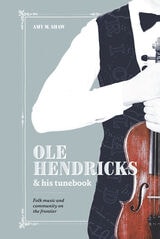
Ole Hendricks and His Tunebook
Folk Music and Community on the FrontierAmy M. Shaw
University of Wisconsin Press, 2020
Such tunebooks, popular during the nineteenth century, rarely survive and are often overlooked by folk scholars in favor of commercially produced recordings, published sheet music, or oral tradition. Based on extensive historical and genealogical research, Amy Shaw presents a grounded picture of a musician, his family, and his community in the Upper Midwest, revealing much about music and dance in the area. This notable contribution to regional music and folklore includes more than one hundred of Ole's dance tunes, transcribed into modern musical notation for the first time. Ole Hendricks and His Tunebook will be valuable to readers and scholars interested in ethnomusicology and the Norwegian American immigrant experience.
On Concepts and Classifications of Musical Instruments
Margaret J. Kartomi
University of Chicago Press, 1990
On Music Theory, and Making Music More Welcoming for Everyone
Philip Ewell
University of Michigan Press, 2023
Winner of the 2024 Association of American Publishers PROSE Award for Music and Performing Arts
Since its inception in the mid-twentieth century, American music theory has been framed and taught almost exclusively by white men. As a result, whiteness and maleness are woven into the fabric of the field, and BIPOC music theorists face enormous hurdles due to their racial identities. In On Music Theory, Philip Ewell brings together autobiography, music theory and history, and theory and history of race in the United States to offer a black perspective on the state of music theory and to confront the field’s white supremacist roots. Over the course of the book, Ewell undertakes a textbook analysis to unpack the mythologies of whiteness and western-ness with respect to music theory, and gives, for the first time, his perspective on the controversy surrounding the publication of volume 12 of the Journal of Schenkerian Studies. He speaks directly about the antiblackness of music theory and the antisemitism of classical music writ large and concludes by offering suggestions about how we move forward. Taking an explicitly antiracist approach to music theory, with this book Ewell begins to create a space in which those who have been marginalized in music theory can thrive.
On Site, In Sound
Performance Geographies in América LatinaKirstie A. Dorr
Duke University Press, 2018
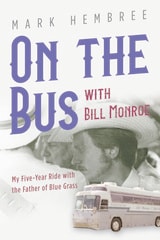
On the Bus with Bill Monroe
My Five-Year Ride with the Father of Blue GrassMark Hembree
University of Illinois Press, 2022
The amusing story of a Yankee fish out of water, On the Bus with Bill Monroe mixes memoir with storytelling to recount the adventures of a Northerner learning new ways and the Old South.
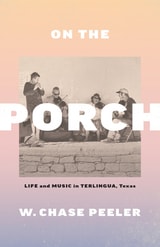
On the Porch
Life and Music in Terlingua, TexasW. Chase Peeler
University of Texas Press, 2021
In sunbaked Terlingua, Texas (pop., a few hundred), residents joke that there is a musician under every rock. Located ten miles from Mexico in one of the remotest corners of the United States, the town had a recording studio before it had a school, a well-stocked grocery store, or even a water utility. Open jam sessions are a daily ritual, and some songwriters make a living from their craft despite being thousands of miles from New York or Nashville. Why does such a tiny and isolated place ring with singing and guitars?
Based on more than two years of on-the-ground research, On the Porch tells the story of this small but remarkable community. Chase Peeler invites us into the music, introducing us to a cast of characters as unique as the town itself. He reveals how novices and experts perform together—a rarity in contemporary America. He recounts the devastation brought on by a border closure and describes how music is once again uniting people across the Rio Grande. He considers the impact of gentrification in an off-the-grid paradise, and how this threatens to transform a precarious musical ecosystem. On the Porch is a celebration of human musicality, of the role that music plays and can play in our lives, both in Terlingua and beyond.
On the Record
Music Journalists on Their Lives, Craft, and CareersMike Hilleary
University of Massachusetts Press, 2020
Bringing together interviews from an impressive roster of over fifty music writers, Mike Hilleary offers up an engaging and wide-reaching examination of the past and potential future of music journalism. This accessible oral history contains professional insights into journalists’ craft and purpose, practical advice, and essential life lessons from a diverse cast of music writers—ranging from long-respected veterans of the field such as Rob Sheffield, Jessica Hopper, Ann Powers, and Chuck Klosterman to must-read modern voices including Amanda Petrusich, Hanif Abdurraqib, Lindsay Zoladz, and Jayson Greene. Honest and absorbing, On the Record will educate and enlighten anyone who wants to write about music, or anyone who wants a better understanding about those who do.

One Long Tune
The Life and Music of Lenny BreauRon Forbes-Roberts
University of North Texas Press, 2006
One Nation Under A Groove
Motown and American CultureGerald Early
University of Michigan Press, 2004
How it got to be that way and how it changed the face of American popular culture are the subjects of this concise study of Berry Gordy's phenomenal creation. Author Gerald Early tells the story of the cultural and historical conditions that made Motown Records possible, including the dramatic shifts in American popular music of the time, changes in race relations and racial attitudes, and the rise of a black urban population. Early concentrates in particular on the 1960s and 70s, when Motown had its biggest impact on American musical tastes and styles.
With this revised and expanded edition, the author provides an up-to-date bibliography of the major books that have been written about Motown Records specifically, and black American music generally. Plus, new appendices feature interviews with four of the major creators of the Motown Sound: Berry Gordy, Stevie Wonder, Diana Ross, and Marvin Gaye.
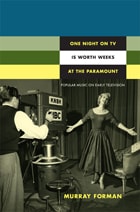
One Night on TV Is Worth Weeks at the Paramount
Popular Music on Early TelevisionMurray Forman
Duke University Press, 2012
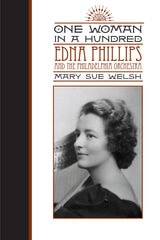
One Woman in a Hundred
Edna Phillips and the Philadelphia OrchestraMary Sue Welsh
University of Illinois Press, 2013
Open Access Musicology
Volume OneLouis Epstein
Lever Press, 2020
In the fall of 2015, a collection of faculty at liberal arts colleges began a conversation about the challenges we faced as instructors: Why were there so few course materials accessible to undergraduates and lay readers that reflected current scholarly debate? How can we convey the relevance of studying music history to current and future generations of students? And how might we represent and reflect the myriad, often conflicting perspectives, positions, and identities that make up both music’s history and the writers of history?
Here we offer one response to those questions. Open Access Musicology is a collection of essays, written in an accessible style and with a focus on modes of inquiry rather than content coverage. Our authors draw from their experience as scholars but also as teachers. They have been asked to describe why they became musicologists in the first place and how their individual paths led to the topics they explore and the questions they pose. Like most scholarly literature, the essays have all been reviewed by experts in the field. Unlike all scholarly literature, the essays have also been reviewed by students at a variety of institutions for clarity and relevance.
These essays are intended for undergraduates, graduate students, and interested readers without any particular expertise. They can be incorporated into courses on a range of topics as standalone readings or used to supplement textbooks. The topics introduce and explore a variety of subjects, practices, and methods but, above all, seek to stimulate classroom discussion on music history’s relevance to performers, listeners, and citizens.
Open Access Musicology
Volume ThreeEdited by Daniel Barolsky and Trudi Wright
Lever Press, 2025
These essays are intended for undergraduates, graduate students, and interested readers without any particular expertise. The topics introduce and explore a variety of subjects, practices, and methods but, above all, seek to stimulate classroom discussion on music history’s relevance to performers, listeners, and citizens. Open Access Musicology will never pretend to present complete histories, cover all elements of a subject, or satisfy the agenda of every reader. Rather, each essay provides an opening to further contemplation and study.
The third volume of Open Access Musicology presents provocative case studies and analyses through which readers can choose their own path while also putting these essays in conversations from those in previous volumes of OAM. This new volume challenges us to ask difficult questions about the place and function of music in our societies, on our stages, and in our institutions. The authors demonstrate ways in which the past can be re-imagined as well as the ways legacies of the past are inscribed in present-day practices, structures, histories, and beliefs. We invite readers to follow the thematic links between essays, pursue notes and other online resources, or simply repurpose the essay’s questions into new and exciting forms of research and creativity.
Open Access Musicology
Volume Twoedited by Daniel Barolsky and Louis Epstein
Lever Press, 2023
In service of our student- and access-centered mission, Open Access Musicology is a free collection of essays, written in an engaging style and with a focus on modes of inquiry rather than coverage of content. Our authors draw from their experience as scholars but also as teachers. They not only make arguments, but also describe why they became musicologists in the first place and explain how their individual paths led to the topics they explore. Like most scholarly literature, the essays have all been reviewed by experts in the field. Unlike most scholarly literature, the essays have also been reviewed by students at a variety of institutions for clarity and relevance.
These essays are intended for undergraduates, graduate students, and interested readers without any particular expertise. They can be incorporated into courses on a range of topics as standalone readings, used to supplement textbooks, or read with an eye to new scholarly insights. The topics introduce and explore a variety of subjects, practices, and methods but, above all, seek to stimulate classroom discussion on music history’s relevance to performers, listeners, and citizens. Open Access Musicology will never pretend to present complete histories, cover all elements of a subject, or satisfy the agenda of every reader. Rather, each essay provides an opening to further contemplation and study. We invite readers to follow the thematic links between essays, pursue notes or other online resources provided by authors, or simply repurpose the essay’s questions into new and exciting forms of research and creativity.
Volume 2 of OAM expands the disciplinary, topical, and geographical ranges of our endeavor, with essays that rely on ethnographic and music theoretical methods as well as historical ones. The essays in this volume touch on music from Europe, South America, and Asia, spanning the 16th century to the present. Throughout, the contributing authors situate music in political, religious, racial, economic, and other cultural and disciplinary contexts. This volume therefore expands what scholars generally mean when they refer to “musicology” and “music,” always with an eye toward relevance and accessibility.
Open the Door
The Life and Music of Betty CarterWilliam R. Bauer
University of Michigan Press, 2003
This book looks at Betty Carter's contribution to the music world and delves behind the scenes to show Carter's growth as a businesswoman who took charge of her career.
Drawing upon revealing interviews with Carter, the author shows how ever-changing shifts in the music industry affected the singer's life and influenced her music. Bauer shows through his analysis of her musical examples how Carter absorbed various musical influences, from Sarah Vaughan and Billie Holiday to Miles Davis, and made them her own. From her apprenticeship with Gladys Hampton, Carter grew to become a shrewd dealer who learned to do her own contracting, A&R, and marketing and distribution. By chronicling one of jazz's great singers and composers, the book sheds light on how early jazz musicians got their work to the public and how this process has changed during the past fifty years.
Opera Observed
Views of a Florentine Impresario in the Early Eighteenth CenturyWilliam C. Holmes
University of Chicago Press, 1993
A member of an illustrious Florentine family, Albizzi (1664-1745) served as one of the principal impresarios of the Pergola, Florence's earliest and greatest opera theater. He also carried on an active correspondence with impresarios in other cities, freely giving his advice on various economic and artistic concerns. Holmes uses the Albizzi family archives—the most abundant and varied material yet available about an eighteenth-century impresario and his theater—to deepen our knowledge of an extraordinary but little understood period in Italian opera.
This book will appeal to anyone curious about operatic history.
Opera Production and Its Resources
Edited by Lorenzo Bianconi and Giorgio Pestelli
University of Chicago Press, 1998
Opera Production and Its Resources traces the social, economic, and artistic history of the production of opera from its origins around 1600 to contemporary stagings. From the very beginning, opera has been a chronically deficit-producing enterprise. Yet it maintained unchallenged preeminence in the culture of all Italians for centuries. The first half explores the central role of theater impresarios in putting on these complex productions and in increasing the output of librettos and scores. The second half considers the roles of the three key figures in the creation of any opera: the librettist, the composer, and the singer.
Opera Scenes for Class and Stage
Mary Elaine Wallace and Robert Wallace
Southern Illinois University Press, 1979
Musically sound and fully annotated, this new reference work provides ready access to over 700 excerpts from 100 operas, by voice categories, and thus provides information on a wide variety of matters of interest to directors, teachers, and singers. A table of voice categories, coded excerpts (including length and reference to accessible scores), character descriptions (including estimations of degrees of difficulty of the music), summaries of the action of each excerpt, and indexes to titles, composers, and well-known arias and ensembles make this book an indispensable tool.
Opera and Sovereignty
Transforming Myths in Eighteenth-Century ItalyMartha Feldman
University of Chicago Press, 2007
Taking an anthropological approach to European music that’s as bold as it is unusual, Martha Feldman traces Italian opera’s shift from a mythical assertion of sovereignty, with its festive forms and rituals, to a dramatic vehicle that increasingly questioned absolute ideals. She situates these transformations against the backdrop of eighteenth-century Italian culture to show how opera seria both reflected and affected the struggles of rulers to maintain sovereignty in the face of a growing public sphere. In so doing, Feldman explains why the form had such great international success and how audience experiences of the period differed from ours today. Ambitiously interdisciplinary, Opera and Sovereignty will appeal not only to scholars of music and anthropology, but also to those interested in theater, dance, and the history of the Enlightenment.

Opera and Vivaldi
Edited by Michael Collins and Elise K. Kirk
University of Texas Press, 1984
From the New York Times review of the Dallas Opera's performance of Orlando furioso and the international symposium on Baroque opera: ". . . it was a serious, thoughtful, consistent and imaginative realization of a beautiful, long-neglected work, one that fully deserved all the loving attention it received. As such, the production and its attendant symposium made a positive contribution to the cause of Baroque opera . . . . "
Baroque opera experienced a revival in the late twentieth century. Its popularity, however, has given rise to a number of perplexing and exciting questions regarding literary sources, librettos, theater design, set design, stage movement, and costumes—even the editing of the operas.
In 1980, the Dallas Opera produced the American premier of Vivaldi's Orlando furioso, which met with much acclaim. Concurrently an international symposium on the subject of Baroque opera was held at Southern Methodist University. Authorities from around the world met to discuss the operatic works of Vivaldi, Handel, and other Baroque composers as well as the characteristics of the genre. Michael Collins and Elise Kirk, deputy chair and chair of the symposium, edited the papers to produce this groundbreaking study, which will be of great interest to music scholars and opera lovers throughout the world.
Contributors to Opera and Vivaldi include Shirley Wynne, John Walter Hill, Andrew Porter, Eleanor Selfridge-Field, Howard Mayer Brown, William Holmes, Ellen Rosand, and the editors.
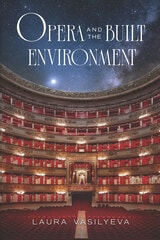
Opera and the Built Environment
Laura Vasilyeva
University of Chicago Press, 2025
In Opera and the Built Environment, music scholar Laura Vasilyeva considers the remarkable mass construction of opera houses around the world since the 1800s and the no-less-remarkable bids to standardize the architectural features of their interiors across this vast theatrical infrastructure. Now known as the teatro all’italiana, this style of architecture—made most famous by Milan’s Teatro alla Scala—is characterized by auditoria with tiers of stacked boxes and a dominant red hue.
With attention to the sensuous dimensions of their auditoria, from their surfaces to their atmospheres to their acoustics and thresholds, Vasilyeva reveals the calculated reasons these theaters took on the form they did. The result is a book that reveals unknown associations between the Italian opera house and matters of environmental destruction, empire, and belonging, showing us new and unexpected patterns in how opera connects to the world we know.
Opera and the Political Imaginary in Old Regime France
Olivia Bloechl
University of Chicago Press, 2018
In Opera and the Political Imaginary in Old Regime France, however, Olivia Bloechl reveals another layer of French opera’s political theater. The make-believe worlds on stage, she shows, involved not just fantasies of sovereign rule but also aspects of government. Plot conflicts over public conduct, morality, security, and law thus appear side-by-side with tableaus hailing glorious majesty. What’s more, opera’s creators dispersed sovereign-like dignity and powers well beyond the genre’s larger-than-life rulers and gods, to its lovers, magicians, and artists. This speaks to the genre’s distinctive combination of a theological political vocabulary with a concern for mundane human capacities, which is explored here for the first time.
By looking at the political relations among opera characters and choruses in recurring scenes of mourning, confession, punishment, and pardoning, we can glimpse a collective political experience underlying, and sometimes working against, ancienrégime absolutism. Through this lens, French opera of the period emerges as a deeply conservative, yet also more politically nuanced, genre than previously thought.
Opera for Everyone
The Industry's Experiments with American Opera in the Digital AgeMegan Steigerwald Ille
University of Michigan Press, 2024
Opera in Theory and Practice, Image and Myth
Edited by Lorenzo Bianconi and Giorgio Pestelli
University of Chicago Press, 2003
This sixth volume in the series centers on the sociological and critical aspects of opera in Italy, considering the art in the context of an Italian literary and cultural canon rarely revealed in English and American studies. In its six chapters, contributors survey critics' changing attitudes toward opera over several centuries, trace the evolution of formal conventions among librettists, explore the historical relationships between opera and Italian literature, and examine opera's place in Italian popular and national culture. In perhaps the volume's most striking contribution, German scholar Carl Dahlouse offers his most important statement on the dramaturgy of opera.
Opera on Stage
Edited by Lorenzo Bianconi and Giorgio Pestelli
University of Chicago Press, 2002
Opera on Stage, the second book of this multi-volume work to be published in English-in an expanded and updated version-focuses on staging and viewing Italian opera, from the court spectacles of the late sixteenth century to modern-day commercial productions. Mercedes Viale Ferrero describes the history of theater and stage design, detailing the evolution of the art well into the twentieth century. Gerardo Guccini does the same for stage and opera direction and the development of the director's role as an autonomous creative force. Kathleen Kuzmick Hansell discusses the interrelationships between theatrical ballet and Italian opera, from the age of Venetian opera to the early twentieth century. The visual emphasis of all three contributions is supplemented by over one hundred illustrations, and because much of this material-on the more "spectacular" visual aspects of Italian opera-has never before appeared in English, Opera on Stage will be welcomed by scholars and opera enthusiasts alike.
Opera on the Road
Traveling Opera Troupes in the United States, 1825-60Katherine K. Preston
University of Illinois Press, 1993
Opera, Sex and Other Vital Matters
Paul Robinson
University of Chicago Press, 2002
The essays on opera gathered here explore how masterpieces like Fidelio and The Magic Flute reflect the intellectual currents of their day. Be it the work of Verdi or Mozart, Wagner or Strauss, Robinson compels us to search for meaning not just in the lyrics of opera but also in the music. In melody, not libretto, we are more likely to discern key historical complexities and appreciate the way opera transcends language and time. The essays on sexuality, meanwhile, are ruminative, funny, and even moving. At one moment, Robinson measures whether homosexuality is the result of destiny or free choice. In another, he shares a touching exchange of letters with a gay student in the process of coming out. The final essays that encompass "other vital matters" find Robinson at his most incisive. Whether defending Freud as the most influential thinker of the twentieth century, attacking the dreaded use of semicolons, reflecting on his own mortality, or even meditating on the nature of cats, Sex, Opera, and Other Vital Matters is an eclectic work that will appeal to any reader interested in the continuing relevance of ideas to life.
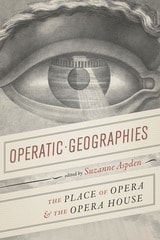
Operatic Geographies
The Place of Opera and the Opera HouseEdited by Suzanne Aspden
University of Chicago Press, 2019
Operatic Geographies invites us to reconsider the opera house’s spatial production. Looking at opera through the lens of cultural geography, this anthology rethinks the opera house’s landscape, not as a static backdrop, but as an expression of territoriality. The essays in this anthology consider moments across the history of the genre, and across a range of geographical contexts—from the urban to the suburban to the rural, and from the “Old” world to the “New.” One of the book’s most novel approaches is to consider interactions between opera and its environments—that is, both in the domain of the traditional opera house and in less visible, more peripheral spaces, from girls’ schools in late seventeenth-century England, to the temporary arrangements of touring operatic troupes in nineteenth-century Calcutta, to rural, open-air theaters in early twentieth-century France. The essays throughout Operatic Geographies powerfully illustrate how opera’s spatial production informs the historical development of its social, cultural, and political functions.
Operatic Infrastructures
Materiality and Meaning in 1890s London, Paris, and New YorkFlora Willson
University of Chicago Press, 2026
An exploration of the fundamental relationship between opera and urban modernity in three iconic cities: London, Paris, and New York.
At the end of the nineteenth century, London, Paris, and New York were quintessential modern metropolises and vital centers for opera. In Operatic Infrastructures, Flora Willson examines opera’s roots in the material worlds of these cities. Reaching beyond histories of opera as spectacle, she investigates the physical underpinnings of opera at the century’s end as an inter-urban, multimedia network.
Operatic Infrastructures considers emergent technologies such as the telephone and the subway, but it also retrieves the hidden, forgotten, and otherwise effaced traces of systems such as storage facilities and colonial trade routes. It takes seriously the mundane aspects of materiality, from the blandest clichés of newspaper columns to the fine print of insurance certificates. In doing so, the book reveals just how far these interfaces with modern urban life reached into opera’s own systems of meaning-making and performance in the 1890s—making it impossible to demarcate neatly between “opera” and its “context.” Without such operatic infrastructures, Willson shows, there would be no opera at all.
Operatic Lives
Alberto Savinio
Northwestern University Press, 1988
Opera—Dead or Alive
Production, Performance and Enjoyment of Musical TheatreRonald E. Mitchell
University of Wisconsin Press, 1972

Orpheus in the Underworld
Essays on MusicTheodor W. Adorno
Seagull Books, 2024
Theodor W. Adorno is recognized as one of the twentieth century’s most prominent social theorists. Though best known for his association with the Frankfurt School of critical theory, Adorno began his career as a composer and successful music critic.
Comprehensive and illuminating, Orpheus in the Underworld centers on Adorno’s concrete and immediate engagement with musical compositions and their interpretation in the concert hall and elsewhere. Here, Adorno registers his initial encounters with the compositions of the Second Viennese School, when he had yet to integrate them into a broad aesthetics of music. Complementarily essays on Bela Bartók, Jean Sibelius, and Kurt Weill afford insight into his understanding of composers who did not fit neatly into the dialectical schema propounded in the Philosophy of New Music. Additionally, essays on recording and broadcasting show Adorno engaging with these media in a spirit that is no less productive than polemical and focused as sharply on their potentialities as on their shortcomings.
Orpheus in the Underworld offers a captivating exploration of Adorno’s musical compositions, shedding new light on his understanding of influential composers and his critical perspectives on recording and broadcasting.
Orphic Bend
Music and Innovative PoeticsRobert L. Zamsky
University of Alabama Press, 2021
WINNER OF THE ELIZABETH AGEE PRIZE IN AMERICAN LITERATURE
Exploring how music reshapes the possibilities of poetry.
Orphic Bend: Music and Innovative Poetics explores the impact of music on recent pioneering literary practices in the United States. Adopting the myth of Orpheus as its framework, Robert L. Zamsky argues that works by Charles Bernstein, Robert Creeley, John Taggart, Tracie Morris, and Nathaniel Mackey restage ancient debates over the relationship between poetry and music even as they develop work that often sharply diverges from traditional literary forms. Opening each chapter with a consideration of the orphic roots of lyric, Zamsky integrates contemporary debates over the prospects and limitations of humanism, the meaningfulness of gesture and performance, and the nature of knowledge with the poetics of the writers under consideration, grounding his analysis in close readings of their work.
The myth of Orpheus is used as a lens throughout the book, its different facets illuminating sometimes dramatically different aspects of the shared framework of poetry and music. In the case of Bernstein, for instance, Zamsky highlights Ezra Pound’s meditations on the relationship between poetry and music (the ground upon which Pound seeks to recapture the lost possibilities of the Renaissance) and Bernstein’s incisive critique of Pound. For her part, Morris emphasizes the performative power of spoken language, foregrounding the fact that all spoken language bears cultural, communal, and personal marks of the speaker, improving an ensemble self even within the most elemental features of language. Meanwhile, in Mackey’s work, the orphic voice of the poet powerfully reaches toward an order of knowledge in which poetry and music are nearly indecipherable from one another. In this sense, music and the musicality of poetic language are the gateways for Mackey’s Gnosticism, the mechanisms of initiation into a realm, not of secrets to be learned, but of visionary knowing that continuously unfolds.
The text explores a range of musical influences on the writers under consideration, from opera to different iterations of jazz, and underscores the variety of ways in which music informs their work. Many of these writers effectively present a theory of music in their invocations of it as an inspiration for, or as an analog to, poetic practice. Zamsky’s focus on poetry and music echoes important interdisciplinary studies on literary modernism, a period for which the importance of music to literary practice is well established and extends that discussion to the contemporary context. In doing so, Orphic Bend provides an important opportunity to consider both the specific legacy of modernism, and to situate contemporary writers in broader historical contexts.
Otello, ossia Il Moro di Venezia
Dramma per musica in Three Acts by Francesco Berio di SalsaGioachino Rossini
University of Chicago Press, 1994
The first of eight serious operas newly-written for the Teatro San Carlo of Naples, Otello reveals Rossini as a composer deeply concerned with both character development and large-scale musical forms. Desdemona's "Willow Song" is a fine example: here not only is variation technique used for dramatic ends, but the song itself forms part of a larger scheme that encompasses the entire third act as a single, unified piece.
Far more than a mere forerunner to Verdi, Rossini's Otello deserves to be known for its own innovative qualities.
Ottaviano Petrucci, Motetti de Passione, de Cruce, de Sacramento, de Beata Virgine et huiusmodi B
Venice, 1503Edited by Warren Drake
University of Chicago Press, 2002
As its lengthy title suggests, Motetti B consists of a wide range of devotional motets on the Passion, the Veneration of the Cross, the Eucharist, and the Virgin Mary. Many display a new style with a more harmonic orientation and also have close connections to lauda, devotional songs in Latin and Italian. Indeed, as Warren Drake points out, the subject matter of these motets displays close ties with the widespread devotional trends of the late fifteenth century, and Motetti B might even be considered a musical book of hours. In addition to a general introduction and the motets themselves, this edition includes detailed concordances and critical commentary on the sources and problematic aspects of the works.
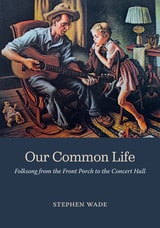
Our Common Life
Folksong from the Front Porch to the Concert HallStephen Wade
University of Illinois Press, 2026
Stephen Wade recounts creators and conservators like Doc Hopkins, many of them born in the closing years of the nineteenth century and the first decades of the twentieth. The figures include Sid Harkreader, Kirk McGee, Ola Belle Reed, Jewel Fagan Haynes, Cordell and Olean Kemp, Bill Monroe, Helen Marie Rowe, Virgil and Mabel Anderson, Joe and Odell Thompson, John Jackson, Huddie Ledbetter, Uncle Dave Macon, Dorris Macon, Raeburn Flerlage, David “Honeyboy” Edwards, Jim Schwall, Archie Green, Lloyd Lewis, Thaddeus Willingham, Jack Conroy, and Fleming Brown. As Will Keys, another of the musicians featured here, once told the author about his way of playing, it’s “AWYC, Any Way You Can.” These individuals and their stories demonstrate how folklore offers a way of understanding the world.
Thoughtfully written, filled with original research, and abundantly illustrated with both color and black and white photography, Our Common Life illuminates the truth that creative freedom within informal tradition, fundamental to the artists and their processes, speaks to a resourcefulness inscribed in the nation’s founding charter and expressed in its common life.
Our Musicals, Ourselves
A Social History of the American Musical TheatreJohn Bush Jones
Brandeis University Press, 2004
Our Own Sweet Sounds
A Celebration of Popular Music in ArkansasRobert Cochran
University of Arkansas Press, 2005
Out of Sync
Ventriloquism in Popular Media from Vinyl to TikTokSarah Rebecca Kessler
Duke University Press, 2026
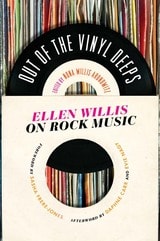
Out of the Vinyl Deeps
Ellen Willis on Rock MusicNona Willis Aronowitz
University of Minnesota Press, 2010
Because Willis stopped writing about music in the early 1980s—when, she felt, rock ’n’ roll had lost its political edge—her significant contribution to the history and reception of rock music has been overshadowed by contemporary music critics like Robert Christgau, Lester Bangs, and Dave Marsh. Out of the Vinyl Deeps collects for the first time Willis’s Rock, Etc. columns and her other writings about popular music from this period (includingliner notes for works by Lou Reed and Janis Joplin) and reasserts her rightful place in rock music criticism.
More than simply setting the record straight, Out of the Vinyl Deeps reintroduces Willis’s singular approach and style—her use of music to comment on broader social and political issues, critical acuity, vivid prose, against-the-grain opinions, and distinctly female (and feminist) perspective—to a new generation of readers. Featuring essays by the New Yorker’s current popular music critic, Sasha Frere-Jones, and cultural critics Daphne Carr and Evie Nagy, this volume also provides a lively and still relevant account of rock music during, arguably, its most innovative period.
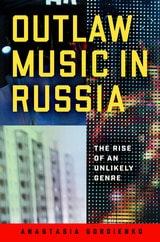
Outlaw Music in Russia
The Rise of an Unlikely GenreAnastasia Gordienko
University of Wisconsin Press, 2023
The Russian shanson can be heard across the country today, on radio and television shows, at mass events like political rallies, and even at the Kremlin. Yet despite its ubiquity, it has attracted almost no scholarly attention. Anastasia Gordienko provides the first full history of the shanson, from its tenuous ties to early modern criminals’ and robbers’ folk songs, through its immediate generic predecessors in the Soviet Union, to its current incarnation as the soundtrack for daily life in Russia. It is difficult to firmly define the shanson or its family of song genres, but they all have some connection, whether explicit or implicit, to the criminal underworld or to groups or activities otherwise considered subversive. Traditionally produced by and popular among criminals and other marginalized groups, and often marked by characters and themes valorizing illegal activities, the songs have undergone censorship since the early nineteenth century. Technically legal only since the collapse of the Soviet Union, the shanson is today not only broadly popular but also legitimized by Vladimir Putin’s open endorsement of the genre.
With careful research and incisive analysis, Gordienko deftly details the shanson’s history, development, and social meanings. Attempts by imperial rulers, and later by Soviet leaders, to repress the songs and the lifestyles they romanticized not only did little to discourage their popularity but occasionally helped the genre flourish. Criminals and liberal intelligentsia mingled in the Gulag system, for instance, and this contact introduced censored songs to an educated, disaffected populace that inscribed its own interpretations and became a major point of wider dissemination after the Gulag camps were closed. Gordienko also investigates the shanson as it exists in popular culture today: not divorced from its criminal undertones (or overtones) but celebrated for them. She argues that the shanson expresses fundamental themes of Russian culture, allowing for the articulation of anxieties, hopes, and dissatisfactions that are discouraged or explicitly forbidden otherwise.
Outlaw Style
PoemsR. T. Smith
University of Arkansas Press, 2007
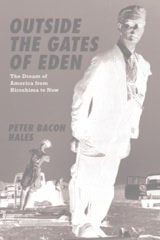
Outside the Gates of Eden
The Dream of America from Hiroshima to NowPeter Bacon Hales
University of Chicago Press, 2014
Born under the shadow of the bomb, with little security but the cold comfort of duck-and-cover, the postwar generations lived through—and led—some of the most momentous changes in all of American history. Hales explores those decades through perceptive accounts of a succession of resonant moments, spaces, and artifacts of everyday life—drawing unexpected connections and tracing the intertwined undercurrents of promise and peril. From sharp analyses of newsreels of the first atomic bomb tests and the invention of a new ideal American life in Levittown; from the music emerging from the Brill Building and the Beach Boys, and a brilliant account of Bob Dylan’s transformations; from the painful failures of communes and the breathtaking utopian potential of the early days of the digital age, Hales reveals a nation, and a dream, in transition, as a new generation began to make its mark on the world it was inheriting.
Full of richly drawn set-pieces and countless stories of unforgettable moments, Outside the Gates of Eden is the most comprehensive account yet of the baby boomers, their parents, and their children, as seen through the places they built, the music and movies and shows they loved, and the battles they fought to define their nation, their culture, and their place in what remains a fragile and dangerous world.
Over Here, Over There
Transatlantic Conversations on the Music of World War IEdited by William Brooks, Christina Bashford, and Gayle Magee
University of Illinois Press, 2019

Oxford, Bodleian Library, MS. Canon. Misc. 213
Edited by David Fallows
University of Chicago Press, 1995
Copied probably in Venice around 1430, the Oxford manuscript contains the most comprehensive surviving collection of secular songs of the late fourteenth and early fifteenth centuries. Of the 326 pieces, 216 are not found in any other source. Including works by Guillaume Dufay, Binchois, and nearly all other leading composers of their generation, it is central to an understanding of fifteenth-century song traditions. Because of the copyist's clear and distinctive hand, it is also significant for studies of late medieval musical notation. David Fallows's introduction includes a history of the manuscript, analysis of its preparation, and survey of its choice of repertory, as well as a full inventory of the music and alphabetical indexes by title and composer. The original-size facsimile includes beta-radiographs of all watermarks, as well as ultraviolet photos that show the copyist's changes and revisions.
This volume is the first edition in a new series called Late Medieval and Early Renaissance Music in Facsimile edited by Margaret Bent and John Nádas and published by the University of Chicago Press. This series will include high-quality reproductions of some of the most important and frequently studied European music manuscripts of the late thirteenth through early fifteenth centuries. Each beautifully produced facsimile edition will include a detailed critical introduction and a complete inventory by an acknowledged expert in the field.
Oye Como Va!
Hybridity and Identity in Latino Popular MusicDeborah Pacini Hernandez
Temple University Press, 2009
Listen Up! When the New York-born Tito Puente composed "Oye Como Va!" in the 1960s, his popular song was called "Latin" even though it was a fusion of Afro-Cuban and New York Latino musical influences. A decade later, Carlos Santana, a Mexican immigrant, blended Puente’s tune with rock and roll, which brought it to the attention of national audiences. Like Puente and Santana, Latino/a musicians have always blended musics from their homelands with other sounds in our multicultural society, challenging ideas of what "Latin" music is or ought to be. Waves of immigrants further complicate the picture as they continue to bring their distinctive musical styles to the U.S.—from merengue and bachata to cumbia and reggaeton.
In Oye Como Va!, Deborah Pacini Hernandez traces the trajectories of various U.S. Latino musical forms in a globalizing world, examining how the blending of Latin music reflects Latino/a American lives connecting across nations. Exploring the simultaneously powerful, vexing, and stimulating relationship between hybridity, music, and identity, Oye Como Va! asserts that this potent combination is a signature of the U.S. Latino/a experience.