Results by title
208 books match the query 'Nation' and 4 start with o
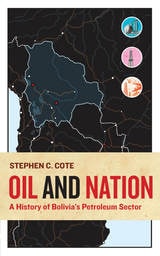
Oil and Nation
A History of Bolivia's Petroleum SectorStephen C. Cote
West Virginia University Press, 2016
Oil and Nation places petroleum at the center of Bolivia’s contentious twentieth-century history. Bolivia’s oil, Cote argues, instigated the largest war in Latin America in the 1900s, provoked the first nationalization of a major foreign company by a Latin American state, and shaped both the course and the consequences of Bolivia’s transformative National Revolution of 1952. Oil and natural gas continue to steer the country under the government of Evo Morales, who renationalized hydrocarbons in 2006 and has used revenues from the sector to reduce poverty and increase infrastructure development in South America’s poorest country.
The book advances chronologically from Bolivia’s earliest petroleum pioneers in the nineteenth century until the present, inserting oil into historical debates about Bolivian ethnic, racial, and environmental issues, and within development strategies by different administrations. While Bolivia is best known for its tin mining, Oil and Nation makes the case that nationalist reformers viewed hydrocarbons and the state oil company as a way to modernize the country away from the tin monoculture and its powerful backers and toward an oil-powered future.
The book advances chronologically from Bolivia’s earliest petroleum pioneers in the nineteenth century until the present, inserting oil into historical debates about Bolivian ethnic, racial, and environmental issues, and within development strategies by different administrations. While Bolivia is best known for its tin mining, Oil and Nation makes the case that nationalist reformers viewed hydrocarbons and the state oil company as a way to modernize the country away from the tin monoculture and its powerful backers and toward an oil-powered future.
[more]

One Third of a Nation
Lorena Hickok Reports on the Great DepressionLorena Hickok
University of Illinois Press, 1981
Between 1933 and 1935, Lorena Hickok traveled across thirty-two states as a "confidential investigator" for Harry Hopkins, head of FDR's Federal Emergency Relief Administration. Her assignment was to gather information about the day-to-day toll the Depression was exacting on individual citizens. One Third of a Nation is her record, underscored by the eloquent photographs of Dorothea Lange, Walker Evans, and others, of the shocking plight of millions of unemployed and dispossessed Americans.
[more]
Our Caribbean Kin
Race and Nation in the Neoliberal AntillesReyes-Santos, Alaí
Rutgers University Press, 2015
Beset by the forces of European colonialism, US imperialism, and neoliberalism, the people of the Antilles have had good reasons to band together politically and economically, yet not all Dominicans, Haitians, and Puerto Ricans have heeded the calls for collective action. So what has determined whether Antillean solidarity movements fail or succeed? In this comprehensive new study, Alaí Reyes-Santos argues that the crucial factor has been the extent to which Dominicans, Haitians, and Puerto Ricans imagine each other as kin.
Our Caribbean Kin considers three key moments in the region’s history: the nineteenth century, when the antillanismo movement sought to throw off the yoke of colonial occupation; the 1930s, at the height of the region’s struggles with US imperialism; and the past thirty years, as neoliberal economic and social policies have encroached upon the islands. At each moment, the book demonstrates, specific tropes of brotherhood, marriage, and lineage have been mobilized to construct political kinship among Antilleans, while racist and xenophobic discourses have made it difficult for them to imagine themselves as part of one big family.
Recognizing the wide array of contexts in which Antilleans learn to affirm or deny kinship, Reyes-Santos draws from a vast archive of media, including everything from canonical novels to political tracts, historical newspapers to online forums, sociological texts to local jokes. Along the way, she uncovers the conflicts, secrets, and internal hierarchies that characterize kin relations among Antilleans, but she also discovers how they have used notions of kinship to create cohesion across differences.
[more]
Our Own Way in This Part of the World
Biography of an African Community, Culture, and NationKwasi Konadu
Duke University Press, 2019
Kofi Dᴐnkᴐ was a blacksmith and farmer, as well as an important healer, intellectual, spiritual leader, settler of disputes, and custodian of shared values for his Ghanaian community. In Our Own Way in This Part of the World Kwasi Konadu centers Dᴐnkᴐ's life story and experiences in a communography of Dᴐnkᴐ's community and nation from the late nineteenth century through the end of the twentieth, which were shaped by historical forces from colonial Ghana's cocoa boom to decolonization and political and religious parochialism. Although Dᴐnkᴐ touched the lives of thousands of citizens and patients, neither he nor they appear in national or international archives covering the region. Yet his memory persists in his intellectual and healing legacy, and the story of his community offers a non-national, decolonized example of social organization structured around spiritual forces that serves as a powerful reminder of the importance for scholars to take their cues from the lived experiences and ideas of the people they study.
[more]