80 books match the query 'Ontology' and 4 start with o
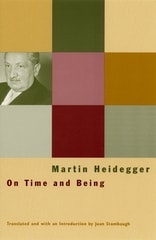
cover of On Time and Being

On Time and Being

Martin Heidegger

University of Chicago Press, 2002

On Time and Being charts the so-called "turn" in Martin Heidegger's philosophy away from his earlier metaphysics in Being and Time to his later thoughts after "the end of philosophy." The title lecture, "Time and Being," shows how Heidegger reconceived both "Being" and "time," introducing the new concept of "the event of Appropriation" to help give his metaphysical ideas nonmetaphysical meanings. On Time and Being also contains a summary of six seminar sessions that Heidegger conducted on "Time and Being," a lecture called "The End of Philosophy and the Task of Thinking," and an autobiographical sketch of Heidegger's intellectual history in "My Way of Phenomenology."

"This collection may well vie with Vom Wesen des Grundes and Identität and Differenz as definitive statements of Heidegger's ontology."—Library Journal

"The title of the English translation is that of the lead essay, the highly celebrated lecture which Heidegger gave in 1962 and which bears the same title as the never published 'third division' of the 'first half' of Being and Time. This lecture is perhaps the most significant document to be added to the Heideggerian corpus since the Letter of Humanism. . . . Stambaugh's translation is superb."—Stanley O. Hoerr and staff, The Review of Metaphysics

[more]
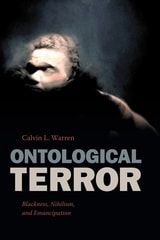
cover of Ontological Terror: Blackness, Nihilism, and Emancipation

Ontological Terror

Blackness, Nihilism, and Emancipation

Calvin L. Warren

Duke University Press, 2018

In Ontological Terror Calvin L. Warren intervenes in Afro-pessimism, Heideggerian metaphysics, and black humanist philosophy by positing that the "Negro question" is intimately imbricated with questions of Being. Warren uses the figure of the antebellum free black as a philosophical paradigm for thinking through the tensions between blackness and Being. He illustrates how blacks embody a metaphysical nothing. This nothingness serves as a destabilizing presence and force as well as that which whiteness defines itself against. Thus, the function of blackness as giving form to nothing presents a terrifying problem for whites: they need blacks to affirm their existence, even as they despise the nothingness they represent. By pointing out how all humanism is based on investing blackness with nonbeing—a logic which reproduces antiblack violence and precludes any realization of equality, justice, and recognition for blacks—Warren urges the removal of the human from its metaphysical pedestal and the exploration of ways of existing that are not predicated on a grounding in being.
[more]
cover of Ontology Of Work Of Art: Musical Work, Picture, Arch., Film

Ontology Of Work Of Art

Musical Work, Picture, Arch., Film

Roman Ingarden

Ohio University Press, 1989

In these studies Roman Ingarden investigates the nature and mode of being of four kinds of art works: the musical work, the picture, the architectural work, and the film. He establishes that the work of art is a purely intentional object but considers also its connections to the real world. By analyzing a work of art in its “constitutive heterogeneous strata,” Ingarden demonstrates that a work of art will reveal, when examined in the appropriate way, its own inherent structure. Further, he shows that in consequence of the art work’s structure, we must distinguish between the work itself and the concretizations of it by the listener or viewer.

Ingarden elaborates upon the conception of concretization which he present in The Literary Work of Art and applies it to music and visual art. He also employs the concept of aspect to clarify the ontic structure of these art works and the distinction between the concretization of the work and the work itself. The distinction between the work’s concretization — effectuated in the mental experiences of the listener or viewer — and the work itself serves to help Ingarden confirm and account for the work’s intersubjective identity.

The problem of aesthetic value, Ingarden maintains, can be fruitfully treated only after the ontic structure of art work has been clarified. His primary concern in Ontology of the Work of Art is to ascertain and describe that structure and the mode of existence of works of art. In addition, he offers several discussions of aesthetic value, showing in the m the connections between questions of aesthetic value and the structure of the work of art.
[more]
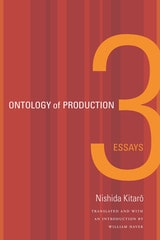
cover of Ontology of Production: Three Essays

Ontology of Production

Three Essays

Nishida KitarM

Duke University Press, 2012

Ontology of Production presents three essays by the influential Japanese philosopher Nishida Kitarō (1870–1945), translated for the first time into English by William Haver. While previous translations of his writings have framed Nishida within Asian or Oriental philosophical traditions, Haver's introduction and approach to the texts rightly situate the work within Nishida's own commitment to Western philosophy. In particular, Haver focuses on Nishida's sustained and rigorous engagement with Marx's conception of production.

Agreeing with Marx that ontology is production and production is ontology, Nishida in these three essays—"Expressive Activity" (1925), "The Standpoint of Active Intuition" (1935), and "Human Being" (1938)—addresses sense and reason, language and thought, intuition and appropriation, ultimately arguing that in this concept of production, ideality and materiality are neither mutually exclusive nor oppositional but, rather, coimmanent. Nishida's forceful articulation of the radical nature of Marx's theory of production is, Haver contends, particularly timely in today's speculation-driven global economy. Nishida's reading of Marx, which points to the inseparability of immaterial intellectual labor and material manual labor, provokes a reconsideration of Marxism's utility for making sense of—and resisting—the logic of contemporary capitalism.

[more]