Results by title
65 books match the query 'Oral tradition' and 5 start with o
Old China Through the Eyes of a Storyteller
Julie Moss Herrera
Parkhurst Brothers, Inc., 2012
“Having traveled on the same People to People Ambassador journey to China with Julie, I have seen Julie's anthology from inception to fruition. It is a masterful, engaging, informative and scholarly addition to our understanding and appreciation of Chinese culture, particularly storytelling and folk traditions, from ancient days to today. Practicing storytellers will especially appreciate her tips for telling and context clues at the end of each story.”
--Judith Heineman, storyteller, producer and Illinois Humanities Road Scholar

Oral Poetry
An IntroductionPaul Zumthor
University of Minnesota Press, 1990
Oral Tradition and the Internet
Pathways of the MindJohn Miles Foley
University of Illinois Press, 2012
challenging the default medium of the linear book and page and all that they entail, Oral Tradition and the Internet shows readers that there are large, complex, wholly viable, alternative
worlds of media-technology out there--if only they are willing to explore, to think outside the usual, culturally constructed categories. This "brick-and-mortar" book exists as an extension of
The Pathways Project (http://pathwaysproject.org), an open-access online suite of chapter-nodes, linked websites, and multimedia all dedicated to exploring and demonstrating the
dynamic relationship between oral tradition and Internet technology
Oral Tradition as History
Jan M. Vansina
University of Wisconsin Press, 1985
Jan Vansina’s 1961 book, Oral Tradition, was hailed internationally as a pioneering work in the field of ethno-history. Originally published in French, it was translated into English, Spanish, Italian, Arabic, and Hungarian. Reviewers were unanimous in their praise of Vansina’s success in subjecting oral traditions to intense functional analysis.
Now, Vansina—with the benefit of two decades of additional thought and research—has revised his original work substantially, completely rewriting some sections and adding much new material. The result is an essentially new work, indispensable to all students and scholars of history, anthropology, folklore, and ethno-history who are concerned with the transmission and potential uses of oral material.
“Those embarking on the challenging adventure of historical fieldwork with an oral community will find the book a valuable companion, filled with good practical advice. Those who already have collected bodies of oral material, or who strive to interpret and analyze that collected by others, will be forced to subject their own methodological approaches to a critical reexamination in the light of Vansina’s thoughtful and provocative insights. . . . For the second time in a quarter of a century, we are profoundly in the debt of Jan Vansina.”—Research in African Literatures
“Oral Traditions as History is an essential addition to the basic literature of African history.”—American Historical Review
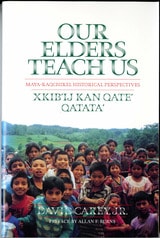
Our Elders Teach Us
Maya-Kaqchikel Historical PerspectivesDavid Anthony Carey, Jr. with a preface by Allan Burns
University of Alabama Press, 2001
Where Maya voices reclaim their history and reshape our understanding of the past.
Combining the methodologies of anthropology and history, Carey uses both oral interviews and meticulous archival research to construct a history of the last 130 years in Guatemala from the perspective of present-day Mayan people. His research took place over five years, including intensive language study, four summers of fieldwork, and a year-long residence in Comalapa, during which he conducted most of the 414 interviews. By casting a wide net for his interviews—from tiny hamlets to bustling Guatemala City—Carey gained insight into more than a single community or a single group of Maya.
The Maya-Kaqchikel record their history through oral tradition; thus, few written accounts exist. Comparing the Kaqchikel point of view to that of the western scholars and Ladinos who have written most of the history texts, Carey reveals the people and events important to the Maya, which have been virtually written out of the national history.
A motto of the Guatemalan organization Maya Decinio para el Pueblo Indigena (Maya Decade for the Indigenous People) is that people who do not know their past cannot build a future. By elucidating what the Kaqchikel think of their own past, Carey also illuminates the value of non-Western theoretical and methodological approaches that can be applied to the history of other peoples. Valuable to historians, anthropologists, archaeologists, or anyone interested in Mayan and Latin American studies, this book will inform as well as enchant.