Results by title
41 books match the query 'Painters'
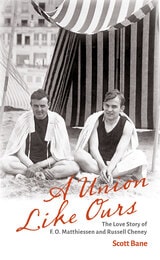
A Union Like Ours
The Love Story of F. O. Matthiessen and Russell CheneyScott Bane
University of Massachusetts Press, 2022
After a chance meeting aboard the ocean liner Paris in 1924, Harvard University scholar and activist F. O. Matthiessen and artist Russell Cheney fell in love and remained inseparable until Cheney’s death in 1945. During the intervening years, the men traveled throughout Europe and the United States, achieving great professional success while contending with serious personal challenges, including addiction, chronic disease, and severe depression.
During a hospital stay, years into their relationship, Matthiessen confessed to Cheney that “never once has the freshness of your life lost any trace of its magic for me. Every day is a new discovery of your wealth.” Situating the couple’s private correspondence alongside other sources, Scott Bane tells the remarkable story of their relationship in the context of shifting social dynamics in the United States. From the vantage point of the present day, with marriage equality enacted into law, Bane provides a window into the realities faced by same-sex couples in the early twentieth century, as they maintained relationships in the face of overt discrimination and the absence of legal protections.
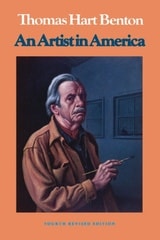
An Artist in America 4th Revised Edition
Thomas Hart Benton
University of Missouri Press, 1983
Controversial, flamboyant, contentious, brilliant--Thomas Hart Benton (1889-1975) was certainly all of those. Few American artists have stirred so much love and hatred as he did in a career that lasted almost seventy years. Although his painting aroused much controversy, perhaps equally as much was created by his words, for his piercing wit, profane sarcasms, and insightful condemnations were fired off without restraint. In this fiery and provocative autobiography, Benton presents an intriguing records of American art and society during his lifetime.
The first installment of this work was published in 1937, but Benton continued his life story in chapters added to editions published in 1951 and 1968. This new edition includes seventy-six drawings that add much to his narrative, plus a foreword discussing Benton's place in American art and an afterword covering his career after 1968, both written by art historian Matthew Baigell.
Although Benton is most famous as a regionalist painter and muralist, his complex and fascinating career brought him into contact with many of the most important artists and thinkers of the century, including Jackson Pollock, Grant Wood, Julian Huxley, Felix Frankfurter, Eugene Debbs, John Reed, and Harry Truman. While living in New York and on Martha's Vineyard in the 1920s and 1930s, Benton often associated with leading intellectuals and radicals. However, when his evolving principles of art led him away from an interest in Marxism, he was bitterly attacked by many of his former friends, and his account of that time reveals strikingly the fierce critical battles he faced in trying to establish his own artistic vision.
Critics on the Left were not his only opponents, however, and equally revealing are his responses to the moral condemnations heaped on his murals done for the states of Indiana and Missouri and on his realistic nudes of the late 1930s.
Throughout his account, from descriptions of his boyhood in southwest Missouri, his travels, and his career to discussions of specific works of art and other artists, Benton portrays people and events as vividly in words as he does in his paintings.
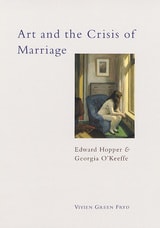
Art and the Crisis of Marriage
Edward Hopper and Georgia O'KeeffeVivien Green Fryd
University of Chicago Press, 2002
Vivien Green Fryd argues that this crisis played a crucial role in the lives and works of two of America's most familiar and beloved artists, Georgia O'Keeffe (1887-1986) and Edward Hopper (1882-1967). Combining biographical study of their marriages with formal and iconographical analysis of their works, Fryd shows how both artists expressed the pleasures and perils of their relationships in their paintings. Hopper's many representations of Victorian homes in sunny, tranquil landscapes, for instance, take on new meanings when viewed in the context of the artist's own tumultuous marriage with Jo and the widespread middle-class fears that the new urban, multidwelling homes would contribute to the breakdown of the family. Fryd also persuasively interprets the many paintings of skulls and crosses that O'Keeffe produced in New Mexico as embodying themes of death and rebirth in response to her husband Alfred Stieglitz's long-term affair with Dorothy Norman.
Art and the Crisis of Marriage provides both a penetrating reappraisal of the interconnections between Georgia O'Keeffe's and Edward Hopper's lives and works, as well as a vivid portrait of how new understandings of family, gender, and sexuality transformed American society between the wars in ways that continue to shape it today.
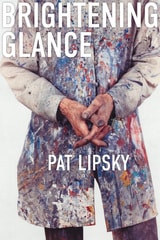
Brightening Glance
Art and LifePat Lipsky
University of Iowa Press, 2025
Brightening Glance offers a stunningly self-revealing portrait of the struggles and sacrifices, joys and excitement inherent in a modern painter’s life, and captures the evergreen allure of New York’s art world between 1970 and 2010. In stripped down, elegant prose, Lipsky summons a New York that no longer exists and ponders why we love (and hate) the art world. Ultimately, it’s a story of a contemporary woman, a mother, and a painter, who dares a career in a field where only a handful of women have succeeded.
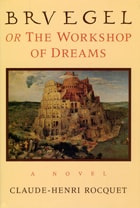
Bruegel, or the Workshop of Dreams
A NovelClaude-Henri Rocquet
University of Chicago Press, 1991
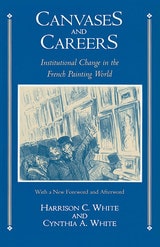
Canvases and Careers
Institutional Change in the French Painting WorldHarrison C. White and Cynthia A. White
University of Chicago Press, 1993
Originally published in 1965, this ground-breaking work is a classic piece of empirical research in the sociology of art. In this edition, Harrison C. White's new Foreword compares the marketing approaches of two contemporary painters, while Cynthia A. White's new Afterword reviews recent scholarship in the field.
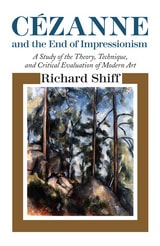
Cezanne and the End of Impressionism
A Study of the Theory, Technique, and Critical Evaluation of Modern ArtRichard Shiff
University of Chicago Press, 1984
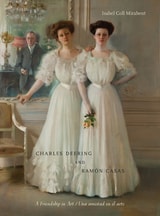
Charles Deering and Ramón Casas / Charles Deering y Ramón Casas
A Friendship in Art / Una amistad en el arteIsabel Coll Mirabent
Northwestern University Press, 2012
This lavishly illustrated, bilingual art book presents drawings by Ramón Casas in the Charles Deering McCormick Library of Special Collections at the Northwestern University Library and oil paintings by Casas from private collections and the Art Institute of Chicago.
Charles Deering and Ramón Casas follows the development and dramatic dissolution of a three-way friendship that connected the Spanish painter Ramón Casas (1866–1932); the Chicago industrialist Charles Deering (1852–1927), who was a collector and admirer of Casas’s work as well as a patron of Northwestern University; and the Spanish artist Miguel Utrillo (1862–1934), Casas’s lifelong friend and the father of the French painter Maurice Utrillo.
Casas introduced Deering to Sitges, a beach town near Barcelona, Spain, where the latter created a palatial estate with a museum to house his art collection. Miguel Utrillo served as director of the museum. The text explores the treasures housed at Maricel and what happened among the three men that led Casas to abandon Utrillo and Deering to depart Spain, taking his art collection with him.

Dancing Ledge
Derek Jarman
University of Minnesota Press, 2010
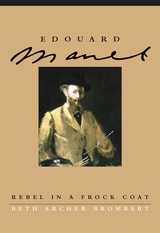
Edouard Manet
Rebel in a Frock CoatBeth Archer Brombert
University of Chicago Press, 1997
"One of the pleasures of reading her is to follow the way she weaves life, art and history into a smooth tapestry. The art emerges from the life, and in the broadest possible context: in terms of its creator's life and concerns and in terns of its historical and cultural setting."—Eric Gibson, The Washington Times Books
"Richly detailed and informative . . . [this biography] exposes the character of an artist who maintained a sharply defined duality between his public and private personas."—Edward J. Sozanski, Philadelphia Inquirer
"Brombert's reading of important canvasses . . . shine, as do her accounts of the changing social and political environment in which Manet worked. . . . Well researched, complexly conceived, and clearly written."—Kirkus Reviews
"Brilliant . . . [this book] grants us a far deeper understanding of why [Manet's] paintings outraged so many of his peers, and why these same masterpieces resonate so richly in our psyches a century later."—Booklist, starred review
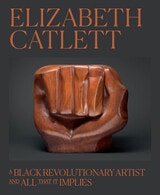
Elizabeth Catlett
A Black Revolutionary Artist and All That It ImpliesEdited by Dalila Scruggs
University of Chicago Press, 2024
Accomplished printmaker and sculptor, avowed feminist, and lifelong activist Elizabeth Catlett (1915–2012) built a remarkable career around intersecting passions for formal rigor and social justice. This book, accompanying a major traveling retrospective, offers a revelatory look at the artist and her nearly century-long life, highlighting overlooked works alongside iconic masterpieces.
Catlett’s activism and artistic expression were deeply connected, and she protested the injustices of her time throughout her life. Her work in printmaking and sculpture draws on organic abstraction, the modernism of the United States and Mexico, and African art to center the experiences of Black and Mexican women. Catlett attended Howard University, studied with the painter Grant Wood, joined the Harlem artistic community, and worked with a leftist graphics workshop in Mexico, where she lived in exile after the US accused her of communism and barred her re-entry into her home country.
The book’s essays address a range of topics, including Catlett’s early development as an artist-activist, the impact of political exile on her work, her pedagogical legacy, her achievement as a social realist printmaker, her work with the arts community of Chicago’s South Side, and the diverse influences that shaped her practice.
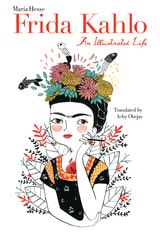
Frida Kahlo
An Illustrated LifeBy María Hesse, translated by Achy Obejas
University of Texas Press, 2018
One of the most important artists of the twentieth century and an icon of courageous womanhood, Frida Kahlo lives on in the public imagination, where her popularity shows no signs of waning. She is renowned for both her paintings and her personal story, which were equally filled with pain and anguish, celebration and life. Thousands of words, including her own, have been written about Kahlo, but only one previous biography has recorded her fascinating, difficult life. Frida Kahlo by María Hesse offers a highly unique way of getting to know the artist by presenting her life in graphic novel form, with striking illustrations that reimagine many of Kahlo’s famous paintings.
Originally published in Spanish in 2016, Frida Kahlo has already found an enthusiastic audience in the Spanish-speaking world, with some 20,000 copies sold in just a few months. This translation introduces English-language readers to Kahlo’s life, from her childhood and the traumatic accident that would change her life and her artwork, to her complicated love for Diego Rivera and the fierce determination that drove her to become a major artist in her own right. María Hesse tells the story in a first-person narrative, which captures both the depths of Frida’s suffering and her passion for art and life.

George Caleb Bingham
Missouri's Famed Painter and Forgotten PoliticianPaul C. Nagel
University of Missouri Press, 2005
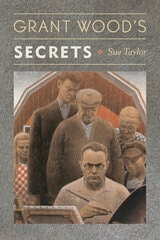
Grant Wood’s Secrets
Sue Taylor
University of Delaware Press, 2011
Published by University of Delaware Press. Distributed worldwide by Rutgers University Press.
Hilma af Klint
A BiographyJulia Voss
University of Chicago Press, 2022
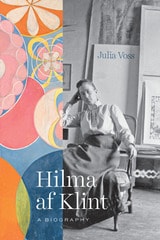
The Swedish painter Hilma af Klint (1862–1944) was forty-four years old when she broke with the academic tradition in which she had been trained to produce a body of radical, abstract works the likes of which had never been seen before. Today, it is widely accepted that af Klint was one of the earliest abstract academic painters in Europe.
But this is only part of her story. Not only was she a working female artist, she was also an avowed clairvoyant and mystic. Like many of the artists at the turn of the twentieth century who developed some version of abstract painting, af Klint studied Theosophy, which holds that science, art, and religion are all reflections of an underlying life-form that can be harnessed through meditation, study, and experimentation. Well before Kandinsky, Mondrian, and Malevich declared themselves the inventors of abstraction, af Klint was working in a nonrepresentational mode, producing a powerful visual language that continues to speak to audiences today. The exhibition of her work in 2018 at the Guggenheim Museum in New York City attracted more than 600,000 visitors, making it the most-attended show in the history of the institution.
Despite her enormous popularity, there has not yet been a biography of af Klint—until now. Inspired by her first encounter with the artist’s work in 2008, Julia Voss set out to learn Swedish and research af Klint’s life—not only who the artist was but what drove and inspired her. The result is a fascinating biography of an artist who is as great as she is enigmatic.
Isaac Rosenberg
The Making of a Great War Poet: A New LifeJean Moorcroft Wilson
Northwestern University Press, 2009
Jerry Bywaters
A Life in ArtBy Francine Carraro
University of Texas Press, 1994
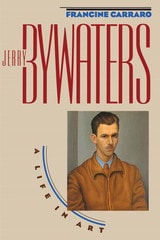
As an artist, art critic, museum director, and art educator, Jerry Bywaters reshaped the Texas art world and attracted national recognition for Texas artists. This first full-scale biography explores his life and work in the context of twentieth-century American art, revealing Bywaters' important role in the development of regionalist painting.
Francine Carraro delves into all aspects of Bywaters' career. As an artist, Bywaters became a central figure and spokesman for a group of young, energetic painters known as the Dallas Nine (Alexandre Hogue, Everett Spruce, Otis Dozier, William Lester, and others) who broke out of the limitations of provincialism and attained national recognition beginning in the 1930s.
As director of the Dallas Museum of Fine Arts, art critic for the Dallas Morning News, and professor of art and art history at Southern Methodist University, Bywaters became a champion of the arts in Texas. Carraro traces his strong supporting role in professionalizing art institutions in Texas and defendlng the right to display art considered "subversive" in the McCarthy era.
From these discussions emerges a finely drawn portrait of an artist who used a vocabulary of regional images to explore universal themes. It will be of interest to all students of American studies, national and regional art history, and twentieth-century biography.
Letters of Gustave Courbet
Gustave Courbet
University of Chicago Press, 1992
pivotal figure in the emergence of modern painting, remains
an artist whose interests, attitudes, and friendships are
little understood. A voluminous correspondent, Courbet
himself, through his letters, offers a tantalizing avenue
toward a keener assessment of his character and
accomplishments. In her critical edition of over six hundred
of the artist's letters, Petra ten-Doesschate Chu presents
just such a look at the inner life of the artist; her
unparalleled feat of gathering together all of Courbet's
known letters, many heretofore unpublished and untranslated,
is sure to change our evaluation of Courbet's creativity and
of his place in nineteenth-century French life.
Beginning when Courbet left his provincial home at
eighteen and ending eight days before his death in exile in
Switzerland, this correspondence enables readers to follow
the artist's development from youth to mature artist of
international repute. Addressed to correspondents such as
the poet Charles Baudelaire, the painter Claude Monet, the
writers Champfleury, Victor Hugo, and Théeophile Gautier,
the political theorist Pierre-Joseph Proudhon, and the
politician Jules Simon, the letters offer numerous insights
into Courbet's life and art as well as the cultural and
political activity of his day. In fascinating detail, they
present the artist's relation to the contemporary media, his
deliberate choice of subject matter for Salon paintings, his
preoccupation with photography, and his participation in the
Commune.
Besides collecting, translating, and annotating the
letters, Chu provides an introduction, a chronology,
biographies of persons appearing frequently in the letters,
and a list of paintings and sculptures mentioned in the
letters. Her work is an essential resource of immediate use
to historians of art and culture, political and social
historians, and readers of biography.
Petra ten-Doesschate Chu is professor and head of the
Department of Art and Music at Seton Hall University.
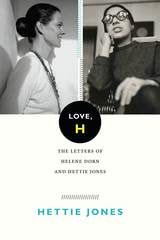
Love, H
The Letters of Helene Dorn and Hettie JonesHettie Jones
Duke University Press, 2016
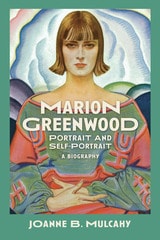
Marion Greenwood
Portrait and Self-Portrait—A BiographyJoanne B. Mulcahy
University of Alabama Press, 2025
This new biography reveals Marion Greenwood's central place in the pantheon of history’s remarkable women artists.
Marion Greenwood: Portrait and Self-Portrait—A Biography brings to life a woman who blazed through the twentieth-century art world. Born in Brooklyn in 1909, Greenwood thrived at storied institutions and arts centers such as the Art Students League, the studio of German modernist Winold Reiss, the Woodstock Colony, and Yaddo. In 1933, she catapulted to international fame as the first woman to paint a public mural in Mexico. Diego Rivera celebrated Greenwood as one of “the world’s greatest living women mural painters.” She traveled the globe to create award-winning portraits of people from diverse backgrounds, crossing racial, cultural, and class lines to reflect her vision for a more just world.
This biography, the first about Greenwood, is based on a decade of research and interviews. Author Joanne B. Mulcahy integrates the artist’s adventuresome personal life with her journey to artistic glory. Greenwood comes alive as a notable and spirited part of the heady art scenes of 1920s and 1930s Mexico, New York City, and Paris, and as one of two women artist-correspondents during World War II. After social realism and portraiture fell from favor, Greenwood doggedly stuck with what she called “the human thing” in art. Her freewheeling romantic life and independent spirit defied expectations for women, and she dismissed sexist critics who mixed acclaim for her work with commentary on her stunning beauty.
A feminist pioneer, Greenwood made a living as an artist in a time when few women could. In following Greenwood’s maverick path and artistic achievements, this book reveals her central place in the pantheon of history’s remarkable women artists.
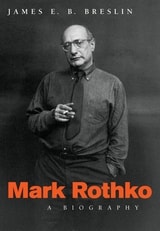
Mark Rothko
A BiographyJames E. B. Breslin
University of Chicago Press, 2012
The definitive biography of one of the most-loved artists of the twentieth century, a book the New York Times called "the best life of an American painter yet written"
A book of heroic dimensions, this is the first full-length biography of one of the greatest artists of the twentieth century—a man as fascinating, difficult, and compelling as the paintings he produced. Drawing on exclusive access to Mark Rothko's personal papers and over one hundred interviews with artists, patrons, and dealers, James Breslin tells the story of a life in art—the personal costs and professional triumphs, the convergence of genius and ego, the clash of culture and commerce. Breslin offers us not only an enticing look at Rothko as a person, but delivers a lush, in-depth portrait of the New York art scene of the 1930s, ’40s, and ’50s—the world of Abstract Expressionism, of Pollock, Rothko, de Kooning, and Klein, which would influence artists for generations to come.
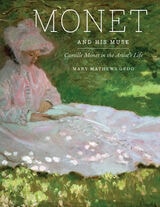
Monet and His Muse
Camille Monet in the Artist's LifeMary Mathews Gedo
University of Chicago Press, 2010
“The mourning never stops, it just changes.” (Edward Albee)
For Claude Monet (1840–1926), the founder of French Impressionist painting, these words are a fitting testament to his lifelong relationship with the female muse, most notably—and most hauntingly—with his first wife, the model Camille Doncieux.
For the esteemed clinical psychologist and art historian Mary Mathews Gedo, Monet and His Muse represents a project twenty years in the making. Artfully interweaving biographical insight with psychoanalytic criticism, Gedo takes us on an exploration of Claude Monet’s conflicted relationships with women, complete with exquisitely researched material never before understood about one of our most popular—and inimitable—artists. Beginning with Monet’s childhood, Gedo delves into his relationships with a distant, unreliable father and his beloved, doting mother—whose death when Monet was just sixteen, the author establishes, inspired a lifetime preoccupation with the sea, its lushly imagined flora, and the figurative landscapes Monet painted to such acclaim.
And then—Camille. Entering Monet’s life when he was still a young man, becoming first his model and then mistress and then—finally—his wife, Camille Doncieux always fulfilled the function of muse, even after her life had ended, as Monet not only painted her one last time on her deathbed, but preserved her memory through the gardens he planted at his home in Giverny. Demonstrating how Monet’s connections with women were exceedingly complex, fraught with abusive impulses and infantile longing, Gedo sensitively uses Monet and Camille as exemplars in order to explore links between artists and muses in our modern age.
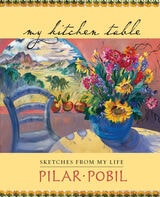
My Kitchen Table
Sketches from My LifePilar Pobil
University of Utah Press, 2007
Other stories describe her meeting in Mallorca with the Utah man who would become her husband, her journey to a faraway country, the birth of her children, and her discovery of her artistic impulses and abilities. All are woven with the threads of color and culture of her two homes. Filled with wit and insight, My Kitchen Table reveals foremost the voice of a woman determined to be true to herself and to her art.
Accompanying the narrative are some fifty color reproductions of the paintings and sculptures for which Pilar Pobil has become known. This is a volume that art lovers everywhere will treasure.
"Like her paintings, Pilar’s stories overflow their pages. They fold us into their embrace, so we feel and see her dancing in and out of our minds, a curious and mischievous child, a young woman in love coming to a foreign land with a foreign culture and tongue, the heartbreak of her losses, and the continual renewals that have ripened her art. Pilar’s book, like her house, is a magic kingdom and she is the fairy princess who presides. She paints her shoes for social engagements. The seats of her chairs beam faces. Her electrical wiring metamorphoses into fantastic snakes. The garden that leads to her studio is Salt Lake City’s Giverny. Paintings are everywhere and talk to each other with glittering non sequiturs. At the center of it all is her kitchen table, the place from which she serves the voices and visions of her life. The subtleties of her telling, like the bold clarity of her judgments, are those of an artist whose inspirations are a feast she graciously invites us to share."
— from the Foreword by Robert D. Newman, Dean of the College of Humanities, University of Utah
A finalist for the Utah Book Award in Nonfiction.
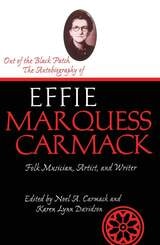
Out Of The Black Patch
Noel Carmack
Utah State University Press, 1999
Effie Marquess Carmack (1885-1974) grew up in the tobacco-growing region of southern Kentucky known as the Black Patch. As an adult she moved to Utah, back to Kentucky, to Arizona, and finally to California. Economic necessity primarily motivated Effie and her husband's moves, but her conversion to the Mormon Church in youth also was a factor. Throughout her life, she was committed to preserving the rural, southern folkways she had experienced as a child. She and other members of her family were folk musicians, at times professionally, and she also became a folk poet and artist, teaching herself to paint. In the 1940s she began writing her autobiography and eventually also completed a verse adaptation of it and an unpublished novel about life in the Black Patch.
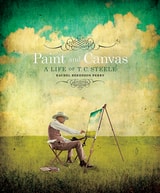
Paint and Canvas
A Life of T. C. SteeleRachel Berenson Perry
Indiana Historical Society Press, 2011

Pissarro, Neo-Impressionism, and the Spaces of the Avant-Garde
Martha Ward
University of Chicago Press, 1996
Paying particular attention to the participation of Camille Pissarro, the only older artist to join the otherwise youthful movement, Ward sets the neo-impressionists' individual achievements in the context of a generational struggle to redefine the purposes of painting. She describes the conditions of display, distribution, and interpretation that the neo-impressionists challenged, and explains how these artists sought to circulate their own work outside of the prevailing system. Paintings, Ward argues, often anticipate and respond to their own conditions of display and use, and in the case of the neo-impressionists, the artists' relations to market forces and exhibition spaces had a decisive impact on their art.
Ward details the changes in art dealing, and chronicles how these and new freedoms for the press made artistic vanguardism possible while at the same time affecting the content of painting. She also provides a nuanced account of the neo-impressionists' engagements with anarchism, and traces the gradual undermining of any strong correlation between artistic allegiance and political direction in the art world of the 1890s.
Throughout, there are sensitive discussions of such artists as Georges Seurat and Paul Signac, as well as Pissarro. Yet the touchstone of the book is Pissarro's intricate relationship to the various factions of the Paris art world.
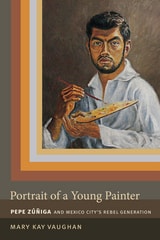
Portrait of a Young Painter
Pepe Zuniga and Mexico City's Rebel GenerationMary Kay Vaughan
Duke University Press, 2015
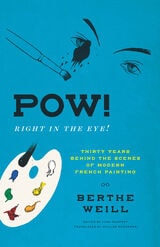
Pow! Right in the Eye!
Thirty Years behind the Scenes of Modern French PaintingBerthe Weill
University of Chicago Press, 2022
Berthe Weill, a formidable Parisian dealer, was born into a Jewish family of very modest means. One of the first female gallerists in the business, she first opened the Galerie B. Weill in the heart of Paris’s art gallery district in 1901, holding innumerable exhibitions over nearly forty years. Written out of art history for decades, Weill has only recently regained the recognition she deserves.
Under five feet tall and bespectacled, Weill was beloved by the artists she supported, and she rejected the exploitative business practices common among art dealers. Despite being a self-proclaimed “terrible businesswoman,” Weill kept her gallery open for four decades, defying the rising tide of antisemitism before Germany’s occupation of France. By the time of her death in 1951, Weill had promoted more than three hundred artists—including Henri Matisse, Pablo Picasso, Amedeo Modigliani, Diego Rivera, and Suzanne Valadon—many of whom were women and nearly all young and unknown when she first exhibited them.
Pow! Right in the Eye! makes Weill’s provocative 1933 memoir finally available to English readers, offering rare insights into the Parisian avant-garde and a lively inside account of the development of the modern art market.

Rounded Up in Glory
Frank Reaugh, Texas Renaissance ManMichael Grauer
University of North Texas Press, 2016
Shaping the Netherlandish Canon
Karel Van Mander's Schilder-BoeckWalter S. Melion
University of Chicago Press, 1992
of Italian art, Karel van Mander's Schilder-Boeck (or
Book on Picturing) has long been recognized for its critical
and historical influence—and yet, until now, no
comprehensive account of the book's conception, aims, and
impact has been available. In this in-depth analysis of the
content and context of Van Mander's work, Walter S. Melion
reveals the Schilder-Boeck's central importance to an
understanding of northern Renaissance and Baroque art.
By interpreting the terminology employed in the
Schilder-Boeck, Melion establishes the text's
relationship to past and contemporary art theory. Van Mander
is seen here developing his critical categories and then
applying them to Ancient, Italian, and Netherlandish artists
in order to mark changes within a culture and to characterize
excellence for each region. Thus Melion demonstrates how Van
Mander revised both the structure and critical language of
Vasari's Lives to refute the Italian's claims for the
superiority of the Tuscan style, and to clarify northern
artistic traditions and the concerns of Netherlandish
artists. A much needed corrective to the view that Dutch art
of the period was lacking in theory, Melion's work offers a
compelling account of a sixteenth- and seventeenth-century
theoretical and critical perspective and shows how this
perspective suggests a rereading of northern art.
Walter S. Melion is assistant professor of art history
at The Johns Hopkins University.
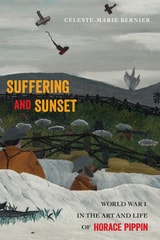
Suffering and Sunset
World War I in the Art and Life of Horace PippinCeleste-Marie Bernier
Temple University Press, 2017
For self-made artist and soldier Horace Pippin—who served in the 369th all-black infantry in World War I until he was wounded—war provided a formative experience that defined much of his life and work. His ability to transform combat service into canvases of emotive power, psychological depth, and realism showed not only how he viewed the world but also his mastery as a painter. In Suffering and Sunset, Celeste-Marie Bernier painstakingly traces Pippin’s life story of art as a life story of war.
Illustrated with more than sixty photographs, including works in various mediums—many in full color—this is the first intellectual history and cultural biography of Pippin. Working from newly discovered archives and unpublished materials, Bernier provides an in-depth investigation into the artist’s development of an alternative visual and textual lexicon and sheds light on his work in its aesthetic, social, and political contexts.
Suffering and Sunset illustrates Pippin’s status as a groundbreaking artist as it shows how this African American painter suffered from but also staged many artful resistances to racism in a white-dominated art world.
Ted Lambert
The Man Behind the PaintingsTed Lambert
University of Alaska Press, 2012
The Culture of San Sepolcro during the Youth of Piero della Francesca
James R. Banker
University of Michigan Press, 2003
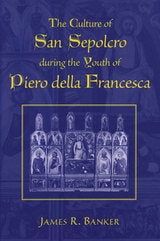
Piero della Francesca has remained an enigma because of the contradictions observed in his life and art. Banker's archival research has enabled him to clear away some of the obscurities. This book situates Piero in the earliest social and intellectual worlds within which he moved. Heretofore, writers on Piero have begun his putative formation in Florence in 1439. Banker demonstrates that the young painter's formation began prior to 1439, when he was surrounded by his family and the local artisans' community.
The Culture of San Sepolcro during the Youth of Piero della Francesca integrates social and art history in order to better understand the formation of a Renaissance artist. It will be vital to scholars and historians of the Italian Renaissance city states, as well as to art historians and those interested in the relationship of art and society.
James R. Banker is Professor of History, North Carolina State University.
The Deaths of Henri Regnault
Marc Gotlieb
University of Chicago Press, 2016
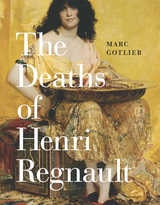
Gotlieb traces Regnault’s trajectory after he won the prestigious Grand Prix de Rome, a fellowship that provided four years of study in Italy. Arriving in Rome, however, Regnault suffered a profound crisis of originality that led him to flee the city in favor of Spain and Morocco. But the crisis also proved productive: from Rome, Madrid, Tangier, and Paris, Regnault enthralled audiences with a bold suite of strange, seductive, and violent Orientalist paintings inspired by his exotic journey—images that, Gotlieb argues, arose precisely from the crisis that had overtaken Regnault and that in key respects was shared by his more avant-garde counterparts.
Both an in-depth look at Regnault’s violent art and a vibrant essay on historical memory, The Deaths of Henri Regnault lays bare a creative legend who helped shape the collective experience of a generation.
The House of the Singing Winds
The Life and Work of T. C. SteeleRachel Berenson Perry
Indiana Historical Society Press, 2016
The Letters and Journals
Paula Modersohn-Becker
Northwestern University Press, 1998
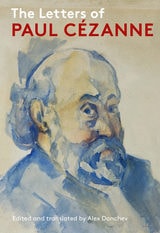
The Letters of Paul Cézanne
Alex Danchev
J. Paul Getty Trust, The, 2013
Revered and misunderstood by his peers and lauded by later generations as the father of modern art, Paul Cézanne (1839-1906) has long been a subject of fascination for artists and art lovers, writers, poets, and philosophers. His life was a ceaseless artistic quest, and he channeled much of his wide-ranging intellect and ferocious wit into his letters. Punctuated by exasperated theorizing and philosophical reflection, outbursts of creative ecstasy and melancholic confession, the artist’s correspondence reveals both the heroic and all-toohuman qualities of a man who is indisputably among the pantheon of all-time greats.
This new translation of Cézanne’s letters includes more than twenty that were previously unpublished and reproduces the sketches and caricatures with which Cézanne occasionally illustrated his words. The letters shed light on some of the key artistic relationships of the modern period—about one third of Cézanne’s more than 250 letters are to his boyhood companion Émile Zola, and he communicated extensively with Camille Pissarro and the dealer Ambroise Vollard. The translation is richly annotated with explanatory notes, and, for the first time, the letters are cross-referenced to the current catalogue raisonné. Numerous inaccuracies and archaisms in the previous English edition of the letters are corrected, and many intriguing passages that were unaccountably omitted have been restored. The result is a publishing landmark that ably conveys Cézanne’s intricacy of expression.
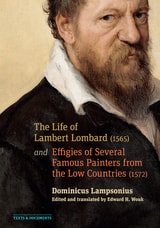
The Life of Lambert Lombard (1565); and Effigies of Several Famous Painters from the Low Countries (1572)
Dominicus Lampsonius
J. Paul Getty Trust, The, 2022
Dominicus Lampsonius’s The Life of Lambert Lombard (1565) is the earliest published biography of a Netherlandish artist. This neo-Latin account of the life of the painter, architect, and draftsman Lambert Lombard of Liège offers a theoretical exposition on the nature and ideal practice of Netherlandish art, emphasizing Lombard’s intellectual curiosity, interest in antiquity, attentive study of the human body, and exemplary generosity as a teacher.
This volume offers the first English edition of The Life of Lambert Lombard, complemented by a new translation of the inscriptions Lampsonius composed to accompany the Effigies of Several Famous Painters from the Low Countries (1572), a cycle of twenty-three engraved portraits of Netherlandish artists developed in collaboration with the print publisher Hieronymus Cock.
Together, The Life of Lambert Lombard and the Effigies established frameworks for a distinctly Netherlandish history of art. Responding to a growing sense of Netherlandish cultural and political identity on the eve of the Dutch Revolt, these texts proposed a critical alternative to Giorgio Vasari’s Lives of the Artists and its Italian model of art historical development, celebrating local ingenuity and skill. They remain the starting point for any history of the northern Renaissance.
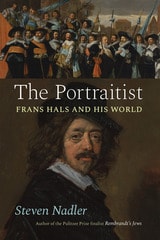
The Portraitist
Frans Hals and His WorldSteven Nadler
University of Chicago Press, 2022
Frans Hals was one of the greatest portrait painters in history, and his style transformed ideas and expectations about what portraiture can do and what a painting should look like.
Hals was a member of the great trifecta of Dutch Baroque painters alongside Rembrandt and Vermeer, and he was the portraitist of choice for entrepreneurs, merchants, professionals, theologians, intellectuals, militiamen, and even his fellow artists in the Dutch Golden Age. His works, with their visible brush strokes and bold execution, lacked the fine detail and smooth finish common among his peers, and some dismissed his works as sloppy and unfinished. But for others, they were fresh and exciting, filled with a sense of the sitter’s animated presence captured with energy and immediacy.
Steven Nadler gives us the first full-length biography of Hals in many years and offers a view into seventeenth-century Haarlem and this culturally rich era of the Dutch Republic. He tells the story not only of Hals’s life, but also of the artistic, social, political, and religious worlds in which he lived and worked.
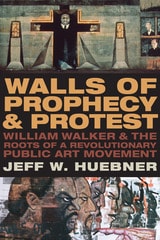
Walls of Prophecy and Protest
William Walker and the Roots of a Revolutionary Public Art MovementJeff W. Huebner
Northwestern University Press, 2019
Though his art could not have been more public, Walker maintained a low profile during his working life and virtually withdrew from the public eye after his retirement in 1989. Author Jeff W. Huebner met Walker in 1990 and embarked on a series of insightful interviews that stretched over the next two decades. Those meetings and years of research form the basis of Walls of Prophecy and Protest, the story of Walker’s remarkable life and the movement that he inspired.
Featuring forty-three color images of Walker’s work, most long since destroyed or painted over, this handsome edition reveals the artist who was the primary figure behind Chicago’s famed Wall of Respect and who created numerous murals that depicted African American historical figures, protested social injustice, and promoted love, respect, racial unity, and community change.
Wyeth People
Gene Logsdon
Ohio University Press, 2003