Results by title
704 books match the query 'Political Process' and 17 start with o

Obama's Race
The 2008 Election and the Dream of a Post-Racial AmericaMichael Tesler and David O. Sears
University of Chicago Press, 2010
Barack Obama’s presidential victory naturally led people to believe that the United States might finally be moving into a post-racial era. Obama’s Race—and its eye-opening account of the role played by race in the election—paints a dramatically different picture.
The authors argue that the 2008 election was more polarized by racial attitudes than any other presidential election on record—and perhaps more significantly, that there were two sides to this racialization: resentful opposition to and racially liberal support for Obama. As Obama’s campaign was given a boost in the primaries from racial liberals that extended well beyond that usually offered to ideologically similar white candidates, Hillary Clinton lost much of her longstanding support and instead became the preferred candidate of Democratic racial conservatives. Time and again, voters’ racial predispositions trumped their ideological preferences as John McCain—seldom described as conservative in matters of race—became the darling of racial conservatives from both parties. Hard-hitting and sure to be controversial, Obama’s Race will be both praised and criticized—but certainly not ignored.

Obama's Washington
Political Leadership in a Partisan EraEdited by Clodagh Harrington
University of London Press, 2014
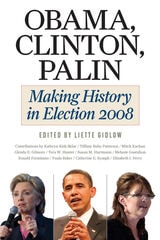
Obama, Clinton, Palin
Making History in Elections 2008Edited by Liette Gidlow
University of Illinois Press, 2011
Election 2008 made American history, but it was also the product of American history. Barack Obama, Hillary Clinton, and Sarah Palin smashed through some of the most enduring barriers to high political office, but their exceptional candidacies did not come out of nowhere. In these timely and accessible essays, a distinguished group of historians explores how the candidates both challenged and reinforced historic stereotypes of race and sex while echoing familiar themes in American politics and exploiting new digital technologies.
Contributors include Kathryn Kish Sklar on Clinton’s gender masquerade; Tiffany Ruby Patterson on the politics of black anger; Mitch Kachun on Michelle Obama and stereotypes about black women’s bodies; Glenda E. Gilmore on black women’s century of effort to expand political opportunities for African Americans; Tera W. Hunter on the lost legacy of Shirley Chisholm; Susan M. Hartmann on why the U.S. has not yet followed western democracies in electing a female head of state; Melanie Gustafson on Palin and the political traditions of the American West; Ronald Formisano on the populist resurgence in 2008; Paula Baker on how digital technologies threaten the secret ballot; Catherine E. Rymph on Palin’s distinctive brand of political feminism; and Elisabeth I. Perry on the new look of American leadership.

Occupy
Three Inquiries in DisobedienceW. J. T. Mitchell, Bernard E. Harcourt, and Michael Taussig
University of Chicago Press, 2013

Ohio’s Kingmaker
Mark Hanna, Man and MythWilliam T. Horner
Ohio University Press, 2010
For a decade straddling the turn of the twentieth century, Mark Hanna was one of the most famous men in America. Portrayed as the puppet master controlling the weak-willed William McKinley, Hanna was loved by most Republicans and reviled by Democrats, in large part because of the way he was portrayed by the media of the day. Newspapers and other media outlets that supported McKinley reported positively about Hanna, but those sympathetic to William Jennings Bryan, the Democrats’ presidential nominee in 1896 and 1900, attacked Hanna far more aggressively than they attacked McKinley himself. Their portrayal of Hanna was wrong, but powerful, and this negative image of him survives to this day.
In this study of Mark Hanna’s career in presidential politics, William T. Horner demonstrates the flaws inherent in the ways the news media cover politics. He deconstructs the myths that surround Hanna and demonstrates the dangerous and long-lasting effect that inaccurate reporting can have on our understanding of politics. When Karl Rove emerged as the political adviser to George W. Bush’s presidential campaigns, the reporters quickly began to compare Rove to Hanna even a century after Hanna’s death. The two men played vastly different roles for the presidents they served, but modern reporters consistently described Rove as the second coming of Mark Hanna, another political Svengali.
Ohio’s Kingmaker is the story of a fascinating character in American politics and serves to remind us of the power of (mis)perceptions.

On Western Terrorism - New Edition
From Hiroshima to Drone WarfareNoam Chomsky and Andre Vltchek
Pluto Press, 2017
“Noam Chomsky is a global phenomenon.”—New York Review of Books
In On Western Terrorism, world-renowned intellectual Noam Chomsky discusses Western power and propaganda with filmmaker and investigative journalist Andre Vltchek. Together they touch on colonialism, propaganda, and the media, and cover topics from the Soviet Union to Latin America to the Arab Spring.
Here is the perfect introduction to Chomsky's political thought and provides an accessible approach for anyone who wishes to better understand the West's fraught role in the world. Admired by some, condemned by others, and feared by all—the military might of the West is undeniably colossal.
Beginning with stories of the New York newsstand where Chomsky started his political education as a teenager, the discussion broadens out to encompass colonialism, imperial control, propaganda, and drone warfare.
Chomsky and Vltchek offer a powerful critique of the legacy of colonialism, touching upon many countries including Syria, Nicaragua, Cuba, China, Chile, and Turkey. The Table of Contents:
1. The Murderous Legacy of Colonialism
2. Concealing the Crimes of the West
3. Propaganda and the Media
4. The Soviet Bloc
5. India and China
6. Latin America
7. The Middle East and the Arab Spring
8. Hope in the Most Devastated Places on Earth
9. The Decline of U.S. Power Timeline
With a fresh design and a new foreword by Chomsky, this edition of On Western Terrorism stands as an influential and powerful critique of the West's role in the world, inspiring all who read it to think independently and critically.
On the East-West Slope
Globalization, Nationalism, Racism and Discourses on Eastern EuropeAttila Melegh
Central European University Press, 2006
Open Marxism 4
Against a Closing WorldAna Cecilia Dinerstein
Pluto Press, 2019
Open Marxism 4
Against a Closing WorldAna Cecilia Dinerstein
Pluto Press, 2019

Opposition and Intimidation
The Abortion Wars and Strategies of Political HarassmentAlesha E. Doan
University of Michigan Press, 2007
The abortion fight has long been a crucible of political tactics, with both sides employing strategies ranging from litigation to civil disobedience to outright violence. Anti-abortion activists have arguably been more tactically innovative than their pro-choice peers. Opposition and Intimidation looks at how their use of political harassment fits—or doesn't—with more conventional political efforts in the struggle over abortion.
Alesha Doan's insightful interviews and observations powerfully portray anti-abortion activists' relationship to the objects of their protest. Her portrait is augmented by thorough quantitative analysis of harassment's role within the movement's multitiered strategy—a strategy that Doan shows has forced a decline in the availability and popularity of abortions. Using her unique study of the anti-abortion movement as a model, Doan extends her findings to propose a novel and valuable theory of the new politics of harassment.
"An interesting and sophisticated account. Seamlessly weaves narrative and analysis, tying local action to national strategy. Explores uncharted territory in the abortion controversy and expands our understanding of political action."
—Deborah R. McFarlane, University of New Mexico
"For 40 years, abortion politics have been endlessly fascinating to American scholars and journalists alike because they generate unique political phenomena that challenge traditional theories of political behavior. In this book, Doan goes straight to the heart of the matter by describing, evaluating, and explaining one of the most characteristic and complex of these phenomena—political harassment. In a well-written narrative that weaves qualitative and quantitative data, she gives us the first scholarly look at this political tactic, whose relevance and use go well beyond American abortion politics."
—Chris Mooney, University of Illinois at Springfield
"The book contributes to political theory and knowledge by adding new empirical data gathered from interviews with those in the front lines of the struggle over abortion. The author refines and develops a category of unconventional political participation—political harassment of nongovernmental actors—and explains why it is particularly effective in undermining the rights of women seeking abortions, as well as the rights of abortion service providers."
—Nikki R. Van Hightower, Texas A&M University
Alesha E. Doan is Assistant Professor of Political Science at the University of Kansas.

Oppositional Consciousness
The Subjective Roots of Social ProtestEdited by Jane J. Mansbridge and Aldon Morris
University of Chicago Press, 2001
Each essay employs a recent historical case to demonstrate how oppositional consciousness actually worked in the experience of a subordinate group. Based on participant observation and interviews, chapters focus on the successful social movements of groups such as African Americans, people with disabilities, sexually harassed women, Chicano workers, and AIDS activists. Ultimately, Oppositional Consciousness sheds new light on the intricate mechanisms that drive the important social movements of our time.
Contributors: Naomi Braine, Sharon Groch, Fredrick C. Harris, Jane Mansbridge, Anna-Maria Marshall, Aldon Morris, Marc Simon Rodriguez, Brett C. Stockdill, Lori G. Waite

Origins of Instability in Early Republican Mexico
Donald F. Stevens
Duke University Press, 1991
Donald F. Stevens’ revisionist account challenges traditional historiography to examine the nature and origins of Mexico’s political instability. Turning to quantitative methods as a way of providing a framework for examining existing hypotheses concerning Mexico’s instability, the author dissects the relationship between instability and economic cycles; contradicts the notion that Mexico’s social elite could have increased political stability by becoming more active; and argues that the principal political fissures were not liberal vs. conservative but were among radical, moderate, and conservative.
Ultimately, Stevens maintains, the origins of that country’s instability are to be found in the contradictions between liberalism and Mexico’s traditional class structure, and the problems of creating an independent republic from colonial, monarchical, and authoritarian traditions.
Our Common Bonds
Using What Americans Share to Help Bridge the Partisan DivideMatthew Levendusky
University of Chicago Press, 2023
One of the defining features of twenty-first-century American politics is the rise of affective polarization: Americans increasingly not only disagree with those from the other party but distrust and dislike them as well. This has toxic downstream consequences for both politics and social relationships. Is there any solution?
Our Common Bonds shows that—although there is no silver bullet that will eradicate partisan animosity—there are concrete interventions that can reduce it. Matthew Levendusky argues that partisan animosity stems in part from partisans’ misperceptions of one another. Democrats and Republicans think they have nothing in common, but this is not true. Drawing on survey and experimental evidence, the book shows that it is possible to help partisans reframe the lens through which they evaluate the out-party by priming commonalities—specifically, shared identities outside of politics, cross-party friendships, and common issue positions and values identified through civil cross-party dialogue. Doing so lessons partisan animosity, and it can even reduce ideological polarization. The book discusses what these findings mean for real-world efforts to bridge the partisan divide.

Our Culture of Pandering
Paul Simon
Southern Illinois University Press, 2006
As we broaden our views, embrace our differences, foster advancements in science and technology, and collaboratively strengthen the political, social, and educational underpinnings from which we build informed and productive lives, we have much to be proud of as a nation and as a people.
But we are tempted—particularly during times of political unrest and unbridled patriotism—to ignore the far-reaching repercussions of a society that caters to money and power. In Our Culture of Pandering, former U.S. Senator Paul Simon interrogates the arenas of politics, media, religion, and education to decry the disturbing practices that confuse public service with profit-making ventures or popularity contests, that compromise the best interests of the broader population to appease a powerful few. Boldly and eloquently contributing to a cumulative understanding of how we can build a sturdier, more ethical foundation for the future, Simon suggests proactive, long-term solutions to the problems that threaten our country’s moral, financial, and intellectual well-being—problems that are increasingly exacerbated by our culture of pandering.
Lest we grow complacent and our nation static, Simon urges us to demand more from the political candidates who chase dollar signs and cater to polls, to raise our expectations of local and national media outlets that recycle gossip and peddle scandals while foreign policy and international news receive back-page treatment or no treatment at all. He asks us to consider the implications of churches that spend more money remodeling their buildings than helping those in need within their own communities and throughout the world, and he presses us to acknowledge the staggering, long-term consequences of schools that drop their academic standards to sustain their reputations and maintain funding.
Our Culture of Pandering is a stalwart and earnest call to action from a steadfast and trusted advocate of progressive public policy. Leavened with altruism and rich with compassion for citizens of America and beyond, present and future, this important and cautioning treatise advocates genuine leadership in the realms of politics, media, religion, and education. In his trademark lucid and synoptic style, Simon supplements up-to-date examples of pandering in our society from a breadth of sources with commentary and interpretive wisdom garnered from a lifetime of public service.

Our Man in Warszawa
How the West Misread PolandJo Harper
Central European University Press, 2021
Written by a Brit who has lived in Poland for more than twenty years, this book challenges some accepted thinking in the West about Poland and about the rise of Law and Justice (PiS) as the ruling party in 2015. It is a remarkable account of the Polish post-1989 transition and contemporary politics, combining personal views and experience with careful fact and material collections. The result is a vivid description of the events and scrupulous explanations of the political processes, and all this with an interesting twist – a perspective of a foreigner and insider at the same time. Settled in the position of participant observer, Jo Harper combines the methods of macro and micro analysis with CDA, critical discourse analysis. He presents and interprets the constituent elements and issues of contemporary Poland: the main political forces, the Church, the media, issues of gender, the Russian connection, the much-disputed judicial reform and many others.
A special feature of the book is the detailed examination of the coverage of the Poland’s latest two elections, one in 2019 (parliamentary) and the other in 2020 (presidential) in the British media, an insightful and witty specimen of comparative cultural and political analysis.
Our Politics
Reflections on Political LifeDouglas Kane, with a foreword by Mike Lawrence
Southern Illinois University Press, 2019
In Our Politics Kane reflects on his nearly fifty years of active engagement in state and local politics. In a series of essays, he seeks to understand the forces, motivations, incentives and technologies that shape our politics and produce the consequences that we live with every day. He describes how candidates and officeholders deal with the fundamental contradictions inherent in the democratic process, and how and why the political power structure has changed. He also explores the personal experience of being a legislator, from deciding how to vote to building relationships with party leaders, fellow legislators, the governor, and the voters in the district. Kane concludes by considering the possibility of change, how it might happen, and the steps that candidates, political parties, activists and others might take to better our politics with results more to our liking.
While many journalists record politics from the outside, and numerous political memoirs focus on personalities and what happened to whom and when, this book gives an insider’s view of politics at the level of state government. This book is not about those politicians but about our politics, which together we have created and together we must deal with.
Over the Wire and on TV
CBS and UPI in Campaign '80Michael J. Robinson
Russell Sage Foundation, 1983