Results by title
2916 books match the query 'Politics and government' and 54 start with o
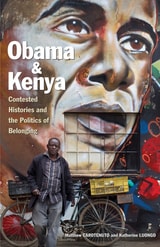
Obama and Kenya
Contested Histories and the Politics of BelongingMatthew Carotenuto
Ohio University Press, 2016
Barack Obama’s political ascendancy has focused considerable global attention on the history of Kenya generally and the history of the Luo community particularly. From politicos populating the blogosphere and bookshelves in the U.S and Kenya, to tourists traipsing through Obama’s ancestral home, a variety of groups have mobilized new readings of Kenya’s past in service of their own ends.
Through narratives placing Obama into a simplified, sweeping narrative of anticolonial barbarism and postcolonial “tribal” violence, the story of the United States president’s nuanced relationship to Kenya has been lost amid stereotypical portrayals of Africa. At the same time, Kenyan state officials have aimed to weave Obama into the contested narrative of Kenyan nationhood.
Matthew Carotenuto and Katherine Luongo argue that efforts to cast Obama as a “son of the soil” of the Lake Victoria basin invite insights into the politicized uses of Kenya’s past. Ideal for classroom use and directed at a general readership interested in global affairs, Obama and Kenya offers an important counterpoint to the many popular but inaccurate texts about Kenya’s history and Obama’s place in it as well as focused, thematic analyses of contemporary debates about ethnic politics, “tribal” identities, postcolonial governance, and U.S. African relations.
Obama's Race
The 2008 Election and the Dream of a Post-Racial AmericaMichael Tesler and David O. Sears
University of Chicago Press, 2010
Barack Obama’s presidential victory naturally led people to believe that the United States might finally be moving into a post-racial era. Obama’s Race—and its eye-opening account of the role played by race in the election—paints a dramatically different picture.
The authors argue that the 2008 election was more polarized by racial attitudes than any other presidential election on record—and perhaps more significantly, that there were two sides to this racialization: resentful opposition to and racially liberal support for Obama. As Obama’s campaign was given a boost in the primaries from racial liberals that extended well beyond that usually offered to ideologically similar white candidates, Hillary Clinton lost much of her longstanding support and instead became the preferred candidate of Democratic racial conservatives. Time and again, voters’ racial predispositions trumped their ideological preferences as John McCain—seldom described as conservative in matters of race—became the darling of racial conservatives from both parties. Hard-hitting and sure to be controversial, Obama’s Race will be both praised and criticized—but certainly not ignored.

Obama's Washington
Political Leadership in a Partisan EraEdited by Clodagh Harrington
University of London Press, 2014
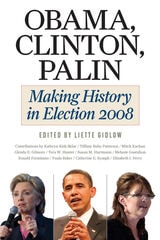
Obama, Clinton, Palin
Making History in Elections 2008Edited by Liette Gidlow
University of Illinois Press, 2011
Election 2008 made American history, but it was also the product of American history. Barack Obama, Hillary Clinton, and Sarah Palin smashed through some of the most enduring barriers to high political office, but their exceptional candidacies did not come out of nowhere. In these timely and accessible essays, a distinguished group of historians explores how the candidates both challenged and reinforced historic stereotypes of race and sex while echoing familiar themes in American politics and exploiting new digital technologies.
Contributors include Kathryn Kish Sklar on Clinton’s gender masquerade; Tiffany Ruby Patterson on the politics of black anger; Mitch Kachun on Michelle Obama and stereotypes about black women’s bodies; Glenda E. Gilmore on black women’s century of effort to expand political opportunities for African Americans; Tera W. Hunter on the lost legacy of Shirley Chisholm; Susan M. Hartmann on why the U.S. has not yet followed western democracies in electing a female head of state; Melanie Gustafson on Palin and the political traditions of the American West; Ronald Formisano on the populist resurgence in 2008; Paula Baker on how digital technologies threaten the secret ballot; Catherine E. Rymph on Palin’s distinctive brand of political feminism; and Elisabeth I. Perry on the new look of American leadership.
Of Beasts and Beauty
Gender, Race, and Identity in ColombiaBy Michael Edward Stanfield
University of Texas Press, 2013
All societies around the world and through time value beauty highly. Tracing the evolutions of the Colombian standards of beauty since 1845, Michael Edward Stanfield explores their significance to and symbiotic relationship with violence and inequality in the country. Arguing that beauty holds not only social power but also economic and political power, he positions it as a pacific and inclusive influence in a country “ripped apart by violence, private armies, seizures of land, and abuse of governmental authority, one hoping that female beauty could save it from the ravages of the male beast.” One specific means of obscuring those harsh realities is the beauty pageant, of which Colombia has over 300 per year. Stanfield investigates the ways in which these pageants reveal the effects of European modernity and notions of ethnicity on Colombian women, and how beauty for Colombians has become an external representation of order and morality that can counter the pathological effects of violence, inequality, and exclusion in their country.

Of Body and Brush
Grand Sacrifice as Text/Performance in Eighteenth-Century ChinaAngela Zito
University of Chicago Press, 1997
Forging a critical cultural historical method that challenges traditional categories of Chinese studies, Zito shows for the first time that in their performance, the ritual texts embodied, literally, the metaphysics upon which imperial power rested. By combining rule through the brush (the production of ritual texts) with rule through the body (mandated performance), the throne both exhibited its power and attempted to control resistance to it. Bridging Chinese history, anthropology, religion, and performance and cultural studies, Zito brings an important new perspective to the human sciences in general.

Of G-Men and Eggheads
The FBI and the New York IntellectualsJohn Rodden
University of Illinois Press, 2017
John Rodden cuts this tall tale down to its authentic pint size, refusing to indulge the public relations myth promoted by J. Edgar Hoover's FBI. In Of G-Men and Eggheads, Rodden portrays federal agents’ hilarious obsession with monitoring that ever-present threat to national security, the American literary intellectual. Drawing on government dossiers and archives, Rodden focuses on the onetime members of a radical political sect of ex-Trotskyists (barely numbering a thousand at its height), the so-called New York intellectuals. He describes the nonsensical decades-long pursuit of this group of intellectuals, especially Lionel Trilling, Dwight Macdonald, and Irving Howe. The Keystone Cops style of numerous FBI agents is documented carefully in Rodden's meticulous case studies of how Hoover's men recruited informants to snoop on the "Commies," opened their personal mail, tracked their movements, and reported on their wives and friends.
Of Gardens and Graves
Kashmir, Poetry, PoliticsSuvir Kaul
Duke University Press, 2017
Ogoni Women's Activism
The Transnational Struggle for Justice against Big Oil and the StateDomale Dube
University of Illinois Press, 2025
Dube’s account examines and documents the issues that drew women into the movement, from concerns for themselves and their communities to grander visions for the Ogoni. As she shows, these issues not only influenced organizing in Nigeria but also the diaspora in general and the United States in particular. Ogoni women relied upon nonviolent protest to realize their aims. Dube looks at their campaigns and how their actions reflected their concerns, values, interests, and priorities. The result is a rare account of Black women and transnational organizing for women’s, climate, and environmental justice that merges a history of their involvement with an in-depth analysis of the racial, gender, and ethnic dimensions of the Ogoni Struggle.
Ohio’s Kingmaker
Mark Hanna, Man and MythWilliam T. Horner
Ohio University Press, 2010
For a decade straddling the turn of the twentieth century, Mark Hanna was one of the most famous men in America. Portrayed as the puppet master controlling the weak-willed William McKinley, Hanna was loved by most Republicans and reviled by Democrats, in large part because of the way he was portrayed by the media of the day. Newspapers and other media outlets that supported McKinley reported positively about Hanna, but those sympathetic to William Jennings Bryan, the Democrats’ presidential nominee in 1896 and 1900, attacked Hanna far more aggressively than they attacked McKinley himself. Their portrayal of Hanna was wrong, but powerful, and this negative image of him survives to this day.
In this study of Mark Hanna’s career in presidential politics, William T. Horner demonstrates the flaws inherent in the ways the news media cover politics. He deconstructs the myths that surround Hanna and demonstrates the dangerous and long-lasting effect that inaccurate reporting can have on our understanding of politics. When Karl Rove emerged as the political adviser to George W. Bush’s presidential campaigns, the reporters quickly began to compare Rove to Hanna even a century after Hanna’s death. The two men played vastly different roles for the presidents they served, but modern reporters consistently described Rove as the second coming of Mark Hanna, another political Svengali.
Ohio’s Kingmaker is the story of a fascinating character in American politics and serves to remind us of the power of (mis)perceptions.
Oil and Nation
A History of Bolivia's Petroleum SectorStephen C. Cote
West Virginia University Press, 2016
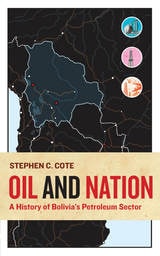
The book advances chronologically from Bolivia’s earliest petroleum pioneers in the nineteenth century until the present, inserting oil into historical debates about Bolivian ethnic, racial, and environmental issues, and within development strategies by different administrations. While Bolivia is best known for its tin mining, Oil and Nation makes the case that nationalist reformers viewed hydrocarbons and the state oil company as a way to modernize the country away from the tin monoculture and its powerful backers and toward an oil-powered future.
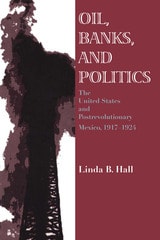
Oil, Banks, and Politics
The United States and Postrevolutionary Mexico, 1917–1924By Linda B. Hall
University of Texas Press, 1995
Mexico was second only to the United States as the world's largest oil producer in the years following the Mexican Revolution. As the revolutionary government became institutionalized, it sought to assure its control of Mexico's oil resources through the Constitution of 1917, which returned subsoil rights to the nation. This comprehensive study explores the resulting struggle between oil producers, many of which were U.S. companies, and the Mexican government.
Linda Hall goes beyond the diplomacy to look at the direct impact of a powerful, highly profitable foreign-controlled industry on a government and a nation trying to recover from a major civil war. She draws on extensive research in Mexican archives, including both government sources and the private papers of Presidents Alvaro Obregón and Plutarco Elías Calles, as well as U.S. government and private sources.
Since the North American Free Trade Agreement has expanded United States business ties to Mexico, this study of a crucial moment in U.S.-Mexican business relations will be of interest to a wide audience in business, diplomatic, and political history.

Olav Audunssøn
III. CrossroadsSigrid Undset
University of Minnesota Press, 2022
The third volume in the Nobel Prize–winning writer’s epic story of medieval Norway, finely capturing Undset’s fluid, natural style in the first English translation in nearly a century
In the early fourteenth century, Norway is a kingdom in political turmoil, struggling with opposing forces within its own borders and drawn into strife with neighboring Sweden and Denmark. Bloody family vendettas and conflicting loyalties sparked by the irrepressible passion of a boy and his foster sister (also his betrothed) have now set in motion a series of terrible consequences—with a legacy of betrayal, murder, and disgrace that will echo down through the generations. Crossroads, the third of Olav Audunssøn’s four volumes, finds Olav heartbroken by loss and further estranged from his son. To escape his grief, Olav leaves his home estate of Hestviken and agrees to serve as captain on a small merchant ship headed to London. There, separated from everything familiar to him, Olav begins a visionary journey that will send him far into the forest and deep into his soul. Questioning past decisions and future plans, Olav must grapple with his own perceptions of love and guilt, sin and penitence, vengeance and forgiveness.
Set in a time and place where royalty and religion vie for power, and bloodlines and loyalties are law, Crossroads summons a powerful picture of Northern life in medieval times, as the Swedish Academy noted in awarding Sigrid Undset the Nobel Prize in 1928. Conveying both the intimate drama and epic sweep of Olav’s story as grief and guilt drive him to ever more desperate action, Crossroads is a moving and masterly re-creation of a vanished world tainted by bloodshed and haunted by sin and retribution.
As with Kristin Lavransdatter, her earlier medieval epic, Undset immersed herself in the legal, religious, and historical documents of the time while writing Olav Audunssøn to create astoundingly authentic and compelling portraits of Norwegian life in the Middle Ages. And as in her translation of Kristin Lavransdatter, Tiina Nunnally does full justice to Undset’s natural, fluid prose, in a style that delicately and lyrically conveys the natural world, the complex culture, and the fraught emotional territory against which Olav’s story inexorably unfolds.
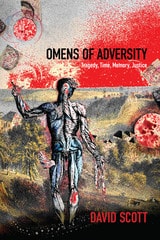
Omens of Adversity
Tragedy, Time, Memory, JusticeDavid Scott
Duke University Press, 2014
On Baltic Slovenia and Adriatic Lithuania
A Qualitative Comparative Analysis of Patterns in Post-Communist TransformationZenonas Norkus
Central European University Press, 2012

On Internal War
American and Soviet Approaches to Third World Clients and InsurgentsWilliam E. Odom
Duke University Press, 1992
On Internal War reviews the contrasting theory and practice in Soviet and American approaches to their competition in the Third World and relates them to indigenous causes of internal wars. Odom also integrates the military dimensions of insurgencies with external influences and internal politics. Drawing on political development theory, he underscores the sources of instability in Third World states that make insurgencies more likely and offers ways to assess the prospects for democracy in specific cases.
The centerpiece of the study is a practical application of the author’s analysis to three case studies—El Salvador, Guatemala, and the Philippines—and a regional assessment of the Middle East. Odom provides no panaceas but suggests that more promising strategies can be devised.
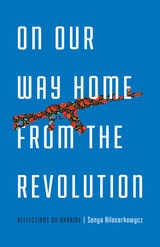
On Our Way Home from the Revolution
Reflections on UkraineSonya Bilocerkowycz
The Ohio State University Press, 2019
In 2014 Sonya Bilocerkowycz is a tourist at a deadly revolution. At first she is enamored with the Ukrainians’ idealism, which reminds her of her own patriotic family. But when the romantic revolution melts into a war with Russia, she becomes disillusioned, prompting a return home to the US and the diaspora community that raised her. As the daughter of a man who studies Ukrainian dissidents for a living, the granddaughter of war refugees, and the great-granddaughter of a gulag victim, Bilocerkowycz has inherited a legacy of political oppression. But what does it mean when she discovers a missing page from her family’s survival story—one that raises questions about her own guilt?
In these linked essays, Bilocerkowycz invites readers to meet a swirling cast of post-Soviet characters, including a Russian intelligence officer who finds Osama bin Laden a few weeks after 9/11; a Ukrainian poet whose nose gets broken by Russian separatists; and a long-lost relative who drives a bus into the heart of Chernobyl. On Our Way Home from the Revolution muddles our easy distinctions between innocence and culpability, agency and fate.
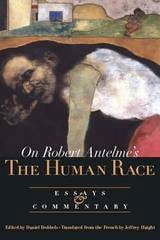
On Robert Antelme's The Human Race
Essays and CommentaryRobert Antelme
Northwestern University Press, 2003
In this volume, the extraordinary nature and extent of Robert Antelme's accomplishment, and of the reverberations he set in motion in French life and literature, finds eloquent expression. The pieces Antelme wrote for journals—including essays on "principles put to the test," man as the "basis of right," and the question of revenge—appear here alongside appreciations of The Human Race by authors from Perec to Maurice Blanchot to Sarah Kofman. Also included are Antelme's personal recollections and interviews with, among others, Dionys Mascolo (who brought Antelme back from Dachau), Marguerite Duras (Antelme's wife, who tells of his return from Germany), and Mitterand.
Also available: Antelme's The Human Race

On Western Terrorism - New Edition
From Hiroshima to Drone WarfareNoam Chomsky and Andre Vltchek
Pluto Press, 2017
“Noam Chomsky is a global phenomenon.”—New York Review of Books
In On Western Terrorism, world-renowned intellectual Noam Chomsky discusses Western power and propaganda with filmmaker and investigative journalist Andre Vltchek. Together they touch on colonialism, propaganda, and the media, and cover topics from the Soviet Union to Latin America to the Arab Spring.
Here is the perfect introduction to Chomsky's political thought and provides an accessible approach for anyone who wishes to better understand the West's fraught role in the world. Admired by some, condemned by others, and feared by all—the military might of the West is undeniably colossal.
Beginning with stories of the New York newsstand where Chomsky started his political education as a teenager, the discussion broadens out to encompass colonialism, imperial control, propaganda, and drone warfare.
Chomsky and Vltchek offer a powerful critique of the legacy of colonialism, touching upon many countries including Syria, Nicaragua, Cuba, China, Chile, and Turkey. The Table of Contents:
1. The Murderous Legacy of Colonialism
2. Concealing the Crimes of the West
3. Propaganda and the Media
4. The Soviet Bloc
5. India and China
6. Latin America
7. The Middle East and the Arab Spring
8. Hope in the Most Devastated Places on Earth
9. The Decline of U.S. Power Timeline
With a fresh design and a new foreword by Chomsky, this edition of On Western Terrorism stands as an influential and powerful critique of the West's role in the world, inspiring all who read it to think independently and critically.
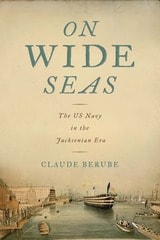
On Wide Seas
The US Navy in the Jacksonian EraClaude Berube
University of Alabama Press, 2022
An analytical study of naval policy, expansion, and maritime strategy in the formative Jacksonian era.
The 1830s is an overlooked period in American naval history and is usually overshadowed by the more dramatic War of 1812 and the Civil War. Nevertheless, the personnel, operations, technologies, policies, and vision of the Navy of that era, which was emerging from the “Age of Sail,” are important components of its evolution, setting it on the long path to its status as a global maritime power. On Wide Seas: The US Navy in the Jacksonian Era details the ways in which the US Navy transformed from an antiquated arm of the nation’s military infrastructure into a more dynamic and effective force that was soon to play a pivotal role in a number of national and international conflicts.
By Andrew Jackson’s inauguration in 1829, the Navy had engaged with two major powers, defended American shipping, conducted antipiracy operations, and provided a substantive, long-term overseas presence. The Navy began to transform during Jackson’s administration due in part to the policies of the administration and to the emerging officer corps, which sought to professionalize its own ranks, modernize the platforms on which it sailed, and define its own role within national affairs and in the broader global maritime commons. Jackson had built his reputation as a soldier, but he quickly recognized as president the necessity for a navy that could foster his policies. To expand American commerce, he needed a navy that could defend shipping as well as conduct punitive raids or deterrence missions.
Jackson developed a clear, concise naval strategy that policymakers and officers alike could seize and execute. He also provided a vision for the Navy, interceded to resolve naval disciplinary challenges, and directed naval operations. Also, given Jackson’s own politics, junior officers were emboldened by the populist era to challenge traditional, conservative thinking. They carried out a collective vision that coincided with the national literary movement that recognized America’s future would rely upon the Navy.

On the Back of an Envelope
A Life in WritingPeter Hennessy
Haus Publishing, 2025
As one of Britain’s foremost constitutional experts and contemporary historians, Peter Hennessy has spent his professional life unpicking the arcane world of Whitehall and Westminster. He began his career as a journalist for the Times, the Economist, and the Financial Times, developing a network of insider contacts who helped him shine a light on some of the dustiest corners of the British establishment. As a journalist, prize-winning contemporary historian, and political commentator, he has chronicled the workings of the British state with wit, affection, and a healthy sense of the absurd over a five-decade career. Now a crossbench peer, he has, in his own words, “moved in with his exhibits.” Hennessy is also a stalwart of BBC election night coverage and a regular commentator on BBC Radio 4, bringing a historical and constitutional perspective on current events.
In this new volume, he brings together selected journalism, unpublished lectures, and new writing alongside personal recollections and reflections on his time observing postwar Britain, how it is governed, and those who do the governing. He reflects on the making and unmaking of prime ministers from Attlee to Truss, life in the House of Lords, and the changing constitutional landscape in the wake of Brexit and amid uncertainty about the future of the Union. Interspersed with lectures, journalism, and new pieces, Hennessy also looks back at a fascinating career, reflecting on his own experiences as a young green graduate navigating the hard-nosed world of Fleet Street in the 1970s, bringing to life a cast of characters from a world now largely gone. He revisits his time as a public historian, academic, and crossbench peer with a levity reflected in his belief that history is “gossip with footnotes.”
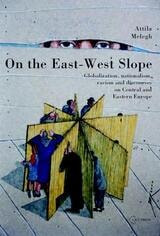
On the East-West Slope
Globalization, Nationalism, Racism and Discourses on Eastern EuropeAttila Melegh
Central European University Press, 2006

On the Eve of Conquest
The Chevalier de Raymond's Critique of New France in 1754Joseph L. Peyser
Michigan State University Press, 1997
In 1754, Charles de Raymond, chevalier of the Royal and Military Order of Saint Louis and a captain in the Troupes de la Marine wrote a bold, candid, and revealing expose; on the French colonial posts and settlements of New France. On the Eve of the Conquest, more than an annotated translation, includes a discussion on the historical background of the start of the French and Indian War, as well as a concise biography of Raymond and Michel Le Courtois de Surlaville, the army colonel at the French court to whom the report was sent. The events surrounding Raymond's controversial year as commandant of the post (now Fort Wayne, Indiana) in 1749-50, his disputed recall by Governor General Jacques-Pierre de Taffanel de La Jonquier, and the subsequent friction between La Jonquiere's successor, Ange de Menneville Duqesne, and Raymond are presented in detail and illustrated by translations of their correspondence.

Once Upon a Time in Texas
A Liberal in the Lone Star StateBy David Richards
University of Texas Press, 2002
Once upon a time in Texas...there were liberal activists of various stripes who sought to make the state more tolerant and more tolerable. David Richards was one of them. In this fast-paced, often humorous memoir, he remembers the players, the strategy sessions, the legal and political battles, and the wins and losses that brought significant gains in civil rights, voter rights, labor law, and civil liberties to the people of Texas from the 1950s to the 1990s.
In his work as a lawyer, Richards was involved in cases covering voters' rights, school finance reform, and a myriad of civil liberties and free speech cases. In telling these stories, he vividly evokes the "glory days" of Austin liberalism, when a who's who of Texas activists plotted strategy at watering holes such as Scholz Garden and the Armadillo World Headquarters. Likewise, he offers vivid portraits of liberal politicians from Ralph Yarborough to Ann Richards (his former wife), progressive journalists such as Molly Ivins and the Texas Observer staff, and the hippies, hellraisers, and musicians who all challenged Texas's conservative status quo.

One or Two Words
Language and Politics in the Toraja Highlands of IndonesiaAurora Donzelli
National University of Singapore Press, 2020
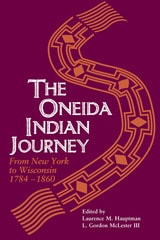
Oneida Indian Journey
From New York to Wisconsin, 1784–1860Edited by Laurence M. Hauptman and L. Gordon McLester III
University of Wisconsin Press, 1999
For the first time, the traumatic removal of the Oneida Indians from New York to Wisconsin is examined in a groundbreaking collection of essays, The Oneida Indian Journey from New York to Wisconsin, 1784–1860. To shed light on this vital period of Oneida history, editors Laurence Hauptman and L. Gordon McLester, III, present a unique collaboration between an American Indian nation and the academic community. Two professional historians, a geographer, anthropologist, archivist and attorney join in with eighteen voices from the Oneida community—local historians, folklorists, genealogists, linguists, and tribal elders—discuss tribal dispossession and community; Oneida community perspectives of Oneida history; and the means of studying Oneida history.
Contributors include: Debra Anderson, Eileen Antone, Jim Antone, Abrahms Archiquette, Oscar Archiquette, Jack Campisi, Richard Chrisjohn, Amelia Cornelius, Judy Cornelius, Katie Cornelius, Melissa Cornelius, Jonas Elm, James Folts, Reginald Horsman, Elizabeth Huff, Francis Jennings, Arlinda Locklear, Jo Margaret Mano, Loretta Metoxen, Liz Obomsawin, Jessie Peters, Sarah Summers, and Rachel Swamp
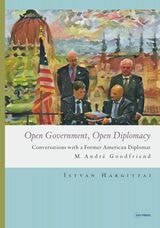
Open Government, Open Diplomacy
Conversations with a Former American Diplomat M. André GoodfriendIstván Hargittai
Central European University Press, 2023
André Goodfriend was Deputy Chief of Mission from 2013 to 2015 at the US Embassy in Budapest. In the absence of an ambassador, most of the time he was Chargé d’Affaires. Goodfriend represented his country, and for that matter, liberal democracy, in the early period of the increasingly autocratic Orbán regime. This tenure was distinguished by an unusually high public visibility and broad-based popularity. This book contains the distilled essence of conversations recorded in the fall of 2015 and in the years after his departure.
Aside from Goodfriend’s reflections on his personal history, the main focus of the deliberations is on open government: its characteristics, preconditions, benefits, and its relation to modern diplomacy. The mindset of a democracy-rooted diplomat with a working experience in an increasingly autocratic regime lends a particular perspective to the topics discussed. These topics include the fight against corruption, the protection of civil society, crisis prevention, education, economy, international relations, applied humanities, and the use of the social and traditional media to achieve policy goals.
This book presents modern, “people-friendly” diplomacy in an era in which public officials are increasingly expected to be transparent and engaged.
Operation Defensive Shield
Witnesses to Israeli War CrimesEdited by Muna Hamzeh and Todd June
Pluto Press, 2003
On March 29, 2002 the Israeli army launched Operation Defensive Shield, the largest military offensive against Palestinian civilians since the 1948 Arab-Israeli War. During the operation, the military used the most advanced weaponry at its disposal: Merkava tanks, Apache attack helicopters and F-15 fighter jets. When the operation ended on April 21, Israel had destroyed the Palestinian economic and social infrastructure, leveled large swathes of residential area, killed 220 people, injured hundreds more and arrested thousands.
This book documents these events through a collection of electronic witness narratives written by Palestinians who were under attack and by Israeli and international peace activists who witnessed the results of these attacks. Deeply moving and courageous, these narratives offer a uniquely powerful and intimate account of the daily reality for Palestinians who endured Ariel Sharon's military strategy, and the death and destruction that strategy has caused throughout the Occupied Territories.
Most important, the witnesses' voices bring to life the aggressive nature of this strategy -- they belie the noble motives ascribed to Sharon and those in his government and military who designed and carried it out. The editors argue that Operation Defensive Shield is a prelude to Israel's ethnic cleansing of the Palestinians. They provide historical context, a chronology, and an analysis of the conflict that situates the horror of these days in their proper perspective.
Operation Defensive Shield: Witnesses to Israeli War Crimes is an essential record for those who want to understand what happened in the West Bank in the spring of 2002, and what it portends for the future of the region.
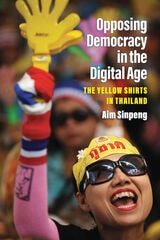
Opposing Democracy in the Digital Age
The Yellow Shirts in ThailandAim Sinpeng
University of Michigan Press, 2021
Opposing Democracy in the Digital Age is about why ordinary people in a democratizing state oppose democracy and how they leverage both traditional and social media to do so. Aim Sinpeng focuses on the people behind popular, large-scale antidemocratic movements that helped bring down democracy in 2006 and 2014 in Thailand. The yellow shirts (PAD—People’s Alliance for Democracy) that are the focus of the book are antidemocratic movements grown out of democratic periods in Thailand, but became the catalyst for the country’s democratic breakdown. Why, when, and how supporters of these movements mobilize offline and online to bring down democracy are some of the key questions that Sinpeng answers. While the book primarily uses a qualitative methodological approach, it also uses several quantitative tools to analyze social media data in the later chapters. This is one of few studies in the field of regime transition that focuses on antidemocratic mobilization and takes the role of social media seriously.
Opposing Power
Building Opposition Alliances in Electoral AutocraciesElvin Ong
University of Michigan Press, 2022
Orange Parades
The Politics of Ritual, Tradition and ControlDominic Bryan
Pluto Press, 2000
Ordering Customs
Ethnographic Thought in Early Modern VeniceKathryn Taylor
University of Delaware Press, 2023
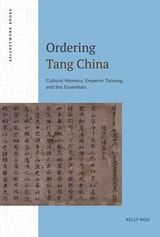
Ordering Tang China
Cultural Memory, Emperor Taizong, and the EssentialsKelly Ngo
Lever Press, 2024
By connecting the textual discourse with an analysis of its use and reception across the region, Ngo demonstrates that the Essentials was a key source of Confucian political thought and practice during the early Tang dynasty. In accounting for the place of the Essentials in political advice literature, Ngo illustrates how it drew from the ancient Confucian heritage and was still responsive to contemporaneous political concerns, suggesting that the Essentials played a part in the success of Zhenguan political practice.
Ordering Tang China also includes the first English-language translations of portions of the seventh-century anthology, with reference to partial translations published in nine languages. Utilizing the theory of cultural memory to study the Essentials not only opens a fresh approach to learning about the imperial consumption of literature, as well as the theory and practice of emperorship, but also offers a case study for how to study Chinese governance literature, including its “mirror for princes” genre.
Organizational State
Social Choice: In National Policy DomainsEdward O. Laumann
University of Wisconsin Press, 1987
But this says nothing about politics. Professor Lauman and Knoke have asked, in this book, how policies were made, in the period 1977-1980, in the areas of energy and health. The question is a very different one from the question of how the positions of president and Congress are filled.
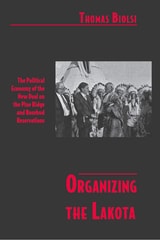
Organizing the Lakota
The Political Economy of the New Deal on the Pine Ridge and Rosebud ReservationsThomas Biolsi
University of Arizona Press, 1992
Biolsi pays particular attention to the administrative means by which the OIA retained the power to design and implement tribal "self-government" as well as the power to control the flow of critical resources—rations, relief employment, credit—to the reservations. He also shows how this imbalance of power between the tribes and the federal bureaucracy influenced politics on the reservations, and argues that the crisis of authority faced by the Lakota tribal governments among their own would-be constituents—most dramatically demonstrated by the 1973 Wounded Knee occupation—is a direct result of their disempowerment by the United States.
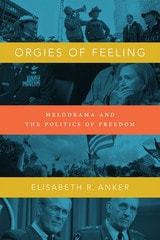
Orgies of Feeling
Melodrama and the Politics of FreedomElisabeth R. Anker
Duke University Press, 2014

Origins of Instability in Early Republican Mexico
Donald F. Stevens
Duke University Press, 1991
Donald F. Stevens’ revisionist account challenges traditional historiography to examine the nature and origins of Mexico’s political instability. Turning to quantitative methods as a way of providing a framework for examining existing hypotheses concerning Mexico’s instability, the author dissects the relationship between instability and economic cycles; contradicts the notion that Mexico’s social elite could have increased political stability by becoming more active; and argues that the principal political fissures were not liberal vs. conservative but were among radical, moderate, and conservative.
Ultimately, Stevens maintains, the origins of that country’s instability are to be found in the contradictions between liberalism and Mexico’s traditional class structure, and the problems of creating an independent republic from colonial, monarchical, and authoritarian traditions.
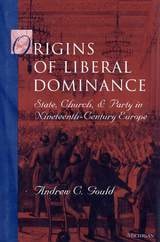
Origins of Liberal Dominance
State, Church, and Party in Nineteenth-Century EuropeAndrew C. Gould
University of Michigan Press, 1999
Origins of a Spontaneous Revolution
East Germany, 1989Karl-Dieter Opp, Peter Voss, and Christiane Gern
University of Michigan Press, 1995
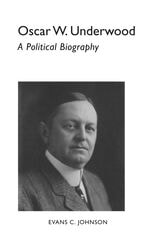
Oscar W. Underwood
A Political BiographyEvans C. Johnson
University of Alabama Press, 2006
Although Oscar W. Underwood was considered a titan of his age, few American political figures have suffered such neglect as he. Except for his candidacy for the Democratic nomination in 1924, his political career is largely forgotten even in Alabama. The one place in which Underwood is well remembered is in the folklore of Congress, where he is widely regarded as a great party leader who had mastered the rules perhaps as thoroughly as any member of Congress. This mastery, together with steady work, personal magnetism, and a willingness to compromise, made him effective as chairman of the Ways and Means Committee in formulating a majority program after the Democrats seized control of the House in 1910. Pat Harrison, Underwood's lieutenant as minority leader, referred to Underwood as the "greatest natural parliamentarian, the greatest leader of a law-making body that I ever saw."
--from the Preface to Oscar W. Underwood: A Political Biography
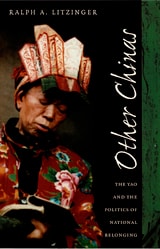
Other Chinas
The Yao and the Politics of National BelongingRalph A. Litzinger
Duke University Press, 2000
Litzinger begins by describing how during the Republican period the Yao were considered a dangerous people who preferred to consort with beasts and goblins rather than join in the making of a modern nation. He then compares this to the communist revolutionaries’ view of the Yao as impressive rebels and positive examples of subaltern agency. Litzinger shows how scholars, government workers, communist party officials, and Taoist ritual specialists have influenced the varied depictions of the Yao and, in doing so, he advances a new understanding of both the Yao and the effects of official discourse, written histories, state policy, and practices of minority empowerment. In addition to analyzing issues of ritual practice, social order, morality, and the governance of ethnic populations, Litzinger considers the Yao’s role in the cultural reforms of the 1980s. By distancing his study from romanticized depictions of minorities Litzinger is able to focus on how minority representation, struggle, and agency have influenced the history of the People’s Republic, cultural debates within contemporary Chinese society, and China’s rapidly changing role in the global order.
This book will be of interest to Asianists in both anthropology and cultural studies and should appeal more generally to scholars invested in issues of ethnic identity, minority politics, and transnationalism.
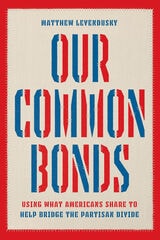
Our Common Bonds
Using What Americans Share to Help Bridge the Partisan DivideMatthew Levendusky
University of Chicago Press, 2023
One of the defining features of twenty-first-century American politics is the rise of affective polarization: Americans increasingly not only disagree with those from the other party but distrust and dislike them as well. This has toxic downstream consequences for both politics and social relationships. Is there any solution?
Our Common Bonds shows that—although there is no silver bullet that will eradicate partisan animosity—there are concrete interventions that can reduce it. Matthew Levendusky argues that partisan animosity stems in part from partisans’ misperceptions of one another. Democrats and Republicans think they have nothing in common, but this is not true. Drawing on survey and experimental evidence, the book shows that it is possible to help partisans reframe the lens through which they evaluate the out-party by priming commonalities—specifically, shared identities outside of politics, cross-party friendships, and common issue positions and values identified through civil cross-party dialogue. Doing so lessons partisan animosity, and it can even reduce ideological polarization. The book discusses what these findings mean for real-world efforts to bridge the partisan divide.
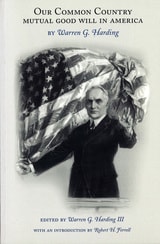
Our Common Country
Mutual Good Will in AmericaWarren G. Harding, Edited by Warren G. Harding, III, & Intro by Robert H. Ferrell
University of Missouri Press, 2003
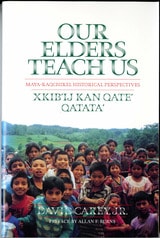
Our Elders Teach Us
Maya-Kaqchikel Historical PerspectivesDavid Anthony Carey, Jr. with a preface by Allan Burns
University of Alabama Press, 2001
Where Maya voices reclaim their history and reshape our understanding of the past.
Combining the methodologies of anthropology and history, Carey uses both oral interviews and meticulous archival research to construct a history of the last 130 years in Guatemala from the perspective of present-day Mayan people. His research took place over five years, including intensive language study, four summers of fieldwork, and a year-long residence in Comalapa, during which he conducted most of the 414 interviews. By casting a wide net for his interviews—from tiny hamlets to bustling Guatemala City—Carey gained insight into more than a single community or a single group of Maya.
The Maya-Kaqchikel record their history through oral tradition; thus, few written accounts exist. Comparing the Kaqchikel point of view to that of the western scholars and Ladinos who have written most of the history texts, Carey reveals the people and events important to the Maya, which have been virtually written out of the national history.
A motto of the Guatemalan organization Maya Decinio para el Pueblo Indigena (Maya Decade for the Indigenous People) is that people who do not know their past cannot build a future. By elucidating what the Kaqchikel think of their own past, Carey also illuminates the value of non-Western theoretical and methodological approaches that can be applied to the history of other peoples. Valuable to historians, anthropologists, archaeologists, or anyone interested in Mayan and Latin American studies, this book will inform as well as enchant.

Our Man in Warszawa
How the West Misread PolandJo Harper
Central European University Press, 2021
Written by a Brit who has lived in Poland for more than twenty years, this book challenges some accepted thinking in the West about Poland and about the rise of Law and Justice (PiS) as the ruling party in 2015. It is a remarkable account of the Polish post-1989 transition and contemporary politics, combining personal views and experience with careful fact and material collections. The result is a vivid description of the events and scrupulous explanations of the political processes, and all this with an interesting twist – a perspective of a foreigner and insider at the same time. Settled in the position of participant observer, Jo Harper combines the methods of macro and micro analysis with CDA, critical discourse analysis. He presents and interprets the constituent elements and issues of contemporary Poland: the main political forces, the Church, the media, issues of gender, the Russian connection, the much-disputed judicial reform and many others.
A special feature of the book is the detailed examination of the coverage of the Poland’s latest two elections, one in 2019 (parliamentary) and the other in 2020 (presidential) in the British media, an insightful and witty specimen of comparative cultural and political analysis.
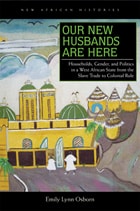
Our New Husbands Are Here
Households, Gender, and Politics in a West African State from the Slave Trade to Colonial RuleEmily Lynn Osborn
Ohio University Press, 2011
In Our New Husbands Are Here, Emily Lynn Osborn investigates a central puzzle of power and politics in West African history: Why do women figure frequently in the political narratives of the precolonial period, and then vanish altogether with colonization? Osborn addresses this question by exploring the relationship of the household to the state. By analyzing the history of statecraft in the interior savannas of West Africa (in present-day Guinea-Conakry), Osborn shows that the household, and women within it, played a critical role in the pacifist Islamic state of Kankan-Baté, enabling it to endure the predations of the transatlantic slave trade and become a major trading center in the nineteenth century. But French colonization introduced a radical new method of statecraft to the region, one that separated the household from the state and depoliticized women’s domestic roles. This book will be of interest to scholars of politics, gender, the household, slavery, and Islam in African history.
Our Politics
Reflections on Political LifeDouglas Kane, with a foreword by Mike Lawrence
Southern Illinois University Press, 2019
In Our Politics Kane reflects on his nearly fifty years of active engagement in state and local politics. In a series of essays, he seeks to understand the forces, motivations, incentives and technologies that shape our politics and produce the consequences that we live with every day. He describes how candidates and officeholders deal with the fundamental contradictions inherent in the democratic process, and how and why the political power structure has changed. He also explores the personal experience of being a legislator, from deciding how to vote to building relationships with party leaders, fellow legislators, the governor, and the voters in the district. Kane concludes by considering the possibility of change, how it might happen, and the steps that candidates, political parties, activists and others might take to better our politics with results more to our liking.
While many journalists record politics from the outside, and numerous political memoirs focus on personalities and what happened to whom and when, this book gives an insider’s view of politics at the level of state government. This book is not about those politicians but about our politics, which together we have created and together we must deal with.
Our Sisters' Promised Land
Women, Politics, and Israeli-Palestinian CoexistenceAyala Emmett
University of Michigan Press, 2003
Our Suffering Brethren
Foreign Captivity and Nationalism in the Early United StatesDavid J. Dzurec III
University of Massachusetts Press, 2019
In October 1785, American statesman John Jay acknowledged that the more his countrymen “are treated ill abroad, the more we shall unite and consolidate at home.” Behind this simple statement lies a complicated history. From the British impressment of patriots during the Revolution to the capture of American sailors by Algerian corsairs and Barbary pirates at the dawn of the nineteenth century, stories of Americans imprisoned abroad helped jumpstart democratic debate as citizens acted on their newly unified identity to demand that their government strengthen efforts to free their fellow Americans. Deliberations about the country's vulnerabilities in the Atlantic world reveal America's commitment to protecting the legacy of the Revolution as well as growing political divisions.
Drawing on newspaper accounts, prisoner narratives, and government records, David J. Dzurec III explores how stories of American captivity in North America, Europe, and Africa played a critical role in the development of American political culture, adding a new layer to our understanding of foreign relations and domestic politics in the early American republic.
Out of Many, One
Obama and the Third American Political TraditionRuth O'Brien
University of Chicago Press, 2013
Bearing traces of Baruch Spinoza, John Dewey, and Saul Alinsky, Obama’s progressivism embraces the ideas of mutual reliance and collective responsibility, and adopts an interconnected view of the individual and the state. So, while Obama might emphasize difference, he rejects identity politics, which can create permanent minorities and diminish individual agency. Analyzing Obama’s major legislative victories—financial regulation, health care, and the stimulus package—O’Brien shows how they reflect a stakeholder society that neither regulates in the manner of the New Deal nor deregulates. Instead, Obama focuses on negotiated rule making and allows executive branch agencies to fill in the details when dealing with a deadlocked Congress. Similarly, his commitment to difference and his resistance to universal mandates underlies his reluctance to advocate for human rights as much as many on the Democratic left had hoped.